Mixed Race Hollywood

Posted in Anthologies, Books, Communications/Media Studies, Literary/Artistic Criticism, Media Archive, Social Science, United States on 2009-10-30 15:35Z by Steven

Mixed Race Hollywood

New York University Press
2008
352 pages
20 illustrations
Paperback ISBN: 9780814799895
Cloth ISBN: 9780814799888

Edited by

Mary C. Beltrán, Associate Professor of Media Studies
University of Texas, Austin

Camilla Fojas, Associate Professor and Director of Latin American and Latino Studies
DePaul University

A Kansas City Star 2008 Notable Book

Since the early days of Hollywood film, portrayals of interracial romance and of individuals of mixed racial and ethnic heritage have served to highlight and challenge fault lines within Hollywood and the nation’s racial categories and borders. Mixed Race Hollywood is a pioneering compilation of essays on mixed-race romance, individuals, families, and stars in U.S. film and media culture.

Situated at the cutting-edge juncture of ethnic studies and media studies, this collection addresses early mixed-race film characters, Blaxploitation, mixed race in children’s television programming, and the “outing” of mixed-race stars on the Internet, among other issues and contemporary trends in mixed-race representation. The contributors explore this history and current trends from a wide range of disciplinary perspectives in order to better understand the evolving conception of race and ethnicity in contemporary culture.

Tags: , , , ,

Mixed-Race Identities

Posted in Identity Development/Psychology, Media Archive, Teaching Resources, Videos on 2009-10-29 17:56Z by Steven

Mixed-Race Identities

American Psychology Association
Item #: 4310742
ISBN: 1-59147-365-9
ISBN 13: 978-1-59147-365-7
Running Time: Over 100 minutes
Format: DVD

With Maria P. P. Root, PhD
Hosted by John Carlson, PsyD, EdD

Part of the Multicultural Counseling APA Psychotherapy Video Series

About the Video

In Mixed-Race Identities, Dr. Maria P. P. Root demonstrates her approach to working with clients who are experiencing conflicts or distress because of mixed-race identity. Dr. Root’s multiculturally sensitive approach seeks to strengthen or find a client’s own voice and validate the client’s experiences and ways of belonging in the world.

In this session, Dr. Root works with a young woman in her mid-20s whose mother is African and whose father is Latino. Dr. Root helps her client to look at various effects that her mixed-race heritage has had on her life. She illuminates the various struggles surrounding the client’s identity as well as her resilience and the need for continued vigilance in discerning how society’s “race rules” are causing much of the stress she is experiencing.

About the Appoach

Dr. Root’s therapeutic orientations blend multicultural sensitivities with feminist perspectives. This means that she helps people strengthen or find their own voice and validate their experiences, taking into account historical events that have affected their family, their ethnic or racial group, gendered experience, or way of belonging and identifying in this world.

Continuing Education in Psychology: Independent Study

4 CE Credits, 50 Test Items
You can take the test in two ways: online (with instant test results) or with mail delivery of a paper version. The DVD is not included with the test and must be purchased separately.

This course is designed to help you:

  1. Comprehend a general model and approach to working with clients who have issues related to mixed-race identity,
  2. Recognize particular techniques and strategies for engaging clients in a dialogue regarding their mixed-race identity issues,
  3. Identify particular strengths that clients with mixed-race identities bring to the counseling process,
  4. Identify particular limitations that working with some clients with mixed-race identities can entail, and
  5. Recognize specific research-based findings about psychosocial and developmental issues that impact the psychological and social development of clients who have mixed-race identities.

Puchase the test here.

Tags: , , ,

Mixed-Race Identity Politics in Nella Larsen and Winnifred Eaton (Onoto Watanna)

Posted in Asian Diaspora, Dissertations, Literary/Artistic Criticism, Media Archive, Passing, Social Science, Women on 2009-10-29 16:30Z by Steven

Mixed-Race Identity Politics in Nella Larsen and Winnifred Eaton (Onoto Watanna)

Ohio University
English (Arts and Sciences) Department
November 2001
217 pages
Advisor: David Dean McWilliams

Sachi Nakachi

A dissertation presented to the faculty of the College of Arts and Sciences of Ohio University In partial fulfillment of the requirements for the degree Doctor of Philosophy.

The dissertation examines how two women authors of mixed-race, Nella Larsen and Winnifred Eaton (Onoto Watanna), resisted American identity politics in their works.  The ideological complexities of mixed-race identity, which is “in-between” races, are the focus of my argument. To discuss what Judith Butler calls “the performativity of identity” in the interracial context, “passing,” “masquerading” and “mimicking” are used as key strategies. I examine whether the space of hybridity, in which the incompatible notions of difference and sameness exist together, opens up the horizon of transformation of significations . In Chapter One, I discuss how Larsen used her “mulatto” heroines to criticize the essentialist notion of identity. I probe how crossing boundaries (passing, geographical crossing and transgressing sexual norms) functions in her novels. In Chapter Two, I examine the works of Winnifred Eaton, who passed as Japanese in her authorship. By crossing the “authentic” ethnic boundaries and placing herself in a fictional identity, Eaton challenged racism and sexism. The dynamics of Orientalism, race and gender in Eaton’s works are examined in this chapter. Postmodern feminist theories and postcolonial theories are used in tandem to support my argument, which tries to discuss how the system of racial oppression operates in multi-racial/multi-ethnic women’s literature.

Read the entire dissertation here.

Tags: , , , ,

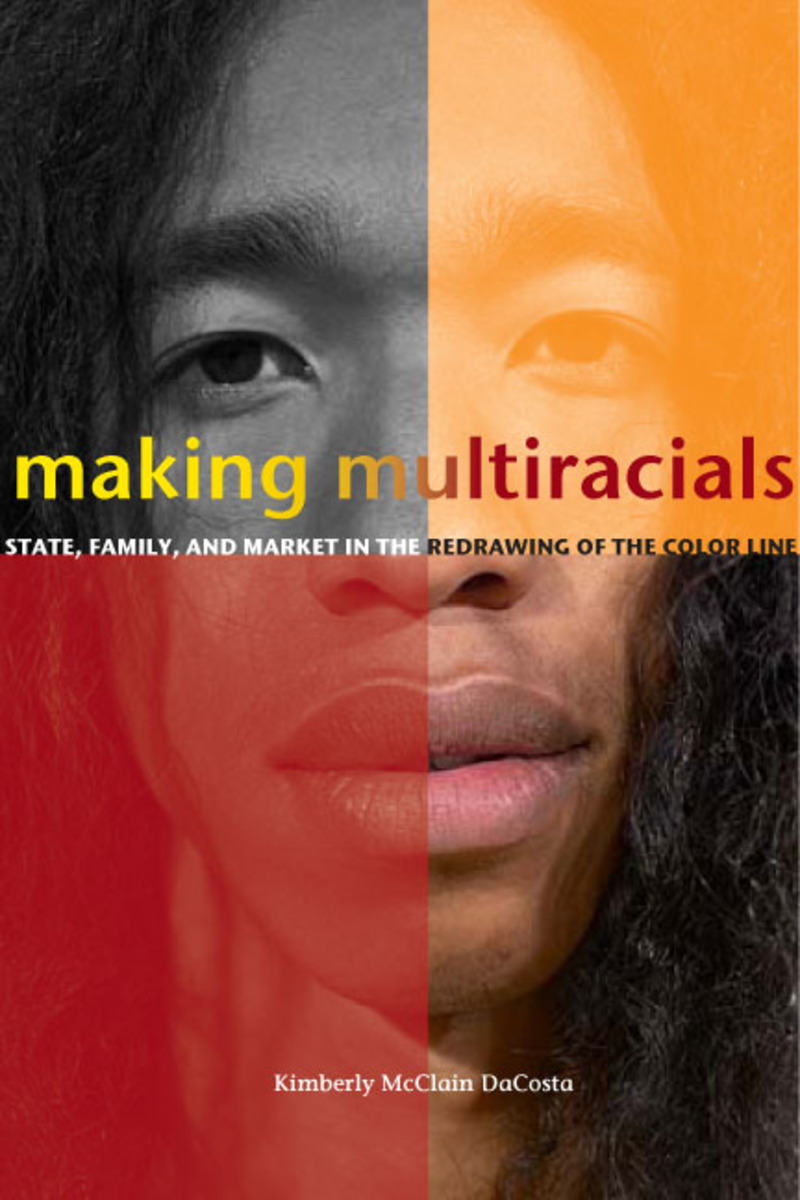
Making Multiracials: State, Family, and Market in the Redrawing of the Color Line

Posted in Anthropology, Books, Economics, Family/Parenting, Identity Development/Psychology, Media Archive, Monographs, Politics/Public Policy, Social Science, United States on 2009-10-29 03:28Z by Steven

Making Multiracials: State, Family, and Market in the Redrawing of the Color Line

Stanford University Press
2007
280 pages
3 tables, 2 figures, 4 illustrations.
Cloth ISBN-10: 0804755450; ISBN-13: 9780804755450
Paper ISBN-10: 0804755469; ISBN-13: 9780804755467

Kimberly McClain DaCosta, Associate Professor
Gallatin School of Individualized Study, New York University

When in 1997 golfer Tiger Woods described his racial identity on Oprah as “cablinasian,” it struck many as idiosyncratic. But by 2003, a New York Times article declared the arrival of “Generation E.A.”—the ethnically ambiguous. Multiracial had become a recognizable social category for a large group of Americans.

Making Multiracials tells the story of the social movement that emerged around mixed race identity in the 1990s. Organizations for interracial families and mixed race people—groups once loosely organized and only partially aware of each other—proliferated. What was once ignored, treated as taboo, or just thought not to exist quickly became part of the cultural mainstream.

How did this category of people come together? Why did the movement develop when it did? What is it about “being mixed” that constitutes a compelling basis for activism? Drawing on extensive interviews and fieldwork, the author answers these questions to show how multiracials have been “made” through state policy, family organizations, and market forces.

Table of Contents

  • Tables, Figures and Photos
  • Acknowledgements
  • The Making of a Category
  • Becoming a Multiracial Entrepreneur: Four Stories
  • Making Multiracial Families
  • Creating Multiracial Identity and Community
  • Consuming Multiracials
  • Redrawing the Color Line?: The Problems and Possibilities of Multiracial Families and Group Making
  • Appendix A: List of Respondents
  • Appendix B: Methodology
  • Appendix C: Situating Multiracial Group Making in the Literature on Social Movements, Race, and the Work of Pierre Bourdieu
  • Notes
  • Bibliography
  • Index

For the press release, click here.
For an excerpt of chapter 2, click here.

Tags: , , , ,

Race Mixing: Black-White Marriage in Postwar America

Posted in Books, Family/Parenting, History, Media Archive, Monographs, Politics/Public Policy, Social Science, United States on 2009-10-29 03:15Z by Steven

Race Mixing: Black-White Marriage in Postwar America

Harvard University Press
April 2003
382 pages
11 halftones, 1 line drawing
ISBN 13: 978-0-674-01033-8
ISBN 10: 0-674-01033-7

Renee C. Romano, Professor of History, Comparative American Studies, and Africana Studies
Oberlin College

Marriage between blacks and whites is a longstanding and deeply ingrained taboo in American culture. On the eve of World War II, mixed-race marriage was illegal in most states, politicians argued for segregated facilities in order to prevent race mixing, and interracial couples risked public hostility, legal action, even violence. Yet, sixty years later, black-white marriage is no longer illegal or a divisive political issue, and the number of such couples and their mixed-race children has risen dramatically. Renee Romano explains how and why such marriages have gained acceptance, and what this tells us about race relations in contemporary America.

Although significant numbers of both blacks and whites still oppose interracial marriage, larger historical forces have greatly diminished overt racism and shaped a new consciousness about mixed-race families. The social revolutions of the 1950s and ’60s (with their emphasis on individualism and nonconformity), the legal sanctions of new civil rights laws, and a decline in the institutional stability of marriage have all contributed to the growing tolerance for interracial relationships. Telling the powerful stories of couples who married across the color line, Romano shows how cultural shifts are lived by individuals, and how they have enabled mixed couples to build supportive communities for themselves and their children.

However, Romano warns that the erosion of this taboo does not mean that racism no longer exists. The history of interracial marriage helps us understand the extent to which America has overcome its racist past, and how much further we must go to achieve meaningful racial equality.

Tags: , , ,

Interracialism: Black-White Intermarriage in American History, Literature, and Law

Posted in Anthologies, Books, History, Law, Media Archive, Social Science, United States on 2009-10-29 01:42Z by Steven

Interracialism: Black-White Intermarriage in American History, Literature, and Law

Oxford University Press
September 2000
560 pages
Paperback ISBN13: 9780195128574
Paperback ISBN10: 0195128575
Hardback ISBN13: 9780195128567
Hardback ISBN10: 0195128567

Edited by:

Werner Sollors, Henry B. and Anne M. Cabot Professor of English and African-American Studies
Harvard University

Interracialism, or marriage between members of different races, has formed, torn apart, defined and divided our nation since its earliest history. This collection explores the primary texts of interracialism as a means of addressing core issues in our racial identity. Ranging from Hannah Arendt to George Schuyler and from Pace v. Alabama to Loving v. Virginia, it provides extraordinary resources for faculty and students in English, American and Ethnic Studies as well as for general readers interested in race relations. By bringing together a selection of historically significant documents and of the best essays and scholarship on the subject of “miscegenation,” interracialism demonstrates that notions of race can be fruitfully approached from the vantage point of the denial of interracialism that typically informs racial ideologies.

Tags: , , , , , ,

“I’m Black an’ I’m Proud”: Ruth Negga, Breakfast on Pluto, and Invisible Irelands

Posted in Articles, Arts, Communications/Media Studies, Europe, Literary/Artistic Criticism, Media Archive on 2009-10-29 00:53Z by Steven

“I’m Black an’ I’m Proud”: Ruth Negga, Breakfast on Pluto, and Invisible Irelands

Invisible Culture: An Electronic Journal for Visible Culture
Issue number 13 (Spring 2009): After Post-Colonialism
University of Rochester, New York

Charlotte McIvor, Lecturer in Drama
National University Ireland, Galway

This article examines Ethiopian-Irish actress Ruth Negga‘s performance in Neil Jordan’s 2005 Breakfast on Pluto in light of recent cultural, racial, and socio-economic shifts in Irish society. How does Negga’s identity as an Irish actress of color influence possible receptions of this film in post-Celtic Tiger Ireland and contest notions of Irishness that have typically been allied only with whiteness?

Roddy Doyle famously posited a relationship between the Irish and African-Americans thus in his 1987 novel The Committments:

–The Irish are the niggers of Europe, lads.
They nearly gasped: it was so true.
–An’ Dubliners are the niggers of Ireland. The culchies have fuckin’ everythin’. An’ the northside Dubliners are the niggers o’ Dublin. —–Say it loud, I’m black an’ I’m proud.
He grinned. He’d impressed himself again.
He’d won them. They couldn’t say anything.

Jimmy Rabitte, band manager, uses this turn of phrase to convince his motley crowd of Dublin Irish musicians to form a soul band, although the phrase was later reimagined in the film as, “The Irish are the blacks of Europe” [emphasis mine]….

…Negga’s performance models an ideal vision of Irish belonging that does not erase the co-mingling of Irish pasts and presents with histories of other peoples. Negga forces the audience towards a contemporary engagement with a transnational Irish history that illuminates the history of a “global Irish” who have now come to the island of Ireland either as returned white Irish emigrants or as would-be citizens who share colonial and European histories with their new neighbors, despite racial and cultural differences. Negga, in an article fittingly entitled, “Ruth Negga, a star without a label,” observes: “For the moment, I don’t have to worry about people trying to fit me into a box. Up until now, there were no mixed-race roles in Ireland. It’s not like in the UK, where these roles do exist and then you are typecast from then on.”…

Charlotte McIvor is a Ph.D. candidate in Performance Studies at University of California, Berkeley. Her research focuses on the production of Irish and Indian (Bengali) colonial and post-colonial nationalism and performance in their transnational and gendered contexts. McIvor’s dissertation is titled “Staging the ‘Global’ Irish: Transnational Genealogies in Irish Performance.” She is a graduate student instructor in the Department of Theater, Dance, and Performance Studies. She has directed several plays at UC Berkeley and in Allentown, Pennsylvania.

Read the entire article here.

Tags: , , , , , , ,

Mixed race, mixed racism and mental health

Posted in Family/Parenting, Identity Development/Psychology, Live Events, Media Archive, Teaching Resources, United Kingdom on 2009-10-28 23:45Z by Steven

Mixed race, mixed racism and mental health (Sponsored by the National Mental Health Development Unit)

Thursday, 2009-10-29, The Kings Fund, Central London

People in Harmony is offering a rare opportunity to hear from a range of experts about the impact of mental health on young people and families of mixed race. The keynote speakers will be Professor Suman Fernando, London Metropolitan University, formerly a consultant psychiatrist in the NHS and now a highly respected international academic and advisor on mental health and race; and Melba Wilson, Director of Equalities at the National Mental Health Development Unit.

For more information, click here.

Tags: , , ,

Friendship choices of multiracial adolescents: Racial homophily, blending, or amalgamation?

Posted in Articles, Census/Demographics, Media Archive, Social Science, United States on 2009-10-28 20:37Z by Steven

Friendship choices of multiracial adolescents: Racial homophily, blending, or amalgamation?

Social Science Research
2007
Number 36
pages 633-653

Jamie Mihoko Doyle
Department of Biostatistics and Epidemiology
University of Pennsylvania

Grace Kao, Professor of Sociology, Education, and Asian American Studies
University of Pennsylvania

Using the National Longitudinal Study of Adolescent Health (Add Health), we utilize the concepts of homophily, blending, and amalgamation to describe the possible friendship patterns of multiracials.  Homophily occurs when multiracials are most likely to choose other multiracials as friends. Blending occurs when friendship patterns of multiracials are somewhere in-between those of their monoracial counterparts. Amalgamation consists of friendship patterns that are similar to one of their monoracial counterparts. All groups exhibit signs of amalgamation such that non-white multiracials resemble Blacks, and White multiracials resemble whites except for Black-White multiracials. Black-Whites, Asian-Whites, and Asian-Blacks also exhibit signs of blending, while only Native American multiracials show signs of homophily. Multiracials have different experiences depending on their specific racial composition, and while they seem to bridge the distance between racial groups, their friendship patterns also fall along Black and White lines.

Introduction

In Robert E. Park’s seminal essay in 1928, he argues that a multiracial person lives in “two worlds, in both of which he [or she] is more or less a stranger,” (Park, 1928, p. 893).  This idea, often referred to as The Marginal Man Theory, has dominated sociological thinking about multiracials and their position in the racial structure of the United States and elsewhere. In the new millennium where multiracial identities are more prevalent and are officially recognized by the 2000 US Census, one emerging question is how multiracial people might self-identify in the modern racial landscape. Do they remain in the racial borderlands or act as a bridge between their two or more racial groups, as Park and Stonequist suggest, or do they simply assimilate into one of their monoracial counterparts?

To address this question, we investigate the extent to which self-identified multiracials are integrated into single-race groups by examining their best friend choices during adolescence. We know that racial groups are salient in part because peer groups tend to be racially homogeneous. Friendship choice offers a gauge of the social distance between groups; best friends, in particular, show with whom people feel the closest identification and greatest sense of acceptance.

Our paper proceeds as follows. We first delineate the specific contributions of previous research, focusing on the limited literature on multiracials and research on the determinants of peer selection. Then, drawing on key points from selected literature, we sketch our theoretical approach to this study and outline our hypotheses. We then describe our data, the National Longitudinal Study of Adolescent Health (Add Health). The survey instrument not only allows individuals to check two or more races, but unlike other datasets, provides linkages to the respondent’s friendship network, making it possible to directly examine survey responses by the respondent’s friends. Race of both the respondent and his/her best friend is self-reported, reflecting the racial identity of the respondent as well as his/her best friend. Lastly, we estimate logistic models using Generalized Estimating Equations (GEE) to examine the actual friendship choices of multiracial youth, taking into account the opportunities for interaction…

Read the entire article here.

Tags: , , , , ,

Are Racial Identities of Multiracials Stable? Changing Self-Identification Among Single and Multiple Race Individuals

Posted in Articles, Identity Development/Psychology, Media Archive, Social Science, United States on 2009-10-28 19:20Z by Steven

Are Racial Identities of Multiracials Stable? Changing Self-Identification Among Single and Multiple Race Individuals

Social Psychology Quarterly
Volume 70, Number 4 (December 2007)
Pages 405–423
DOI: 10.1177/019027250707000409

Jamie Mihoko Doyle
Department of Biostatistics and Epidemiology
University of Pennsylvania

Grace Kao, Professor of Sociology, Education, and Asian American Studies
University of Pennsylvania

Using the National Longitudinal Study of Adolescent Health (Add Health), we estimate the determinants and direction of change in individual racial identification among multiracial and monoracial adolescents as they transition to young adulthood. We find that while many multiracials subsequently identify as monoracials, sizable numbers of monoracials also subsequently become multiracials. Native American-whites appear to have the least stable identification. We find strong support that socioeconomic status, gender, and physical appearance shape the direction of change for multiracials, and that black biracials are especially compelled to identify as monoracial blacks.

Read or purchase the article here.

Tags: , , , , , ,