Living as Others in Japan

Posted in Asian Diaspora, History, Law, Live Events, Media Archive, Oceania, Papers/Presentations, Politics/Public Policy on 2011-07-04 00:12Z by Steven

Living as Others in Japan

Japanese Studies Association of Australia 2011 Biennial Conference
Internationalising Japan: Sport, Culture and Education
University of Melbourne, Melbourne Law School
185 Pelham Street
Carlton, Victoria 3053, Australia
2011-07-04 through 2011-07-07

Wednesday, 2011-07-06, 11:00-12:30 AEDT (Local Time)
Room 102

This panel will present two historical papers about individuals whose lives were affected by the Pacific War, and a third paper which examines issues involving intercultural communication between Japanese and non-Japanese people. The two historical stories focus on how their respective individuals navigated their life course as “Others” in Japan. Hamilton will shed light on children born to Japanese mothers and Australian fathers during the Allied Occupation in Kure. Tamura’s paper is on a businessman of mixed heritage, English and Japanese, born in Kobe, who was interned in Japan. Parry’s paper provides a look into intercultural communication between Australian students in a homestay among ten Japanese host parents.

Kure Kids
Walter Hamilton

Walter Hamilton has recently completed a book on the mixed-race children of the Occupation, under the working title of Lest We Beget: The Mixed-Race Legacy of Occupied Japan. (www.lestwebeget.com).

Nearly sixty years have passed since the post-war occupation of Japan. It might be assumed historians will have exhausted all there is to say about its political, economic and social effects. But one unexplored aspect remains vividly alive: the hidden ancestral links that bind Australians, Americans, Britons and others to Japanese blood-relations never known, never met: the unclaimed, mixed-race offspring left in Japan when the troops departed. Their fathers would not or could not acknowledge them: an estimated 10,000 children, including several hundred fathered by Australians.

So familiar is the idea of military conquest leading to the birth of “unwanted” children outside marriage – across racial, class and cultural divides – they tend to be dismissed as a natural corollary of war. Their appearance in occupied Japan came as no surprise. The “Madame Butterfly” tradition provided a high-toned model of Western men exploiting Japanese women. As if their biological inevitability made them what they were, the children attracted scant attention from Western writers, who acquiesced in facile assumptions about their fate. Surely they were disowned by their fathers, lamented by their mothers and thrust to the lower depths of society. The eminent American historian John Dower has called them “one of the sad, unspoken stories” of the occupation. Japanese historical and fictional treatments of the issue also suffer from a determination to link the children exclusively to prostitution, moral collapse and national humiliation.

Australia joined the occupation not expecting to convert the former enemy but to punish and ostracise him. With immigration restrictions, in some respects, even tighter than they were in 1941, permission was denied for troops in Japan to marry across the race divide. Anyone defying the ban risked being forcibly removed from his de facto wife and children. Although these measures were relaxed in 1952 to admit the first Japanese war brides, no such right was extended to the unacknowledged or orphaned children of Australian servicemen. In addition, the federal government maintained an elaborate deception to stop the children being adopted by Australian families. Bogus welfare arguments were used to cover a purely political determination. The moment the strategy showed signs of faltering, it was reinforced through public monies being deployed to keep the children in Japan. There were almost no exceptions, even for the sons and daughters of brave men who had fought and died in the Korean War. In the words of a leading churchman of the day, the Reverend Alan Walker: “There have been few more disgraceful incidents in the whole miserable history of Australia’s racial immigration policy.”

This paper will introduce several individuals born in or near the city of Kure, in Hiroshima prefecture, where the British Commonwealth Occupation Force (BCOF) was based from 1946 until the withdrawn of the last Korean War contingent in 1956. The Kure Kids encountered discrimination because of their physical appearance, dysfunctional family life, low socioeconomic status and social isolation. But the lives of these Japanese “others” represented much more—in quality, variety and achievement—than is suggested by the conventional portrayal of “sad, unspoken stories.”

Between Father Land and Mother Land: a British-Japanese Dual National and his Pacific War
Keiko Tamua

In war, individuals are categorized either as friend or foe, and enemy nationals are seen and treated with suspicion and fear. In December 1941, when the Pacific War started, about 700 out of 2134 civilians of the Allied nations who were residing in Japan were arrested or interned as enemy aliens. Most of them had lived in Japan for a number of years and had become part of the community. Some civilians were repatriated to their home countries on exchange boats in 1942 and 43, but others decided to remain in Japan even though they knew they were going to be interned or kept under police surveillance. Most of them had mixed heritage through their parents and/or having Japanese spouse; they thought their home was Japan rather than Britain or the USA, and they felt they could not leave without their family members.

F. M. Jonas was one of these expatriates who were caught in the war. He was born in Osaka in 1878, having a British father and a Japanese mother. He had established himself as a respectable British businessman in pre-war Kobe, running a stevedore business at the port. He was highly regarded both in the expatriate and Japanese communities, having been vicechairman of the Kobe Foreign Chamber of Commerce, and president of the Kobe Regatta and Athletic Club – the premier expatriate social club in Kobe. When the war started Jonas was arrested by the Japanese authorities, and later interned as an enemy alien. However, he managed to secure release from internment through British-Japanese dual citizenship, and he changed his name to Morii Kamejirō. When the war ended, he tried to re-establish his formal status as a British national. He died in 1950 before final resolution was officially made. Did he claim citizenship of convenience to suit the circumstances, to avoid internment, and consequently did he betray his father land? Or did he have legitimate reasons to do so? What were the consequences of his action for himself and his family? Japanese nationality laws upheld the principle of paternal succession until 1985, and dual citizenship has never been recognized. How did Jonas convince the authorities of his dual nationality? In this paper, I will discuss the life course of F. M. Jonas, who lived between father land and mother land in the middle of the Pacific War. Through Jonas’ story, I will explore, from a historical point of view, how the nationality of mixed decent people has been interpreted and handled in Japan and Britain.

For more information, click here.
Tags: , , , ,

Asians in S.A. claim multiracial identity

Posted in Articles, Asian Diaspora, Census/Demographics, Texas, United States on 2011-06-28 21:07Z by Steven

Asians in S.A. claim multiracial identity

San Antonio Express-News
2011-06-26

Elaine Ayala and Kelly Guckian

San Antonio’s Asian residents are more likely to self-identify as being of more than one race or ethnicity than their U.S. and Texas counterparts, according to new 2010 Census data. The trend indicates not only intermarriage with whites and Hispanics since World War II, experts said, but more of a willingness or opportunity among Asians to intermarry outside their group.
 
Data compiled by the San Antonio Express-News points to the impact of a strong military presence in San Antonio over several generations, among them Anglo and Hispanic soldiers who brought home “war brides,” said Mitsu Yamazaki of the Alamo Asian American Chamber of Commerce, who studies demographic trends.
 
San Antonio stands out from other U.S. and Texas cities in another way that may fuel more intermarriage among Asians, said Texas state demographer Lloyd Potter: It doesn’t have an Asian enclave…

Read the entire article here.

Tags: , , , , ,

Mixed Race: Yesterday, Today, and Tomorrow

Posted in Articles, Asian Diaspora, Autobiography, Identity Development/Psychology, Media Archive, United States, Women on 2011-06-23 21:19Z by Steven

Mixed Race: Yesterday, Today, and Tomorrow

Rafu Shimpo: Los Angeles Japanese Daily News
2011-06-19

Velina Hasu Houston

Recently I was honored with a Loving Award from the Mixed Roots Film & Literary Festival (held June 11-12 at the Japanese American National Museum). The award and the meaning behind it has caused me to reflect on multiracial identity.

My parents married in 1954 after a nine-year courtship in Japan. When they left Japan, they arrived in the U.S., a country in which their marriage was illegal in 17 states and would remain so until 1967, two years before my father’s death.

In the landmark civil rights case Loving v. Virginia, the U.S. Supreme Court finally struck down laws against interracial marriage, honoring the marriage of Afro-Indian Mildred Loving and her white husband Richard (who also were second cousins).

I grew up in a community where being mixed race was a natural thing, at least for those of us who had foreign mothers and American fathers. We were multiracial, multiethnic, and multicultural — and often, like me, transnational. The idea of having a foot in at least two countries and being a blend of three or four ethnicities was par for the course…

Read the entire article here.

Tags: , , , , ,

The Role of Reflected Appraisals in Racial Identity: The Case of Multiracial Asians

Posted in Articles, Asian Diaspora, Identity Development/Psychology, Media Archive, Social Science, United States on 2011-06-14 18:00Z by Steven

The Role of Reflected Appraisals in Racial Identity: The Case of Multiracial Asians

Social Psychology Quarterly
Volume 67, Number 2 (June 2004)
pages 115-131
DOI: 10.1177/019027250406700201

Nikki Khanna, Associate Professor of Sociology
University of Vermont

Asian Americans are one of the fastest-growing minorities in the United States and show the highest outmarriage rate; yet little research has investigated the racial identity of multiracial Asians. This study explores the racial identity of multiracial Asians in the United States, using survey data on 110 Asian-white adults, and examines the factors that shape this identity. The literature suggests a number of factors; drawing on the theoretical framework of reflected appraisals, I hypothesize that certain factors will be more important than others in this process. When respondents were asked with which race they identified more strongly, Asian or white, two factors were shown to exert the strongest influence on racial identity, namely phenotype and cultural exposure. Logistic regression and qualitative responses reveal that the racial identities of this sample of Asian-white adults are shaped largely by the reflected appraisals of others regarding their appearance and cultural knowledge.

Read or purchase the article here.

Tags: ,

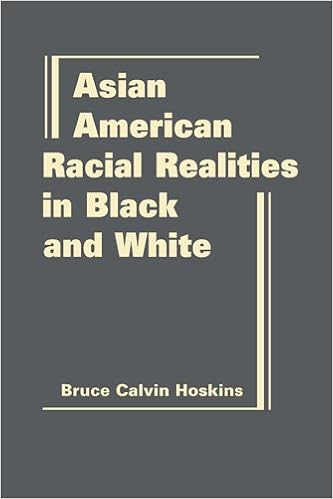
Asian American Racial Realities in Black and White

Posted in Asian Diaspora, Books, Identity Development/Psychology, Media Archive, Monographs, United States on 2011-06-14 16:11Z by Steven

Asian American Racial Realities in Black and White

Lynne Rienner Publishers
June 2011
167 pages
ISBN: 978-1-935049-39-5

Bruce Calvin Hoskins, Professor of Sociology
MiraCosta College, Oceanside, California

What does it mean for an Asian American to be part white—or part black? Bruce Hoskins probes the experience of biracial Asian Americans, revealing the ways that our discourse about multiracial identities too often reinforces racial hierarchies.

Hoskins explores the everyday lives of people of Asian/white and Asian/black heritage to uncover the role of our society’s white-black continuum in shaping racial identity. Mixing intimate personal stories with cutting-edge theoretical analysis, he directly confronts the notion that multiracial identity provides an easy solution for our society’s racial stratification.

Read the introduction here.

Table of Conents

  • Introduction
  • Internal Racial Identity
  • Public Racial Identity
  • The External Context of Racial Identity Formation
  • Learning Racial Hierarchy
  • Conclusion
Tags: , , ,

The Military Camptown in Retrospect: Multiracial Korean American Subject Formation Along the Black-White Binary

Posted in Asian Diaspora, Dissertations, Literary/Artistic Criticism, United States on 2011-06-14 14:56Z by Steven

The Military Camptown in Retrospect: Multiracial Korean American Subject Formation Along the Black-White Binary

Bowling Green State University
December 2007
116 pages

Perry Dal-nim Miller

Submitted to the Graduate College of Bowling Green State University in partial fulfillment of the requirements for the degree of Master of Arts

This thesis applies theoretical approaches from the sociology of literature and Asian Americanist critique to a study of two novels by multiracial Korean American authors. I investigate themes of multiracial identity and consumption in Heinz Insu Fenkl’s Memories of My Ghost Brother and Nora Okja Keller’s Fox Girl, both set in the 1960’s and 1970’s gijichon or military camptown geography, recreational institutions established around U.S. military installations in the Republic of Korea. I trace the literary production of Korean American subjectivity along a socially constructed dichotomy of blackness and whiteness, examining the novels’ representations of cross-racial interactions in a camptown economy based on the militarized sexual labor of working-class Korean women. I conclude that Black-White binarisms are reproduced in the gijichon through the consumption practices of both American military personnel and Korean gijichon workers, and that retrospective fictional accounts of gijichon multiraciality signal a shift in artistic, scholarly, and popular conceptualizations of Korean American and Asian American group identities.

Table of Contents

  • CHAPTER I. INTRODUCTION
  • CHAPTER II. SOCIOLOGY OF ASIAN AMERICAN LITERATURE
  • CHAPTER III. WRITING THE MULTIRACIAL SELF: FENKL’S MEMORIES OF MY GHOST BROTHER
  • CHAPTER IV. HISTORICAL FICTIONALIZATIONS OF THE GIJICHON: KELLER’S FOX GIRL
  • CHAPTER V. CONCLUSION
  • WORKS CITED
  • APPENDIX A. CHAPTER SYNOPSES OF MEMORIES
  • APPENDIX B. CHAPTER SYNOPSES OF FOX GIRL

W.E.B. Du Bois’ oft-quoted problem for the twentieth-century was that of the color line: of racial classification and stratification policed and reproduced by the nation-state, cultural institutions, and hegemonized subjects within these institutions.1 The 2000 U.S. Census form revised racial demarcations to accommodate multiracial self-identification. By offering respondents the option of multiple selections from the categories “White, Black, Asian, some other race, American Indian, and Native Hawaiian or other Pacific Islander,” the form allowed 6.8 million of 281.4 million respondents to identify themselves as multiracial. Though multiraciality is now institutionally recognized, the individual must still choose from finite combinations of racial categories determined by the state. Given the centuries-old problem of the color line in the United States, what are the implications of the increased public presence of multiracial subjectivity? In contemporaneous fictional works by and about multiracial subjects, what correspondences exist to the state’s regulation of race and multi-race?

In the twenty-first century, the racialization of subjects in and beyond the United States continues to form the basis for structures of social and economic inequality. Omi and Winant define race as “a concept which signifies and symbolizes social conflicts and interests by referring to different types of human bodies” and racial formation as “the sociohistorical process by which racial categories are created, inhabited, transformed, and destroyed.” The significant body of scholarship on the social fallout of racial hierarchy continues to focus primarily on the socio-political binary constructions of blackness and whiteness. This binary is key to understanding the existing historical context for racialized cross-group interaction in the U.S. However, the centrality of the Black-White binary in academic discourses also has the unfortunate consequence of marginalizing other racial groups and actors in the present racial state. Paradigms of race that fail to consider interstices beyond this primary binary thereby compromise the underlying anti-racist project of race scholarship itself. The anti-racist project is rendered incapable of addressing the fault lines and politics of division formed among non-white ethnic groups in the United States. In addition, multiculturalist discourses tend toward triumphalist celebrations of cultural diversity in a Post Civil-Rights Era and ignore the structural and institutional-level consequences of racial difference. The elision of inter- and intra-group relations beyond Black-White functions to conserve discourses, cultural practices, and social and economic processes that maintain the centrality and dominance of whiteness. As Omi and  Winant point out,

As much as the politicians or mainstream media, academic analyses reproduce this distorted model of race [racial dichotomizing] as a largely black-white dichotomy… Too often, today as in the past, when scholars and journalists talk about race relations, they mean relations between African Americans and whites.

The 1990s witnessed increased media and academic attention to the positioning of other ethnic groups in the American racial construct. Omi and Winant suggest a new scenario of racial actors coming into prominence nationally in the 1992 Los Angeles uprising, where “Koreans, African Americans, and Chicanos [were both] victims and victimizers.” In discourses on race in the United States, the model minority is that group poised (or posed) at the threshold separating racial otherness from whiteness. Touted as the apex of economic and assimilationist success to which other minoritized groups could and should aspire, the model minority figure is ostensible evidence of an egalitarian, equal-opportunity society. At the same time, it diverts awareness from the actuality of race-class articulated stratifications that restrict opportunity to those already privileged by class and whiteness. Today Asians in the United States are positioned in that discursive liminality, i.e. the model minority position.

Complex negotiations occur among racialization, systemic, overt, and covert racial discrimination, sedimented prejudice, and conflicting tides of assimilation and the perpetuation of Asian ethnic identities. This thesis analyzes the fiction of two multiracial Korean American writers who explore cross-racial dynamics while departing from model minoritization mythologies. My primary question is how this particular construction of Asian American ethnic subjectivity, that is, the multiracial Korean American, perpetuates Black-White binarisms. In this section, I review pertinent literatures—the historical and social contexts of Asian American literature and of multiracial identity. In both Heinz Insu Fenkl’s Memories of My Ghost Brother and Nora Okja Keller’s Fox Girl, the Black-White binary is manifest in multiracial spaces and bodies and consumption practices. Drawing on the established significance of biography in delineating Asian American social margins, I present one understanding of the Black-White binary as a factor in multiracial Asian American subjectivity. Fenkl and Keller’s novels are fictionalized retrospective accounts of life in recreational districts or gijichon (military camptowns) around U.S. military installations in Korea during the 1960’s and 1970’s. As such, these novels demonstrate the significance of Yellow-Black-White transracial interaction and consumption in national hegemonies.

I will first explain some of the discourse around Asian American as a signifier and panethnic rubric. Espiritu characterizes Asian American panethnicity as an entity coalescing in terms of social movements and political initiatives during and after the 1960’s in an “organizational dimension;” that is, the political and social structures through which Asian American-ness itself is manifested. Historically, the panethnic Asian American movement has fallen far short of encompassing all ethnicities and class backgrounds within the Asian rubric; in addition, the movement has tended to replicate patriarchal structures extant in the larger American culture. According to Yen Le Espiritu, the rubric of “Asian American” not only encompasses a multiplicity of ethnicities, but describes “a highly contested terrain on which Asian American of different racial, cultural, and class backgrounds merge and clash over terms of inclusion.” My thesis locates the works of Fenkl and Keller, and the racially hybridized subjectivities they depict, along this terrain of contestation. Through the implication of the Black-White binary in constructions of multiracial Korean American identity, it is possible to understand the significance of existing race hierarchies on the politics of inclusion and exclusion in Asian American collective and group identities…

Read the entire thesis here.

Tags: , , , , , , , , , , ,

Panel by Hapa and Critical Mixed Race Studies Scholars and Artists

Posted in Arts, Asian Diaspora, Live Events, Media Archive, United States, Women on 2011-06-13 03:52Z by Steven

Panel by Hapa and Critical Mixed Race Studies Scholars and Artists

Oregon Nikkei Legacy Center
Japanese American History Museum
2011-08-04

Emily Momohara, Assistant Professor of Art
Art Academy of Cincinnati

Laura Kina, Associate Professor of Art, Media and Design
DePaul University

Dmae Roberts

Moderated by

Tim DuRoche, Director of Programs
World Affairs Council of Oregon

This talk will showcase their work as the artists talk about how they address hapa identity through art. Emily Momohara is currently an Assistant Professor of Art at the Art Academy of Cincinnati where she heads the photography major. Dmae Roberts is a two-time Peabody award-winning independent radio artist and writer who has written and produced more than 400 audio art pieces and documentaries for NPR and PRI programs. Laura Kina is Associate Professor of Art, Media, and Design; Global Asian Studies affiliated faculty member; and a distinguished Vincent de Paul Professor at DePaul University in Chicago, where she has also been involved in the emerging field of critical mixed race studies. This panel will be moderated by Tim DuRoche, Director of Programs for the World Affairs Council of Oregon.

For more information, click here.

Tags: , , , , , , ,

Through Eyes Like Mine

Posted in Asian Diaspora, Autobiography, Books, Media Archive, Novels, United States on 2011-06-13 03:28Z by Steven

Through Eyes Like Mine

Createspace Publishing
2010-11-20
164 pages
5.2 x 0.4 x 8 inches
ISBN-13: 978-1450535786

Nori Nakada

Through Eyes Like Mine is the story of a childhood told through the present-tense voice of Nori Nakada. Born to a Japanese American father and German-Irish mother in rural Oregon, Nori’s family becomes increasingly diverse when they adopt a six-year-old boy from Korea. She struggles to find comfort within a family, a community and a world that is both simple and complex. By examining her family’s silences, she begins to understand life, death and her own identity. The joys and challenges of growing up invite the reader to recall the world through eyes like mine.

Tags: , ,

Petitioning subjects: miscegenation in Okinawa from 1945 to 1952 and the crisis of sovereignty

Posted in Articles, Asian Diaspora, History, Literary/Artistic Criticism, Media Archive, Women on 2011-05-30 19:46Z by Steven

Petitioning subjects: miscegenation in Okinawa from 1945 to 1952 and the crisis of sovereignty

Inter-Asia Cultural Studies
Volume 11, Issue 3 (2010)
pages 355-374
DOI: 10.1080/14649373.2010.484172

Annmaria Shimabuku, Assistant Professor of Comparative Literature
University of California, Riverside

This paper tells a story about miscegenation between US military personnel and Okinawan women from 1945-1952, which includes sexual violence, the establishment of ‘entertainment districts,’ and the emergence of international marriage. Whereas this history has been mobilized by leftists as a truth-weapon in the struggle for political sovereignty from the US military, this paper takes an explicitly genealogical approach. Drawing on Foucault’s work on biopower, this paper shows how Okinawans were transformed into ‘petitioning subject’—subjects that negotiated the sexual exploitation of their bodies in tandem with the radically changing relationship between their bodies and the territory.

Read or purchase the article here.

Tags: , , , ,

Barack Obama as the post-racial candidate for a post-racial America: perspectives from Asian America and Hawai’i

Posted in Articles, Asian Diaspora, Barack Obama, Media Archive, Social Science, United States on 2011-05-30 02:02Z by Steven

Barack Obama as the post-racial candidate for a post-racial America: perspectives from Asian America and Hawai’i

Patterns of Prejudice
Volume 45, Issue 1 & 2  (Special Issue: Obama and Race) (2011)
Pages 133-153
DOI: 110.1080/0031322X.2011.563159

Jonathan Y. Okamura, Professor of Ethnic Studies
University of Hawai’i

Okamura reviews the 2008 US presidential campaign and the election of Barack Obama as a ‘post-racial candidate’ in terms of two different meanings of ‘post-racialism’, namely, colour blindness and multiculturalism. He also discusses his campaign and election from the perspective of Asian America and Hawai’i given that Obama has been claimed as ‘the first Asian American president’ and as a ‘local’ person from Hawai’i where he was born and spent most of his youth. In both cases, Obama has been accorded these racialized identities primarily because of particular cultural values he espouses and cultural practices he engages in that facilitate his seeming transcendence of racial boundaries and categories generally demarcated by phenotype and ancestry. Okamura contends that proclaiming Obama as an honorary Asian American and as a local from Hawai’i inadvertently lends support to the post-racial America thesis and its false assertion of the declining significance of race: first, by reinforcing the ‘model minority’ stereotype of Asian Americans and, second, by affirming the widespread view of Hawai’i as a model of multiculturalism.

Read or purchase the article here.

Tags: , , , ,