Reading Racist Literature

Posted in Articles, Literary/Artistic Criticism, Media Archive on 2015-04-18 21:48Z by Steven

Reading Racist Literature

New Yorker
2015-04-13

Elif Batuman, Staff Writer

Of the many passages that gave me pause when I first read “Lady Chatterley’s Lover,” in high school, the one I remember the most clearly is this conversation between Connie, Clifford, and the Irish writer Michaelis:

“I find I can’t marry an Englishwoman, not even an Irishwoman…”
“Try an American,” said Clifford.
“Oh, American!” He laughed a hollow laugh. “No, I’ve asked my man if he will find me a Turk or something…something nearer to the Oriental.”
Connie really wondered at this queer, melancholy specimen.

For many readers, this exchange might have slipped by unnoticed. But, as a Turkish American, I couldn’t prevent myself from registering all the slights against Turkish people that I encountered in European books. In “Heidi,” the meanest goat is called “the Great Turk.”…

…A few weeks later, I saw “An Octoroon,” Branden Jacobs-Jenkins’s refashioning of the Irish playwright Dion Boucicault’s 1859 melodrama of almost the same title (“The Octoroon”). (Jacobs-Jenkins was formerly on the staff of this magazine.) In an opening monologue, B. J. J., “a black playwright,” recounts a conversation with his therapist, about his lack of joy in theatre. When asked to name a playwright he admires, he can think of only one: Dion Boucicault. The therapist has never heard of Boucicault, or “The Octoroon.”

“What’s an octoroon?” she asks. He tells her. “Ah. And you like this play?” she says.

“Yes.”

This is the basic dramatic situation: a black playwright, in 2014, is somehow unable to move beyond a likeable 1859 work, named after a forgotten word once used to describe nonwhite people in the same terms as breeds of livestock. What do you do with your mixed feelings toward a text that treats as stage furniture the most grievous and unhealed insult in American history—especially when you belong to the insulted group?

Boucicault’s original script is set on a plantation, Terrebonne, shortly after the death of its owner, Judge Peyton. Peyton’s nephew, George, has just returned from Paris to take control of the property; he falls in love with Zoe, the judge’s illegitimate octoroon daughter, who has been raised as a member of the family. The villain M’Closkey, who has designs on both Terrebonne and Zoe, manages to have both put under the auctioneer’s hammer. The estate is eventually saved, by complex means involving an exploding steamship—but not before Zoe has poisoned herself in despair.

B. J. J., following his therapist’s advice, decides to restage “The Octoroon,” but white actors refuse to work with him: nobody wants to play slave owners. In the play within a play, B. J. J. puts on whiteface and acts both the hero George and the villain M’Closkey himself…

Read the entire article here.

Tags: , , , ,

Legacies of war

Posted in Articles, Asian Diaspora, History, Media Archive, United States on 2015-04-18 18:09Z by Steven

Legacies of war

The Washington Post
2015-04-17

Annie Gowen, Bureau chief — New Delhi

Linda Davidson, Photography

Forty years after the fall of Saigon, soldiers’ children are still left behind

Vo Huu Nhan was in his vegetable boat in the floating markets of the Mekong Delta when his phone rang. The caller from the United States had stunning news — a DNA database had linked him with a Vietnam vet believed to be his father.

Nhan, 46, had known his father was an American soldier named Bob, but little else.

“I was crying,” Nhan recalled recently. “I had lost my father for 40 years, and now I finally had gotten together with him.”

But the journey toward their reconciliation has not been easy. News of the DNA match set in motion a chain of events involving two families 8,700 miles apart that is still unfolding and has been complicated by the illness of the veteran, Robert Thedford Jr., a retired deputy sheriff in Texas.

When the last American military personnel fled Saigon on April 29 and 30, 1975, they left behind a country scarred by war, a people uncertain about their future and thousands of their own children. These children — some half-black, some half-white — came from liaisons with bar girls, “hooch” maids, laundry workers and the laborers who filled sandbags that protected American bases.

They are approaching middle age with stories as complicated as the two countries that gave them life. Growing up with the face of the enemy, they were spat on, ridiculed, beaten. They were abandoned, given away to relatives or sold as cheap labor. The families that kept them often had to hide them or shear off their telltale blond or curly locks. Some were sent to reeducation or work camps, or ended up homeless and living on the streets.

They were called “bui doi,” which means “the dust of life.”

Forty years later, hundreds remain in Vietnam, too poor or without proof to qualify for the program created by the Amerasian Homecoming Act of 1987 that resettles the children of American soldiers in the United States.

Now, an Amerasian group has launched a last-chance effort to reunite fathers and children with a new DNA database on a family heritage Web site. Those left behind have scant information about their GI dads — papers and photographs were burned as the communist regime took hold, and memories faded. So DNA matches are their only hope…

Read the entire photo-essay here.

Tags: , , , , ,

The officer who refused to lie about being black

Posted in Articles, Biography, History, Media Archive, Passing, United Kingdom on 2015-04-17 21:59Z by Steven

The officer who refused to lie about being black

BBC News Magazine
2015-04-17

Leslie Gordon Goffe

Today it’s taken for granted that people of all ethnic groups should be treated equally in the armed forces and elsewhere. But as Leslie Gordon Goffe writes, during World War One black officers in the British armed forces faced a system with prejudice at its core.

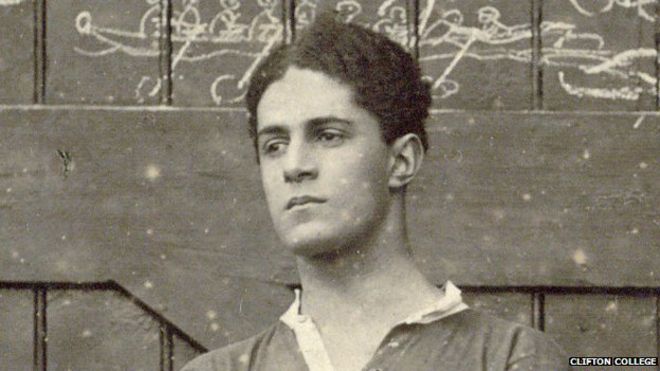
When war was declared in 1914, a Jamaican, David Louis Clemetson, was among the first to volunteer.

A 20-year-old law student at Cambridge University when war broke out, Clemetson was eager to show that he and others from British colonies like Jamaica – where the conflict in Europe had been dismissed by some as a “white man’s war” – were willing to fight and die for King and Country.

He did die. Just 52 days before the war ended, he was killed in action on the Western Front…

…Another candidate for the first black officer is Jamaican-born George Bemand. But he had to lie about his black ancestry in order to become an officer. Bemand, whose story was unearthed by historian Simon Jervis, became a 2nd lieutenant in the Royal Field Artillery on 23 May 1915, four months before Clemetson became an officer and two years before Walter Tull.

When the teenage Bemand and his family migrated to Britain from Jamaica in 1907, and the ship he was on made a brief stopover in New York, Bemand, the child of a white English father and a black Jamaican mother, was categorised by US immigration officials as “African-Black”. Yet, asked in a military interview seven years later, in 1914, whether he was “of pure European descent”, Bemand said yes. His answer was accepted.

But Clemetson took a different approach.

“Are you of pure European descent?” he was asked, in an interrogation intended to unmask officer candidates whose ethnicity was not obvious and who were perhaps light-skinned enough to pass for white. “No,” answered Clemetson, whose grandfather Robert had been a slave in Jamaica, he was not “of pure European descent”.

By telling the truth about his ancestry, Clemetson threatened to disrupt the military’s peculiar “Don’t ask, don’t tell” racial practices, which were conducted with a wink and a nod…

Read the entire article here.

Tags: , , , , ,

Misty Copeland

Posted in Articles, Arts, Media Archive, United States, Women on 2015-04-17 21:06Z by Steven

Misty Copeland

The 100 Most Influential People
Time
2015-04-16

Nadia Comăneci, Five-time Olympic gold medalist

Ballet’s breakout star

Like all gymnasts, I’ve done some ballet—it’s a part of our program. And people don’t realize the tremendous amount of time and work you have to put in to do the maneuvers they do. Ballerinas like Misty Copeland look so beautiful and perfect, but it takes thousands of hours of hard work to make it look that easy.

It was an honor to learn that a movie about me inspired a 7-year-old Misty to see the joy in movement. When I competed in the 1976 Olympics, no one thought that a 14-year-old from a place people couldn’t find on a map could contend. Misty proves that success is not about how you grow up or the color of your skin. Her story—of overcoming personal and physical challenges to become a soloist at the American Ballet Theatre—is the story of someone who followed her dreams and refused to give up. In that way, she is a model for all young girls…

Read the entire article here.

Tags: , , , , ,

Jennifer Lisa Vest to explore ‘post-racial present’ at Women’s and Gender Studies Symposium

Posted in Articles, Arts, Gay & Lesbian, Literary/Artistic Criticism, Media Archive, Social Justice, United States, Women on 2015-04-16 23:09Z by Steven

Jennifer Lisa Vest to explore ‘post-racial present’ at Women’s and Gender Studies Symposium

Report: Faculty/Staff Newsletter
Illinois State University
2015-04-02

Rachel Hatch, Editor

Performing artist and scholar Jennifer Lisa Vest will be the keynote speaker for the 20th annual Women’s and Gender Studies (WGS) Symposium.

Vest will present Black Lives Matter: [Trans]Gender Violence, Disability, and Women in a ‘Post-racial,’ ‘Post-Sexist’ Present at 1 p.m. Friday, April 17, in the Bone Student Center. The talk is free and open to the public.

In celebration of the event, there will be a poetry reading at 7 p.m. Thursday April 16, at the University Galleries, 11 Uptown Circle, Normal.

Vest is a self-described “mixed-race queer feminist philosopher, poet, and artivist whose philopoetic works combine philosophy, poetry and feminist theories to provide intersectional analyses of social justice issues by explicating raced, gendered, and sexualized components of privilege, ablelism, and oppression.”…

Read the entire article here.

Tags: , ,

Afro-Iran | The Unknown Minority

Posted in Articles, Arts, Media Archive on 2015-04-16 22:59Z by Steven

Afro-Iran | The Unknown Minority
2015-04-16

Mahdi Ehsaei, Photographer

The photographic series shows a side of Iran, which is unknown by even Iranians. A trip to a place which is inhabited and dominated by the descendants of slaves and traders from Africa.

The Hormozgan province in the Persian Gulf is a traditional and historical region with a diverse and unexplored population. It is framed with unique landscapes and people with profound personalities. Iranians, who still have African blood in them and continue their African heritage with their clothing style, their music, their dance and their oral traditions and rituals.

The resulting portraits reveal new facets and unfamiliar faces, which are not typical for the common picture of Iran. They show details documenting the centuries-long history of this ethnic minority. A confrontation between the Persian culture and the, for Iran unusual, African consciousness.

A surprisingly new experience for the viewer, which shows the current presence of Afro-Iranians in Iran.

For more information, click here.

Tags: , , , ,

Breast cancer and racialized medicine

Posted in Articles, Health/Medicine/Genetics, Media Archive, United States on 2015-04-16 22:17Z by Steven

Breast cancer and racialized medicine

Race, Racism & Human Genetics IDS 243: Race, Racism, and Human Genetics
Willamette University
Salem, Oregon
2014-11-28

Stephanie Matsuura

Katie Herr

Camille Debreczeny

Race, Racism & Human Genetics IDS 243: Race, Racism, and Human Genetics is an interdisciplinary course taught at Willamette University by Emily Drew and Chris Smith. This blog represents the work of students enrolled in the course, and their reactions to current scholarly and popular work relating to the biology of human difference.

Racial disparities in breast cancer are often attributed to biology uncritically, without considering social factors. In many genetic studies, rhetorical framing of human diversity conflates differences between populations with racial categories. An unconscious complicity in the racial worldview informs these studies, which are then used to justify racialized explanations for disparities in breast cancer. Many researchers recognize that individualized, complete genome analysis would provide better care for patients, but lack the technological and economic resources to make this a realistic goal. Instead they rely on racialized medicine, which has serious consequences for women of color with breast cancer.

Racialized medicine occurs when the U.S. racial worldview goes unchallenged in the way it shapes medical research, health care practices, and public health policy. It is a way of making inequalities in health and illness seem natural by erroneously linking them to “innate” and “biological” differences between racial groups. In the U.S., women of color are disproportionately affected by breast cancer. Black women in particular have higher breast cancer mortality rates than any other racial/ethnic group in the country (Happe 2006). In this blog we aim to cover the main possible explanations for observed racial disparities in both incidence and prognosis of breast cancer. Studies have attributed racial disparities in both incidence and prognosis to the genetics underlying breast cancer as well as to social factors…

Read the entire article here.

Tags: , , , , , , ,

Kwame Anthony Appiah: The Complexities of Black Folk

Posted in Articles, Identity Development/Psychology, Media Archive, Philosophy, United States on 2015-04-16 21:34Z by Steven

Kwame Anthony Appiah: The Complexities of Black Folk

The Stone
The New York Times
2015-04-16

George Yancy, Professor of Philosophy
Duquesne University, Pittsburgh, Pennsylvania

Kwame Anthony Appiah, Professor of Law and Philosophy
New York University


Kwame Anthony Appiah

This is the 10th in a series of interviews with philosophers on race that I am conducting for The Stone. This week’s conversation is with Kwame Anthony Appiah, who teaches in New York University’s department of philosophy and its school of law. He has been the president of the American Philosophical Association, Eastern Division, and of the PEN American Center. He is the author of numerous books, including, most recently, “Lines of Descent: W.E.B. Du Bois and the Emergence of Identity.” — George Yancy

George Yancy: How did you become interested, philosophically, in the question of race? Did it grow out of something like a conceptual problem of reference, or did it come more out of lived experience? Or, perhaps this disjunction is a false start?

Kwame Anthony Appiah: I’m always skeptical when intellectuals give accounts of how they came about their interests! So you should take what I have to say as a set of hypotheses about my own past, not as the results of introspection, which yields nothing about this.

When I first started teaching in the United States in 1981 I had a joint appointment at Yale, in African and African-American studies, on the one hand, and philosophy, on the other, and I was casting about for things to do on the African and African-American side of my work, both as a teacher and as a scholar. I had been an undergraduate student at Cambridge in medical sciences for one year, and philosophy for two, and I was puzzled, as a newcomer to the United States, by the fact that many people appeared to think “race” was a biological concept, whereas I had been taught in my brief career in the life sciences to think it was not.

G.Y.: In your new book, “Lines of Descent,” you write that W.E.B. Du Bois saw himself as an American and a Negro (as opposed to an African-American). You state correctly how being an “American” and being a “Negro” did not fit well for him. I’m reminded of Du Bois’s encounter in “The Souls of Black Folk” with the tall (white) newcomer and how she refused to exchange visiting cards with him and how this signified early on in his life a deep tension in his sense of “racial” identity. Do you think contemporary African-Americans also find themselves possessed by, as Du Bois describes it, “two warring ideals in one dark body, whose dogged strength alone keeps them from being torn asunder”?

K.A.A.: I think that Du Bois’s way of thinking about this, which was informed by 19th- century German social philosophy, can be put like this: Each people, each Volk, has a soul, a Geist, that is the bearer of a folk culture and of what he called spiritual “strivings.” American Negroes were possessed of the soul of America and the soul of the Negro. Since America’s folk culture was racist, they were possessed by a spirit that was, in some respects, hostile to them. The Negro soul gave them the resources for a positive sense of self, which helped to resist this, but it also gave them various other gifts…

…K.A.A.: Well, I should begin by saying that I think that a background of class privilege on both sides of my family has protected both my sisters and me from some of the worst challenges of living in a racist world. (They have also had the advantage of living much of their lives in various parts of Africa!) I was born in London but moved with my family to Ghana when I was 1. My sisters were all born there. When I was an undergraduate at college in England, Skip Gates and I and a Nigerian philosophy student we knew were the only black people in our college. But I had white upper-middle-class high school friends and upper-middle-class English cousins around, so I guess I didn’t feel that there was any question as to my right to be there, and I don’t think anyone else thought so either. (And I wouldn’t have cared if they did!)

As a young person in Ghana, many people I met in my daily life in my hometown knew my family, and knew why I was brown and not black. They knew my mother was an Englishwoman (and white) and my father was Ashanti (and black). And throughout my childhood in Ghana the Asantehene, the king of Ashanti, whose capital was my hometown, was my great-uncle by marriage. (To those who didn’t know me, though, I was a “broni kokoo,” a red [skinned] foreigner; “broni” is often mistranslated these days as “white person.”) So, in a way, the most interesting “problem” for me, having been in America and then an American citizen for much of my adult life (since 1997), has been how to figure out a black identity, having come from two places where my color had a very different significance.

One of the things that I have always been most grateful to this country for is the sense of welcome I have often felt from African-Americans as a person of African descent. There’s no necessity about this: my ancestors — and not so many generations back — were in the business of capturing and selling other black people into the Atlantic slave trade (and some of my mother’s kinfolk back then were no doubt in the business of buying and shipping them). So one thing that race does in the world is bring black people together in spite of these divided histories. But I suppose that the main effect of my being black has been to draw me to black subject matter, black issues, and to give me an interest — in both senses of the term, an intellectual engagement and a stake — in pursuing them. Without this connection to the world of Africa and her diaspora I would just be someone else…

Read the entire article here.
Tags: , , , ,

White Parents, Becoming a Little Less White

Posted in Anthropology, Articles, Asian Diaspora, Census/Demographics, Family/Parenting, Media Archive, United States on 2015-04-16 19:07Z by Steven

White Parents, Becoming a Little Less White

Motherlode: Living the Family Dynamic
The New York Times
2015-04-15

Jack Cheng


Amy Crosson

Former Gov. Jeb Bush made news recently because he checked “Hispanic” on a voter registration form. This is obviously ridiculous from a scion of the Bush family (and Mr. Bush has said he made a mistake). Yet, I understand, because the family he raised is not unlike mine.

A few years ago, in fact, my wife casually mentioned that she doesn’t consider herself 100 percent white any more. She has blond hair, blue eyes and fair skin, and as far back as anyone can remember, all of her ancestors have been Irish.

She was white when we were married. I know that because I’m Chinese and that made us an interracial couple. My wife jokes (I think she’s joking) that she married me in part because my increased melanin would protect her children from skin cancer.

She became less white when our son, and then our daughter, were born. I think the first bit of doubt surfaced the day we were on the subway with our newborn and a woman came up to my wife and said: “Oh, he’s so cute! When did you adopt him?” I was livid: Did it not occur to this woman that the father was sitting right next to his wife and child? It turned out that the woman really just wanted to talk about her own adopted granddaughter but somewhere in that moment my wife was identified as the mother of a nonwhite child…

…While it will take 18 years for that mixed race baby to vote, there is a parent in that family who suddenly has an altered perspective on the culture and policies of the United States. White mothers who realize that their sons will be victims of racial profiling, white fathers who suddenly feel a little squeamish about the fact that “Asian” is a category of pornography. There are white parents whose children look vaguely Middle Eastern and will face harder times getting onto airplanes…

Read the entire article here.

Tags: , , ,

First Listen: Alabama Shakes, ‘Sound & Color’

Posted in Articles, Arts, Audio, Media Archive, United States on 2015-04-16 17:10Z by Steven

First Listen: Alabama Shakes, ‘Sound & Color’

First Listen
National Public Radio
2015-04-12

Ann Powers, NPR Music Critic


The Alabama Shakes’ new album, Sound & Color, comes out April 21.
Brantley Gutierrez/Courtesy of the artist

In the six years I’ve lived in the region, I’ve developed a mantra: Southern freaks are the best freaks. For me, the word “freak” can be both positive and downright spiritual. It describes serious individualists who are tolerant of others whose own paths may diverge from their own; people whose ways of thinking connect to form an antidote to the deep conventionality that often surrounds them. Southern freaks, like the four young musicians in Alabama Shakes, face multiple challenges: not only the love of tradition (and defensive attitude about it) that their neighbors nurture, but also the prejudices of those who live elsewhere and expect Southerners to be somehow limited by their native surroundings. Southern freaks are the best freaks because they have the resilience to flourish in a home that can feel foreign, while also recognizing that legacies can’t be simply processed. They must be lived, confronted and altered from within.

Brittany Howard expresses this more fancifully in “Gemini,” the first song the band recorded for its boundary-leaping second album, Sound & Color. “On a planet not so far away, we were born together,” she sings, maybe to her lost sister, a lover or a best friend, in a voice that contains shadows of Richmond, Virginia‘s son, D’Angelo. Howard’s imagined pair washes up in Athens, Alabama, “suckled on the honey of the Tennessee,” whose wet banks are both adorned with the flower whose name she’s playing with and rife with the snakes she mentions in the next verse. The dream Howard spins in “Gemini” could have come from the pen of South Carolina native Dorothy Allison. The thick, expansive bed of druggy funk the band creates to convey it recalls the deepest experiments of Denton, Texas, native Sly Stone. The resonance the band achieves with the help of producer Blake Mills turns the track into serious funk: something George Clinton, born in North Carolina and now living in Tallahassee, would enjoy…

Read the article here. Listen to the story here.

Tags: , , , , , , ,