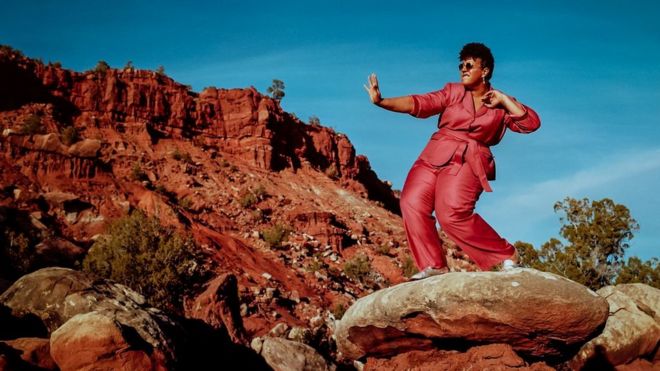
Scholarly perspectives on the mixed race experience.
Sabrina Jacobucci: “Mixed race children often face the same issues black mono-heritage children face. No matter their skin tone, they are seen as black and therefore it is healthier and more empowering for them to identify as such, without denying their dual heritage at the same time. A racist is not going to ask them whether they are mixed-race.”
Her [Brittany Howard’s] most striking lyrics come on Goat Head [in her album Jaime], as she discusses growing up as the child of a poor, interracial couple in rural Alabama.
“When I was born – or rather when my sister was born in 1984 – that was like the first wave of mixed babies, little brown babies,” she says.
“My mama would go around town, pushing my sister and I in a cart to the grocery store, and people would actually come up to her and lecture her. They would say, ‘Do you know what you’ve done?'”
In the song, she recalls an incident that happened when she was a baby, but was told about later, where “someone cut off a goat’s head, and they put it in the back of my dad’s car and slashed his tyres, and smeared blood all over his car”.
“It’s always been a part of me, that story,” says Howard. “Because Athens was a beautiful, peaceful country place, where people are neighbours and we really care about each other. But there’s a racial line, or there was at least, and that’s why I wanted to write that song. Just to explain where I was coming from.”
Comments Off on “My mama would go around town, pushing my sister and I in a cart to the grocery store, and people would actually come up to her and lecture her. They would say, ‘Do you know what you’ve done?'”
The Alabama Shakes’ new album, Sound & Color, comes out April 21. Brantley Gutierrez/Courtesy of the artist
In the six years I’ve lived in the region, I’ve developed a mantra: Southern freaks are the best freaks. For me, the word “freak” can be both positive and downright spiritual. It describes serious individualists who are tolerant of others whose own paths may diverge from their own; people whose ways of thinking connect to form an antidote to the deep conventionality that often surrounds them. Southern freaks, like the four young musicians in Alabama Shakes, face multiple challenges: not only the love of tradition (and defensive attitude about it) that their neighbors nurture, but also the prejudices of those who live elsewhere and expect Southerners to be somehow limited by their native surroundings. Southern freaks are the best freaks because they have the resilience to flourish in a home that can feel foreign, while also recognizing that legacies can’t be simply processed. They must be lived, confronted and altered from within.
Brittany Howard expresses this more fancifully in “Gemini,” the first song the band recorded for its boundary-leaping second album, Sound & Color. “On a planet not so far away, we were born together,” she sings, maybe to her lost sister, a lover or a best friend, in a voice that contains shadows of Richmond, Virginia‘s son, D’Angelo. Howard’s imagined pair washes up in Athens, Alabama, “suckled on the honey of the Tennessee,” whose wet banks are both adorned with the flower whose name she’s playing with and rife with the snakes she mentions in the next verse. The dream Howard spins in “Gemini” could have come from the pen of South Carolina native Dorothy Allison. The thick, expansive bed of druggy funk the band creates to convey it recalls the deepest experiments of Denton, Texas, native Sly Stone. The resonance the band achieves with the help of producer Blake Mills turns the track into serious funk: something George Clinton, born in North Carolina and now living in Tallahassee, would enjoy…
Brittany Howard of the Alabama Shakes: “I Don’t Think About Color”
If you haven’t heard of Brittany Howard of the Alabama Shakes, the 24-year-old is making jaws drop in the music industry. Armed with ferocious vocals, passionate lyrics and a dynamic presence — on and off stage — Howard as the front woman of the Alabama Shakes is bringing rock and blues back from the grave for a new generation.
On Sunday night at the Capital Theatre in Port Chester, NY, the Grammy-nominated Alabama Shakes performed to a sold-out show, performing music from their latest album Boys & Girls. Hours before hitting the stage, Brittany was prepping for her first one-on-one interview with BET.com.
Just finishing a cigarette, Howard sat down to discuss her roots, music and fame. Although surprisingly reserved, the Athens, AL, native possessed a quiet strength. Interviews, celebrity and folks wanting to know your business is new for Brittany and the band who never strived be the next big thing in music: “It’s a miracle that we are sitting in Port Chester, New York doing an interview with BET. Like, what the hell?”
When did you first fall in love with rock music?
Sitting in my grandmother’s kitchen, she always had solid golden oldies on the radio. The grittiest music, I was like, “That’s my s–t.”
You’re often compared to ’60’s rocker Janis Joplin. How do you feel about that comparison?
People hear a powerful female singer in a rock and roll band and they say, “Janis Joplin.” I think people just make that comparison because it’s easy. But I don’t think I sound like her at all. What do you think?…
…What is your racial background?
Mom is white, dad is Black.
Do you identify as Black, mixed — how do you see yourself?
I’m both. Everything and nothing…
With its highly anticipated second album, this band of small-town misfits finally has a ticket out — not that they would ever leave.
In the upstairs dressing room at the Georgia Theater in Athens, Ga., in January, Alabama Shakes was getting restless. The band was about to perform songs from its second album, “Sound & Color,” for the first time, and the room was full of distractions. Friends and relatives had driven over from Alabama: cousins and uncles, wives and girlfriends, crying babies and unrestrained toddlers. Sippy cups and spilled Cheerios were scattered everywhere.
Off to one side, Brittany Howard, the 26-year-old lead singer, stared into the middle distance, listening to the new tracks on her headphones, concentrating on the sections that had given her trouble in rehearsal. She got the last touch-ups on her makeup and hair, a sort of Mohawk-bouffant cropped close on the sides, her bouncy curls left free to run wild on the top, and slipped into her show boots: ankle-high burgundy suede.
As the band made its way toward the stairwell that connected the dressing room to the stage, the backup gospel singers, a first-time luxury, followed close behind. The procession moved slowly down the six flights of steel and concrete, which formed a sort of vertical echo chamber. The singers ran scales as they descended, and invited Howard to join them, to take advantage of the acoustics and the last few remaining seconds to prep her vocal cords.
“I don’t really know how to warm up,” she said, laughing. Maybe she was joking. Maybe not. Then, as if to punctuate the point, she let loose a guttural roar that reverberated up and down the stairwell. She laughed again just before she walked through the door to the stage, where a thousand fans screamed at the first glimpse of her. Then she turned around and shouted the University of Alabama rally cry back to the musicians assembled in the stairwell, at the top of her lungs: “ROLLLLLL TIDE!”
Alabama Shakes’s rapid ascent has been largely fueled by Howard’s singular stage presence. When she first steps in front of a crowd, there are moments when she seems like the awkward adolescent she used to be, all too aware of her size, her looks and her lumbering gait. But when she hits that first big unrestrained note — her face contorted as if possessed — or a thundering chord on her Gibson, stomping and quaking, preaching and confessing, her jaw jutting out like an angry, pouting child’s, everything changes. It becomes impossible to look anywhere else. She can sound by turns ferocious or angelic, sometimes in the same song. When she sings about heartbreak, it feels as if, right there at that moment, she is consumed by it…