Suspect Relations: Sex, Race, and Resistance in Colonial North Carolina (Review)

Posted in Articles, Book/Video Reviews, History, Media Archive, Slavery, Social Science, United States on 2010-02-04 22:23Z by Steven

Suspect Relations: Sex, Race, and Resistance in Colonial North Carolina (Review)

William and Mary Quarterly
Volume LX, Number 1 (January 2003)
Reviews of Books

Richard Godbeer, Professor of History
University of Miami

Suspect Relations: Sex, Race, and Resistance in Colonial North Carolina. By Kirsten Fischer. (Ithaca, N. Y.: Cornell University Press, 2002. Pp. xiv, 265.)

Kirsten Fischer’s compelling new book explores the interplay between sexual relations and racial attitudes in colonial North Carolina. In common with other recent scholars, Fischer sees evolving conceptions of race, sex, gender, and social status as closely intertwined in the early South. Unlike those who argue for a shift in emphasis from gender or class to race, Fischer stresses instead “the continual contestation, reassertion, and reconfiguration” of these categories as “assumptions of gender, race, and class difference propped each other up in the developing social hierarchy” (p. 5). Fischer identifies a gradual movement away from somewhat fluid notions of race toward an ideology in which racial difference figured as permanent and inherent. Sexual regulation played a crucial role in official attempts to affirm and police racial boundaries in southern society. This in turn “made race seem as corporeal as sex” and so “bolstered the notion that race was a physical fact” (pp. 10-11).

In colonial society, the establishment of slavery and racial subordination required careful regulation of European as well as African residents and especially of white women. Legislation that prohibited marriage between servants, outlawed interracial sex, and prescribed lengthy apprenticeships for the mixed-race children of white women made marriage and sex integral to the imposition of racial as well as class and gender ideologies. Yet sexual unions in North Carolina embodied the contestedness of racial relations in the early South: as “men and women made personal choices based on many contingencies, of which racial or ethnic identity was only one” (p. 7), they often challenged emerging proscriptive codes. The widespread incidence of unauthorized unions bespoke the resilience of alternative popular codes and the willingness of ordinary colonists, women and men, to ignore or self-consciously resist official norms….

Read the entire review here.

Tags: , , ,

I’m Color-blind But What Are You, Anyway?

Posted in Articles, Media Archive, Social Science, United States on 2010-02-04 22:03Z by Steven

I’m Color-blind But What Are You, Anyway?

Electronic Journal of Sociology (2007)
ISSN: 1198 3655

Kathleen Korgen, Professor of Sociology
William Paterson University

Eileen O’Brien, Assistant Professor of Sociology
Christopher Newport University

Using primary data from interviews conducted with 1) close black-white friends and 2) biracial Americans, we examine the relationship between the traditional fixation on racial categorizations and the current emphasis on color-blindness. In doing so, we reveal that, instead of indicating a decline in the importance of race, the color-blind ideology acts as both a cover for the obsession with race in U.S. society and a subtle but effective reinforcement for it.

Read the entire article here.

Tags: , , ,

Multicultural/Multiracial Psychology: Mestizo Perspectives in Personality and Mental Health

Posted in Books, Identity Development/Psychology, Media Archive, Monographs on 2010-02-03 23:05Z by Steven

Multicultural/Multiracial Psychology: Mestizo Perspectives in Personality and Mental Health 

Jason Aronson an imprint of Rowman Littelfield
1997
296 pages
Cloth 0-7657-0073-5 / 978-0-7657-0073-5

Manuel Ramirez, III, Professor of Psychology
University of Texas, Austin

also Clinical Professor of Psychology
University of Texas Southwestern Medical Center, Dallas

This book presents a cognitive styles framework that explores the relationship between traditionalism/modernism and cognitive styles and offers a method for multiculturalism assessment and psychotherapy that promotes the development of pluralistic perspectives and lifestyles.

Tags: , ,

Jean Toomer and Cane: “Mixed-Blood” Impossibilities

Posted in Arts, Literary/Artistic Criticism, Media Archive, United States on 2010-02-03 03:46Z by Steven

Jean Toomer and Cane: “Mixed-Blood” Impossibilities

Arizona Quarterly: A Journal of American Literature, Culture, and Theory
Volume 64, Number 4, Winter 2008
E-ISSN: 1558-9595, Print ISSN: 0004-1610
DOI: 10.1353/arq.0.0025

Gino Michael Pellegrini, Adjunct Assistant Professor of English
Pierce College, Woodland Hills, California

Even though Jean Toomer was black and white, his fascination with miscegenation in his hybrid short-story cycle Cane (1923) was puzzling and untimely. Joel Williamson writes that by 1915 the one-drop rule had been accepted by both blacks and whites in the North and South (109). Hence, mixed bloods with visible traces of blackness, including members of the former mulatto elite, would be judged as black by both blacks and whites. At best, they could be “in some way, satisfyingly black”. In this article, I put forward a reading of Toomer and Cane that explains his fascination with miscegenation in terms of his hope for what was possible in America. Specifically, his unique and solitary position vis-à-vis the New Negro in Black Washington and the Young American in White Manhattan provided him with the reasons, models, and ideals to believe that, in Cane, he could effectively voice and sketch out a mixed race sensibility and community that would be grasped and appreciated by the American public. However, in the process of writing Cane, he came face to face with the rigid categories and limits of the black-white color line in the Jim Crow era, which rendered unintelligible and unsustainable in the culture at large the mixed race sensibility and community he sought to express and develop. In other words, we see in Cane the ultimately futile clash of Toomer’s Young American ideals with the socio-political realities of the black-white color line. Cane reveals the pain and frustration of this clash through muffled and ambivalent narrative voices, and through sketches of unacknowledged, crippled, misunderstood, and lost mixed race protagonists…

Read or purchase the article here.

Tags: , , , , ,

Tiger Woods Is Not the End of History: or, Why Sex across the Color Line Won’t Save Us All

Posted in Articles, History, Media Archive, Social Science, United States on 2010-02-02 19:08Z by Steven

Tiger Woods Is Not the End of History: or, Why Sex across the Color Line Won’t Save Us All

The American Historical Review
Volume 108, Number 5
December 2003

Henry Yu, Professor of History
University of California, Los Angeles

In December 1996, several months after Tiger Woods left Stanford University to become a professional golfer, a Sports Illustrated story entitled “The Chosen One” quoted Tiger’s father, Earl, claiming that his son was “qualified through his ethnicity” to “do more than any other man in history to change the course of humanity.” Tiger’s mother, Kultida, agreed, asserting that, because Tiger had “Thai, African, Chinese, American Indian and European blood,” he could “hold everyone together. He is the Universal Child.” The story’s author concluded that, “when we swallow Tiger Woods, the yellow-black-red-white man, we swallow … hope in the American experiment, in the pell-mell jumbling of genes. We swallow the belief that the face of the future is not necessarily a bitter or bewildered face; that it might even, one day, be something like Tiger Woods’ face.” Building on the interest in Tiger Woods, stories about mixed-race children and intermarriage proliferated. In January 2000, both Newsweek and Time opened the millennium with cover art speculating on the multi-racial faces of America’s future. 

The celebration of Tiger Woods’ mixed descent and his widespread popularity would seem to support David Hollinger‘s argument that the history of the United States has been a successful (albeit episodic) history of “amalgamation” overcoming group differences. With Woods as a prominent example, we might even be “crazy enough to believe” the idea that eventually “racism can be ended by wholesale intermarriage,” as Hollinger hints in his concluding paragraph.  However, I would argue that focusing on “intermarriage” and “race-mixing” should bring us to a different conclusion about U.S. history, and Woods might serve as a useful prism for separating out some other important aspects of the encounter of the United States with Asia and the Pacific…

Read the entire article here.

Tags: , , , , ,

Meet the New Faculty: Jennifer Brody

Posted in Articles, Biography, Media Archive, United States, Women on 2010-02-02 18:24Z by Steven

Meet the New Faculty: Jennifer Brody

Duke Today
The Duke Community’s Daily News and Information Resource
Duke University
2008-10-22

Andrea Fereshteh

Exploring the intersection of race, gender and art

Durham, North Carolina — From a very early age, Jennifer Brody was curious about the intersection of art, gender and race. She recalls a time as a young girl when she drew a picture of herself and colored her skin in brown.

“I told my mother that was the color I really was, even though she couldn’t see it,” says the fair-skinned Brody, the newest member of Duke’s African and African American Studies department. “As a young child, I had a conscious perception of how I might move through the world and what kinds of limitations and possibilities my specific location might engender.”…

Read the entire article here.

Tags: , , , ,

Fort Red Border

Posted in Books, Media Archive, Poetry on 2010-02-02 02:50Z by Steven

Fort Red Border

Sarabande Books
2009-08-01
88 pages
trim: 9 x 6
ISBN 13 (paper): 978-1-932511-74-1

Kiki Petrosino

Kiki Petrosino has audacity to spare. She devotes the entire first section of her debut collection of poems to a putative affair the speaker is conducting with an imaginary Robert Redford. In the poems, Redford is solicitous of the speaker, as well as curious about her “difference,” probing her about the various meanings of “natural” when applied to her African-American hair. The poems’ hilarity and poignancy issue from the speaker’s distance from, and yearning toward, the center of mainstream culture. Redford serves as ideal partner, the embodiment of American masculinity––but there is also an odd tenderness and actuality to the relationship. In these poems Petrosino is fearless, proceeding from the recognizable terrain of daily life’s emotions rather than seeking refuge in the cool of mere obscurity. Petrosino’s poems scout a new path, one that discovers a believably fierce, vivid, feeling self.

YOU HAVE MADE A CAREER OF NOT LISTENING

God has spider skin and lives in secret trees. I have stood beside you, saying this, as you reach into the cupboard for another stack of dry noodles. You eat them with the dead still on, with the sticky deadness still on, because you always throw out the foil package of seasoning. So the noodle brick just loosens, slowly, in a flat brine of city water, just squats and spreads in the center of the frying pan like a washed-up boxer or a stranger’s face disappearing into morphine. After the fight the boxer wraps a towel around his hips and walks into his manager’s office. Some boys wipe fifty bucks’ worth of sweat from the ring, then head to the all-night diner smelling like stacks of thumbs. Meanwhile, dollars bills are blooming in the stranger’s lonely raincoat pocket. It is 5:00 a.m. There are places you will never go with me, no matter how many times you ask, or how hard you eat.

Tags: ,

The Politics of Biracialism [Issue]

Posted in Articles, Barack Obama, Census/Demographics, Communications/Media Studies, History, Identity Development/Psychology, Media Archive, Social Science on 2010-02-01 18:54Z by Steven

The Politics of Biracialism [Issue]

The Black Scholar
Journal of Black Studies and Research
Fall 2009 (2009-09-22)
Volume 39, No. 3/4

Guest Editors:

Laura Chrisman, Professor of English
University of Washington

Habiba Ibrahim, Assistant Professor of English
University of Washington

Ralina Joseph, Assistant Professor of Communications
University of Washington

Why a biracial issue, and why now? As black Americans we have mixed ancestry; one might ask what is gained by giving this obvious fact the attention of a special issue. Rather than focus on this broad history, however, we instead highlight here the situations of first-generation biracial black people. Perhaps this does not simplify matters. Foregrounding their specific experiences, identities, and concerns may stir up the anger of those who feel judged “not black enough” and the anger of those who feel betrayed and devalued by self-identifying biracial individuals. The politics of biracialism, seen this way, are individualistic, diminishing our community’s cohesion. Yet we feel that the time is right for an exploration of the topic. Biracial or multiracial studies is fast-growing and itself extremely varied in its methods, disciplines, and orientation. Acknowledging the important and interesting work that has been produced in the last two decades, we provide a forum for such work. Another factor in our choice of topic is the emergence, in 2008, of Obama as a presidential candidate. Both his blackness and his first generation biracialism have prompted new consideration, within black communities and within the U.S. population as a whole, of the operations and meanings of race, nation, family and community within the U.S.A. This gives us additional incentive to explore biracialism in the present moment. Our moment differs from the fraught late 1990s when the multiracial social movement campaigned for recognition in the 2000 Census, and was opposed by influential black voices. The present adds some confidence and optimism: to profile biracialism now, we suggest, is not to jeopardize black collectivity so much as it is to recognize and join the healthy debates that are flourishing within and beyond black studies…

Table of Contents

Tags: , , , , , , , , , , , , , , , , , , , , , , ,

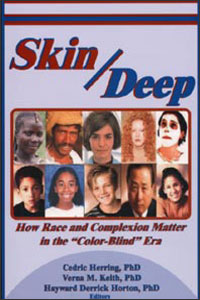
Skin Deep: How Race and Complexion Matter in the “Color-Blind” Era

Posted in Anthologies, Books, Media Archive, Social Science, United States on 2010-02-01 17:58Z by Steven

Skin Deep: How Race and Complexion Matter in the “Color-Blind” Era

Univerisity of Illinois Press
October 2003
256 pages
Dimensions: 6 x 9 in. 
Illustrations: 11 Line Drawings, 11 Tables
Paper ISBN: 978-1-929011-26-1

Edited by:

Cedric Herring, Professor of Sociology
Univeristy of Illinois, Chicago

Verna M. Keith, Professor of Socilology
Florida State University

Hayward Derrick Horton, Professor of Sociology
State University of New York, Albany

A collection of essays questioning the truth of American’s color-blind society from outside and inside communities of color.

Shattering the myth of the color-blind society, the essays in Skin Deep examine skin tone stratification in America, which affects relations not only among different races and ethnic groups but also among members of individual ethnicities. Written by some of the nation’s leading thinkers on race and colorism, these essays ask whether skin tone differentiation is imposed upon communities of color from the outside or is an internally-driven process aided and abetted by community members themselves. They also question whether the stratification process is the same for African Americans, Hispanics, and Asian Americans. Skin Deep addresses such issues as the relationship between skin tone and self esteem, marital patterns, interracial relationships, socioeconomic attainment, and family racial identity and composition. The essays also grapple with emerging issues such as biracialism, color-blind racism, and 21st century notions of race.

Tags: , , , ,

The Amerasian Problem: Blood, Duty, and Race

Posted in Articles, Asian Diaspora, Media Archive, Politics/Public Policy, United States on 2010-02-01 15:18Z by Steven

The Amerasian Problem: Blood, Duty, and Race

International Relations
Volume 21, Number 1 (March 2007)
pages 86-102
DOI: 10.1177/0047117807073769

Sue-Je Lee Gage, Assistant Professor of Anthropology
Ithaca University

The concept of ‘mixed blood’ is not a new one; however, it was not until 1982 that an unprecedented policy entitled ‘The Amerasian Act’ was created by the US government. Focusing on the author’s ethnographic fieldwork in South Korea and the US, this article will unpack the assumptions underlying the seemingly religious statement ‘the American thing to do’ in terms of US policy, where ostensibly scientific notions of ‘race’, blood and identity are employed.

Read or purchase the article here.

Tags: , , , ,