WATCH: Jesse Williams of ‘Grey’s Anatomy’ on Race

Posted in Articles, History, Law, Media Archive, Politics/Public Policy, United States, Videos on 2014-12-28 03:43Z by Steven

WATCH: Jesse Williams of ‘Grey’s Anatomy’ on Race

Heavy
2014-12-22

Paul Farrell, Breaking News Editor

Actor Jesse Williams appears in a viral video that was published on December 17. The Grey’s Anatomy star take aim at racism and double standards in America, including public housing discrimination, specifically in Chicago.

The star goes on to discuss the logic behind the argument that Michael Brown robbed a store and therefore deserved to be shot, versus the argument about whether corrupt Goldman Sachs bankers also deserve violence.

Williams is mixed-race, the son of an African-American father and a Swedish-American mother. In the video, he states, “Half of my family is white.” He also says, “I’m as white as you can get as a black person.”…

Read the entire article here.

Tags: , ,

Brazil’s hidden slavery past uncovered at Valongo Wharf

Posted in Articles, Brazil, Caribbean/Latin America, History, Media Archive, Slavery on 2014-12-27 00:41Z by Steven

Brazil’s hidden slavery past uncovered at Valongo Wharf

BBC News
2014-12-24

Julia Carneiro
BBC Brasil, Rio de Janeiro

Rio de Janeiro is a city looking to the future. Major development work is underway in the city’s historic port area as it prepares to host the Olympics in 2016.

But the construction effort to make all that happen has unexpectedly shone a light on a dark side of Rio: its past as the largest entry point for African slaves in the Americas.

In 2011, excavation work uncovered the site of Valongo Wharf, where almost a million African slaves disembarked before the slave trade was declared illegal in Brazil in 1831.

The wharf and the complex surrounding it were constructed in 1779 as part of an effort to move what was regarded as an unsightly trade to an area far from the city centre…

…Anthropologist Milton Guran, who co-ordinates the bid to have Valongo recognised as a Unesco World Heritage site, thinks preservation is especially important because “we had successive attempts to erase this history”.

“Slavery finally started being perceived as something heinous and the Empire sought to obliterate that mark,” he says…

…The impact of slavery on Brazilian society can be seen to this day. Over half of Brazil’s population is black or mixed race, but its elite remains largely white…

Read the entire article here.

Tags: , , , , ,

White? Black? A Murky Distinction Grows Still Murkier

Posted in Anthropology, Articles, Health/Medicine/Genetics, History, Latino Studies, Law, Media Archive, Native Americans/First Nation, Slavery, United States on 2014-12-24 17:50Z by Steven

White? Black? A Murky Distinction Grows Still Murkier

The New York Times
2014-12-24

Carl Zimmer

In 1924, the State of Virginia attempted to define what it means to be white.

The state’s Racial Integrity Act, which barred marriages between whites and people of other races, defined whites as people “whose blood is entirely white, having no known, demonstrable or ascertainable admixture of the blood of another race.”

There was just one problem. As originally written, the law would have classified many of Virginia’s most prominent families as not white, because they claimed to be descended from Pocahontas.

So the Virginia legislature revised the act, establishing what came to be known as the “Pocahontas exception.” Virginians could be up to one-sixteenth Native American and still be white in the eyes of the law.

People who were one-sixteenth black, on the other hand, were still black.

In the United States, there is a long tradition of trying to draw sharp lines between ethnic groups, but our ancestry is a fluid and complex matter. In recent years geneticists have been uncovering new evidence about our shared heritage, and last week a team of scientists published the biggest genetic profile of the United States to date, based on a study of 160,000 people…

Read the entire article here.

Tags: , , , , , , , , , ,

Chowan Discovery Group, Marvin T. Jones

Posted in Audio, History, Media Archive, United States on 2014-12-23 14:57Z by Steven

Chowan Discovery Group, Marvin T. Jones

Backintyme.biz
Blog Talk Radio
2014-12-20

Stacey Webb, Host

Marvin T. Jones, Executive Director
Chowan Discovery Group

Author & Historian Marvin T. Jones, Executive Director & owner of Marvin T. Jones and Associates, specializing in corporate communications photography and photographic design. His love of the community of his birth led him to create the now defunct Rowan-Chowan.com website, a personal website of stories and photo essays. jones is a native of Cofield, North Carolina. He attended the Winton Triangle’s C.S. Brown School and graduated from Ahoskie High School.

Marvin also wrote a chapter in Carolina Genesis, Beyond The Color Line and presents the first history of the Winton Triangle. Marvin’s essay “The Leading Edge of Edges-The Tri-Racial People of the Winton Triangle”, tells the story of a people who emerge from the meeting of the New and Old Worlds and how they created success from century to century in northeastern North Carolina. Highlights of the essay include: Origins of the Winton Triangle and the Triangle’s contribution to the Civil War in expanding freedom in the United States, Founding of Pleasant Plains Baptist Church & the C.S. Brown & Robert L. Vann Schools, and the achievements of their members & graduates. Leadership in worship, education, business & government.

Associates; Laverne Jones, Director & Dr. Harold Mitchell, Director.

Mission of the Chowan Discovery Group is to Collect, Preserve & present materials that describe & illustrate the Winton Triangle history. Dating back to the 1740’s, North Carolina’s Winton Triangle is one of the oldest communities if land-owning people of color in America. The Triangle originally encompassing the towns of Winton, Cofield & Union. In the late 19th century the Triangle expanded toward the newly incorporated town of Ahoskie.

Tags: , , , , , ,

English 49, “Whiteness” and Racial Difference

Posted in Course Offerings, History, Literary/Artistic Criticism, Media Archive, Passing, United States on 2014-12-21 01:28Z by Steven

English 49, “Whiteness” and Racial Difference

Swarthmore College, Swarthmore, Pennsylvania
Spring 1997

Peter Schmidt, William R. Kenan, Jr. Professor of English Literature

A look at the conflicted ways in which “racial” identities and differences have been constructed in past and contemporary cultures, especially in the U.S. Topics given emphasis in the syllabus include why saying “race doesn’t matter” is not enough; how a new debates about the history of race have changed American Studies and feminist studies; how European immigrants to the U.S. became “white” and with what benefits and what costs; how popular culture can both resist and perpetuate racist culture; and an introduction to issues of “passing,” multi-racial identity, and recovering a multiracial past. The format of the class will include both lecture and student-led discussion.

For more information, click here.

Tags: ,

“The Double Curse of Sex and Color”: Robert Purvis and Human Rights

Posted in Articles, History, Media Archive, United States, Women on 2014-12-17 18:59Z by Steven

“The Double Curse of Sex and Color”: Robert Purvis and Human Rights

Pennsylvania Magazine of History and Biography
Volume 121 [CXXI], Number 1-2, January/April 1997
pages 53-76

Margaret Hope Bacon (1921-2011)

In 1869 A NATIONAL WOMAN’S SUFFRAGE convention was held for the first time in Washington, D.C. The Fourteenth Amendment had recently been ratified and the Fifteenth was about to be introduced into Congress. Elizabeth Cady Stanton, Susan B. Anthony, and other women present used the opportunity to object to black men receiving the vote before women, both black and white, were enfranchised. Their arguments were countered by those of Frederick Douglass, Edward M. Davis, Dr. Charles Burleigh Purvis, and others, who maintained that the Southern black male needed the shield of suffrage to protect him from the reign of terror being visited upon him by former slave owners.

A tall slender man with fair skin and white hair rose at his seat and began to speak. Elizabeth Stanton invited him to come forward and address the convention from the platform. Robert Purvis of Philadelphia said that he was willing to wait for the vote for himself and his sons and his race until women were also permitted to enjoy it. It was important to him that his daughter be enfranchised, since she bore the double curse of sex and race. He chided his son, Dr. Charles Purvis, for holding a narrow position, and reminded him that his sister Hattie also deserved to be enfranchised.

Alone among the black men who had supported women’s rights in the antislavery movement, Robert Purvis remained an advocate of suffrage for women throughout the period of debate and schism over the Fourteenth and Fifteenth amendments. In 1888 he was honored by Susan B. Anthony at the International Council of Women, meeting in Washington, D.C., for his courageous stand in 1869 in opposition to his own son.

Purvis’s advocacy of women’s rights was rooted in his deeply held convictions on human rights. He believed strongly that the struggle for equality for blacks could not be separated from that of women, of American Indians, of Irish nationalists demanding home rule, of all minorities. He objected to all associations based on color alone and rejected the term “African-American.” ‘There is not a single African in the United States,” he told a Philadelphia audience in 1886. “We are to the manner born; we are native Americans.”

Purvis’s position on human rights undoubtedly stemmed in part from his own mixed-race background. His grandmother, Dido Badaracka, was born in Morocco. Purvis described her as a “full-blooded Moor of magnificent features and great beauty. She had crisp hair and a stately manner.” In approximately 1766, at the age of twelve, she was captured by a slave trader along with an Arab girl. The two had been enticed to go a mile or two out of the city where they lived to see a deer that had been caught. They were seized, loaded on the backs of camels, and carried to a slave market on the coast. Here they were loaded onto a slaver and transported to Charleston, South Carolina. At the slave market in Charleston, Dido was bought by a kind white woman, named Day or Deas, who educated her, treated her as a companion, and left instructions that she was to be freed when the woman died, nine years later, in 1775…

Read the entire article here.

Tags: , , , , , ,

Immigration, Ethnicity, and National Identity in Brazil, 1808 to the Present by Jeffrey Lesser (review)

Posted in Articles, Book/Video Reviews, Brazil, Caribbean/Latin America, History, Slavery on 2014-12-16 01:58Z by Steven

Immigration, Ethnicity, and National Identity in Brazil, 1808 to the Present by Jeffrey Lesser (review)

Journal of Interdisciplinary History
Volume 45, Number 3, Winter 2015
pages 449-451

Samuel L. Baily, Professor Emeritus of History
Rutgers, The State University of New Jersey

Jeffrey Lesser, Immigration, Ethnicity, and National Identity in Brazil, 1808 to the Present (Cambridge, New York: Cambridge University Press, 2013).

Lesser’s book is an ambitious, commendable effort to explain the complex evolving relationships between immigration, ethnicity, and national identity in Brazil since 1808. Over that period of time, 6 million immigrants entered Brazil. The large majority of them were of European descent—slightly fewer than one-third of them from both Portugal and Italy, 13 percent from Spain, and 4 percent from Germany. Non-Europeans comprised nearly 20 percent of the total—Japanese about 5 percent, and Middle Eastern Jews and Arabs, Chinese, Latin Americans, and Americans the remainder. The flow of each group varied in intensity over time. Most of the immigrants settled in the southern part of the country and in the state and city of Sao Paulo, but others spread into other areas as well. Lesser seeks to analyze the impact of migration both on the immigrants themselves and on the evolving meaning of Brazilian national identity.

As daunting a task as Lesser’s may seem, the topic is further complicated by the fact that approximately 30 percent of Brazil’s population at the time of its independence in 1822 were African Brazilians, who served as the primary workforce for the colonial economy. Thus, race became intimately linked to immigration, to ethnicity, and ultimately to definitions of national identity. Immigrants did not provide labor in Brazil alone; they did so in the United States as well. But conceptions of immigrants’ standing in these two societies differed considerably. The United States saw itself as the “promised land” where immigrants could immediately improve their prospects, whereas many of the people who constituted Brazil’s host society hoped that immigrants, by virtue of their physical and cultural presence, would gradually improve an imperfect nation by ameliorating its mixed racial composition. They adopted a “whiteness model” of development. Lesser correctly insists that immigration and national identity cannot be understood separately from the broader context of race.

The book includes many important statistical tables and interesting illustrations (postage stamps, postcards, maps, photos, magazine ads, and cartoons, among others). At the end of five of the six chapters are appended relevant short primary documents related to the topics that they discussed. The work also includes a useful, comprehensive historiographical essay on Brazilian immigration, ethnicity, and national identity, but also sufficient citations to facilitate comparisons with the United States, Argentina, and other New World countries that experienced major immigrations.

Lesser previously published three books on major aspects of his current subject—one about Jewish rnigration to Brazil, the second about negotiating national identity in Brazil, and the third about Japanese Brazilians. In the present volume, he builds skillfully on this foundation of primary data and analysis to deepen our understanding of these complex issues. He organizes his book in loose chronological order beginning with a chapter about Central European and Asian migration schemes (1822–1870), followed by chapters about mass European migration (1880–1920), Middle Eastern migration (Arabs and Jews) (1880–1940), and Asian migration (especially Japanese) (1900–1955). The epilogue focuses on the post–World War II period, bringing the story to the present day. All of these chapters examine the evolving patterns of national identity, but Chapter 4 is specifically focused on the creation of Euro-Brazilian identities.

Lesser’s book has much to offer to both specialists and general readers. His overview carries profound insights about the problems of national identity in Brazil and elsewhere. One of Lesser’s greatest contributions is his effective use of comparative methodology. He clearly delineates the similarities and differences between the specific European, Middle Eastern, and Asian groups within Brazil regarding such important matters as intermarriage with Afro-Brazilians, “whiteness,” the relationship with country of origin, et al. His revealing comparisons between Brazil, the United States, and Argentina provide an important international perspective on immigration and the evolution of national identity…
Tags: , ,

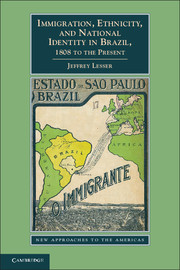
Immigration, Ethnicity, and National Identity in Brazil, 1808 to the Present

Posted in Books, Brazil, Caribbean/Latin America, History, Media Archive, Monographs, Slavery on 2014-12-15 18:32Z by Steven

Immigration, Ethnicity, and National Identity in Brazil, 1808 to the Present

Cambridge University Press
January 2013
219 pages
19 b/w illus. 1 map 19 tables
229 x 153 x 14 mm
Hardback ISBN: 9780521193627
Paperback ISBN: 9780521145350
eBook ISBN: 9781139602723

Jeffrey Lesser, Samuel Candler Dobbs Professor of History
Emory University, Atlanta, Georgia

Immigration, Ethnicity, and National Identity in Brazil, 1808 to the Present examines the immigration to Brazil of millions of Europeans, Asians, and Middle Easterners beginning in the nineteenth century. Jeffrey Lesser analyzes how these newcomers and their descendents adapted to their new country and how national identity was formed as they became Brazilians along with their children and grandchildren. Lesser argues that immigration cannot be divorced from broader patterns of Brazilian race relations, as most immigrants settled in the decades surrounding the final abolition of slavery in 1888 and their experiences were deeply conditioned by ideas of race and ethnicity formed long before their arrival. This broad exploration of the relationships between immigration, ethnicity, and nation allows for analysis of one of the most vexing areas of Brazilian study: identity.

  • Includes oral histories and primary documents so readers can get a sense of the voices of immigrants and those with whom immigrants interacted
  • Does not treat immigrants only as victims, unlike other immigration studies
  • Places immigrants within a broader context of racial and ethnic relations

Table of Contents

  • List of Figures, Tables, and Documents
  • Acknowledgments
  • Chapter 1: Creating Brazilians
  • Chapter 2: From Central Europe and Asia: Immigration Schemes, 1822–1870
  • Chapter 3: Mass Migrations, 1880–1920
  • Chapter 4: The Creation of Euro-Brazilian Identities
  • Chapter 5: How Arabs Became Jews, 1880–1940
  • Chapter 6: Asianizing Brazil: New Immigrants and New
  • Identities, 1900–1955
  • Epilogue: The Song Remains the Same
  • Historiographical Essay
  • Index
Tags: ,

In Memoriam: María Elena Martínez-López, 47

Posted in Articles, Campus Life, Caribbean/Latin America, History, Mexico, United States on 2014-12-14 22:22Z by Steven

In Memoriam: María Elena Martínez-López, 47

University of Southern California
News
2014-11-20

Susan Bell, Senior Writer
(213) 740-7894

María Elena Martínez-López, associate professor of history and American studies and ethnicity at USC Dornsife and a leading scholar of colonial Latin America has died. She was 47.

Martínez-López died at home in Los Angeles, surrounded by family and close friends on Nov. 16 after being diagnosed with cancer in late May.

“Professor Martínez-López was a brilliant scholar of Spanish American and colonial Mexican history,” said William Deverell, professor and chair of history, and director of the USC-Huntington Institute on California and the West at USC Dornsife. “Her historical insights on race, conquest and religion garnered richly deserved awards and praise, and her dedication to scholarship and her students was exemplary. We will miss her terribly.”

Martínez-López joined USC Dornsife in 2001. Her work focused on colonial Mexico, the cultural connections between Spain and the Americas, and more generally the formation of the Iberian Atlantic world. She taught courses on Latin American history, slavery in the Atlantic world, early modern religion and race, and gender and sexuality in Spanish America…

…While at USC Dornsife, she published a number of articles on space, religion, gender and race in New Spain. Her groundbreaking book Genealogical Fictions: Limpieza de Sangre, Religion, and Gender in Colonial Mexico (Stanford University Press, 2008) reinterpreted the historical foundations of race. It received the American Historical Association’s 2009 James A. Rawley Prize in Atlantic History and the American Historical Association’s Conference on Latin American History’s prize for the best book on Mexican history.

Most recently she was working on the relationship of Spanish colonial law and indigenous “genealogical histories” in central Mexico as well as on science and theories of race and sex in the 18th century Spanish Atlantic world.

She had been conducting extensive research in Mexican, Spanish and U.S. archives for her new book titled The Enlightened Creole Science of Race and Sex: Naturalizing the Body in the Eighteenth-Century Spanish Atlantic World.This was intended to be an extension of her first book about ideas of blood purity and race in the early-modern Spanish Atlantic world, examining how religion provided the epistemological foundations for racial discourses in Spain and colonial Mexico…

Read the entire article here.

Tags: , , ,

“Race”: a Political Weapon

Posted in Articles, History, Law, Media Archive, Politics/Public Policy, Social Science, United States on 2014-12-14 01:40Z by Steven

“Race”: a Political Weapon

Counterpunch: Tells the Facts and Names the Names
2014-12-03

Luciana Bohne, Professor
Edinboro University, Edinboro, Pennsylvania

“The racial categories included in the census questionnaire generally reflect a social definition of race recognized in this country and not an attempt to define race biologically, anthropologically, or genetically.”

US Census

According to a widely circulated statistic, the police kill a young black man every twenty-eight hours in America. Without doubt, the police have a problem with race. Moreover, the justice system appears to have a problem, too, as proven by the Grand Jury’s failed indictment of Darren Wilson in the killing this summer of young Michael Brown in Ferguson, Missouri. The failed indictment does not mean that Wilson is innocent; only that he will not be brought to trial. This is a terrible perversion of the path to justice. It suggests deliberate prevention of trial on the nearly 100% certainty that Wilson would be found guilty if tried. I am disturbed, however, by the well-intentioned flagellants among the white, non-racist community virtually calling for “America’s” white male blood, metaphorically speaking. I am disturbed because this is the wrong response to the judicial outrage in Ferguson. We should be calling for ruling-class blood, not dividing ourselves into blacks and whites. Isn’t this division a benefit that our divide-and-rule oppressors hardly deserve? Let us not play with the cards in their deck.

To begin with, is “America” racist? Real, existing Americans voted for a black candidate for president, one, moreover, who ticked off only the “African American” category on race in the US Census of 2010. In choosing the less privileged racial group than white, Obama adhered to the principle of “hypo descent,” which the US has traditionally used to determine the race of a child born of a mixed-race union. We have a black political class in the Congress; a black Supreme Court justice; two blacks have been secretary of state (one a woman). We have not one institution in which blacks don’t figure more or less prominently. Mixed marriages have been legal since 1967. In 2008, about 14% of all first marriages were mixed race; 9% of whites, 16% of blacks, 26% of Hispanics, and 31% of Asians were interracially married…

Read the entire article here.

Tags: , , , , , ,