Life and Adventures of Joaquin Murieta: Celebrated California Bandit

Posted in Biography, Books, History, Media Archive, Monographs, United States on 2015-02-20 20:03Z by Steven

Life and Adventures of Joaquin Murieta: Celebrated California Bandit

University of Oklahoma Press
1977 (Originally published in 1854 by W. R. Cooke and Company)
210 pages
5″ x 7.5″
Paperback ISBN: 9780806114293

John Rollin Ridge (1827-1867)

In 1854, a Cherokee Indian called Yellow Bird (better known as John Rollin Ridge) launched in this book the myth of Joaquín Murieta, based on the California criminal career of a 19th century Mexican bandit. Today this folk hero has been written into state histories, sensationalized in books, poems, and articles throughout America, Spain, France, Chile, and Mexico, and made into a motion picture.

The Ridge account is here reproduced from the only known copy of the first edition, owned by Thomas W. Streeter, of Morristown, New Jersey. According to it, the passionate, wronged Murieta organized an outlaw company numbering over 2,000 men, who for two years terrorized gold-rush Californians by kidnapping, bank robberies, cattle thefts, and murders. So bloodthirsty as to be considered five men, Joaquin was aided by several hardy subordinates, including the sadistic cutthroat, “Three-Fingered Jack.” Finally, the state legislature authorized organization of the Mounted Rangers to capture the outlaws. The drama is fittingly climaxed by the ensuing chase, “good, gory” battle, and the shocking fate of the badmen.

Read the entire book (Courtesy of Three Rocks Researchhere.

Tags: , , , , ,

Memories of Metis Women of Saint-Eustache, Manitoba — (1910-1980)

Posted in Articles, Canada, History, Media Archive, Women on 2015-02-20 15:53Z by Steven

Memories of Metis Women of Saint-Eustache, Manitoba — (1910-1980)

Oral History Forum/Forum d’histoire orale
Volumes 19-20 (1999-2000)
pages 90-111

Nicole St-Onge, Professor of History
University of Ottawa

Introductory Comments

In an article entitled “Hired Men: Ontario Agricultural Wage Labour in Historical Perspective” Joy Parr wrote the following, telling,  words:

Scholars too have claimed that from the beginnings of the province, agriculturalists’ desire for independence combined with the rigorous seasonality of rural work to determine that “no hierarchical labour organization would persist ilz Canadian agriculture.” Yet in each successive generation from the settlement phase onward, rural wage labourers have been essential to the functioning of the province’s persistent and unmistakably hierarchical agricultural system. Through two centuries of clearing, tilling, seeding, and harvesting, the relationships between land and labour and capital and labour have changed, but the reality of the rural hierarchy has been as enduring as the season.

The ‘rural hierarchy’ examined by Parr for Ontario also existed and endured in the Prairie region of Canada. Census data available since 1891 reveal that hired men, over the age of fourteen, were always an important component of farm labour on the Prairie; they represented 13% (6,000) of all rural workers in 1891, 19.4% (84,000) in 1931 and 14.1% (46,000) in 1951. Yet, standard histories of North American agriculture have had difficulty probing beyond the positivist myth that surround the ‘Family Farm’. Few studies discuss in any detail the existence of an impoverished underclass of rural wage workers. Even oral history projects dealing with rural inhabitants have tended to be celebratory; charting the progress of a community since its pioneering days without much regard or analysis to the price paid by some individuals for this ‘success.’ Or, other rural oral history have been apocalyptic lamenting the demise of the Family Farm again without much regard for the consequences ofthis economic and social restructuration for people other than the owners of farms or the businesses that service them…

Read the entire article here.

Tags: , , ,

One Drop of Love

Posted in Arts, Census/Demographics, History, Live Events, Media Archive, Social Science, United States on 2015-02-18 02:54Z by Steven

One Drop of Love

Northern Arizona University
Ashurst Hall
Flagstaff, Arizona
Wednesday, 2015-02-18, 18:00 MST (Local Time)

Performed by Fanshen Cox DiGiovanniPresented by NAU College of Education

One Drop of Love, is an hour-long one woman show. This funny, interactive and moving memoir explores history, family, race, class, justice and love and takes audiences from the 1600s to the present, to cities all over the U.S. and to West and East Africa, where both father and daughter spent time in search of their ‘racial’ roots.

For more information, click here.

Tags: , ,

Charcoal and Cinnamon: The Politics of Color in Spanish Caribbean Literature

Posted in Books, Caribbean/Latin America, History, Literary/Artistic Criticism, Media Archive, Monographs, Women on 2015-02-16 21:03Z by Steven

Charcoal and Cinnamon: The Politics of Color in Spanish Caribbean Literature

University Press of Florida
2000-04-09
192 pages
6 x 9
Cloth ISBN 13: 978-0-8130-1736-5
Paper ISBN 13: 978-0-8130-2717-3

Claudette M. Williams, Senior Lecturer
Department of Modern Languages and Literatures
University of the West Indies, Kingston, Jamaica

Charcoal and Cinnamon explores the continuing redefinition of women of African descent in the Caribbean, focusing on the manner in which literature has influenced their treatment and contributed to the formation of their shifting identities.

While various studies have explored this subject, much of the existing research harbors a blindness to the literature of the non-English-speaking territories. Claudette Williams bases her analyses on poetry and prose from Cuba, Puerto Rico, and the Dominican Republic and enhances it by comparing these writings with the literatures of the English- and French-speaking Caribbean territories.

Williams also questions the tendency of some of the established schools of feminism to de-emphasize the factor of race in their gender analyses. A novel aspect of this work, indicated by the allusion to “charcoal” and “cinnamon” in its title, is its focus on the ways in which many writers use language to point to subtle distinctions between black and brown (mulatto) women.

The originality of Williams’s approach is also evident in her emphasis on the writer’s attitudes toward race rather than on the writer’s race itself. She brings to the emotionally charged subject of the politics of color the keen analysis and sustained research of a scholar, as well as the perceptive personal insights of an African-ancestored Caribbean woman.

Though the main focus is on literary works, the book will also be a valuable reference for courses on Caribbean history, sociology, and psychology.

Tags: , , , , ,

Settlers, Servants and Slaves: Aboriginal and European Children in Nineteenth-century Western Australia

Posted in Anthropology, Books, History, Media Archive, Monographs, Oceania, Social Science on 2015-02-11 15:53Z by Steven

Settlers, Servants and Slaves: Aboriginal and European Children in Nineteenth-century Western Australia

University of Western Australia Publishing
2002-08-31
246 pages
207 x 139 mm
ISBN: 978-1876268732

Penelope Hetherington

Settlers, Servants and Slaves documents the exploitation of both Aboriginal and European children by the settler elite of nineteenth-century Western Australia. In a struggling colony desperately short of labour, early settlers relied on the labour of children—their own and other people’s.

Convicted and neglected children from the poorest sections of this divided society were placed in institutions, where they were trained to become a useful part of the work force. Education services developed only slowly, and there was no system of secondary education provided by the government in the nineteenth century.

From the 1870s, Aboriginal children were widely ‘employed’, in a complex web of contract and apprenticeship law, in the pastoral and pearling industries in the North West. Often kidnapped by ‘blackbirders’, these children received no wages and had no opportunity to attend school.

Settlers, Servants and Slaves also shows how concern over ‘the problem’ of children of mixed descent in the last decade of the nineteenth century was to provide the rationale for infamous twentieth-century ‘solutions’: the removal of children from their parents and the establishment of Aboriginal Reserves.

Tags: , , ,

A History of Loss

Posted in Articles, History, Media Archive, Passing, United States on 2015-02-10 21:08Z by Steven

A History of Loss

The Chronicle Review
The Chronicle of Higher Education
2015-02-09

Allyson Hobbs, Assistant Professor of History
Stanford University

Alexander L. Manly could have been the first victim of the bloody race riot that exploded in Wilmington, N.C., in early November 1898. Manly, publisher of the Daily Record, North Carolina’s only African-American newspaper, was the target of the rioters after he wrote an inflammatory editorial about white supremacists’ charges that black men were assaulting white women. Manly fired back that the white women who claimed that black men had raped them had, in fact, engaged in consensual sex. His press was burned to the ground. He narrowly escaped to Philadelphia, but upon arrival, discovered that work was hard for a black man to find. Employers summarily rejected his applications for employment as a painter, insisting that no union would accept a black member.

“So I tried being white,” Manly later explained to the journalist Ray Stannard Baker, “that is, I did not reveal the fact that I had coloured blood, and I immediately got work in some of the best shops in Philadelphia. I joined the union and had no trouble at all.”

But Manly soon tired of the charade. Passing only during the work day—”9-to-5 passing,” it was called—meant that he had to leave his house early in the morning and could not return until after nightfall. He feared discovery. “The thing became unbearable,” he lamented. “I preferred to be a Negro and hold up my head rather than to be a sneak.” So he became a janitor and lived openly with his recognizably black wife and children.

Manly could have reaped all of the benefits that accrued to whiteness: economic opportunity and security, political agency, and countless social privileges. Indeed, by some accounts, his light skin had eased his escape from Wilmington, protected him from the racial violence that had engulfed the city, and very likely saved his life. But for Manly, those gains were far outweighed by all that there was to lose…

Read the entire article here.

Tags: , , , , , , , ,

Association for Critical Race Art History: Building a Multiracial American Past

Posted in History, Literary/Artistic Criticism, Live Events, Media Archive, Native Americans/First Nation, United States on 2015-02-10 20:28Z by Steven

Association for Critical Race Art History: Building a Multiracial American Past

CAA 103rd Annual Conference
College Art Association
New York, New York
2015-02-11 through 2015-02-14

Session Location/Time:
New York Hilton Midtown
2nd Floor, Sutton Parlor Center
1335 Avenue of the Americas
New York, New York 10019
2015-02-11, 12:30-14:00 EST (Local Time)


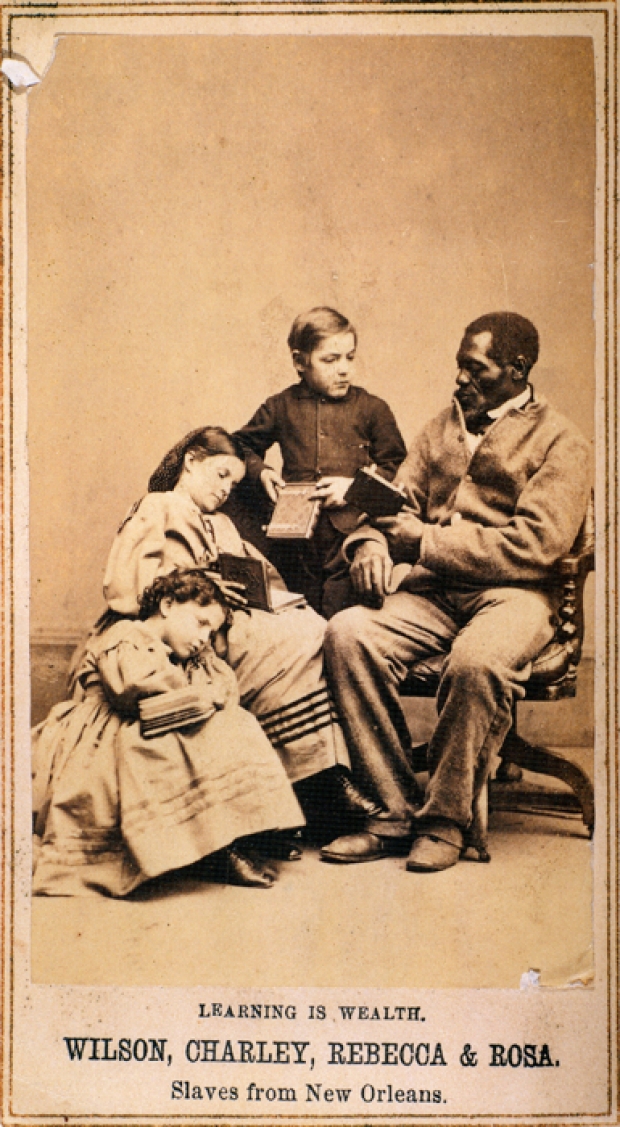
Charles Paxson, Learning is Wealth. Wilson, Charley, Rebecca, and Rosa. Slaves from New Orleans, 1864

Free and open to the public.

Chair:

Susanna Gold, Assistant Professor of Art History
Tyler School of Art, Temple University, Philadelphia, Pennsylvania; New York Public Library, Schomburg Center for Research in Black Culture

Panelists:

“The Drop Sinister: Harry Watrous’s Visualization of the ‘One Drop Rule’”
Mey-Yen Moriuchi, Assistant Professor of Art History
La Salle University, Philadelphia, Pennsylvania

“You Are What You Eat: Racial Transformation and Miscegenation in Nineteenth-Century Representations of Food”
Shana Klein
Department of Art History
University of New Mexico

“‘Half-Breed’: Picturing Native American Identity in the Early Nineteenth Century”
Elizabeth W. Hutchinson, Associate Professor of Art History
Barnard College, Columbia University

For more information, click here.

Tags: , , , , , , , ,

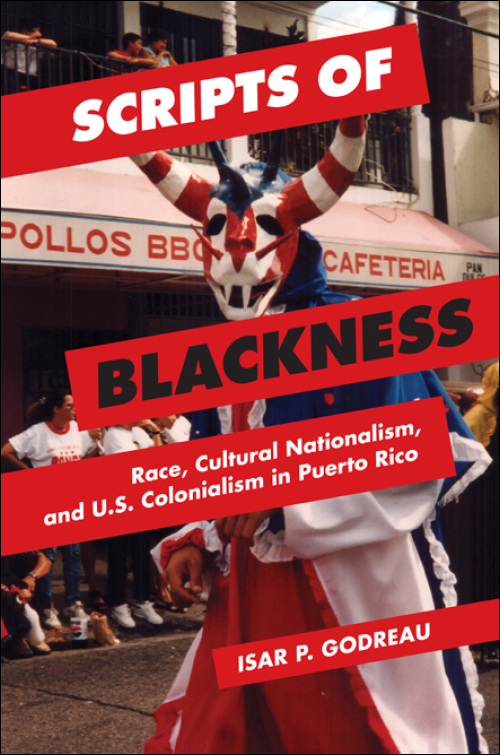
Scripts of Blackness: Race, Cultural Nationalism, and U.S. Colonialism in Puerto Rico

Posted in Anthropology, Books, Caribbean/Latin America, Economics, History, Media Archive, Monographs, Politics/Public Policy, United States on 2015-02-08 20:07Z by Steven

Scripts of Blackness: Race, Cultural Nationalism, and U.S. Colonialism in Puerto Rico

University of Illinois Press
February 2015
320 pages
6.125 x 9.25 in.
38 black & white photographs, 3 maps, 1 chart, 3 tables
Cloth ISBN: 978-0-252-03890-7
Paper ISBN: 978-0-252-08045-6

Isar P. Godreau, Researcher and Former Director
Institute for Interdisciplinary Research
University of Puerto Rico, Cayey

Ideas of blackness, whiteness, and racial mixture in a Puerto Rican barrio

The geopolitical influence of the United States informs the processes of racialization in Puerto Rico, including the construction of black places. In Scripts of Blackness, Isar P. Godreau explores how Puerto Rican national discourses about race—created to overcome U.S. colonial power—simultaneously privilege whiteness, typecast blackness, and silence charges of racism.

Based on an ethnographic study of the barrio of San Antón in the city of Ponce, Scripts of Blackness examines institutional and local representations of blackness as developing from a power-laden process that is inherently selective and political, not neutral or natural. Godreau traces the presumed benevolence or triviality of slavery in Puerto Rico, the favoring of a Spanish colonial whiteness (under a hispanophile discourse), and the insistence on a harmonious race mixture as discourses that thrive on a presumed contrast with the United States that also characterize Puerto Rico as morally superior. In so doing, she outlines the debates, social hierarchies, and colonial discourses that inform the racialization of San Antón and its residents as black.

Mining ethnographic materials and anthropological and historical research, Scripts of Blackness provides powerful insights into the critical political, economic, and historical context behind the strategic deployment of blackness, whiteness, and racial mixture.

Tags: , , , , ,

Racial Passing in the U.S. and Mexico in the Early Twentieth Century

Posted in Articles, Biography, Caribbean/Latin America, History, Media Archive, Mexico, Passing, United States on 2015-02-06 21:58Z by Steven

Racial Passing in the U.S. and Mexico in the Early Twentieth Century

RSF Review: Research from the Russell Sage Foundation
Russell Sage Foundation
New York, New York
2015-01-22

This feature is part of an ongoing RSF blog series, Work in Progress, which highlights some of the ongoing research of our current class of Visiting Scholars.

During his time in residence at the Russell Sage Foundation, Visiting Scholar Karl Jacoby (Columbia University) is completing a book that examines the changing race relations along the U.S.–Mexico border at the dawn of the twentieth century. Drawing on interviews, archival research, and the unique biographical details of one individual in particular, his book will analyze the distinct systems of racial classification found in the two countries despite their geographical proximity, and show how the border shapes race relations in both countries.

In a new interview with the Foundation, Jacoby discussed the growing field of “microhistory,” and detailed his current research on the elusive figure of Guillermo Eliseo (also known as William Ellis), an African American who was able to “pass” as an upper-class Mexican in the United States, and whose life’s story sheds critical insight on the racial regimes of both Mexico and the U.S. during the Gilded Age.

Q. Your current research fits into a practice that some have called “microhistory”. What is microhistory? How do we connect these highly detailed narratives to larger social issues of a given era?

There is, alas, no precise definition of “microhistory,” perhaps because it is a relatively new approach, with no professional association, no journal, no annual meeting. My preferred way of thinking about it is as a small story that helps us to rethink the large narratives that we tell about the past. Microhistorians tend to be drawn to quirky, peculiar events (Robert Darnton’s The Great Cat Massacre) or people (Natalie Zemon Davis’s The Return of Martin Guerre) that simultaneously demonstrate the cultural practices that prevailed in the past and the capacity of individuals to evade or reshape these practices. My account of William Ellis / Guillermo Eliseo, for example, sketches the increasingly confining limits that segregation imposed on African Americans after emancipation as well as the ways in which the color line could often prove unexpectedly porous.

Microhistory may focus on discretely bounded subjects, but its aspirations are expansive. The underlying concept is that by immersing oneself in places or peoples one can lend precision and particularity to what can otherwise seem like unduly broad or abstract generalizations, allowing for more accurate discussions of past social issues.

Q. You have focused on the curious case of Guillermo Eliseo, or William Ellis, an African American who was freed from slavery and went on to “pass” as a Mexican businessman in the US during the Gilded Age. What enabled his passing during this era? Was Ellis mostly an aberration, or was “passing” a widespread phenomenon?

Passing is a profoundly difficult topic to research because it was such a secret practice. As a result, unsurprisingly, estimates of the numbers of passers from Black to white at the turn of the last century are all over the map. Sociologists working in the early twentieth century, comparing the actual count of African Americans in the census with the expected count, computed that some 25,000 blacks were passing every year. Walter White of the NAACP, who often passed (temporarily) to investigate lynchings in the South, estimated in the 1940s that the total was closer to 12,000. Other commentators admitted that “[n]o one, of course, can estimate the number of men and women with Negro blood who have thus ‘gone over to white,’” although they hastened to add that “the number must be large.”…

Read the entire interview here.

Tags: , , , , , ,

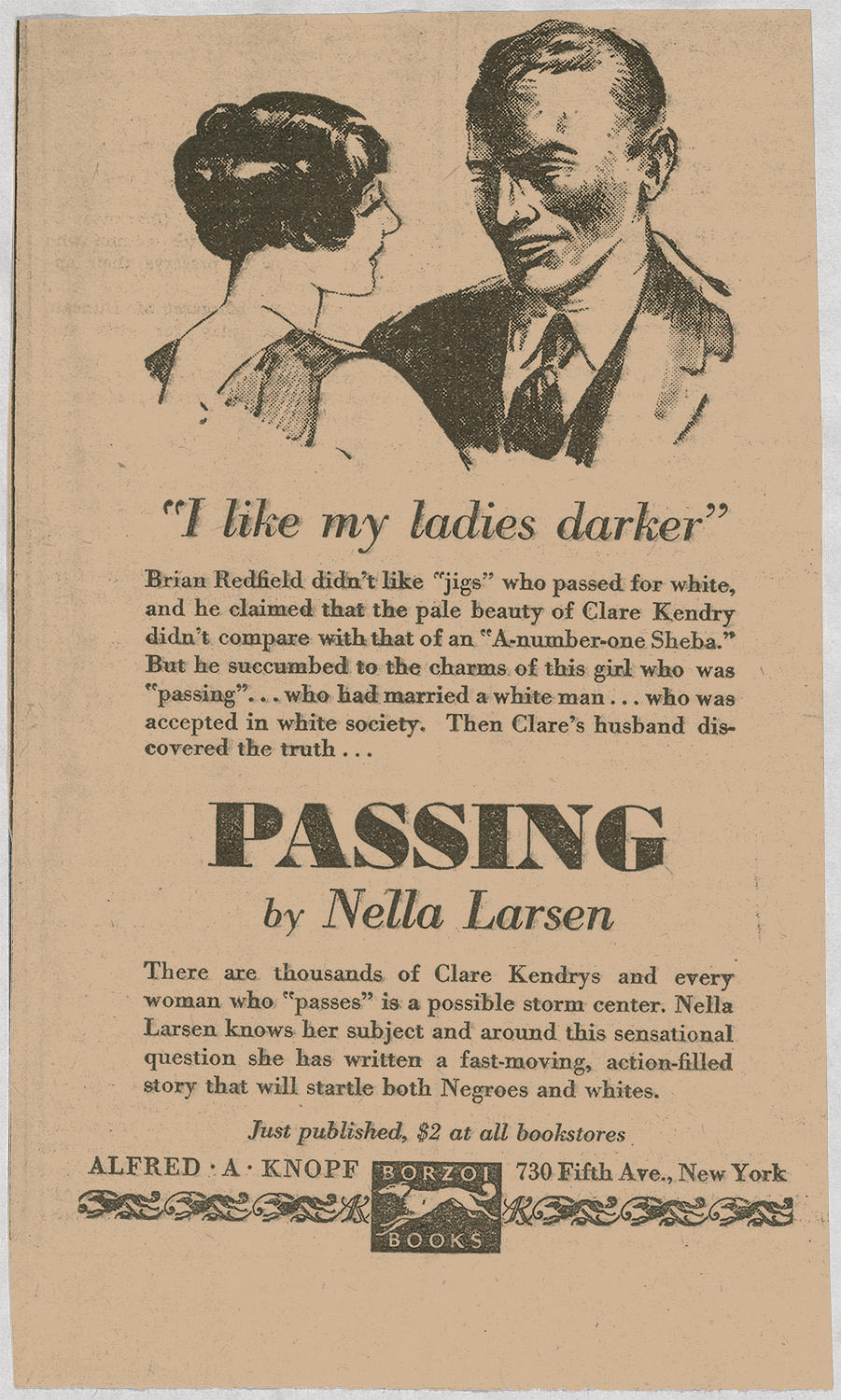
Passing the Line

Posted in Articles, Biography, Caribbean/Latin America, History, Media Archive, Mexico, Passing, Slavery, United States on 2015-02-06 20:45Z by Steven

Passing the Line

Karl Jacoby
2012-12-20

Karl Jacoby, Professor of History
Columbia University, New York, New York

Who was Guillermo Eliseo?

Such was the question that any number of people asked themselves during the Gilded Age as this enigmatic figure flitted in and out of an astonishing array of the era’s most noteworthy events—scandalous trials, unexpected disappearances, diplomatic controversies. To many, the answer was obvious. The tall, exquisitely dressed figure with the carefully coifed mustache, was an upper-class Mexican—in fact “the wealthiest resident of the City of Mexico” and “a prominent Mexican politician.”

For confirmation, one needed to look no farther than his elegant appearance and his frequent journeys south of the border. Indeed, based on his connections with Latin America, he was widely believed to be, if not a Mexican, than a “Spaniard” or “a Cuban gentleman of high degree.” At least a few observers, however, ventured a quite different answer: despite the widespread acceptance of Eliseo’s “Latin-American extraction,” he was not of Hispanic descent at all. Rather, he was just “an ordinary American mulatto” named William (or W.H.) Ellis, who had managed to play an elaborate game of racial passing

Read the entire article here.

Tags: , , , , ,