Mixed But Not Divided: Multi-ethnic populations redefine racial lines

Posted in Articles, Asian Diaspora, Census/Demographics, Media Archive, Politics/Public Policy, United States on 2011-10-22 17:05Z by Steven

Mixed But Not Divided: Multi-ethnic populations redefine racial lines

City on a Hill Press: A Student-Run Newspaper
University of California, Santa Cruz
2011-10-20

Chelsea Hawkins

When I was six or seven years old, I would spend my Saturday afternoons at the local Korean Baptist Church. A pink textbook opened in front of me, oversized hangul lightly sketched on sheets of paper. I kept my eyes turned downward behind a veil of straight brown hair as I avoided speaking. My face would become red and hot with embarrassment, as the guttural sounds got caught in my throat and I fumbled over words — the syllables swirled around in my mouth, only to be spit out awkwardly, a jumble of sounds always a little off.

Korean school was a short-lived experience — I hated going because even though I wasn’t sure what it was, I knew I was different. I looked different. I was shy and out of place. I hated my limited Korean and I hated feeling like an outsider. I spent more afternoons hiding in the secret places of a little garden than talking to my peers.

I am — like 4.2 million Americans — multiracial. My mother is Native American and white; my father, Korean and white. If my parents had followed the life paths their families had in mind, I would not be here. A product of teen parents, I stumbled through life and grew up with them. And when they came into the picture, my two younger brothers joined our little family.

Among American children, the multiracial population has increased almost 50 percent to 4.2 million people since 2000, according to The New York Times. The 2000 census report was the first time that Americans had the option to select more than one race — and reports flooded in, indicating the number of mixed race people in the United States…

…Mark-Griffin, who is a native of Michigan and former UCSC student, had an experience unique compared to a multiracial Californian: He was one of the only Asian-American students in his school.

While Mark-Griffin said he doesn’t want to portray Michigan or the Midwest as a racist area, he did emphasize that it wasn’t nearly as diverse as California. But as a result of the differences in culture between California and Michigan, Mark-Griffin has seen the way people’s perceptions can change with communities.

“In Michigan, most people identify me as Asian, but here in California, I’m a white guy,” Mark-Griffin said…

Read the entire article here.

Tags: , , , ,

The Preacher and the Politician: Jeremiah Wright, Barack Obama, and Race in America

Posted in Barack Obama, Books, Communications/Media Studies, History, Media Archive, Monographs, Politics/Public Policy, United States on 2011-10-21 21:43Z by Steven

The Preacher and the Politician: Jeremiah Wright, Barack Obama, and Race in America

University of Virginia Press
October 2009
160 pages
5 1/2x 81/4
Cloth ISBN: 0-8139-2886-9

Clarence E. Walker, Professor of History
University of California, Davis

Gregory D. Smithers, Visiting Associate Professor of History
Virginia Commonwealth University

Barack Obama’s inauguration as the first African American president of the United States has caused many commentators to conclude that America has entered a postracial age. The Preacher and the Politician argues otherwise, reminding us that, far from inevitable, Obama’s nomination was nearly derailed by his relationship with Jeremiah Wright, the outspoken former pastor of Trinity United Church of Christ on the South Side of Chicago. The media storm surrounding Wright’s sermons, the historians Clarence E. Walker and Gregory D. Smithers suggest, reveals that America’s fraught racial past is very much with us, only slightly less obvious.

With meticulous research and insightful analysis, Walker and Smithers take us back to the Democratic primary season of 2008, viewing the controversy surrounding Wright in the context of key religious, political, and racial dynamics in American history. In the process they expose how the persistence of institutional racism, and racial stereotypes, became a significant hurdle for Obama in his quest for the presidency.

The authors situate Wright’s preaching in African American religious traditions dating back to the eighteenth century, but they also place his sermons in a broader prophetic strain of Protestantism that transcends racial categories. This latter connection was consistently missed or ignored by pundits on the right and the left who sought to paint the story in simplistic, and racially defined, terms. Obama’s connection with Wright gave rise to criticism that, according to Walker and Smithers, sits squarely in the American political tradition, where certain words are meant to incite racial fear, in the case of Obama with charges that the candidate was unpatriotic, a Marxist, a Black Nationalist, or a Muslim.

Once Obama became the Democratic nominee, the day of his election still saw ballot measures rejecting affirmative action and undermining the civil rights of other groups. The Preacher and the Politician is a concise and timely study that reminds us of the need to continue to confront the legacy of racism even as we celebrate advances in racial equality and opportunity.

Table of  Contents

  • “They Didn’t Give Us Our Mule and Our Acre”: Introduction
  • “The “Chickens Are Coming Home to Roost”: Jeremiah Wright, Barack Obama, and the Black Church
  • “I Don’t Want People to Pretend I’m Not Black”: Barack Obama and America’s Racial History
  • “To Choose Our Better History?” Epilogue
  • Text of Barack Obama’s March 18, 2008, Speech on Race
  • Notes
  • Index
Tags: , , , , ,

Documentary Genocide: Families Surnames on Racial Hit List

Posted in Articles, History, Law, Media Archive, Native Americans/First Nation, Politics/Public Policy, United States, Virginia on 2011-10-21 01:39Z by Steven

Documentary Genocide: Families Surnames on Racial Hit List

Richmond Times-Dispatch
2000-03-05

Peter Hardin, Former Washington Correspondent
 
Long before the Indian woman gave birth to a baby boy, Virginia branded him with a race other than his own.
 
The young Monacan Indian mother delivered her son at Lynchburg General Hospital in 1971. Proud of her Indian heritage, the woman was dismayed when hospital officials designated him as black on his birth certificate. They threatened to bar his discharge unless she acquiesced. The original orders came from Richmond generations ago.
 
Virginia’s former longtime registrar of the Bureau of Vital Statistics, Dr. Walter Ashby Plecker, believed there were no real native-born Indians in Virginia and anybody claiming to be Indian had a mix of black blood.
 
In aggressively policing the color line, he classified “pseudo-Indians” as black and even issued in 1943 a hit list of surnames belonging to “mongrel” or mixed-blood families suspected of having Negro ancestry who must not be allowed to pass as Indian or white.
 
With hateful language, he denounced their tactics.
 
“ . . . Like rats when you are not watching, [they] have been ‘sneaking’ in their birth certificates through their own midwives, giving either Indian or white racial classification,” Plecker wrote.
 
Twenty-eight years later, the Monacan mother’s surname still was on Plecker’s list. She argued forcefully with hospital officials. She lost…

…“It’s not that we’re trying to dig him [Plecker] up and re-inter him again,” said Gene Adkins, assistant chief of the Eastern Chickahominy Tribe.
 
“We want people to know that he did damage the Indian population here in the state. And it’s taken us years, even up to now, to try to get out from under what he did. It’s a sad situation, really sad.”
 
Said Chief William P. Miles of the Pamunkey Tribe: “He came very close to committing statistical genocide on Native Americans in Virginia.”…

Read the entire article here.

Tags: , , , , ,

Race and Ethnicity in Society: The Changing Landscape, 3rd Edition

Posted in Anthologies, Asian Diaspora, Books, Health/Medicine/Genetics, Identity Development/Psychology, Judaism, Law, Literary/Artistic Criticism, Media Archive, Politics/Public Policy, Religion, Social Science, Social Work, United States on 2011-10-18 02:50Z by Steven

Race and Ethnicity in Society: The Changing Landscape, 3rd Edition

Cengage Learning
2012
480 pages
ISBN-10: 1111519536; ISBN-13: 9781111519537

Edited by

Elizabeth Higginbotham, Professor of Sociology, Women’s Studies, and Criminology
University of Delaware

Margaret L. Andersen, Edward F. and Elizabeth Goodman Rosenberg Professor of Sociology
University of Delaware

This engaging reader is organized in four major thematic parts, subdivided into thirteen different sections. Part I (“The Social Basis of Race and Ethnicity”) establishes the analytical frameworks that are now being used to think about race in society. The section examines the social construction of race and ethnicity as concepts and experience. Part II (“Continuity and Change: How We Got Here and What It Means”) explores both the historical patterns of inclusion and exclusion that have established racial and ethnic inequality, while also explaining some of the contemporary changes that are shaping contemporary racial and ethnic relations. Part III (“Race and Social Institutions”) examines the major institutional structures in contemporary society and investigates patterns of racial inequality within these institutions. Persistent inequality in the labor market and in patterns of community, residential, and educational segregation continue to shape the life chances of different groups. Part IV (“Building a Just Society”) concludes the book by looking at both large-scale contexts of change, such as those reflected in the movement to elect the first African American president.

  • Major themes include coverage showing the diversity of experiences that now constitute “race” in the United States; teaching students the significance of race as a socially constructed system of social relations; showing the connection between different racial identities and the social structure of race; understanding how racism works as a belief system rooted in societal institutions; providing a social structural analysis of racial inequality; providing a historical perspective on how the racial order has emerged and how it is maintained; examining how people have contested the dominant racial order; exploring current strategies for building a just multiracial society.
  • Each section includes several pages of analysis that outline the main concepts to be covered, providing a clear initial roadmap for reading and a convenient resource students can use with assignments and while preparing for exams.
  • The text’s unique organization according to overarching themes and relevant subtopics, including identity, social construction of race, why race matters, inequality, and segregation, places the articles into a broader context to promote greater understanding.
  • This innovative text looks beyond a simple black/white dichotomy and focuses more broadly on an extremely wide range of ethnic groups, providing a much more realistic and useful exploration of key topics that is more relevant and compelling for today’s diverse student population.

Table of Contents

  • PART I: THE SOCIAL BASIS OF RACE AND ETHINICITY
    • 1. The Social Construction of Race and Ethnicity
      • Introduction by Elizabeth Higginbotham and Margaret L. Andersen
      • 1. Howard F. Taylor, “Defining Race”
      • 2. Joseph L. Graves, Jr., “The Race Myth”
      • 3. Abby Ferber, “Planting the Seed: The Invention of Race”
      • 4. Karen Brodkin, “How Did Jews Become White Folks?”
      • 5. Michael Omi and Howard Winant, “On Racial Formation”—Student Exercises
    • 2. What Do You Think? Prejudice, Stereotyping, and Racism
      • Introduction by Elizabeth Higginbotham and Margaret L. Andersen
      • 6. Matthew Desmond and Mustafa Emirbayer, “American Racism in the Twenty-First Century”
      • 7. Charles A. Gallagher, “Color-Blind Privilege: The Social and Political Functions of Erasing the Color Line in Post Race America”
      • 8. Judith Ortiz Cofer, “The Myth of the Latin Woman: I Just Met a Girl Named Maria”
      • 9. Rainier Spencer, “Mixed Race Chic”
      • 10. Rebekah Nathan, “What a Professor Learned by Becoming a Student”—Student Exercises
    • 3. Representing Race and Ethnicity: The Media and Popular Culture
      • Introduction by Elizabeth Higginbotham and Margaret L. Andersen
      • 11. Craig Watkins, “Black Youth and the Ironies of Capitalism”
      • 12. Fatimah N. Muhammed, “How to NOT Be 21st Century Venus Hottentots”
      • 13. Rosie Molinary, “María de la Barbie”
      • 14. Charles Springwood and C. Richard King, “‘Playing Indian’: Why Native American Mascots Must End”
      • 15. Jennifer C. Mueller, Danielle Dirks, and Leslie Houts Picca, “Unmasking Racism: Halloween Costuming and Engagement of the Racial Order”—Student Exercises
    • 4. Who Are You? Race and Identity
      • Introduction by Elizabeth Higginbotham and Margaret L. Andersen
      • 16. Beverly Tatum, interview with John O’Neil, “Why are the Black Kids Sitting Together?”
      • 17. Priscilla Chan, “Drawing the Boundaries”
      • 18. Michael Omi and Taeku Lee, “Barack Like Me: Our First Asian American President”
      • 19. Tim Wise, “White Like Me: Reflections on Race from a Privileged Son”—Student Exercises
  • PART II: CONTINUITY AND CHANGE: HOW WE GOT HERE AND WHAT IT MEANS
    • 5. Who Belongs? Race, Rights, and Citizenship
      • Introduction by Elizabeth Higginbotham and Margaret L. Andersen
      • 20. Evelyn Nakano Glenn, “Citizenship and Inequality”
      • 21. C. Matthew Snipp, “The First Americans: American Indians”
      • 22. Susan M. Akram and Kevin R. Johnson, “Race, Civil Rights, and Immigration Law After September 11, 2001: The Targeting of Arabs and Muslims”
      • 23. Peggy Levitt, “Salsa and Ketchup: Transnational Migrants Saddle Two Worlds”—Student Exercises
    • 6. The Changing Face of America: Immigration
      • Introduction by Elizabeth Higginbotham and Margaret L. Andersen
      • 24. Mae M. Ngai, “Impossible Subjects: Illegal Aliens and the Making of Modern America”
      • 25. Nancy Foner, “From Ellis Island to JFK: Education in New York’s Two Great Waves of Immigration”
      • 26. Charles Hirschman and Douglas S. Massey, “Places and Peoples: The New American Mosaic”
      • 27. Pew Research Center, “Between Two Worlds: How Young Latinos Come of Age in America”—Student Exercises
    • 7. Exploring Intersections: Race, Class, Gender and Inequality
      • Introduction by Elizabeth Higginbotham and Margaret L. Andersen
      • 28. Patricia Hill Collins, “Toward a New Vision: Race, Class and Gender as Categories of Analysis and Connection”
      • 29. Yen Le Espiritu, “Theorizing Race, Gender, and Class”
      • 30. Roberta Coles and Charles Green, “The Myth of the Missing Black Father”
      • 31. Nikki Jones, “From Good to Ghetto”
      • 32. Gladys García-Lopez and Denise A. Segura, “‘They Are Testing You All the Time’: Negotiating Dual Femininities among Chicana Attorneys”—Student Exercises
  • PART III: RACE AND SOCIAL INSTITUTIONS
    • 8. Race and the Workplace
      • Introduction by Elizabeth Higginbotham and Margaret L. Andersen
      • 33. William Julius Wilson, “Toward a Framework for Understanding Forces that Contribute to or Reinforce Racial Inequality”
      • 34. Deirdre A. Royster, “Race and The Invisible Hand: How White Networks Exclude Black Men from Blue-Collar Jobs”
      • 35. Pierrette Hondagneu-Sotelo, “Families on the Frontier”.
      • 36. Angela Stuesse, “Race, Migration and Labor Control”—Student Exercises
    • 9. Shaping Lives and Love: Race, Families, and Communities
      • Introduction by Elizabeth Higginbotham and Margaret L. Andersen
      • 37. Joe R. Feagin and Karyn D. McKinney, ”The Family and Community Costs of Racism”
      • 38. Dorothy Roberts, “Shattered Bonds: The Color of Child Welfare”
      • 39. Kumiko Nemoto, “Interracial Relationships: Discourses and Images”
      • 40. Zhenchao Qian, “Breaking the Last Taboo: Interracial Marriage in America”—Student Exercises
    • 10. How We Live and Learn: Segregation, Housing, and Education
      • Introduction by Elizabeth Higginbotham and Margaret L. Andersen
      • 41. John E. Farley and Gregory D. Squires, “Fences and Neighbors: Segregation in the 21st Century”
      • 42. Melvin L. Oliver and Thomas M. Shapiro, “Sub-Prime as a Black Catastrophe”
      • 43. Gary Orfield and Chungmei Lee, “Historic Reversals, Accelerating Resegregation and the Need for New Integration Strategies”
      • 44. Heather Beth Johnson and Thomas M. Shapiro, “Good Neighborhoods, Good Schools: Race and the ‘Good Choices’ of White Families”—Student Exercises
    • 11. Do We Care? Race, Health Care and the Environment
      • Introduction by Elizabeth Higginbotham and Margaret L. Andersen
      • 45. H. Jack Geiger, “Health Disparities: What Do We Know? What Do We Need to Know? What Should We Do?”
      • 46. Shirley A. Hill, “Cultural Images and the Health of African American Women”
      • 47. David Naguib Pellow and Robert J. Brulle, “Poisoning the Planet: The Struggle for Environmental Justice”
      • 48. Robert D. Bullard and Beverly Wright, “Race, Place and the Environment”—Student Exercises
    • 12. Criminal Injustice? Courts, Crime, and the Law
      • Introduction by Elizabeth Higginbotham and Margaret L. Andersen
      • 49. Bruce Western, “Punishment and Inequality”
      • 50. Rubén Rumbaut, Roberto Gonzales, Goinaz Kamaie, and Charlie V. Moran, “Debunking the Myth of Immigrant Criminality: Imprisonment among First and Second Generation Young Men”
      • 51. Christina Swarns, “The Uneven Scales of Capital Justice”
      • 52. Devah Pager, “The Mark of a Criminal Record”—Student Exercises
  • PART IV: BUILDING A JUST SOCIETY
    • 13. Moving Forward: Analysis and Social Action
      • Introduction by Elizabeth Higginbotham and Margaret L. Andersen
      • 53. Thomas F. Pettigrew, “Post-Racism? Putting Obama’s Victory in Perspective”
      • 54. Frank Dobbins, Alexandra Kalev, and Erin Kelly, “Diversity Management in Corporate America”
      • 55. Southern Poverty Law Center, “Ways to Fight Hate”—Student Exercises
Tags: , , , , , , , , , , , , , , , , , , , , , , , , , , , , , , , , , , , , , , , , , , , , , , , , , , , , , , , , , , , , , , , , , , , , , , , , , , , , , , , , , , , , , , , , , , , , , , , , , , , , , , , , , , , , , , , ,

Bill John Baker named official winner in Cherokee chief election

Posted in Articles, Native Americans/First Nation, New Media, Politics/Public Policy, United States on 2011-10-13 17:50Z by Steven

Bill John Baker named official winner in Cherokee chief election

Tusla World
2011-10-13

Lenzy Krehbiel-Burton, World Correspondent

TAHLEQUAHBill John Baker is now officially principal chief-elect of the Cherokee Nation.

About 1:45 p.m. Wednesday, the Cherokee Nation Election Commission certified the results from the tribe’s special election. The certified results show Baker defeating former chief Chad Smith, 10,703 votes to 9,128.

“I’d just like to thank every person involved in this election,” said commission chairwoman Susan Plumb. “First and foremost, a big thank you to the voters, who came out in record numbers. We received ballots from all 50 states and four foreign countries.”

Almost 20,000 Cherokee citizens voted in the special election, an increase of 5,000 people from the June 25 general election…

…Among the Baker supporters were several freedmen who came in part because of a tribal Supreme Court order issued Tuesday afternoon.

The order, filed at noon, declined to recognize an agreement brokered in federal district court that reinstated the tribal citizenship of 2,800 freedmen descendants.

“This is a time-out for all the racism that’s going on in all the tribes,” said Yvette Hill. “The large amount he (Baker) won by shows that the Cherokee Nation is not for that. The people have spoken, and the tribe needs to be an example.”

About 1,200 freedmen were registered to vote. It is unknown how many cast ballots in the special election.

The tribe’s attorney general, Diane Hammons, issued a statement Tuesday that the tribe does not have the option of ignoring a federal order. As of Wednesday, it is still unclear, what – if any – impact the justices’ order will have on the election.

On Aug. 22, the tribe’s Supreme Court had upheld a 2007 tribal referendum that disenrolled the freedmen descendants and required at least one Cherokee ancestor on the final Dawes Rolls in order to apply for citizenship…

Read the entire article here.

Tags: , ,

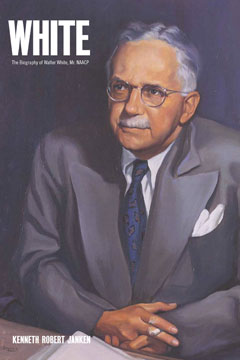
White: The Biography of Walter White, Mr. NAACP

Posted in Biography, Books, Law, Media Archive, Monographs, Passing, Politics/Public Policy, United States on 2011-10-12 22:14Z by Steven

White: The Biography of Walter White, Mr. NAACP

The New Press
Fall 2002
496 pages
Trim: 6 1/8 x 9 1/4
Hardcover ISBN: 978-1-56584-773-6

Kenneth R. Janken, Professor, African and Afro-American Studies
University of North Carolina, Chapel Hill

A publishing landmark, the first biography of the man who brought the NAACP to national prominence

From his earliest years, Walter White was determined to transcend the rigid boundaries of segregation-era America. An African American of exceptionally light complexion, White went undercover as a young man to expose the depredations of Southern lynch mobs. As executive secretary of the NAACP from 1931 until his death in 1955, White was among the nation’s preeminent champions of civil rights, leading influential national campaigns against lynching, segregation in the military, and racism in Hollywood movies.

White is portrayed here for the first time in his full complexity, a man whose physical appearance enabled him to negotiate two very different worlds in segregated America, yet who saw himself above all as an organization man, “Mr. NAACP.” Deeply researched and richly documented, White’s biography provides a revealing vantage point from which to view the leading political and cultural figures of his time—including W.E.B. DuBois, Eleanor Roosevelt, and James Weldon Johnson—and an unrivaled glimpse into the contentious world of civil rights politics and activism in the pre–civil rights era.

Tags: , , , , ,

PLAIN PEOPLE: Is There Anywhere?…

Posted in Articles, Media Archive, Politics/Public Policy, Social Work, United Kingdom, United States on 2011-10-11 22:14Z by Steven

PLAIN PEOPLE: Is There Anywhere?…

Time Magazine
1946-03-11

Prewar Britain’s Negro problem was as minuscule as prewar Britain’s Negro population. But the 70,000 U.S. Negro troops who served in Britain during the war left behind hundreds of illegitimate mulatto babies. Last fortnight London’s League of Colored Peoples reported that already 544 children of U.S. Negro soldiers and British women were in social or economic straits.

So long as the Negro fathers were in the U.S. Army and acknowledged paternity, the mothers received support allowances. In the British provinces $85 a month was comparative riches. But when Negro soldiers were demobilized in the U.S., allowances ceased; some Negro fathers neglected to make any other provision. Then the social pressure of British provincial respectability became unbearable. Said one British mother of a Negro’s child: “I am shunned by the whole village. . . . The inspector for the National Society for the Prevention of Cruelty to Children has told my friend to keep her children away from my house… as didn’t she know that I had two illegitimate colored children? Is there anywhere I can go where my children will not get… pushed around?”…

Read the entire article here.

Tags:

The right colour

Posted in Articles, Brazil, Caribbean/Latin America, Media Archive, Politics/Public Policy, Social Science on 2011-10-08 03:31Z by Steven

The right colour

Index on Censorship
Volume 28, Issue 1, 1999
Special Issue: The Last Empire
pages 110-114
DOI: 10.1080/03064229908536514

Daniela Cestarollo

Five hundred years after the arrival of the Portuguese, Brazilians are only Just beginning to address the legacy of slavery

Brazil is at last revealing its other face. After 500 years of seeking to shape itself in the image of a white, western Catholic country, Brazil is having to come to terms with its immense ethnic diversity and the social and economic implications this brings with it. An extensive report published in 1996 by the daily Folha de São Paulo revealed to the nation that almost half its 160 million people are black. This amounts to the realisation that Brazil had the largest black population in the world after Nigeria. The report also presented figures on racial prejudice, illiteracy, unemployment and income distribution among blacks from all over Brazil. The figures shocked a nation that has always believed itself to be the racial democracy of the southern hemisphere.

The myth of racial democracy has since the 1930s marketed Brazil as the sunny country where people of all races mix happily together on the beach, on the football pitch and in the Carnival parade. However, the myth has in reality served as a buttress for one of the most perverse and sophisticated forms of modern racism. By contrast to the apartheid system of South Africa, Brazil reveals a number of examples of disguised discrimination, such as in job advertising or television programming. Job adverts, which often ask for a ‘good appearance, in reality mean that blacks are not expected to apply. Television dramas, meanwhile, typically portray blacks within extremely limited, stereotyped roles, such as domestic servants or thieves. Not surprisingly, a recent poll on racial origins showed that only 5 per cent of Brazilians identified themselves as black. Most preferred to be called brown, bronze or coffee-coloured.

Discrimination based on skin colour was made a criminal offence in 1951, but the law was completely ignored and almost no-one was aware of its existence. During the military dictatorship (1964-1985), any…

Read or purchase the article here.

Tags: ,

Mixed Britannia, BBC Two, review

Posted in Articles, Literary/Artistic Criticism, Media Archive, Politics/Public Policy, Social Science, United Kingdom on 2011-10-06 21:58Z by Steven

Mixed Britannia, BBC Two, review

The Telegraph
2011-10-06

Josephine Moulds

Josephine Moulds reviews the first episode of BBC Two’s documentary Mixed Britannia, presented by George Alagiah.

The first part of an ambitious documentary series, Mixed Britannia, ran last night, continuing BBC Two’s season about mixed-race life in the UK.

Over the course of three programmes, it aims to show the experiences of mixed-race people living in Britain from 1910 to the present day. The problem was it tiptoed so lightly around the subject of race, the first episode at least fell rather flat.

Last night covered 1910-1939, so presenter George Alagiah could shudder at how racist our country once was rather than tackle the thornier issue of the current climate. (That is saved for the last instalment.)…

Read the entire article here.

Tags: , , , , , ,

Obama and the Politics of blackness: Antiracism in the “post-black” Conjuncture

Posted in Articles, Barack Obama, Media Archive, Politics/Public Policy, Social Science, United States on 2011-10-04 04:48Z by Steven

Obama and the Politics of blackness: Antiracism in the “post-black” Conjuncture

Souls: A Critical Journal of Black Politics Culture and Society
Volume 12, Issue 4 (2010)
pages 313-322
DOI: 10.1080/10999949.2010.526046

Ben Pitcher, Lecturer in Sociology
University of Westminster, London

This article sets out think about some of the challenges to U.S. antiracism heralded by Barack Obama’s presidency. It begins by examining the relationship Obama negotiates with notions of blackness in his autobiographical writings, and it considers how this exemplifies what has been described as a “post-black” politics. It proceeds to discuss the insufficiency of critiques of “post-black” as having sold out a black political tradition, but it notes that these critiques reveal something of the changing significance of blackness as a form of antiracist practice. Considering how Obama represents a move in black politics from the margins to the mainstream, I argue that the President’s symbolic centrality undermines a conception of critical oppositionality hitherto implicit to the antiracist imaginary. Exploring how this challenges longstanding ideas about who “owns” or controls the antiracist struggle, I suggest that antiracism will need to move beyond accusations of betrayal if it is to account for and understand the profound ways in which Obama has transformed the entire field of U.S. race discourse.

To think about what Barack Obama’s presidency means for U.S. racial politics invariably involves considering his relationship to a politics of blackness. For some, Obama’s mixed-race transnational heritage means that he is grounded in ‘‘the multicultural and global reality of today’s world.’’ For others, Obama’s claim on blackness is delimited by his not having been born to the descendents of slaves. The complex and subtle criteria of identity claims made of Obama reveal something of the complexity of race in twenty-first-century America and exemplify Gary Younge’s observation that however marginal race might be to Obama’s message, it is nevertheless central to his meaning.

While of course Obama’s autobiographical writings cannot exhaust or provide a definitive answer to this meaning, it is notable that they reveal a distantiated relationship to the politics of blackness. The first paragraph to the 2004 preface of Dreams from My Father describes its author’s intention to communicate ‘‘the fluid state of identity’’ that characterizes the politics of race in contemporary America. Obama’s passage into a performative black male adolescence is archly self-conscious, the result of a ‘‘decision’’ rather than a question of necessity. Though he rightly acknowledges the inescapably determining power of race, Obama retains an ironic distance that resists an understanding of this determination as absolute. Even the final section of Dreams, which stages a trip to Kenya as a key biographical moment in Obama’s self-understanding, is undercut by an epilogue on cultural hybridity that refuses as a romantic illusion the search for an African authenticity…

…So what does Obama’s skillful negotiation of the politics of blackness mean for antiracism? Does Obama’s status as ‘‘a black man who doesn’t conform to the normal scripts for African-American identity’’ jeopardize his progressive potential, or is it a precondition of his success? Does Obama’s victory signal ‘‘the end of black politics,’’ or its radical reinvention?…

…For one thing, the immediate symbolic potency of the black president simply invalidates claims predicated on the explicit and straightforward marginalization of black people in America. Obama stands for the move of blackness from the margins to the mainstream. Obama was by no means the first black person to obtain access to a position of power, but his presidency represents a qualitatively new dimension; most important, it records a moment in U.S. racial politics when a critical mass of whites were prepared to cast their vote for a black person…

Read the entire article here.

Tags: , ,