Hybrid: Bisexuals, Multiracials, and Other Misfits Under American Law

Posted in Books, Gay & Lesbian, Law, Media Archive, Monographs, Social Science, United States on 2009-11-04 02:51Z by Steven

Hybrid: Bisexuals, Multiracials, and Other Misfits Under American Law

New York University Press
1996-05-01
176 pages
16 illustrations
ISBN: 9780814715383

Ruth Colker, Distinguished University Professor and Heck Faust Memorial Chair in Constitutional Law
Michael E. Moritz College of Law, Ohio State University

The United States, and the West in general, has always organized society along bipolar lines. We are either gay or straight, male or female, white or not, disabled or not.

In recent years, however, America seems increasingly aware of those who defy such easy categorization. Yet, rather than being welcomed for the challenges that they offer, people living the gap are often ostracized by all the communities to which they might belong. Bisexuals, for instance, are often blamed for spreading AIDS to the heterosexual community and are regarded with suspicion by gays and lesbians. Interracial couples are rendered invisible through monoracial recordkeeping that confronts them at school, at work, and on official documents. In Hybrid, Ruth Colker argues that our bipolar classification system obscures a genuine understanding of the very nature of subordination. Acknowledging that categorization is crucial and unavoidable in a world of practical problems and day-to-day conflicts, Ruth Colker shows how categories can and must be improved for the good of all.

Tags: ,

“Of Portuguese Origin”: Litigating Identity and Citizenship among the “Little Races” in Nineteenth-Century America

Posted in Articles, History, Law, Media Archive, Tri-Racial Isolates, United States on 2009-11-01 23:48Z by Steven

“Of Portuguese Origin”: Litigating Identity and Citizenship among the “Little Races” in Nineteenth-Century America

Law and History Review
2007
Volume 25, Number 3

Ariela J. Gross, John B. and Alice R. Sharp Professor of Law and History
University of Southern California

The history of race in the nineteenth-century United States is often told as a story of black and white in the South, and white and Indian in the West, with little attention to the intersection between black and Indian. This article explores the history of nineteenth-century America’s “little races”—racially ambiguous communities of African, Indian, and European origin up and down the eastern seaboard. These communities came under increasing pressure in the years leading up to the Civil War and in its aftermath to fall on one side or the other of a black-white color line. Drawing on trial records of cases litigating the racial identity of the Melungeons of Tennessee, the Croatans/Lumbee of North Carolina, and the Narragansett of Rhode Island, this article looks at the differing paths these three groups took in the face of Jim Crow: the Melungeons claiming whiteness; the Croatans/Lumbee asserting Indian identity and rejecting association with blacks; the Narragansett asserting Indian identity without rejecting their African origins. Members of these communities found that they could achieve full citizenship in the U.S. polity only to the extent that they abandoned their self-governance and distanced themselves from people of African descent.

Historians have only begun to tell the histories of “red and black” peoples in the United States, and much of their attention has focused on the “Black Indians” of the Five Civilized Tribes of the Southeastern United States. Yet up and down the eastern seaboard, there were clusters of people who shared African, European, and Indian ancestry, many of whom lived as distinct and separate communities into the nineteenth and even the mid-twentieth centuries, some retaining or struggling to retain Indian identities, others becoming known as “free people of color,” and still others claiming whiteness.

These “little races,” as they were sometimes known, in many ways gave the lie to the binary statutory regimes of nineteenth-century America. They came under growing pressure from local officials and neighbors as communities became increasingly preoccupied with racial line drawing. But they followed very different paths. By studying these racially ambiguous communities, it is possible to learn more about the relationship among whiteness, blackness, and citizenship in the United States…

Read the entire article here.

Tags: , , , , , , , ,

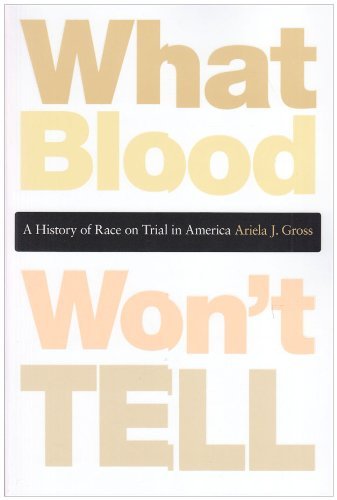
What Blood Won’t Tell: A History of Race on Trial in America

Posted in Books, History, Law, Louisiana, Media Archive, Monographs, Native Americans/First Nation, Slavery, Social Science, Tri-Racial Isolates, United States, Women on 2009-11-01 18:58Z by Steven

What Blood Won’t Tell: A History of Race on Trial in America

Harvard University Press
October 2008
384 Pages
Hardcover ISBN 13: 978-0-674-03130-2; ISBN 10: 0-674-03130-X
Paperback ISBN 13: 978-0-674-04798-3; ISBN 10: 0-674-04798-2

Ariela J. Gross, John B. and Alice R. Sharp Professor of Law and History
University of Southern California

  • Co-Winner 2009 James Willard Hurst Prize, Law and Society Association
  • Co-Winner 2009 Lillian Smith Book Awards, the Southern Regional Council and the University of Georgia
  • Winner of the 2009 American Political Science Association Award for the Best Book on Race, Ethnicity and Politics

Is race something we know when we see it? In 1857, Alexina Morrison, a slave in Louisiana, ran away from her master and surrendered herself to the parish jail for protection. Blue-eyed and blond, Morrison successfully convinced white society that she was one of them. When she sued for her freedom, witnesses assured the jury that she was white, and that they would have known if she had a drop of African blood. Morrison’s court trial—and many others over the last 150 years—involved high stakes: freedom, property, and civil rights. And they all turned on the question of racial identity.

Over the past two centuries, individuals and groups (among them Mexican Americans, Indians, Asian immigrants, and Melungeons) have fought to establish their whiteness in order to lay claim to full citizenship in local courtrooms, administrative and legislative hearings, and the U.S. Supreme Court. Like Morrison’s case, these trials have often turned less on legal definitions of race as percentages of blood or ancestry than on the way people presented themselves to society and demonstrated their moral and civic character.

Unearthing the legal history of racial identity, Ariela Gross’s book examines the paradoxical and often circular relationship of race and the perceived capacity for citizenship in American society. This book reminds us that the imaginary connection between racial identity and fitness for citizenship remains potent today and continues to impede racial justice and equality.

Tags: , , , ,

Interracial Intimacies: Sex, Marriage, Identity, and Adoption

Posted in Books, Family/Parenting, History, Identity Development/Psychology, Law, Media Archive, Monographs, Passing, Slavery, Social Science, United States on 2009-10-31 15:16Z by Steven

Interracial Intimacies: Sex, Marriage, Identity, and Adoption

Vintage an imprint of Random House, Inc. Academic Resources
2003
688 pages
Paperback ISBN: 978-0-375-70264-8 (0-375-70264-4)

Randall Kennedy, Michael R. Klein Professor of Law
Harvard Law School

From the author of Nigger: The Strange Career of a Troublesome Word and Race, Crime, and the Law—a tour de force about the controversial issue of personal interracial intimacy as it exists within ever-changing American social mores and within the rule of law.

Fears of transgressive interracial relationships, informed over the centuries by ugly racial biases and fantasies, still linger in American society today. This brilliant study—ranging from plantation days to the present—explores the historical, sociological, legal, and moral issues that continue to feed and complicate that fear.

In chapters filled with provocative and cleanly stated logic and enhanced by intriguing historical anecdotes, Randall Kennedy tackles such subjects as the presence of sex in racial politics and of race in sexual politics, the prominence of legal institutions in defining racial distinction and policing racial boundaries, the imagined and real pleasures that have attended interracial intimacy, and the competing arguments around interracial romance, sex, and family life throughout American history.

Table of Contents

  • Introduction
  • One – In the Age of Slavery
  • Two – From Reconstruction to Guess Who’s Coming to Dinner?
  • Three – From Black-Power Backlash to the New Amalgamationism
  • Four – Race, Racism, and Sexual Coercion
  • Five – The Enforcement of Antimiscegenation Laws
  • Six – Fighting Antimiscegenation Laws
  • Seven – Racial Passing
  • Eight – Passing the the Schuyler Family
  • Nine – Racial Conflict and the Parenting of Children: A Survey of Competing Approaches
  • Ten – The Tragedy of Race Marching in Black and White
  • Eleven – White Parents and the Black Children in Adoptive Families
  • Twelve – Race, Children, and Custody Battles: The Special Status of Native Americans
  • Afterword
  • Notes
  • Bibliography
  • Acknowledgments
  • Index

Read an excerpt of the book here.

Tags: , , , , ,

Interracialism: Black-White Intermarriage in American History, Literature, and Law

Posted in Anthologies, Books, History, Law, Media Archive, Social Science, United States on 2009-10-29 01:42Z by Steven

Interracialism: Black-White Intermarriage in American History, Literature, and Law

Oxford University Press
September 2000
560 pages
Paperback ISBN13: 9780195128574
Paperback ISBN10: 0195128575
Hardback ISBN13: 9780195128567
Hardback ISBN10: 0195128567

Edited by:

Werner Sollors, Henry B. and Anne M. Cabot Professor of English and African-American Studies
Harvard University

Interracialism, or marriage between members of different races, has formed, torn apart, defined and divided our nation since its earliest history. This collection explores the primary texts of interracialism as a means of addressing core issues in our racial identity. Ranging from Hannah Arendt to George Schuyler and from Pace v. Alabama to Loving v. Virginia, it provides extraordinary resources for faculty and students in English, American and Ethnic Studies as well as for general readers interested in race relations. By bringing together a selection of historically significant documents and of the best essays and scholarship on the subject of “miscegenation,” interracialism demonstrates that notions of race can be fruitfully approached from the vantage point of the denial of interracialism that typically informs racial ideologies.

Tags: , , , , , ,

Mixed Race America and the Law: A Reader

Posted in Anthologies, Books, Census/Demographics, History, Law, Media Archive, Passing, Politics/Public Policy, United States on 2009-10-23 23:45Z by Steven

Mixed Race America and the Law: A Reader

New York Univeristy Press
2003-02-01
512 pages
ISBN: 9780814742570

Edited by:

Kevin R. Johnson, Mabie-Apallas Professor of Public Interest Law and Chicano/a Studies
University of California Davis

For the first time in United States history, the Year 2000 census allowed people to check more than one box to identify their race. This new way of gathering data and characterizing race and ethnicity reflects important changes in how racial identity is understood in America. Besides acknowledging the presence of mixed race citizens, this new understanding promises to have major implications for American law and policy.

With this anthology, Kevin R. Johnson brings together ground-breaking scholarship on the mixed race experience in America to examine the impact of law on these citizens. The foundational essays that comprise the collection present the historical, social, and political contexts surrounding the body of law that addresses race while analyzing the implications of multiracialism. Divided into 12 sections, the reader includes an introduction by Johnson and essential essays by contributors such as Garrett Epps, Judith Resnick, Richard Delgado, Ian Haney López, Randall Kennedy, and Patricia Hill Collins. Selections address miscegenation, racial classification, interracial adoption, the 2000 census, “passing,” and other topics; each section includes questions to promote further discussion. This book is an invaluable resource for examining the complexities of racial categories in modern America.

Read the entire introduction here.

Tags: , , , , , , ,

Crimes of ‘Blood’: A comparative analysis of South Africa’s Immorality Act (1927 & 1950) and Prohibition of Mixed Marriages Act (1949), and Miscegenation Laws in North America

Posted in Africa, Canada, Caribbean/Latin America, Law, Media Archive, South Africa, United States on 2009-10-19 20:58Z by Steven

Crimes of ‘Blood’: A comparative analysis of South Africa’s Immorality Act (1927 & 1950) and Prohibition of Mixed Marriages Act (1949), and Miscegenation Laws in North America

W.E.B. DuBois Insitute for African and African American Research at Harvard University
Date: Spring 2010

Zimitri Erasmus, Senior Lecturer in Sociology
University of Cape Town

This study compares the effects of Miscegenation Laws in 20th century North America with those of apartheid South Africa’s Immorality (1927 & 1950) and Prohibition of Mixed Marriages (1949) Acts. It draws on three sets of primary data: a) law reports of cases tried and sent for appeal – under various versions of the Immorality Act – before 1948 under the government of the Union of South Africa and after 1948, under the Apartheid government; b) House of Assembly and Senate Debates of the South African Parliament, under both the Union and Apartheid governments; and c) related Government Commission Reports. It also draws on already existing analyses of similar data from the North American experience to produce a comparative analysis of relevant laws in South Africa and North America.

The project examines the logic, procedures and socio-political effects of these key laws of Grand Apartheid. I ask four broad questions:

  • What can we learn from the North American body of knowledge on the administration of ‘interracial’ sex and marriage that might be of relevance to such administration in colonial and apartheid South Africa?
  • What is different about the South African case?
  • How does this difference contribute to knowledge in this field?
  • What does this comparative analysis offer in support of a critical literacy for the use of ‘race’?
Tags: , , , , ,

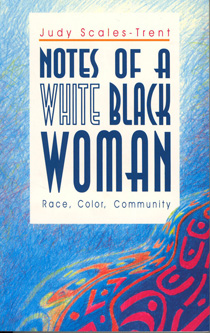
Notes of a White Black Woman: Race, Color, Community

Posted in Autobiography, Books, Law, Media Archive, Monographs, Social Science, United States, Women on 2009-10-17 20:36Z by Steven

Notes of a White Black Woman: Race, Color, Community

Penn State Press
1995
206 pages
6 x 9
cloth: ISBN 978-0-271-01430-2
paper: ISBN 978-0-271-02124-9

Judy Scales-Trent, Floyd H. & Hilda L. Hurst Faculty Scholar, Professor Emerita
State Univerisity of New York at Buffalo Law School

“I remember one time in particular, after the cab I was in crashed into the car in front, then backed into the one behind. A policeman stopped to help.  As he was taking down my name and address, I noticed that he had checked the ‘white’ box.  ‘Officer,’ I said politely, ‘you made an error on your form. I am not white. I am black.’ He gave me a long, bored look, decided not to discuss it, and said, ‘Sure, lady.  If you say so.’ If I say so? If I say so!  As if it were my idea!  I was enraged at his assumption that all of this—the categories, the racial purity laws, the lives that are stomped, mangled, ruined because of those categories and those laws ïwas based on my say-so.  If I said so, we would do away with all of it ïthe sickness and fear, the need to classify as a way to control, the need to make some appear smaller so that others can appear larger. ‘If I say so’ indeed.”

While the “one-drop rule” in the United States dictates that people with any African ancestry are black, many black Americans have white skin.  Notes of a White Black Woman is one woman’s attempt to describe what it is like to be a “white” black woman and to live simultaneously inside and outside of both white and black communities.

Law professor Judy Scales-Trent begins by describing how our racial purity laws have operated over the past four hundred years.  Then, in a series of autobiographical essays, she addresses how race and color interact in relationships between men and women, within families, and in the larger community.  Scales-Trent ultimately explores the question of what we really mean by “race” in this country, once it is clear that race is not a tangible reality as reflected through color.

Scales-Trent uses autobiography both as a way to describe these issues and to develop a theory of the social construction of race.  She explores how race and color intertwine through black and white families and across generations; how members of both black and white communities work to control group membership; and what happens to relations between black men and women when thelayer of color is placed over the already difficult layer of race.  She addresses how one can tell–and whether one can tell–who, indeed, is “black” or “white.”  Scales-Trent also celebrates the richness of her bicultural heritage and shows how she has revised her teaching methods to provide her law students with a multicultural education.

Tags: , ,

The Social Construction of Race and Ethnicity in the United States (2nd Edition)

Posted in Anthologies, Anthropology, Books, Census/Demographics, Law, Media Archive, Politics/Public Policy, Social Science, United States on 2009-10-17 19:19Z by Steven

The Social Construction of Race and Ethnicity in the United States (2nd Edition)

Prentice Hall
2001
525 pages
Paperback ISBN-10: 0130283231; ISBN-13:  9780130283238

Edited By:

Joan Ferrante
Northern Kentucky University

Prince Brown, Jr.
Northern Kentucky University

For undergraduate courses in race and ethnic relations.

This groundbreaking collection of classic and cutting edge sociological research gives special attention to the social construction of race and ethnicity in the United States. It offers an in-depth and eye-opening analysis of (a) the power of racial classification to shape our understanding of race and race relations, (b) the way in which the system came into being and remains, and (c) the real consequences this system has on life chances.

I. THE PERSONAL EXPERIENCE OF CLASSIFICATION SCHEMES.
Patricia Riley, Adventures of an Indian Princess. Timothy Egan, Expelled in 1877, Indian Tribe is Now Wanted as a Resource. Lawrence Otis Graham, Black Man with a Nose Job. Garrett Hongo, Culture Wars in Asian America. Andrea Kim, Born and Raised in Hawaii, But Not Hawaiian. Yolanda Adams, Don’t Want to Be Black Anymore. Mitzi Uehara-Carter, On Being Blackanese. Joan Ferrante, Six Case Studies. Dympna Ugwu-Oju, What Will My Mother Say. Paul Andrew Dawkins, Apologizing for Being a Black Male. Judy Scales-Trent, Choosing Up Sides. Marilyn Halter, Identity Matters: The Immigrant Children. Sarah Van’t Hul, How It Was for Me. Joseph Tovares, Mojado Like Me. Yuri Kochiyama, Then Came the War.

II. CLASSIFYING PEOPLE BY RACE.
Paul Knepper, Historical Origins of the Prohibition of Multiracial Legal Identity in the State and the Nation. Federal Statistical Directive No. 15 THE U.S. OFFICE OF MANAGEMENT AND BUDGET, OMB’s Decisions: Revisions to Federal Statistical Directive. Prince Brown, Jr., Biology and the Social Construction of the “Race” Concept. Ian F. Haney Lopez, The Mean Streets of Social Race. Jack D. Forbes, “Indian” and “Black” as Radically Different Categories. Michael Granberry, A Tribe’s Battle for Its Identity. Madison Hemings, The Memoirs of Madison Hemings. Ariela J. Gross, Litigating Whiteness. Laura L. Lovett, Invoking Ancestors. Angelo N. Ancheta, Race Relations in Black and White . Time Magazine, How to Tell Your Friends From the Japs.

III. ETHNIC CLASSIFICATION.
The U.S. Bureau of the Census, Questions Related to Ethnicity. Luis Angel Toro, Directive No. 15 and Self-Identification. Himilce Novas, What’s in a Name? Julie E. Sprott, The Mingling of Alaska Natives with “Foreigners”: A Brief Historical Overview. Mary C. Waters, Choosing an Ancestry. David Steven Cohen, Reflections on American Ethnicity. Yen Le Espiritu, Theories of Ethnicity. Rudolph J. Vecoli, Are Italian-Americans Just White Folk? Peter D. Salins, Americans United by Myths.

IV. THE PERSISTENCE, FUNCTIONS, AND CONSEQUENCES OF SOCIAL CLASSIFICATION.
Judy Scales-Trent, On Being Like a Mule. Article XIX, Chinese, Constitution of the State of California, 1872; Repealed, November 4, 1952, State of California. Howard Zinn, Persons of Mean and Vile Condition. Stephen Jay Gould, Science and Jewish Immigration. J. A. Rogers, Remarks on the First Two Volumes of Sex and Race. Prince Brown, Jr., Why “Race” Makes No Scientific Sense: The Case of Africans and Native Americans. Albert Jacquard, Science, Pseudo-science and Racism. Charles A Gallagher, White Reconstruction in the University. Trina Grillo and Stephanie M. Wildman, Taking Back the Center. The U.S. Supreme Court, Plessy v. Ferguson. Cheryl I. Harris, Plessy. Albert Jacquard, Declaration of Athens: Scientists Speak Out Against Racism.

V. TOWARD A NEW PARADIGM: TRANSCENDING CATEGORIES.
Vivian J. Rohrl, The Anthropology of Race: A Study of Ways of Looking at Race. Letter from Thomas Jefferson: Virginia’s Definition of a Mulatto. Cruz Reynoso, Ethnic Diversity: Its Historical and Constitutional Roots. Erich Loewy, Making Good Again. Stephen H. Caldwell and Rebecca Popenoe, Perceptions and Misperceptions of Skin Color. Selected Discrimination Cases Handled by the U.S. Department of Justice in 1999. Nicholas Peroff, Indianess. K.C. Cole, Brain’s Use of Shortcuts Can Be A Route to Bias. Richard T. Schaefer, Talking Past One Another. Ward Churchill, Let’s Spread the “Fun” Around: The Issue of Sports Team Names and Mascots. Lawrence Otis Graham, The Rules of Passing. Anthony S. Parent and Susan Brown Wallace, Childhood and Sexual Identity Under Slavery. Patricia Hill Collins, Toward a New Vision: Race, Class, and Gender as Categories of Analysis and Connection. Bruce N. Simon, White-Blindness. Robert Jensen, White Privilege Shapes the U.S. Robert Jensen, More Thoughts on Why the System of White Privilege is Wrong.

Tags: , , , , , , , , , , , , , , , , , , , , , , , , , , , , , , , , , , , , , , , , ,

Children of Perdition: Melungeons and the Struggle of Mixed America

Posted in Books, History, Law, Media Archive, Monographs, Slavery, Tri-Racial Isolates, United States on 2009-10-07 18:50Z by Steven

Children of Perdition: Melungeons and the Struggle of Mixed America

Mercer University Press
2006
192 pages
ISBN (paperback): 9780881460742
ISBN (hardback): 9780881460131

Tim Hashaw

Some oppressed groups fought with guns, some fought in court, some exercised civil disobedience; the Melungeons, however, fought by telling folktales. Whites and blacks gave the name “children of perdition” to mixed Americans during the 300 years that marriage between whites and nonwhites was outlawed. Mixed communities ranked socially below communities of freed slaves although they had lighter skin. To escape persecution caused by the stigma of having African blood, these groups invented fantastic stories of their origins, known generally as “lost colony” legends. From the founding of America, through the American Revolution, the Civil War and World War II, the author documents the histories of several related mixed communities that began in Virginia in 1619 and still exist today, and shows how they responded to racism over four centuries. Conflicts led to imprisonment, whippings, slavery, lynching, gun battles, forced sterilization, and exile—but they survived.  America’s view of mixing became increasingly intolerant and led to a twentieth-century scheme to forcibly exile U.S. citizens, with as little as “one drop” of black blood, to Africa even though their ancestors arrived before the Mayflower. Evidence documents the collaboration between American race purists and leading Nazi Germans who perpetrated the Holocaust. The author examines theories of ethnic purity and ethnic superiority, and reveals how mixed people responded to “pure race” myths with origin myths of their own as Nazi sympa-thizers in state and federal government segregated mixed Americans, citing the myth of Aryan supremacy. Finally, Children of Perdition explains why many Americans view mixing as unnatural and shows how mixed people continue to confront the Jim Crow “one drop” standard today.

Tags: , , , , , ,