Of Many Colors: Portraits of Multiracial Families

Posted in Arts, Books, Family/Parenting, Media Archive, Monographs, Social Science, United States on 2015-01-03 18:46Z by Steven

Of Many Colors: Portraits of Multiracial Families

University of Massachusetts Press
1997-11-21
160 pages
0.5 x 8 x 10.5 inches
ISBN (paper): 978-1-55849-101-4
ISBN (cloth): 978-1-55849-100-7 (out of print)

Gigi Kaeser, Co-director
Family Diversity Projects, Inc., Amherst, Massachusetts

Peggy Gillespie, Co-director
Family Diversity Projects, Inc., Amherst, Massachusetts

Photographs by Gigi Kaeser. Interviews by Peggy Gillespie.

Based on an award-winning photo exhibit, this book documents the feelings and experiences of Americans who live in multiracial families. Of Many Colors tells the stories of thirty-nine families who have bridged the racial divide through interracial marriage or adoption. In these pages, parents and children speak candidly about their lives, their relationships, and the ways in which they have dealt with issues of race.

Although the number of mixed-race families in America is steadily rising, this trend remains controversial. For centuries, America has depended on distinct racial categories for its social, political, and economic organization. The current debate over the inclusion of a “multiracial” category on census forms illustrates the extent to which the deeply embedded construct of race continues to divide our society.

Transracial adoption has also generated fierce controversy and debate. As in the case of racial categories, the discussion of transracial adoption reflects ever-changing social standards. As recently as 1987, thirty-five states had laws prohibiting the adoption of black children by white families. In 1996, however, President Clinton signed a bill making it illegal to prohibit adoptions based on race.

The interviews in this book provide the reader with a clear understanding of how mixed-race families contradict stereotypes, challenge racism, and demonstrate that people of different races can indeed live together in harmony. Family members also have much to say about the most intimate form of integration, familial love, and this love is made visible in the superb photographs by Gigi Kaeser.
Tags: , , , ,

Revealing Racial Purity Ideology: Fear of Black–White Intimacy as a Framework for Understanding School Discipline in Post-Brown Schools

Posted in Articles, Campus Life, Media Archive, Teaching Resources, United States on 2015-01-03 18:41Z by Steven

Revealing Racial Purity Ideology: Fear of Black–White Intimacy as a Framework for Understanding School Discipline in Post-Brown Schools

Educational Administration Quarterly
Volume 50, Number 5 (December 2014)
pages 783-795
DOI: 10.1177/0013161X14549958

Decoteau J. Irby, Assistant Professor
School of Education
University of Wisconsin, Milwaukee

Purpose: In this article, I explore White racial purity desire as an underexamined ideology that might help us understand the compulsion of disciplinary violence against Black boys in U.S. public schools. By pointing to the dearth of research on sexual desire as a site of racial conflict and through revisiting Civil Rights–era fears about interracial intimacy between Black men and White women, I encourage readers to consider if and to what extent fears about sexual desires remain in the fabric of our school and social lives.

Proposed Conceptual Argument: I argue that in schools, White-supremacist patriarchy reproduces normative Whiteness through the continual surveillance, punishment, distancing, and removal of primarily heteronormative Black male bodies, locating its justification in protecting the bodily safety and academic achievement of heteronormative White girls. I suggest that in predominantly White desegregated schools, disciplining heteronormative Black boys represents a new policy-based campaign of institutionalized violence and intimidation that reflects a subtle, but nonetheless pernicious, White male segregationist agenda.

Implications: Considering fear/desire of interracial intimacy as a lens, alongside economic and political explanations of resistance to desegregation, provides a more complete analytical framework to comprehend racial conflict and segregationism in contemporary school settings. Our collective failure to acknowledge and interrogate the ways schools produce Whiteness by seeking to protect White girls from Black boys ensures Black boys’ bodies and minds will continue to be unfairly subjected to the violence of harsh and disproportionate disciplinary measures.

Read or purchase the article here.

Tags: , ,

Professor Jared Ball on Ferguson and the Media

Posted in Articles, Communications/Media Studies, History, Interviews, Law, Media Archive, Social Science, United States on 2015-01-03 17:02Z by Steven

Professor Jared Ball on Ferguson and the Media

Truthout
2014-12-29

Dan Falcone

At the recent “Shrouded Narrative teach-in” at American University, Dan Falcone met Jared A. Ball, a professor of communication studies at Morgan State University in Baltimore, Maryland, who discussed, “Propaganda and Media.” In this interview, father and husband, author of I MiX What I Like: A MiXtape Manifesto and coeditor of A Lie of Reinvention: Correcting Manning Marable’s Malcolm X, Ball talks about the construction of Black identity, colonialism and what is needed to stop the police killings of a Black person every 28 hours.

Dan Falcone for Truthout.org: Professor Ball, could you tell the readers about your teaching, academic interests, and how they relate to activism and democratic participation?

Jared Ball: Thank you. My academic interests and teaching are very much tied to my personal political passions – all of which revolve around Black or Africana studies, political struggles, cultural production and how that all intersects or interacts with the political and “libidinal” (thanks to the work of Frank Wilderson and Jared Sexton) economies of media, communication and journalism.

This primarily works out to be a focus on the political function of mass media within the context of ongoing power (national, racial, class) struggles. I generally look to extend or tailor deep traditions of radical political, economic and cultural analyses and media criticism to our time and hope that I can make them relevant to students today. To better connect traditions of political activism to the immediate work of my classes, I’ve increasingly infused the work of political prisoners into our own course work, which allows me to tap an almost endless reservoir of knowledge and experience – while exposing students to a more realistic political context for our own studies.

Additionally, this approach infuses into our classes, ideas of political struggle and activism while challenging the limitations of conventional approaches to such study, including notions of “American democracy.”…

Read the entire interview here.

Tags: , , , , ,

Section of Creative Media lecturer to speak at Global Mixed Race conference in Chicago

Posted in Articles, Europe, Media Archive, United States, Videos on 2015-01-03 16:25Z by Steven

Section of Creative Media lecturer to speak at Global Mixed Race conference in Chicago

Dundalk Institute of Technology
Dundalk, County Louth, Ireland
2014-11-10

Kathryn Moley
Communications Office

Dundalk Institute of Technology is incredibly proud to announce that Joint Programme Director of Video and Film in the Institute, Zélie Asava, is travelling to Chicago, to participate in a ‘Global Mixed Race’ conference.

The conference will be held at DePaul University’s Lincoln Park Campus and will focus on critical mixed race studies with discussions by scholars, filmmakers and performers at this international conference across November 13th-15th. The DkIT lecturer will join nearly two hundred presenters from the United States, Canada, United Kingdom, Ireland, Japan and Australia who will participate in 45 panels during this third biennial conference, which was founded in 2010…

Read the entire article here. Watch the keynote address here.

Tags: , , , , , , ,

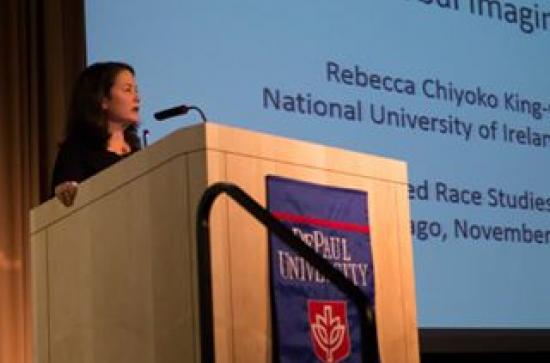
Dr. Rebecca King O’Riain gives opening keynote address

Posted in Articles, Europe, Media Archive, Social Science, Videos on 2015-01-02 21:16Z by Steven

Dr. Rebecca King O’Riain gives opening keynote address

Maynooth University
Maynooth University Department of Sociology
Maynooth, County Kildare, Ireland
2014-11-27

Dr. Rebecca King-O’Riain gave the opening keynote address on “mixed race, transconnectivity and the global imagination” at the critical mixed race studies conference on 13 November, 2014 at DePaul, University on Chicago, USA.

Her talk examined two key questions – ‘Is there such a thing as Global Mixed Race? If so, what is it, where did it come from and is it a good thing?’. Below is the abstract for her talk.

If race gains meaning through the process of racialization, this meaning only makes sense within very specific local contexts entwined with complex local histories, which in turn shape local political, economic and social arrangements. Mixed-race studies started primarily in the United States and has been deeply shaped by the politics of race in that context, with strong racial boundaries and the legacy of the ‘one drop rule’. How then do we make sense of mixed race as a global phenomenon across the globe without losing the specificity of local context from which it derives its meaning?

Drawing on our recent edited volume Global Mixed Race, I use empirical research from Kazakhstan, Okinawa, Zambia, Trinidad and Tobago, Australia, New Zealand, and Mexico, as well as the UK, Germany, and Canada, to ask what happens when we take mixed race on the road? Because as Mahtani (2014) keenly observes, it is not just about asking ‘what are you?’ but also about asking ‘where (in the world) are you?’…

Read the entire article here watch the keynote here. [MixedRaceStuides.org is mentioned from 00:35:41 to 00:36:07 in the video].

Tags: , ,

Racial Fluidity and Inequality in the United States

Posted in Articles, Census/Demographics, Media Archive, Social Science, United States on 2015-01-02 20:36Z by Steven

Racial Fluidity and Inequality in the United States

American Journal of Sociology
Volume 118, Number 3, November 2012
pages 676–727
DOI: 10.1086/667722

Aliya Saperstein, Assistant Professor of Sociology
Stanford University

Andrew M. Penner, Associate Professor of Sociology
University of California, Irvine

The authors link the literature on racial fluidity and inequality in the United States and offer new evidence of the reciprocal relationship between the two processes. Using two decades of longitudinal data from a national survey, they demonstrate that not only does an individual’s race change over time, it changes in response to myriad changes in social position, and the patterns are similar for both self-identification and classification by others. These findings suggest that, in the contemporary United States, microlevel racial fluidity serves to reinforce existing disparities by redefining successful or high-status people as white (or not black) and unsuccessful or low-status people as black (or not white). Thus, racial differences are both an input and an output in stratification processes; this relationship has implications for theorizing and measuring race in research, as well as for crafting policies that attempt to address racialized inequality.

Read the entire article here or here.

Tags: , , ,

The fluidity of race

Posted in Anthropology, Asian Diaspora, Dissertations, History, Media Archive, Oceania on 2015-01-02 20:18Z by Steven

The fluidity of race

Rutgers, The State University of New Jersey
May 2012
221 pages
DOI: 10.7282/T3FN154X

Nicholas Trajano Molnar, Assistant Professor
Department of History, Philosophy, and Religious Studies
Community College of Philadelphia, Philadelphia, Pennsylvania

This study is an examination of the American mestizos who lived in the Philippines from 1900 to 1955. No scholarly studies exist that analyze and historicize this group, but this is understandable, as the population of the American mestizos compared to the overall Filipino population is miniscule, never exceeding 20,000 individuals at any one time. Despite their small numbers, the American mestizos were a matter of social concern for the Philippine state and the expatriate Americans and Filipino nationalists who resided there. Various actors in the Philippines carried their own imposed racializations of the group that changed over time, ranging from American expatriates who emphasized the group’s “American” blood to Filipino nationalists who embraced them as Filipinos.

This study will demonstrate that the boundaries of race have been constantly shifting, with no single imposed or self-ascribed American mestizo identity coalescing. American mestizo racial definitions and constructs are historically and regionally specific, complicating conventional scholarly assumptions and requiring a historically grounded approach to the understanding of race and ethnicity. This study makes theoretical contributions to the study of race in the United States and its former colonies. Contemporary literature seeks to explain by what means racial identity is created and maintained. My study, however, seeks to explore racial formation from another angle, exploring why a distinct group identity never coalesced among the American mestizos despite the presence of similar economic, historical, and social forces that have clearly led to racial formation in other groups.

The concept of the American mestizo and the fluid Philippine racial framework challenged static American notions of race. I argue that contact with the Philippines led to an assimilation of Filipino racial ideas among American expatriates, who in turn created their own colonialized concepts of race and nationality, demonstrating that under certain historical conditions, American concepts of race had room to bend. Tracking the transmittal of these hybridized ideas, and their transformations and various interpretations at each venue, allows us to gain insight into the malleability of Philippine and American notions of nation and race, and into the larger processes of racial construction overall.

Request a copy of the dissertation here.

Tags: , , , ,

Losing My Cool: Love, Literature, and a Black Man’s Escape from the Crowd

Posted in Autobiography, Books, Media Archive, Monographs, United States on 2015-01-02 20:05Z by Steven

Losing My Cool: Love, Literature, and a Black Man’s Escape from the Crowd

Penguin Books
April 2010
240 pages
Paperback ISBN: 9780143119623
ePub ISBN: 9781101404348

Thomas Chatterton Williams

Growing up, Thomas Chatterton Williams knew he loved three things in life: his parents, literature, and the intoxicating hip-hop culture that surrounded him. For years, he managed to juggle two disparate lifestyles, “keeping it real” in his friends’ eyes and studying for the SATs under his father’s strict tutelage-until it all threatened to spin out of control. Written with remarkable candor and emotional depth, Losing My Cool portrays the allure and danger of hip-hop culture with the authority of a true fan who’s lived through it all, while demonstrating the saving grace of literature and the power of the bond between father and son.

Tags: ,

The Birth of A Nation: How a Legendary Filmmaker and a Crusading Editor Reignited America’s Civil War

Posted in Books, Communications/Media Studies, History, Media Archive, Religion, United States on 2015-01-02 17:04Z by Steven

The Birth of A Nation: How a Legendary Filmmaker and a Crusading Editor Reignited America’s Civil War

PublicAffairs
2014-11-04
368 pages
6.300 x 9.500
Hardcover ISBN: 9781586489878
eBook ISBN: 9781586489885

Dick Lehr, Professor of Journalism
Boston University, Boston, Massachusetts

In 1915, two men—one a journalist agitator, the other a technically brilliant filmmaker—incited a public confrontation that roiled America, pitting black against white, Hollywood against Boston, and free speech against civil rights.

Monroe Trotter and D. W. Griffith were fighting over a film that dramatized the Civil War and Reconstruction in a post-Confederate South. Almost fifty years earlier, Monroe’s father, James, was a sergeant in an all-black Union regiment that marched into Charleston, South Carolina, just as the Kentucky cavalry—including Roaring Jack Griffith, D. W.’s father—fled for their lives. Griffith’s film, The Birth of a Nation, included actors in blackface, heroic portraits of Knights of the Ku Klux Klan, and a depiction of Lincoln’s assassination. Freed slaves were portrayed as villainous, vengeful, slovenly, and dangerous to the sanctity of American values. It was tremendously successful, eventually seen by 25 million Americans. But violent protests against the film flared up across the country.

Monroe Trotter’s titanic crusade to have the film censored became a blueprint for dissent during the 1950s and 1960s. This is the fiery story of a revolutionary moment for mass media and the nascent civil rights movement, and the men clashing over the cultural and political soul of a still-young America standing at the cusp of its greatest days.

Tags: , , , , , , , , ,

Racial Passing and the Raj

Posted in Asian Diaspora, History, Live Events, Media Archive, Papers/Presentations, Passing on 2015-01-02 03:10Z by Steven

Racial Passing and the Raj

American Historical Association
129th Annual Meeting
New York, New York
2015-01-02 through 2015-01-05

Saturday, 2015-01-03, 15:10 EST (Local Time)
Park Suite 3 (Sheraton New York)

Uther Charlton-Stevens
Volgograd State University, Volgograd, Russia

Racial passing is a subject that has attracted much attention in the historiography of the Americas, as well as other settings such as South Africa. It has hitherto been overlooked in the South Asian context. Mixed race groups in South Asia have until recently also been largely neglected by historians, while attracting more attention from geographers and anthropologists.

Mixed race groups such as Anglo-Indians have been perceived as marginal, despite existing on the fault line of constructed racial difference. In many ways they embody the colonial connection and the transnational most tangibly, and through their mere presence make problematic the binary of ruler and ruled, colonizer and colonized. The British perceived not only those of mixed race but also poor whites of Indian domicile as undermining their racial prestige in the eyes of their Indian subjects, treating the two groups as essentially one class. However the socio-racial and class-based hierarchies which the British sought to erect and to police motivated widespread attempts at transgression, resulting in widespread passing in hopes of upward mobility along the spectrum from Indian Christians to mixed-race Anglo-Indians to supposedly unmixed Domiciled Europeans and even into the ranks of the British population, such as those who came out to take senior positions on the railways. This world of racial mixing and transgression was one which the British found unsettling and which later Indian Hindu nationalists, concerned with concepts of purity, also had reasons to overlook. Exploring racial passing across the boundaries erected by the Raj should yield us far greater insight into the nature of race in late colonial India and the lasting impact of the imperial presence.

Tags: , , ,