Creole Crossings: Domestic Fiction and the Reform of Colonial Slavery

Posted in Books, History, Literary/Artistic Criticism, Media Archive, Monographs, Slavery, United States on 2009-11-13 04:47Z by Steven

Creole Crossings: Domestic Fiction and the Reform of Colonial Slavery

Cornell University Press
2005
254 pages, 6 x 9
ISBN: 978-0-8014-4384-8 

Carolyn Vellenga Berman
Department of Humanities
The New School, New York

The character of the Creole woman—the descendant of settlers or slaves brought up on the colonial frontier—is a familiar one in nineteenth-century French, British, and American literature. In Creole Crossings, Carolyn Vellenga Berman examines the use of this recurring figure in such canonical novels as Jane Eyre, Uncle Tom’s Cabin, and Indiana, as well as in the antislavery discourse of the period. “Creole” in its etymological sense means “brought up domestically,” and Berman shows how the campaign to reform slavery in the colonies converged with literary depictions of family life.

Illuminating a literary genealogy that crosses political, familial, and linguistic lines, Creole Crossings reveals how racial, sexual, and moral boundaries continually shifted as the century’s writers reflected on the realities of slavery, empire, and the home front. Berman offers compelling readings of the “domestic fiction” of Honoré de Balzac, Charlotte Brontë, Maria Edgeworth, Harriet Jacobs, George Sand, Harriet Beecher Stowe, and others, alongside travel narratives, parliamentary reports, medical texts, journalism, and encyclopedias. Focusing on a neglected social classification in both fiction and nonfiction, Creole Crossings establishes the crucial importance of the Creole character as a marker of sexual norms and national belonging.

Tags: , , , , , , , ,

Suspect Relations: Sex, Race, and Resistance in Colonial North Carolina

Posted in Books, History, Law, Media Archive, Monographs, Slavery, Social Science, United States on 2009-11-13 03:44Z by Steven

Suspect Relations: Sex, Race, and Resistance in Colonial North Carolina

Cornell University Press
2001
288 pages
6 1/8 x 9 1/4, 2 maps, 13 halftones, 1 line drawing
Paper ISBN: 978-0-8014-8679-1
Cloth ISBN: 978-0-8014-3822-6 

Kirsten Fischer, Associate Professor of History
University of Minnesota

Over the course of the eighteenth century, race came to seem as corporeal as sex. Kirsten Fischer has mined unpublished court records and travel literature from colonial North Carolina to reveal how early notions of racial difference were shaped by illicit sexual relationships and the sanctions imposed on those who conducted them. Fischer shows how the personal–and yet often very public–sexual lives of Native American, African American, and European American women and men contributed to the new racial order in this developing slave society.

Liaisons between European men and native women, among white and black servants, and between servants and masters, as well as sexual slander among whites and acts of sexualized violence against slaves, were debated, denied, and recorded in the courtrooms of colonial North Carolina. Indentured servants, slaves, Cherokee and Catawba women, and other members of less privileged groups sometimes resisted colonial norms, making sexual choices that irritated neighbors, juries, and magistrates and resulted in legal penalties and other acts of retribution. The sexual practices of ordinary people vividly bring to light the little-known but significant ways in which notions of racial difference were alternately contested and affirmed before the American Revolution.

Fischer makes an innovative contribution to the history of race, class, and gender in early America by uncovering a detailed record of illicit sexual exchanges in colonial North Carolina and showing how acts of resistance to sexual rules complicated ideas about inherent racial difference.

Table of Contents

List of Illustrations
Acknowledgments
Introduction: Changing Conceptions of Race
1. Disorderly Women and the Struggle for Authority
2. Cross-Cultural Sex in Native North Carolina
3. The Sexual Regulation of Servant Women and Subcultures of Resistance
4. White Reputations “Blacken’d & Made Loose”
5. Sexualized Violence and the Embodiment of Race
Epilogue: Dangerous Liaisons
Notes
Index

Tags: , ,

Chameleon’s Fate: Transnational Mixed-Race Vietnamese Identities

Posted in Articles, Asian Diaspora, Identity Development/Psychology, Media Archive, United States on 2009-11-13 03:26Z by Steven

Chameleon’s Fate: Transnational Mixed-Race Vietnamese Identities

Amerasia Journal
University of Califonia, Los Angeles Asian American Studies Center Press
ISSN: 0044-7471
2005
Issue Volume 31, Number 2
Pages 51-62

Fiona I. B. Ngô, Assistant Professor, Asian American Studies & Gender and Women’s Studies
University of Illinois, Urbana-Champaign

The chameleon’s fate is an apt metaphor for the lives of mixed-race Vietnamese children, many of whom were born of these kind of brutal cultural contact. In the aftermath of the U.S. war in Southeast Asia, a number of mixed-race children told the story of the war. Though the story of the war is physically signified by these individuals, the meanings produced through mixed-race identity are multiple and unfixed. The fluidity of meaning comes partially through shifting historical and geographical contextualizations of transnational mixed-race identities.

Tags: , ,

Is Parental Love Colorblind? Allocation of Resources within Mixed-Race Families (Preliminary Version)

Posted in Brazil, Family/Parenting, Media Archive, Papers/Presentations, Social Science on 2009-11-12 02:31Z by Steven

Is Parental Love Colorblind? Allocation of Resources within Mixed-Race Families (Preliminary Version)

Prepared for the Labor and Population Workshop,
Department of Economics, Yale University
May, 2007
53 pages

Marcos A. Rangel, Assistant Professor
Harris School of Public Policy Studies
University of Chicago

Recent studies have shown that differences in wage-determinant skills between blacks and whites are likely to emerge during a child’s infancy. These findings highlight the role of parental investment decisions and suggest that differences in labor income tend to persist across generations, either because minority parents are limited in their choices, or because they have relatively negative expectations regarding the rewards attached to investments in skills. Exploring the genetics of skin-color determination and the widespread incidence of mixed-race families in Brazil, I present evidence that, controlling for observed and unobserved parental characteristics, light-skinned children are more likely to receive investments in formal education than their dark-skinned siblings. Even though not denying the importance of borrowing constraints (or other ancestry effects), this suggests that parental expectations regarding differences in the return to human capital investments may play an independent role on the persistence of earnings differentials.

Read the entire working paper here or here.

Tags:

Conversation with Rev. Dr. Frederick J. Streets

Posted in Articles, Identity Development/Psychology, Media Archive, Religion, Slavery, Social Science, United States on 2009-11-12 02:19Z by Steven

Conversation with Rev. Dr. Frederick J. Streets

The Gilder Lehrman Center for the Study of Slavery, Resistance & Abolition
Yale University
1990-02-02

Frederick J. Streets, University Chaplain and Senior Pastor
Church of Christ, Yale University

A conversation with Rev. Dr. Frederick J. Streets, University Chaplain and Senior Pastor of the Church of Christ, Yale University.

Dr. Streets spoke about race in America. He discussed the resistance to thinking about shared history that black and white Americans might feel. He suggested several reasons for the resistance…

…On mixed racial heritage:

(Dr. Streets is an African American of mixed heritage.)

I grew up identifying with African Americans by color while learning the Polish traditions of my maternal grandmother.

I think that acknowledging one’s mixed heritage is a rebuttal to two ideas about race. One is the linking of mixed heritage to slavery. The second is the idea of racial purity.

African Americans reject their white heritage as the story of slavery. White Americans believe that their heritage carries no genes of color. The great divide between black and white Americans is mythical and destructive.

Neither groups wants to acknowledge their mixed ancestry because a mixed racial heritage furthers the destruction of separate racial identity. As blacks begin to examine their roots, they find a confusion of identity…

Read the entire article here.

Tags: , ,

Negotiating Ethnic Boundaries: Multiethnic Mexican Americans and Ethnic Identity in the United States

Posted in Articles, Identity Development/Psychology, Media Archive, United States on 2009-11-11 18:50Z by Steven

Negotiating Ethnic Boundaries: Multiethnic Mexican Americans and Ethnic Identity in the United States

Ethnicities
Volume 4, Number  1 (March 2004)
pages 75-97
DOI: 10.1177/1468796804040329

Tomás R. Jiménez, Assistant Professor of Sociology
Stanford University

This article examines the ethnic identity of the offspring of Mexican/white (non-Hispanic) intermarriages, or multiethnic Mexican Americans, using 20 in-depth interviews with multiethnic Mexican Americans in California. Interviews indicate that respondents gravitate toward a Mexican American ethnic identity since it is the most salient ethnicity in their social environment. But as respondents choose their identities, they confront ethnic boundaries, or sharp division between ethnic categories, that influence the extent to which they feel free to assert any one particular identity. They respond to these boundaries by taking a symbolic approach, a Mexican American approach, a multiethnic approach to their ethnicity, and a combination of these approaches.

Read or purchase the article here.

Tags: , , ,

A Feminist Critique of Research on Interracial Family Identity: Implications for Family Health

Posted in Articles, Family/Parenting, Media Archive, Politics/Public Policy, United States on 2009-11-11 18:42Z by Steven

A Feminist Critique of Research on Interracial Family Identity: Implications for Family Health

Journal of Family Nursing
2004
Vol. 10, No. 3
pp. 302-322
DOI: 10.1177/1074840704267189

Marcia M. Byrd, Assistant Professor of Nursing
College of St. Catherine

Ann W. Garwick, Associate Dean for Research, Professor and Director of Center for Child and Family Health Promotion Research
University of Minnesota

The focus of this literature review is on family identity formation within a social cultural context for families, couples, and women who are in committed Black-White interracial relationships that include biracial children. This review and synthesis of interdisciplinary literature was limited to U.S. research studies completed between 1990 and 2002. The American racial lens represented the environmental context that this article seeks to capture. Health care providers lack knowledge of this complex mixed-race family identity formation and its implications for healthy interracial families. Family nurses who can assess and intervene in a culturally competent manner will be essential to promoting health and eliminating health disparities for these interracial families of color.

Tags: , , ,

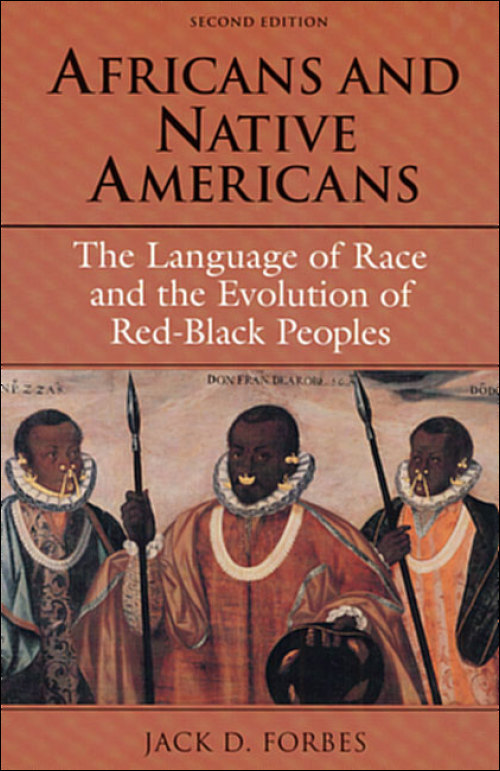
Africans and Native Americans: The Language of Race and the Evolution of Red-Black Peoples (Second Edition)

Posted in Anthropology, Books, Canada, Caribbean/Latin America, Europe, History, Media Archive, Monographs, Native Americans/First Nation, United States on 2009-11-11 18:16Z by Steven

Africans and Native Americans: The Language of Race and the Evolution of Red-Black Peoples (Second Edition)

University of Illinois Press
1993
Paper: 978-0-252-06321-3
352 pages

Jack D. Forbes, Professor Emeritus. Native American Studies and Anthropology
University of California, Davis

This volume will revise the way we look at the modern populations of Latin America and North America by providing a totally new view of the history of Native American and African American peoples throughout the hemisphere. Africans and Native Americans explores key issues relating to the evolution of racial terminology and European colonialists’ perceptions of color, analyzing the development of color classification systems and the specific evolution of key terms such as black, mulatto, and mestizo, which no longer carry their original meanings. Jack Forbes presents strong evidence that Native American and African contacts began in Europe, Africa, and the Caribbean and that Native Americans may have crossed the Atlantic long before Columbus.

Tags: , ,

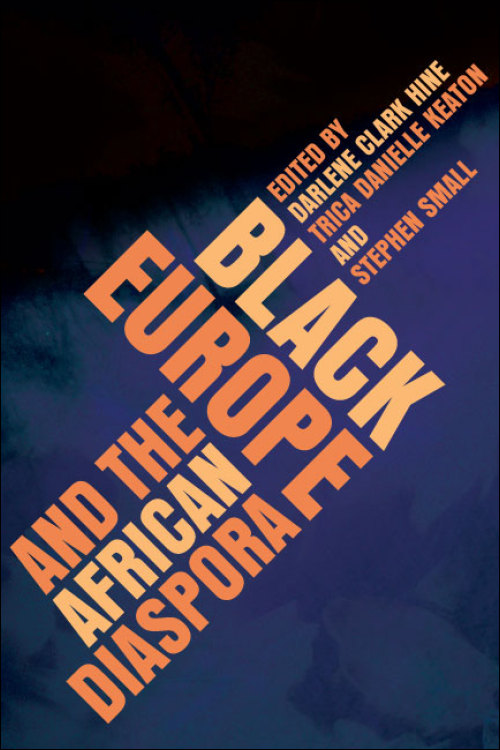
Black Europe and the African Diaspora

Posted in Anthologies, Anthropology, Books, Europe, Identity Development/Psychology, Media Archive, Social Science on 2009-11-11 16:35Z by Steven

Black Europe and the African Diaspora

University of Illinois Press
2009
368 pages
6 x 9 in. 
15 black & white photographs, 1 map
Cloth: ISBN 978-0-252-03467-1
Paper: ISBN 978-0-252-07657-2

Edited by

Darlene Clark Hine, Board of Trustees Professor of African American Studies
Northwestern University

Trica Danielle Keaton, Associate Professor of African American and Diaspora Studies
the University of Minnesota, Twin Cities

Stephen Small, Associate Professor of African American Studies
University of California, Berkeley

Multifaceted analyses of the African diaspora in Europe

The presence of Blacks in a number of European societies has drawn increasing interest from scholars, policymakers, and the general public. This interdisciplinary and multi-disciplinary collection penetrates the multifaceted Black presence in Europe, and, in so doing, complicates the notions of race, belonging, desire, and identities assumed and presumed in revealing portraits of Black experiences in a European context. In focusing on contemporary intellectual currents and themes, the contributors theorize and re-imagine a range of historical and contemporary issues related to the broader questions of blackness, diaspora, hegemony, transnationalism, and “Black Europe” itself as lived and perceived realities.

Contributors are Allison Blakely, Jacqueline Nassy Brown, Tina Campt, Fred Constant, Alessandra Di Maio, Philomena Essed, Terri Francis, Barnor Hesse, Darlene Clark Hine, Dienke Hondius, Eileen Julien, Trica Danielle Keaton, Kwame Nimako, Tiffany Ruby Patterson, T. Denean Sharpley-Whiting, Stephen Small, Tyler Stovall, Alexander G. Weheliye, Gloria Wekker, and Michelle M. Wright.

Tags: , , , , , , , , , , , , , , , , , , , , , , ,

On Being Amorphous: Autoethnography, Genealogy, and a Multiracial Identity

Posted in Articles, Autobiography, Identity Development/Psychology, Media Archive, Social Science, United States on 2009-11-11 16:04Z by Steven

On Being Amorphous: Autoethnography, Genealogy, and a Multiracial Identity

Qualitative Inquiry
Volume 9, Number 1 (2003)
pages 20-48
DOI: 10.1177/1077800402239338

Sarah N. Gatson, Associate Professor of Sociology
Texas A&M University

The article is a sociologically informed approach to understanding the author’s own place and identity. Questions of personal identity serve to highlight larger insights about a crucial reality in the United States. The author engages a standpoint at the crux of America’s racial dilemma, combined with a specialization in research on race and ethnicity. First, the interactive and overlapping set of methodologies within which her own narrative of identity fits is discussed. These data are systematically collected and analyzed field notes, historical documents, and the embedded interactions from within a larger culture of literature, scholarship, and popular understandings. The body of the article consists of three examples that she characterizes as confronting her Blackness, confronting her multiracialness, and confronting her Whiteness.

Read or purchase the article here.

Tags: , ,