Love and Race Caught in the Public Eye

Posted in Articles, History, Law, Media Archive, Social Science, United States on 2009-12-05 05:23Z by Steven

Love and Race Caught in the Public Eye

ND Newswire
University of Notre Dame
2001-05-31

Heidi Ardizzone, Assistant Professor of American Studies
University of Notre Dame

Earl Lewis, Provost
Emory University

Lovers seek to create a place that they can inhabit together against the obstacles of the world. Marriage promises that they will live in that place forever. What happens, though, when love cannot keep out the world’s strictures? What happens when the bond severs, and the nation serves as a witness to marital separation? And what happens when a culture’s notions about love and romance come into conflict with the lines dividing races and classes?

In 1925 Alice Beatrice Jones and Leonard “Kip” Rhinelander found themselves painfully trapped in this conflict between love and family, desire and social standing. Their marriage had the trappings of a fairy tale — wealthy New York scion marries humble girl from New Rochelle — yet the events that led to their estrangement provide an unusual window into the nation’s attitudes about race, class, and sexuality. Their sensational annulment trial scandalized 1920’s America and opened their private life to public scrutiny, amid cultural conflicts over racial definitions, class propriety, proper courtship and sexual behavior, and racial mixing.

As a Rhinelander, Leonard was descended from several of New York’s oldest and wealthiest families. Had he followed in the family tradition, Leonard might have attended Columbia University, joined the Rhinelander Real Estate Company, and made his mark on New York society through philanthropy and support of the arts.

By contrast, Alice’s parents immigrated in 1891 to the United States from England, where they had both worked as servants. George Jones had had some success in his adopted country; he eventually owned a fleet of taxicabs and several small properties. Alice, her sisters, and their husbands worked primarily as domestics and servants — solid members of the working class.

Despite this pronounced class difference, Alice and Leonard met and began dating in 1921. Their love deepened over the next three years, tested by months and years of separation as Leonard’s father tried to keep them apart. Philip Rhinelander’s efforts were in vain, however.  From 1921 to 1924 the lovers exchanged hundreds of letters and visited when possible. As soon as Leonard turned 21 and received money from a trust fund, he left school and returned to Alice. In the fall of 1924, they quietly married in a civil ceremony at the New Rochelle City Hall.

Had reporters from the New Rochelle Standard Star ignored the entry in the City Hall records, the couple might have lived their lives away from the public spotlight. They did not. Someone eventually realized that a Rhinelander had married a local woman, and it was news. And once they discovered who Alice Jones was, it was big news. The first story appeared one month after their wedding, announcing to the world that the son of a Rhinelander had married the daughter of a colored man.

Or had he? Well, at least he had married the daughter of a working-class man, and that was enough to start a tremor of gossip throughout New York. Reporters rushed to sift through the legal documents and contradictory accounts of and by the Joneses and the newlyweds. Despite the confidence of the first announcement, there was confusion for quite some time as to George Jones’s — and therefore Alice’s — precise racial identity…

Read the entire article here.

Tags: , , , , , , , , , ,

An Illuminated Life: Bella da Costa Greene’s Journey from Prejudice to Privilege

Posted in Arts, Biography, Books, History, Media Archive, Monographs, Passing, United States, Women on 2009-12-05 04:15Z by Steven

An Illuminated Life: Bella da Costa Greene’s Journey from Prejudice to Privilege

W. W. Norton & Company
June 2007
592 pages
6.6 × 9.6 in
Hardcover ISBN: 978-0-393-05104-9

Heidi Ardizzone, Assistant Professor of American Studies
University of Notre Dame

Named a New York Times Editor’s Choice.

The secret life of the sensational woman behind the Morgan masterpieces, who lit up New York society.

What would you give up to achieve your dream? When J. P. Morgan hired Belle da Costa Greene in 1905 to organize his rare book and manuscript collection, she had only her personality and a few years of experience to recommend her. Ten years later, she had shaped the famous Pierpont Morgan Library collection and was a proto-celebrity in New York and the art world, renowned for her self-made expertise, her acerbic wit, and her flirtatious relationships. Born to a family of free people of color, Greene changed her name and invented a Portuguese grandmother to enter white society. In her new world, she dined both at the tables of the highest society and with bohemian artists and activists. She also engaged in a decades-long affair with art critic Bernard Berenson. Greene is pure fascination—the buyer of illuminated manuscripts who attracted others to her like moths to a flame.

Tags: , , ,

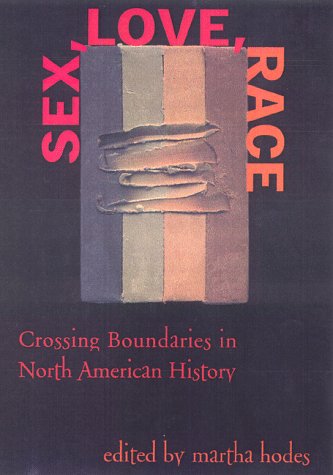
Sex, Love, Race: Crossing Boundaries in North American History

Posted in Anthologies, Asian Diaspora, Books, History, Law, Media Archive, Slavery, Social Science, United States, Women on 2009-12-05 02:53Z by Steven

Sex, Love, Race: Crossing Boundaries in North American History

New York University Press
1999
416 pages
Cloth ISBN: 9780814735565
Paperback ISBN: 9780814735572

Edited by

Martha Hodes, Professor of History
New York University

Since pre-colonial days, America has been both torn apart and united by love, sex, and marriage across racial boundaries. Whether motivated by violent conquest, economics, lust, or love, such unions have disturbed some of America’s most sacred beliefs and prejudices.

Sex, Love, Race provides a historical foundation for contemporary discussions of sex across racial lines, which, despite the numbers of interracial marriages and multiracial children, remains a controversial issue today. The first historical anthology to focus solely and widely on the subject, Sex, Love, Race gathers new essays by both younger and well-known scholars which probe why and how the specter of sex across racial boundaries has so threatened Americans of all colors and classes.

Traversing the whole of American history, from liaisons among Indians, Europeans, and Africans to twentieth-century social scientists’ fascination with sex between “Orientals” and whites, the essays cover a range of regions, races, ethnicities, and sexual orientations. In so doing, Sex, Love, Race, sketches a larger portrait of the overlapping construction of racial, ethnic, and sexual identities in America.

Tags: ,

The Sea Captain’s Wife: A True Story of Love, Race, and War in the Nineteenth Century

Posted in Biography, Books, Caribbean/Latin America, History, Media Archive, Monographs, Social Science, United States, Women on 2009-12-05 02:13Z by Steven

The Sea Captain’s Wife: A True Story of Love, Race, and War in the Nineteenth Century

W. W. Norton & Company
September 2007
384 pages
5.5 × 8.3 in
Paperback ISBN: 978-0-393-33029-8

Martha Hodes, Professor of History
New York University

Finalist for the Lincoln Book Prize.

Award-winning historian Martha Hodes brings us into the extraordinary world of Eunice Connolly. Born white and poor in New England, Eunice moved from countryside to factory city, worked in the mills, then followed her husband to the Deep South. When the Civil War came, Eunice’s brothers joined the Union army while her husband fought and died for the Confederacy. Back in New England, a widow and the mother of two, Eunice barely got by as a washerwoman, struggling with crushing depression. Four years later, she fell in love with a black sea captain, married him, and moved to his home in the West Indies. Following every lead in a collection of 500 family letters, Hodes traced Eunice’s footsteps and met descendants along the way. This story of misfortune and defiance takes up grand themes of American history—opportunity and racism, war and freedom—and illuminates the lives of ordinary people in the past.

Midwinter 1881, Ellen Merrill received a letter. It came from the West Indies, written by a man Ellen didn’t know, and the news was bad. That was clear from the second sentence, in which the stranger spoke of “the late Mr. and Mrs. Connolly.” When Ellen reached the end of the letter, she read it again, and then again, before she took out a sheet of paper. “My Dear Brother,” she wrote to Henry Richardson, “I have at last succeeded in learning the fate of Mrs. Connolly and family.” She asked Henry to impart the news to their mother and to their sister Ann McCoy. As Ellen signed off, she thought about dangerous weather. “We had a Storm here last week which blowd the tide in and nearly washed us away for three days.” She posted the letter from Mississippi to Massachusetts.

The hurricane that swirled off the Miskito Cays of Central America in September 1877 took the life of an American woman named Eunice Connolly. Eunice was an ordinary woman who led an extraordinary life by making momentous decisions within a world that offered her few choices. Eunice Richardson Stone Connolly was born white and working class in New England in 1831. She married a fellow New Englander who took her to the South and fought for the Confederacy in the Civil War, while Eunice’s two brothers fought for the Union. After the war, Eunice married a well-to-do man of color and went to live in a settlement of former slaves on the British Caribbean island of Grand Cayman. This book tells her story…

…Eunice’s story and the choices she made expose the complexities of racial classification across geographical borders. Her family traced their lineage back to England and France, but as Eunice worked in the mills and labored as a servant, she came precariously close to the degraded status of impoverished Irish and black women. Later, when she married a “man of color” (that was the phrase invoked at the time), she found out that reputation also counted in a person’s racial status and that for women, whiteness depended upon specific ideas about purity. Then, when Eunice took up residence on a West Indian island, she realized that labels like “white,” “black,” “mulatto,” and “colored” carried different meanings in different places. Eunice’s story illuminates the complexities of racism too: Her unusual experiences make clear just how mercurial racial categories could be in the nineteenth century, but her life also proves just how much power those mercurial markers could exert to confine—or transform—a person’s life. In her voyages from New England to the Deep South to the British Caribbean, Eunice also made a journey from the life of an impoverished white woman in the United States to the life of an elite woman of color in the West Indies…

Read chapter 1 in PDF or HTML format.

Tags: , ,

White Women, Black Men: Illicit Sex in the Nineteenth-Century South

Posted in Books, History, Law, Media Archive, Monographs, Slavery, Social Science on 2009-12-05 01:50Z by Steven

White Women, Black Men: Illicit Sex in the Nineteenth-Century South

Yale University Press
January 1997
352 pages
6 1/8 x 9 1/4
ISBN: 9780300077506
ISBN-10: 0300077505

Martha Hodes, Professor of History
New York University

White Women, Black Men: Illicit Sex in the Nineteenth-century South by [Hodes, Martha]

  • Winner of the Allan Nevins Prize given by the Society of American Historians.
  • Honorable mention in the Gustavus Myers Outstanding Book Awards, sponsored by the Gustavus Myers Center for the Study of Bigotry and Human Rights in North America.

This book is the first to explore the history of a powerful category of illicit sex in America’s past: liaisons between Southern white women and black men. Martha Hodes tells a series of stories about such liaisons in the years before the Civil War, explores the complex ways in which white Southerners tolerated them in the slave South, and shows how and why these responses changed with emancipation.

Hodes provides details of the wedding of a white servant-woman and a slave man in 1681, an antebellum rape accusation that uncovered a relationship between an unmarried white woman and a slave, and a divorce plea from a white farmer based on an adulterous affair between his wife and a neighborhood slave. Drawing on sources that include courtroom testimony, legislative petitions, pardon pleas, and congressional testimony, she presents the voices of the authorities, eyewitnesses, and the transgressors themselves—and these voices seem to say that in the slave South, whites were not overwhelmingly concerned about such liaisons, beyond the racial and legal status of the children that were produced. Only with the advent of black freedom did the issue move beyond neighborhood dramas and into the arena of politics, becoming a much more serious taboo than it had ever been before. Hodes gives vivid examples of the violence that followed the upheaval of war, when black men and white women were targeted by the Ku Klux Klan and unprecedented white rage and terrorism against such liaisons began to erupt. An era of terror and lynchings was inaugurated, and the legacy of these sexual politics lingered well into the twentieth century.

Tags: , , ,

Casta Painting: Images of Race in Eighteenth-Century Mexico

Posted in Arts, Books, Caribbean/Latin America, History, Media Archive, Mexico, Monographs on 2009-12-05 01:08Z by Steven

Casta Painting: Images of Race in Eighteenth-Century Mexico

Yale University Press
2004-04-10
252 pages
8 1/2 x 11
100 b/w +100 color illus.
Paper ISBN: 9780300109719
Cloth ISBN: 9780300102413

Ilona Katzew, Associate Curator of Latin American Art
Los Angeles County Museum of Art

Selected for Honorable Mention for a 2003-2004 Book Award given by the Association for Latin American Art.

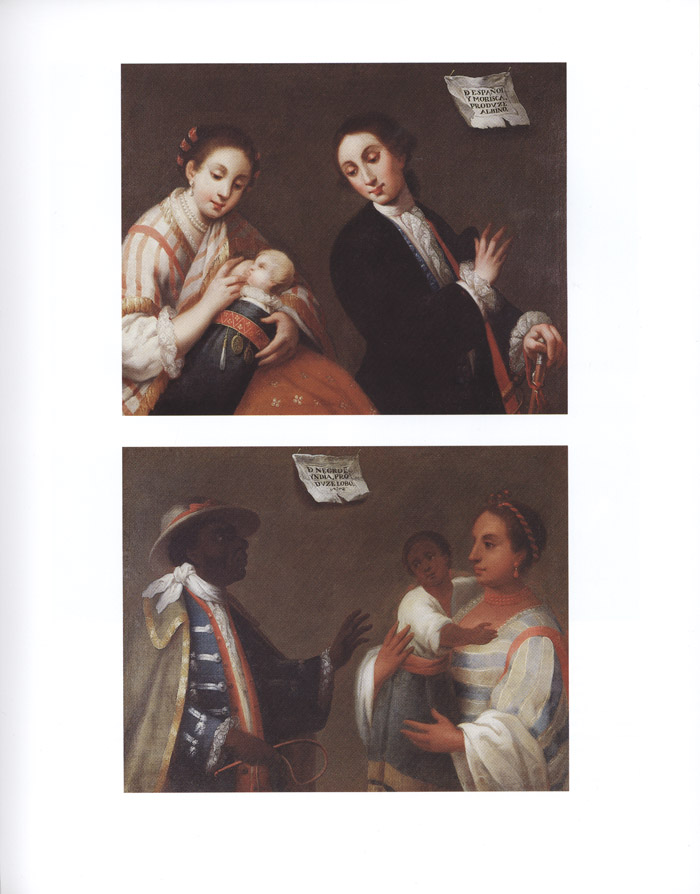
The pictorial genre known as casta painting is one of the most compelling forms of artistic expression from colonial Mexico. Created as sets of consecutive images, the works portray racial mixing among the main groups that inhabited the colony: Indians, Spaniards, and Africans. In this beautifully illustrated book, Ilona Katzew places casta paintings in their social and historical context, showing for the first time the ways in which the meanings of the paintings changed along with shifting colonial politics.

The book examines how casta painting developed art historically, why race became the subject of a pictorial genre that spanned an entire century, who commissioned and collected the works, and what meanings the works held for contemporary audiences. Drawing on a range of previously unpublished archival and visual material, Katzew sheds new light on racial dynamics of eighteenth-century Mexico and on the construction of identity and self-image in the colonial world.

Table of Contents

  • Acknowledgements
  • Introduction
  • 1. Painters and Paintings: A Visual Tradition and Its Historiography
  • 2. “A Marvelous Variety of Colors?”: Racial Ideology and the Sistema de Castas
  • 3. The Rise of Casta Painting: Exoticism and Creole Pride, 1711-1760
  • 4. Changing Perspectives: Casta Painting in the Era of the Bourbon Reforms, 1760-1790
  • 5. The Theater of Marvels: Casta Paintings in the Textual Microcosmos
  • Concluding Remarks: A Genre with Many Meanings
  • Abbreviations
  • Notes
  • Bibliography
  • Photograph Credits
  • Index
Tags: , , , ,

Creoles of Color in the Bayou Country

Posted in Books, History, Louisiana, Media Archive, Monographs, Slavery, United States on 2009-12-04 22:41Z by Steven

Creoles of Color in the Bayou Country

University Press of Mississippi
1994
192 pages
Paper ISBN: 0878059490, ISBN 13: 9780878059492

Carl A. Brasseaux, Professor of History and Director of the Center for Cultural and Eco-Tourism
University of Louisiana, Lafayette

Claude F. Oubre

Keith P. Fontenot

Creoles of Color are rightfully among the first families of south-western Louisiana. Yet in both antebellum and postbellum periods they remained a people considered apart from the rest of the population. Historians, demographers, sociologists, and anthropologists have given them only scant attention.

This probing book, focused on the mid-eighteenth to the early twentieth centuries, is the first to scrutinize this multiracial group through a close study of primary resource materials.

During the antebellum period they were excluded from the state’s three-tiered society–white, free people of color, and slaves. Yet Creoles of Color were a dynamic component in the region’s economy, for they were self-compelled in efforts to become and integral part of the community.

Tags: , , , , , , , ,

Nagô Grandma and White Papa: Candomblé and the Creation of Afro-Brazilian Identity

Posted in Anthropology, Books, Brazil, Caribbean/Latin America, History, Identity Development/Psychology, Media Archive, Monographs, Religion, Social Science on 2009-12-04 18:12Z by Steven

Nagô Grandma and White Papa: Candomblé and the Creation of Afro-Brazilian Identity

University of North Carolina Press
September 2009
208 pages
6.125 x 9.25, 2 figs., 4 tables, notes, bibl., index
Cloth ISBN: 978-0-8078-3177-9
Paper ISBN: 978-0-8078-5975-9

Beatriz Góis Dantas, Professor Emerita of Anthropology
Universidade Federal de Sergipe in Brazil

Translated by Stephen Berg

Nagô Grandma and White Papa is a signal work in Brazilian anthropology and African diaspora studies originally published in Brazil in 1988. This edition makes Beatriz Góis Dantas’s historioethnographic study available to English-speaking audiences for the first time.

Dantas compares the formation of Yoruba (Nagô) religious traditions and ethnic identities in the Brazilian states of Sergipe and Bahia, revealing how they diverged from each other due to their different social and political contexts and needs. By tracking how markers of supposedly “pure” ethnic identity and religious practice differed radically from one place to another, Dantas shows the social construction of identity within a network of class-related demands and alliances. She demonstrates how the shape and meaning of “purity” have been affected by prolonged and complex social and cultural mixing, compromise, and struggle over time. Ethnic identity, as well as social identity in general, is formed in the crucible of political relations between social groups that purposefully mobilize and manipulate cultural markers to define their respective boundaries–a process, Dantas argues, that must be applied to understanding the experience of African-descended people in Brazil.

Tags: , ,

Almighty God Created the Races: Christianity, Interracial Marriage, and American Law

Posted in Books, History, Law, Media Archive, Monographs, Politics/Public Policy, Religion, Social Science, United States on 2009-12-04 17:14Z by Steven

Almighty God Created the Races: Christianity, Interracial Marriage, and American Law

University of North Carolina Press
December 2009
288 pages
6.125 x 9.25, notes, bibl., index
Cloth ISBN: 978-0-8078-3318-6
Paper ISBN: 978-1-4696-0727-6

Fay Botham, Adjunct Professor of Religious Studies
University of Iowa

In this fascinating cultural history of interracial marriage and its legal regulation in the United States, Fay Botham argues that religion–specifically, Protestant and Catholic beliefs about marriage and race–had a significant effect on legal decisions concerning miscegenation and marriage in the century following the Civil War.

Botham argues that divergent Catholic and Protestant theologies of marriage and race, reinforced by regional differences between the West and the South, shaped the two pivotal cases that frame this volume, the 1948 California Supreme Court case of Perez v. Lippold (which successfully challenged California’s antimiscegenation statutes on the grounds of religious freedom) and the 1967 U.S. Supreme Court case Loving v. Virginia (which declared legal bans on interracial marriage unconstitutional). Botham contends that the white southern Protestant notion that God “dispersed” the races, as opposed to the American Catholic emphasis on human unity and common origins, points to ways that religion influenced the course of litigation and illuminates the religious bases for Christian racist and antiracist movements.

Tags: , , , , , ,

Visible Identities: Race, Gender, and the Self

Posted in Books, Identity Development/Psychology, Latino Studies, Media Archive, Monographs, Philosophy, Social Science on 2009-12-04 07:10Z by Steven

Visible Identities: Race, Gender, and the Self

Oxford University Press
2006
344 pages
6-1/8 x 9-1/4
ISBN13: 978-0-19-513735-4
ISBN10: 0-19-513735-3

Linda Martín Alcoff, Professor of Philosophy
Hunter College/CUNY Graduate Center

Winner of the 2009 Frantz Fanon Prize

In the heated debates over identity politics, few theorists have looked carefully at the conceptualizations of identity assumed by all sides. Visible Identities fills this gap. Drawing on both philosophical sources as well as theories and empirical studies in the social sciences, Martin Alcoff makes a strong case that identities are not like special interests, nor are they doomed to oppositional politics, nor do they inevitably lead to conformism, essentialism, or reductive approaches to judging others. Identities are historical formations and their political implications are open to interpretation. But identities such as race and gender also have a powerful visual and material aspect that eliminativists and social constructionists often underestimate.

Visible Identities offers a careful analysis of the political and philosophical worries about identity and argues that these worries are neither supported by the empirical data nor grounded in realistic understandings of what identities are. Martin Alcoff develops a more realistic characterization of identity in general through combining phenomenological approaches to embodiment with hermeneutic concepts of the interpretive horizon. Besides addressing the general contours of social identity, Martin Alcoff develops an account of the material infrastructure of gendered identity, compares and contrasts gender identities with racialized ones, and explores the experiential aspects of racial subjectivity for both whites and non-whites. In several chapters she looks specifically at Latino identity as well, including its relationship to concepts of race, the specific forms of anti-Latino racism, and the politics of mestizo or hybrid identity.

Table of Contents

  • Part One: Identities Real and Imagined
    • Introduction: Identity and Visibility.
    • 1. The Pathologizing of Identity.
    • 2. The Political Critique.
    • 3. The Philosophical Critique.
    • 4. Real Identities.
  • Part Two: Gender Identity and Gender Differences
    • 5. The Identity Crisis in Feminist Theory.
    • 6. The Metaphysics of Gender and Sexual Difference.
  • Part Three: Racialized Identities and Racist Subjects
    • 7. A Phenomenology of Racial Embodiment.
    • 8. Racism and Visible Race.
    • 9. The Whiteness Question.
  • Part Four: Latino/a Particularity
    • 10. Latinos and the Categories of Race.
    • 11. Latinos, Asian Americans, and the Black-White Binary.
    • 12. On Being Mixed.
  • Conclusion.
  • Notes.
  • Bibliography.
  • Index.
Tags: , , ,