Deterritorialised Blackness: (Re)making coloured identities in South Africa

Posted in Africa, Anthropology, Articles, Arts, Media Archive, Social Science, South Africa on 2010-02-27 02:52Z by Steven

Deterritorialised Blackness: (Re)making coloured identities in South Africa

postamble
Volume 2, Number 1
2006

Janette Yarwood, Doctoral Candidate
Department of Anthropology
City University of New York

“When I was a kid in the early eighties, this music [hip-hop] was the first I’d heard that I could relate to. You know, ‘Fuck da Police’, and all that shit, that’s what I was feeling.”
Shamel X interview

“Black is not a question of pigmentation. The Black I’m talking about is a historical category, a political category, a cultural category…  Black was created as a political category in a certain historical moment.”2

During the summer of 2003 I took my first pre-dissertation trip to South Africa to develop my dissertation topic on coloured identities in post-apartheid South Africa. Although it is no secret that hip-hop as both a musical genre and a defined lifestyle has gained recognition and popularity around the globe, I was not quite prepared for what I experienced in South Africa. I encountered cars blasting Jay-Z, Sean Paul and P. Diddy among others; people wearing Sean John, Avirex or United States sports team jerseys; and cell phones ringing to the tunes of the latest 50 Cent or R. Kelly songs. I found that as a black person of Caribbean and American descent, I felt a common blackness with the coloured people I interacted with not because of a common African heritage but mainly because of black popular culture and hip-hop culture specifically. This led me to ask: What does it mean to be black in today’s world? Is there a transnational or globalised notion of blackness?…

Read the entire article here.

Tags: , ,

Blood-Lines That Waver South: Hybridity, the “South,” and American Bodies

Posted in Articles, Arts, Caribbean/Latin America, Literary/Artistic Criticism, Media Archive, United States on 2010-02-26 19:39Z by Steven

Blood-Lines That Waver South: Hybridity, the “South,” and American Bodies

Southern Quarterly
Volume 41, Number 1 (Fall 2003)
pages 39-52

Tace Hedrick, Associate Professor of English
University of Florida

In the paper I investigate a certain kind of imaginative response, especially on the part of mixed-race artists, to the prevalence of racialized discourses of modernity and nationalism in the Americas. Such discourses often dominated public thought in the Americas in general; more specifically for my purposes, I will be looking at the work of two artists, in Harlem and Mexico City, between the 1920s and the 1940s. In negotiating their own sense of a particularly mixed-race and thoroughly modern American nationalism, the United States mulatto writer Jean Toomer (1895-1967) and the Mexican mestiza painter Frida Kahlo (1907-1954) each would try to imagine an organic fusion-one which saw the fusion presumably inherent in race-mixing as a practice of hybridization and/ or grafting. Such a fusion was, further, imagined as a coming together of a (largely imaginary) time and space of primitive energies with the energies of modernity. As William Carlos Williams conceived it, to hybridize or to marry, as he put it in his 1925 In the American Grain, would be the only “moral” way to “fertilize . . . to create, to hybridize, to crosspollenize” (121). For artists and intellectuals in the United States who saw that the 1920s presented a crossroads in how the US would define itself as “American,” people like Williams, the writer Waldo Frank, and even many intellectuals of color such as Toomer felt indeed that cultural, if not also racial, fusion might be the “crosspollenizing” way out of the seeming sterility of an ever-deepening divide along the color line. For Mexican artists and intellectuals at a time of intense nation building, given that race and cultural mixing in Mexico were already an unavoidable fact, the idea of hybridity, that is mestizaje (Indo-Hispanic mixing), of necessity became the watchword for a new and unified Mexican nation. At a time when eugenics science generally characterized race-mixing as productive only of degenerate or sterile offspring, Kahlo and Toomer, and others like them, would effect this imaginative unification, fusion, and cross-pollenization by means of a eugenic counter-discourse which privileged race (and cultural) mixing as productive of hybrid, and therefore stronger, cultures and, ultimately, nations. If we remember the fascination that genetic, eugenic, and evolutionary theories held for both North and South Americans in the earlier part of the twentieth century, it begins to make sense that such an idea of cultural and racial hybridity ultimately would give rise to a very general notion that North must fuse in some way with South, given the tendency to divide the United States and Mexico into “North” and “South,” a division which often imaginatively paralleled the industrial/agricultural divide assigned to these same regions in the United States itself. For Toomer in the United States, this fusion would involve a literally organic connection between the urban North and the agrarian South. For Kahlo and her husband, the artist and muralist Diego Rivera, the fusion would often be envisioned in terms of an agrarian Mexico (South) with an industrial United States (North)…

Read the entire article here.

Tags: , , ,

Sociology Noir: Studies at the University of Chicago in Loneliness, Marginality and Deviance, 1915–1935

Posted in Books, Literary/Artistic Criticism, Media Archive, Monographs, Social Science, United States on 2010-02-26 19:28Z by Steven

Sociology Noir: Studies at the University of Chicago in Loneliness, Marginality and Deviance, 1915–1935

McFarland Publishers
2007
196 pages
7 photos, bibliography, index
softcover ISBN: 978-0-7864-2990-5

Roger A. Salerno, Professor of Sociology
Pace University, New York

Between 1915 and 1935 the University of Chicago was the center for the production of innovative sociological research that unearthed the marginalized existence of unconventional Americans. Referred to as the Chicago school monographs by social historians, these works brought acclaim to the country’s premiere graduate program in sociology. Working at the shadowy margins of the city, these Chicago school scholars dramatically examined the lives of delinquents, prostitutes, gangsters, and homeless men. Their work harmonized with narratives of proletarian and pulp fiction and the serialized newspaper accounts of urban vice and deviance. This book offers a survey of some of these key monographs such as The Unadjusted Girl, The Hobo, The Jack-Roller and The Taxi Dance Hall.

Tags: ,

Place, scale and the racial claims made for multiracial children in the 1990 US Census

Posted in Articles, Census/Demographics, Family/Parenting, Identity Development/Psychology, Media Archive, United States on 2010-02-26 18:26Z by Steven

Place, scale and the racial claims made for multiracial children in the 1990 US Census

Ethnic and Racial Studies
Volume 32, Issue 3 (March 2009)
pages 522 – 547

Steven R. Holloway, Professor of Geography
University of Georgia

Richard Wright, Orvil E. Dryfoos Professor of Geography and Public Affairs and Geography Department Chair
Dartmouth College

Mark Ellis, Professor of Geography
University of Washington, Seattle

Margaret East, PhD., Independent Scholar
Lexington, Virginia

Multiracial children embody ambiguities inherent in racial categorization and expose fictions of discrete races. Nevertheless, parents of multiracial children were asked for the 1990 US Census to report a single race for their offspring. Using confidential 1990 Census micro-data, we investigate the choices parents made for the three most common racially mixed household types (Asian-white, black-white and Latino-white) in twelve large metropolitan areas. We find that context affects the reporting of children’s racial identity. We examine these effects with models that incorporate three spatial scales: households, neighbourhoods and metropolitan areas. Model estimates reveal that racial claims made by parents of Latino- and Asian-white (but not black-white) children varied significantly across metropolitan area. A neighbourhood’s proportion white increased the probability that parents reported their children as white, while a neighbourhood’s racial diversity increased the probability that black-white parents claimed a non-white race (black or ‘other’) for their children.

Read or purchase the article here.

Tags: , , , , ,

Race and the “One Drop Rule” in the Post-Reconstruction South

Posted in Anthropology, Articles, History, Media Archive, Passing, Social Science, United States on 2010-02-25 20:25Z by Steven

Race and the “One Drop Rule” in the Post-Reconstruction South

Renegade South: Histories of Unconventional Southerners
2009-03-17

Victoria E. Bynum, Emeritus Professor of History
Texas State University, San Marcos

Many people, perhaps most, think of “race” as an objective reality. Historically, however, racial categorization has been unstable, contradictory, and arbitrary. Consider the term “passing.” Most of us immediately picture a light-skinned person who is “hiding” their African ancestry. Many would go further and accuse that person of denying their “real” racial identity. Yet few people would accuse a dark-skinned person who has an Anglo ancestor of trying to pass for “black,” and thereby denying their “true” Anglo roots!

So why is a white person with an African ancestor presumed to be “really” black? In fact, in this day of DNA testing, it’s become increasingly clear that many more white-identified people have a “drop” or two of African ancestry than most ever imagined. Are lots of white folks (or are they black?) “passing,” then, without even knowing it?..

Read the entire article here.

Tags: , , ,

The Sorcery of Color: Identity, Race, and Gender in Brazil

Posted in Books, Brazil, Caribbean/Latin America, History, Identity Development/Psychology, Literary/Artistic Criticism, Media Archive, Monographs, Politics/Public Policy, Social Science on 2010-02-25 17:26Z by Steven

The Sorcery of Color: Identity, Race, and Gender in Brazil

Temple University Press
November 2006
336 pages
6×9
6 tables
Paper EAN: 978-1-59213-351-2; ISBN: 1-59213-351-7
Cloth EAN: 978-1-59213-350-5; ISBN: 1-59213-350-9
Electronic Book EAN: 978-1-59213-352-9

Elisa Larkin Nascimento, Director
IPEAFRO Afro-Brazilian Studies and Research Institute, Rio de Janeiro, Brazil

Originally published in 2003 in Portuguese, The Sorcery of Color argues that there are longstanding and deeply-rooted relationships between racial and gender inequalities in Brazil. In this pioneering book, Elisa Larkin Nascimento examines the social and cultural movements that have attempted, since the early twentieth century, to challenge and eradicate these conjoined inequalities.

The book’s title describes the social sleight-of-hand that disguises the realities of Brazilian racial inequity. According to Nascimento, anyone who speaks of racism—or merely refers to another person as black—traditionally is seen as racist. The only acceptably non-racist attitude is silence. At the same time, Afro-Brazilian culture and history have been so overshadowed by the idea of a general “Brazilian identity” that to call attention to them is also to risk being labeled racist.

Incorporating leading international scholarship on Pan Africanism and Afrocentric philosophy with the writing of Brazilian scholars, Nascimento presents a compelling feminist argument against the prevailing policy that denies the importance of race in favor of a purposefully vague concept of ethnicity confused with color.

Table of Contents

  • Acknowledgments
  • List of Tables
  • List of Abbreviations
  • Introduction to the English Edition
  • Preface – Kabengele Munanga
  • Introduction
  • 1. Identity, Race, and Gender
  • 2. Brazil and the Making of “Virtual Whiteness”
  • 3. Constructing and Desconstructing the “Crazy Creole”
  • 4. Another History: Afro-Brazilian Agency (São Paulo and Rio de Janeiro, 1914-1960)
  • 5. The Black Experimental Theater: Plots, Texts, and Actors
  • Glossary of Brazilian Words
  • Bibliographical References

…The second obstacle to the discussion of race in Brazil is resistance to the idea that African populations in different parts of the world share a common experience. The presumption is that blacks in Brazil are in a unique situation determined solely by the circumstances of their society and have little or nothing in common with black populations in other parts of the world. Critics have frequently accused the black social movement in Brazil of attempting to import foreign standards and raising a problem that has never existed before. On the other hand, the concerns of the black movement often revolve around issues specific to Brazil rather than racism as a world phenomenon.

But racist domination is worldwide in scope. It derives from the historical imposition of Western hegemony over non-Western peoples and its essence is expressed in the ideology of white supremacy. The standard of whiteness affects the identity constructs of all dominated peoples, making the issue of identity crucial, but oftentimes, it is expressed in specific local terms. In Brazil, the sorcery of color transforms mixed-race identity into a permanent search for the simulation of whiteness…

Tags: ,

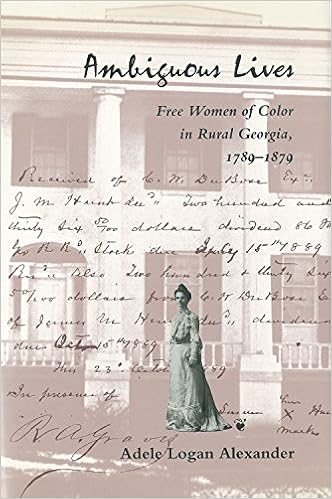
Ambiguous Lives: Free Women of Color in Rural Georgia, 1789-1879

Posted in Biography, Books, History, Media Archive, Monographs, Social Science, United States, Women on 2010-02-25 15:36Z by Steven

Ambiguous Lives: Free Women of Color in Rural Georgia, 1789-1879

University of Arkansas Press
1992
304 pages
ISBN Cloth: 1-55728-214-5
ISBN Paper: 1-55728-215-3
Out of Print

Adele Logan Alexander, Professor of History
George Washington University, Washington, D.C.

1992 Winner, Gustavus Myers award as one of the year’s outstanding books promoting racial understanding.

Historians have produced scores of studies on white men, extraordinary white women, and even the often anonymous mass of enslaved Black people in the United States. But in this innovative work, Adele Logan Alexander chronicles there heretofore undocumented dilemmas of one of nineteenth-century America’s most marginalized groups—free women of color in the rural South.

Ambiguous Lives focuses on the women of Alexander’s own family as representative of this subcaste of the African-American community. Their forbears, in fact, included Africans, Native Americans, and whites. Neither black nor white, affluent nor impoverished, enslaved nor truly free, these women of color lived and died in a shadowy realm situated somewhere between the legal, social, and economic extremes of empowered whites and subjugated blacks. Yet, as Alexander persuasively argues, these lives are worthy of attention precisely because of these ambiguities—because the intricacies, gradations, and subtleties of their anomalous experience became part of the tangled skein of American history and exemplify our country’s endless diversity, complexity, and self-contradictions.

Written as a “reclamation” of a long-ignored substratum of our society, Ambiguous Lives is more than the story of one family—it is a well-researched and fascinating profile of America, its race and gender relations, and its complex cultural weave.

Tags: , , ,

Kilombismo, Virtual Whiteness, and the Sorcery of Color

Posted in Articles, Brazil, Caribbean/Latin America, History, Identity Development/Psychology, Literary/Artistic Criticism, Media Archive, Social Science on 2010-02-25 14:11Z by Steven

Kilombismo, Virtual Whiteness, and the Sorcery of Color

Journal of Black Studies
Volume 34, Number 6 (2004)
pages 861-880
DOI: 10.1177/0021934704264009

Elisa Larkin Nascimento
Afro-Brazilian Studies and Research Institute

This article explores the legacy and current presence of racism in Brazil, particularly their unique expression in the juxtaposition of the miscegenation ideology of nonracism with the living legacy of Lombrosian criminology. The author proposes the Sorcery of Color as a metaphor for the Brazilian standard of race relations, which transforms a perverse system of racial domination into a pretense of antiracist ideals and establishes what the author describes as the category of virtual whiteness, a fulcrum of identity intrinsically intermeshed with issues of gender and patriarchy. The groundings of Afrocentric thought can be found in the writings and actions of African Brazilian intellectuals of the 20th century, and its most articulated expression is the thesis of Kilombismo, developed by Abdias do Nascimento in the context of his work in Pan-African affairs in the 1970s and 1980s.

Read or purchase the article here.

Tags: , ,

The Long Shadow of the Civil War: Southern Dissent and Its Legacies

Posted in Books, History, Media Archive, Mississippi, Monographs, Slavery, Texas, United States on 2010-02-24 02:06Z by Steven

The Long Shadow of the Civil War: Southern Dissent and Its Legacies

University of North Carolina Press
April 2010
240 pp.
6.125 x 9.25, 9 illus.
1 map, notes, bibl., index
Cloth ISBN: 978-0-8078-3381-0
Large Print ISBN: 978-0-8078-7909-2

Victoria E. Bynum, Emeritus Professor of History
Texas State University, San Marcos

In The Long Shadow of the Civil War, Victoria Bynum relates uncommon narratives about common Southern folks who fought not with the Confederacy, but against it. Focusing on regions in three Southern states–North Carolina, Mississippi, and TexasBynum introduces Unionist supporters, guerrilla soldiers, defiant women, socialists, populists, free blacks, and large interracial kin groups that belie stereotypes of the South and of Southerners as uniformly supportive of the Confederate cause.

Examining regions within the South where the inner civil wars of deadly physical conflict and intense political debate continued well into the era of Reconstruction and beyond, Bynum explores three central questions. How prevalent was support for the Union among ordinary Southerners during the Civil War? How did Southern Unionists and freed people experience both the Union’s victory and the emancipation of slaves during and after Reconstruction? And what were the legacies of the Civil War–and Reconstruction–for relations among classes and races and between the sexes, both then and now?

Centered on the concepts of place, family, and community, Bynum’s insightful and carefully documented work effectively counters the idea of a unified South caught in the grip of the Lost Cause.

Visit Dr. Bynum’s blog Renegade South here.

Tags: , , , , , ,

Husband And Wife Duo Paved The Way For Blacks In Diplomacy [Interview with Adele Logan Alexander]

Posted in Biography, History, Interviews, Live Events, Media Archive, Social Science, United States, Women on 2010-02-22 04:53Z by Steven

Husband And Wife Duo Paved The Way For Blacks In Diplomacy [Interview with Adele Logan Alexander]

Tell Me More
National Public Radio
2010-02-10

Michel Martin, Host of Tell Me More

with

Adele Logan Alexander, Professor of History
George Washington University

Tell Me More continues its Black History Month series with a conversation with Adele Logan Alexander. Alexander is professor of history at George Washington University and a member of the National Council on the Humanities. She’s also author of “Parallel Worlds,” a new book that details the lives of married couple William Henry Hunt and Ida Gibbs Hunt. William Henry Hunt was the first African-American to have a complete career in U.S. diplomacy; Ida Gibbs Hunt was an intellectual on world issues.

…MARTIN: And I have to ask you a question, which might be a delicate one for some people, which is these were both very light-skinned people.

Prof. ALEXANDER: Yes.

MARTIN: And, you know, this is an issue which has kind of newly surfaced because of, you know, Senate Majority Leader Harry Reid’s comments about Senator Obama, or rather President Obama’s complexion. But I do want to ask whether these two people moved in the world as African-Americans, or were they seen as white? Were they passing?

Prof. ALEXANDER: I am convinced, and many other sources that I quote in this book are convinced that one of the reasons he lasted so long with the State Department was that they really weren’t quite 100 percent sure. But one of the tricky points with this comes when what do you do when people simply assume in a world where you don’t think in the middle of France, where certainly the local people didn’t run into African-Americans all of that time – here is this sophisticated man, here is this consul who likes to do sporting things and ride horses and eat fine food and wine. He is not part of their image of what a black man is supposed to be. And, of course, in France a lot of the things that black people were pictured as had to do with their colonial visions, and they didn’t fit this picture…

 Listen to the interview and/or read the transcript here.

Tags: , , , , ,