“A Black Girl Should Not be With a White Man”: Sex, Race, and African Women’s Social and Legal Status in Colonial Gabon, c. 1900–1946

Posted in Africa, Articles, History, Law, Media Archive, Social Science, Women on 2010-06-16 05:06Z by Steven

“A Black Girl Should Not be With a White Man”: Sex, Race, and African Women’s Social and Legal Status in Colonial Gabon, c. 1900–1946

Journal of Women’s History
Volume 22, Number 2, Summer 2010
E-ISSN: 1527-2036
Print ISSN: 1042-7961
DOI: 10.1353/jowh.0.0140

Rachel Jean-Baptiste, Associate Professor of African History
University of California, Davis

This article reviews representations and lived experiences of interracial sex and métissage in twentieth-century colonial Gabon to argue that African communities and colonial societies debated over “the métis problem” as question of how to demarcate African women’s sexuality, and socioeconomic and political power in the urban locale. These discourses and social realities reflected ambiguous and contradictory colonial discourses and polyvalent struggles among Gabonese populations to recast gender and respectability in the colonial capital city. Mpongwé women’s participation in interracial relationships, frequently brokered by male kin, had unintended consequences that threatened colonial order and reordered gender hierarchies within Mpongwé communities. Following World War I through the 1950s, shifting coalitions of elite African men, colonial officials, and private French citizens—anxious of the social mobility black and mixed race women achieved and sought to maintain—frowned upon and sought to restrict interracial liasons. Mpongwé women, both black and métis, involved in interracial relationships struggled to maintain control over their property, their labor, and insist upon their respectability in the precarious urban milieu. Using oral and written sources, this article addresses a gap in the scholarship on gender, sexuality, and colonialism by foregrounding how African women and men engaged in and reflected on miscegenation at the center of analysis. Furthermore, this article emphasizes the colonial encounter as a dialectic in which the actions of African women shaped colonial perceptions and policies.

Read or purchase the article here.

Tags: , , ,

In Search of Nella Larsen: A Biography of the Color Line

Posted in Biography, Books, Media Archive, Monographs, United States, Women on 2010-06-12 00:41Z by Steven

In Search of Nella Larsen: A Biography of the Color Line

Harvard University Press
May 2006
624 pages
6-3/8 x 9-1/4 inches
37 halftones
Hardcover ISBN: 9780674021808

George Hutchinson, Newton C. Farr Professor of American Culture
Cornell University

  • 2006 Booklist Editor’s Choice
  • 2006 Honorable Mention of the Professional/Scholarly Publishing Annual Award Competition, Biography & Autobiography
  • Finalist, 2007 Independent Publisher Book Awards, Biography Category
  • 2007 Christian Gauss Award for literary scholarship or criticism, Phi Beta Kappa Society
  • Choice Magazine A Best Academic Book of the Year

Born to a Danish seamstress and a black West Indian cook in one of the Western Hemisphere’s most infamous vice districts, Nella Larsen (1891-1964) lived her life in the shadows of America’s racial divide. She wrote about that life, was briefly celebrated in her time, then was lost to later generations–only to be rediscovered and hailed by many as the best black novelist of her generation. In his search for Nella Larsen, the “mystery woman of the Harlem Renaissance,” George Hutchinson exposes the truths and half-truths surrounding this central figure of modern literary studies, as well as the complex reality they mask and mirror. His book is a cultural biography of the color line as it was lived by one person who truly embodied all of its ambiguities and complexities.

Author of a landmark study of the Harlem Renaissance, Hutchinson here produces the definitive account of a life long obscured by misinterpretations, fabrications, and omissions. He brings Larsen to life as an often tormented modernist, from the trauma of her childhood to her emergence as a star of the Harlem Renaissance. Showing the links between her experiences and her writings, Hutchinson illuminates the singularity of her achievement and shatters previous notions of her position in the modernist landscape. Revealing the suppressions and misunderstandings that accompany the effort to separate black from white, his book addresses the vast consequences for all Americans of color-line culture’s fundamental rule: race trumps family.

Tags: , ,

What’s at stake in claims of “post-racial” media?

Posted in Articles, Communications/Media Studies, Media Archive, Social Science, United States on 2010-06-09 06:45Z by Steven

What’s at stake in claims of “post-racial” media?

FlowTV
Department of Radio, Television, and Film at the University of Texas at Austin
2010-06-03

Mary C. Beltrán, Associate Professor of Media Studies
University of Texas, Austin

Tracy Morgan, comedic actor best known for his role as comedic performer Tracy Jordan on the NBC series 30 Rock (2006+), trumpeted America’s supposed post-racial identity at the Golden Globe Awards in January 2009. When 30 Rock was awarded Best Musical or Comedy Television Series, he gleefully snatched the statuette from Tina Fey, creator and star of the series, quipping, “Tina Fey and I had an agreement that if Barack Obama won, I would speak for the show from now on.” He continued, “Welcome to post-racial America! I am the face of post-racial America. Deal with it, Cate Blanchett! We’d like to thank the Hollywood Foreign Press … especially me, ’cause a black man can’t get no love at the Emmys. I love you, Europe! That’s what’s up!”…

…Unsurprisingly, when used in description of media trends, post-racial has taken on differing meanings both for scholars and media professionals. For one, it’s been used as shorthand to describe purported progress in ethnic/racial inclusion in employment and casting, as appears to be at least part of what Morgan had in mind in his claim that he is the face of post-racial America. In fact, a fair number of television series and films now integrate a few characters of color into their casts (notably, this was described recently by the Hollywood Reporter as perhaps due in part to an “Obama effect”), and we’ve witnessed a growing number of non-white and mixed race stars. Important to note and study, a major catalyst of these shifts is a turn away from niche productions targeting African American or Latina/o audiences to media texts that aim instead to appeal to a broad, multicultural audience. Arguably this does not make these texts post-racial (Dale Hudson’s concept of “multicultural whiteness” comes closer to describing this trend in relation to the continuing centrism of whiteness), but does raise the need for new methodological tools and theoretical frameworks for studying ethnic and racial representation in this supposed post-racial era. Also important to take into consideration is the continuing and sometimes growing underrepresentation of creative professionals of color behind the screen in tandem with “post-racial” shifts.

There is a need in such study to also take note of the casting and portrayal of mixed-race actors and individuals in Hollywood media productions. I’ve noted in my own work that the rhetoric of post-race has followed in the wake of the rising vogue for mixed-race and racially ambiguous actors and models since the 1990s. The “raceless” or “ethnically ambiguous” aesthetic (as I and journalist Ruth La Ferla described this trend, respectively), particularly noticeable in contemporary tween programming and stardom, is an important strand of contemporary media formations that at times falls into descriptions of post-racial trends. Given that mixed-race representation does offer the potential to highlight the constructed nature of race and fissures in racial boundaries, as Camilla Fojas and I discuss in the introduction to Mixed Race Hollywood, this will be an important site of study in relation to the implications of contemporary trends in ethnic and racial representation…

Read the entire article here.

Tags: , ,

What Does “White” Mean? Interpreting the Choice of “Race” by Mixed Race Young People in Britain

Posted in Articles, Census/Demographics, Identity Development/Psychology, Media Archive, Social Science, United Kingdom on 2010-06-09 05:08Z by Steven

What Does “White” Mean? Interpreting the Choice of “Race” by Mixed Race Young People in Britain

Sociological Perspectives
Volume 53, Number 2 (Summer 2010)
Pages 287–292
DOI: 10.1525/sop.2010.53.2.287

Miri Song, Professor of Sociology
University of Kent

Ferhana Hashem, Research Fellow
Centre for Health Services Studies
University of Kent

Despite the often cited idea that racial identities are socially constructed, and potentially fluid, much public policy is still based on surveys that elicit only one measure of racial identity. A number of U.S. studies have employed “best single race” questions on racial identification, in which multiracial respondents are asked to choose only one race to describe themselves. We extend some American studies by examining responses to a “best single race” survey question posed to a small sample of multiracial young people in Britain. In-depth interviews with British multiracial respondents are employed to investigate the extent to which a “best single race” (BSR) question captures someone’s sense of attachment and belonging to a particular ethnic or racial group. In particular, we focus on how we should interpret East Asian/white respondents’ choice of “white” as their BSR.

Read or purchase the article here.

Tags: , ,

Race in an Era of Change: A Reader

Posted in Family/Parenting, Health/Medicine/Genetics, History, Identity Development/Psychology, Law, Media Archive, Native Americans/First Nation, Politics/Public Policy, Social Science, United States on 2010-06-08 04:42Z by Steven

Race in an Era of Change: A Reader

Oxford University Press
September 2010
544 pages
ISBN13: 9780199752102
ISBN10: 0199752109

Edited By:

Heather Dalmage, Professor of Sociology and Director of the Mansfield Institute
Roosevelt University

Barbara Katz Rothman, Professor of Sociology
Baruch College of the City Univerity of New York
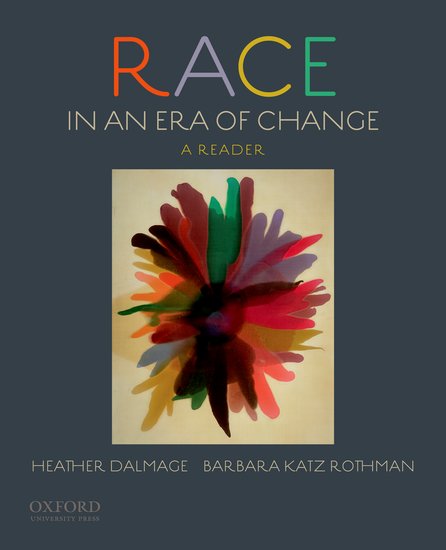
Featuring a wide range of classic and contemporary selections, Race in an Era of Change: A Reader is an affordable and timely collection of articles on race and ethnicity in the United States today. Opening with coverage of racial formation theory, it goes on to cover “racial thinking” (including the challenging and compelling concept of “whiteness”) and the idea of “assigned and claimed” racial identities. The book also discusses the relationships between race and a variety of institutions—including healthcare, economy and work, housing and environment, education, policing and prison, the media, and the family—and concludes with a section on issues of globalization, immigration, and citizenship.

Editors Heather Dalmage and Barbara Katz Rothman have carefully edited the selections so that they will be easily accessible to students. A detailed introduction to each article contains questions designed to help students focus as they begin reading. In addition, each article is followed by a “journaling question” that encourages students to share their responses to the piece. Offering instructors great flexibility for course use—the selections can be used in any combination and in any order—Race in an Era of Change: A Reader is ideal for any undergraduate course on race and ethnicity.

Table of Contents

PART I: RACIAL FORMATION THEORY

1. Michael Omi and Howard Winant, from Racial Formation in the United States
2. Eva Marie Garroutte, “The Racial Formation of American Indians”
3. Nicholas DeGenova and Ana Y. Ramos-Zayas, “Latino Racial Formations in the United States: An Introduction”

PART II: RACIAL THINKING

Essentialism

4. Joanne Nagel, “Sex and Conquest: Domination and Desire on Ethnosexual Frontiers”
5. Janell Hobson, “The “Batty” Politics: Towards an Aesthetic of the Black Female Body”
6. Barbara Katz-Rothman, from The Book of Life: A Personal Guide to Race, Normality, and the Implications of the Genome Project
A Voice from the Past: Franz Boas, “Race and Progress”

The Social Construction of Race

7. Eduardo Bonilla Silva, David Embrick, Amanda Lewis, “‘I did not get that job because of a Black man…’ The storylines and testimonies of color-blind racism”
8. Margaret Hunter, “The Beauty Queue: Advantages of Light Skin”
9. Heather Dalmage, “Discovering Racial Borders”
A Voice from the Past: W.E.B. Du Bois, “The Conservation of the Races”

Outing Whiteness

A Special Introduction by the Editors
10. France Winddance Twine and Charles Gallagher, “Introduction: The Future of Whiteness: A Map of the ‘Third Wave'”
11. Troy Duster, “The Morphing Properties of Whiteness”
12. Jennifer L. Eichstedt, “Problematic Identities and a Search for Racial Justice”
A Voice from the Past: Frederick Douglass, “The Color Line”

PART III: RACIAL IDENTITIES

A Special Introduction by the Editors
13. Joy L. Lei, “(Un) Necessary Toughness?: ‘Those Loud Black Girls’ and Those ‘Quiet Asian Boys'”
14. Nada Elia, “Islamophobia and the ‘Privileging’ of Arab American Women”
15. Nina Asher, “Checking the Box: The Label of ‘Model Minority'”
16. Patty Talahongva, “Identity Crisis: Indian Identity in a Changing World”
17. Juan Flores, “Nueva York – Diaspora City: U.S. Latinos Between and Beyond”
18. Nancy Foner, “The Social Construction of Race in Two Immigrant Eras”

PART IV: RACIALIZED AND RACIALIZING INSTITUTIONS

Economy and Work

19. Sherry Cable and Tamara L. Mix, “Economic Imperatives and Race Relations: The Rise and Fall of the American Apartheid System”
20. Marianne Bertrand and Sendhil Mullainathan, “Are Emily and Greg More Employable than Lakisha and Jamal? A Field Experiment on Labor Market Discrimination”

Housing & Environment

21. Benjamin Howell, “Exploiting Race and Space: Concentrated Subprime Lending as Housing Discrimination”
22. Mary Patillo, “Black Middle Class-Class Neighborhoods”
23. Kari Marie Norgaard, “Denied Access to Traditional Foods Including the Material Dimension to Institutional and Environmental Racism”

Education

24. Linda Darling-Hammond, “Race, Inequality, and Educational Accountability: The Irony of ‘No Child Left Behind'”
25. Amanda E. Lewis, Mark Chesler, and Tyrone Forman, “The Impact of ‘Colorblind’ Ideologies on Students of Color: Intergroup Relations at a Predominantly White University”

Policing and Prison

26. Loic Wacquant, “Deadly Symbiosis: When Ghetto and Prison Meet and Mesh”
27. David Harris, “U.S. Experiences with Racial and Ethnic Profiling: History, Current Issues, and the Future”

Media

28. Jose Antonio Padin, “The Normative Mulattoes: The Press Latinos. And the Racial Climate on the Moving Immigration Frontier”
29. Jonathan Markovitz, “Anatomy of a Spectacle: Race, Gender, and Memory in the Kobe Bryant Rape Case”

Family

30. Dorothy Roberts, from Shattered Bonds: The Color of Child Welfare
31. Krista M Perreira, Mimi V Chapman, and Gabriela L Stein, “Becoming an American Parent: Overcoming Challenges and Finding Strength in a New Immigrant Latino Community”

Healthcare

32. Mathew R. Anderson, Susan Moscou, Celestine Fulchon and Daniel R. Neuspiel, “The Role of Race in the Clinical Presentation”
33. Susan Starr Sered and Rushika Fernandopulle, “Uninsured in America: Life and Death in the Land of Opportunity”

PART V: GLOBALIZATION, IMMIGRATION AND CITIZENSHIP

34. Anupam Chander, “Flying the Mexican Flag in Los Angeles”
35. Patricia Hill Collins, “New Commoditites, New Consumers: Selling Blackness in a Global Marketplace”
36. William I. Robinson, “‘Aqui estamos y no nos vamos!’: Global capital and immigrant rights”

Tags: , ,

Ushering children away from a “light grey world”: Dr. Daniel Hill III and his pursuit of a respectable Black Canadian community.

Posted in Articles, Canada, Media Archive, Social Science on 2010-06-06 02:59Z by Steven

Ushering children away from a “light grey world”: Dr. Daniel Hill III and his pursuit of a respectable Black Canadian community.

Ontario History
2007-03-22

Daniel R. McNeil, Lecturer in Media and Cultural Studies
Newcastle University, United Kingdom

This paper is about Dr. Daniel Hill III, the first director of the Ontario Human Rights Agency. Paying particular attention to Dr Hill’s work with the Committee for the Adoption of Coloured Youngsters and the Ontario Black History Society, I argue that he fashioned himself as “Negro race man”, a masculinist term assigned to people who sought to lead a Black community in North America and lay to rest the infantilised and feminized image of the “tragic mulatto” trapped in a “light grey world”.

Read or purchase the article here.

Tags: , , ,

Marrying Out: One-in-Seven New U.S. Marriages is Interracial or Interethnic

Posted in Asian Diaspora, Census/Demographics, Media Archive, Reports, Social Science, United States on 2010-06-04 21:56Z by Steven

Marrying Out: One-in-Seven New U.S. Marriages is Interracial or Interethnic

Pew Research Center
2010-06-04
41 pages

Paul Taylor, Project Director
Pew Research Center

Jeffrey S. Passel, Senior Demographer
Pew Research Center

Wendy Wang, Research Associate
Pew Research Center

Jocelyn Kiley, Research Associate
Pew Research Center

Gabriel Velasco, Research Analyst
Pew Research Center

Daniel Dockterman, Research Assistant
Pew Research Center

A record 14.6% of all new marriages in the United States in 2008 were between spouses of a different race or ethnicity from each other, according to a Pew Research Center analysis of new data from the U.S. Census Bureau.

That figure is an estimated six times the intermarriage rate among newlyweds in 1960 and more than double the rate in 1980.

This dramatic increase has been driven in part by the weakening of longstanding cultural taboos against intermarriage and in part by a large, multi-decade wave of immigrants from Latin America and Asia.

In 1961, the year Barack Obama’s parents were married, less than one in 1,000 new marriages in the United States was, like theirs, the pairing of a black person and a white person, according to Pew Research estimates. By 1980, that share had risen to about one in 150 new marriages. By 2008, it had risen to one-in-sixty.

Key findings:

  • A record 14.6% of all new marriages in the United States in 2008 were between spouses of a different race or ethnicity from one another. This includes marriages between a Hispanic and non-Hispanic (Hispanics are an ethnic group, not a race) as well as marriages between spouses of different races — be they white, black, Asian, American Indian or those who identify as being of multiple races or “some other” race.
  • Among all newlyweds in 2008, 9% of whites, 16% of blacks, 26% of Hispanics and 31% of Asians married someone whose race or ethnicity was different from their own.
  • Gender patterns in intermarriage vary widely. Some 22% of all black male newlyweds in 2008 married outside their race, compared with just 9% of black female newlyweds. Among Asians, the gender pattern runs the other way. Some 40% of Asian female newlyweds married outside their race in 2008, compared with just 20% of Asian male newlyweds. Among whites and Hispanics, by contrast, there are no gender differences in intermarriage rates.
  • Rates of intermarriages among newlyweds in the U.S. more than doubled between 1980 (6.7%) and 2008 (14.6%). However, different groups experienced different trends. Rates more than doubled among whites and nearly tripled among blacks. But for both Hispanics and Asians, rates were nearly identical in 2008 and 1980.
  • These seemingly contradictory trends were both driven by the heavy, ongoing Hispanic and Asian immigration wave of the past four decades. For whites and blacks, these immigrants (and, increasingly, their U.S.-born children who are now of marrying age) have enlarged the pool of potential spouses for out-marriage. But for Hispanics and Asians, the ongoing immigration wave has also enlarged the pool of potential partners for in-group marriage.
  • There is a strong regional pattern to intermarriage. Among all new marriages in 2008, 21% in the West were interracial or interethnic, compared with 13% in both the South and Northeast and 11% in the Midwest.
  • Most Americans say they approve of racial or ethnic intermarriage — not just in the abstract, but in their own families. More than six-in-ten say it “would be fine” with them if a family member told them they were going to marry someone from any of three major race/ethnic groups other than their own.
  • More than a third of adults (35%) say they have a family member who is married to someone of a different race. Blacks say this at higher rates than do whites; younger adults at higher rates than older adults; and Westerners at higher rates than people living in other regions of the country.

Table of Contents

Executive Summary

Section I. Overview
Section II. Intermarriage by Race and Ethnicity
Section III. Intermarriage Trends
Section IV. Attitudes about Intermarriage

Appendices
Methodology
Additional charts
State and Regional Rates

Read the entire report here.

Tags: , , , , , , ,

Exploring the Many Facets of Mixed-Race Identity

Posted in Articles, Identity Development/Psychology, Media Archive, Social Science, United States on 2010-06-03 04:03Z by Steven

Exploring the Many Facets of Mixed-Race Identity

Renegade South: histories of unconventional southerners
2010-05-26

Victoria E. Bynum, Moderator and Emeritus Professor of History
Texas State University, San Marcos

In recent weeks, The Family Origins of Vernon Dahmer, Civil Rights Activist, by Yvonne Bivins and Wilmer Watts Backstrom, published December 6, 2009 on Renegade South, has received increased attention and interesting comments from readers. I’m pleased that Tiffany Jones even republished it on her blog, Mulatto Diaries.

A few readers of Renegade South posed interesting questions after reading the Dahmer history.  ”Ms T. A.”, for example, wondered what caused Vernon Dahmer, a man of limited African ancestry, to identify as “black,” and ultimately sacrifice his life working for black civil rights. Also, in regard to racial identification, A.D. Powell (author of Passing for Who You Really Are: Studies in Support of Multiracial Whiteness), drew attention to two instances in which the mixed-race infants of unmarried white women were reportedly given to mulatto families to be raised.

To better understand the ways in which economic class as well as race have historically shaped multiracial communities, I returned to my research files on mixed-race people, and also to a few books on my shelf.  In her 1986 history of the Horne family, for example, Gail Lumet Buckley illuminated the “old black bourgeoisie” from which her mother, Lena Horne, descended. That elite group, writes Buckley, was comprised of “three segments of black society in existence before the Civil War: free northern blacks, free southern blacks, and ‘favored’ slaves.” (The Hornes: An American Family, p. 4)*…

Read the entire article here.

Tags: , ,

An Existential Gaze at Multiracial Self-Concept: Implications for Psychotherapy

Posted in Articles, Identity Development/Psychology, Media Archive on 2010-06-03 03:31Z by Steven

An Existential Gaze at Multiracial Self-Concept: Implications for Psychotherapy

Journal of Humanistic Psychology
Volume 50, Number 3 (July 2010)
DOI: 10.1177/0022167810365909

Matthew J. Taylor, Assistant Professor of Psychology
University of Missouri, St. Louis

John T. Nanney
Department of Psychology
University of Missouri, St. Louis

Multiracial self-concept is conceptualized using an existential framework. First, the authors offer an analysis of how existential concerns are revealed within the multiracial experience, employing the theoretical constructs of terror management and social identity theories. Expanding on this foundation, they apply Heideggerian notions of human existence and self to multiracialness. And finally, using the aforementioned analysis as a backdrop, the authors discuss the emergence of existential themes in psychotherapy with multiracial individuals.

Read or purchase the article here.

Tags: , , , ,

Biracial Identity and Its Relation to Self-Esteem and Depression in Mixed Black/White Biracial Individuals

Posted in Articles, Identity Development/Psychology, Media Archive, United States on 2010-06-03 02:38Z by Steven

Biracial Identity and Its Relation to Self-Esteem and Depression in Mixed Black/White Biracial Individuals

Journal of Ethnic And Cultural Diversity in Social Work
Volume 19, Issue 2 (April 2010)
pages 109 – 126
DOI: 10.1080/15313201003771783

Elizabeth M. Lusk
Department of Psychology
Washburn University, Topeka, Kansas

Matthew J. Taylor, Assistant Professor of Psychology
University of Missouri, St. Louis

John T. Nanney
Department of Psychology
University of Missouri, St. Louis

Chammie C. Austin, Assistant Professor of Psychology
Maryville University, St. Louis

The present study examined how self-identification and ethnic identity relate to levels of depression and self-esteem in black/white biracial individuals. Seventy-four black/white biracial individuals were recruited using a modified snowball sampling technique and completed online survey measures related to self-identification, ethnic identity, self-esteem, and depression. Ethnic identity was positively related to self-esteem and negatively to depression. Results also revealed that participants who either identified as biracial all the time (border identity) or sometimes (protean identity) had higher self-esteem and lower levels of depression than those who did not acknowledge their biracial identity (singular and transcendent identity). This study suggests the incorporation of both component races, rather than choosing one or denying both races as part of the identity, is associated with better psychosocial adjustment.

Read or purchase the article here.

Tags: , , , , , , , ,