From Slavery to Wealth: The Life of Scott Bond

Posted in Biography, Books, Media Archive, Monographs, Slavery, United States on 2013-01-01 01:56Z by Steven

From Slavery to Wealth: The Life of Scott Bond

University of Arkansas Press
February 2008 (Originally Published: 1917)
336 pages
6 x 9; 72 photographs and index
ISBN 13: 978-0-9768007-6-7 ISBN 10: 0-9768007-6-4

Dan. A. (Daniel Arthur) Rudd (1854-1933)

Theo. (Theophilus) Bond

Edited with a new Preface and Introduction by

Willard B. Gatewood, Alumni Distinguished Professor of History Emeritus
University of Arkansas, Fayetteville
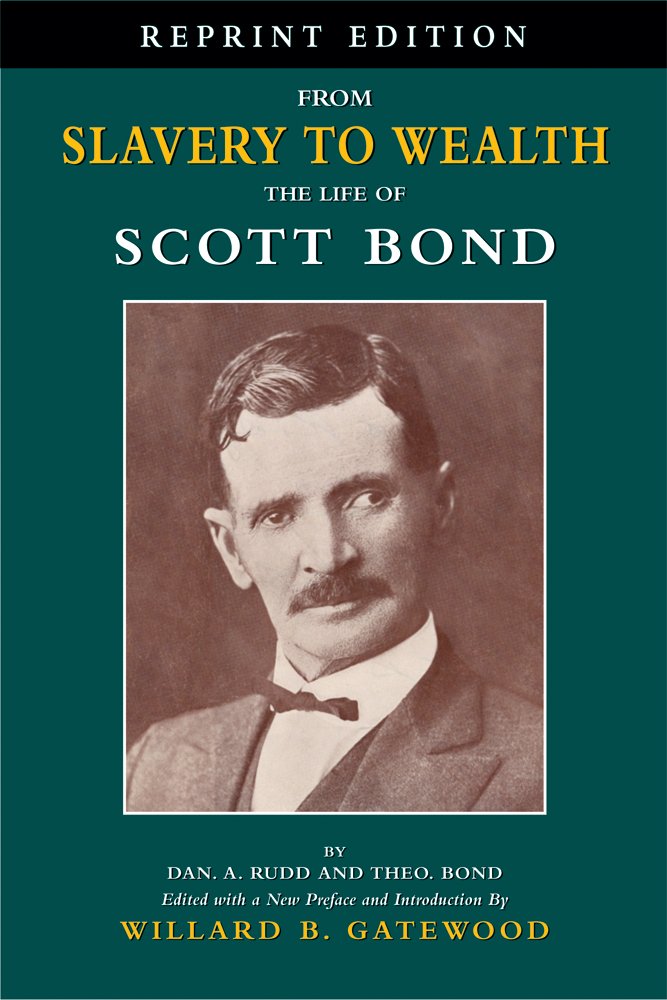
In an era in which African Americans were oppressed and deprived of many of the rights and privileges of citizenship, Scott Bond rose from being born a slave in Madison County, Mississippi, in the early 1850s to wealth and status as a farmer, merchant, and business entrepreneur in Madison, Arkansas, by the early 1900s. From Slavery to Wealth is the story of an extraordinary individual widely known and respected at the time of its first publication in 1917, for his integrity, prodigious energy, and strong work ethic. Throughout his career he never wearied of imploring African Americans to seize the opportunities offered them in the South in general and in the Arkansas Delta in particular. Scott Bond enjoyed an enviable reputation among blacks as well as whites. This reputation ultimately extended far beyond his local community to prominent blacks throughout the South and elsewhere, especially after he gained wider exposure as a conspicuous figure in the National Negro Business League in the early years of the twentieth century.

With this 2008 reprint edition, the current generation can be inspired by the man who has been referred to as the black John D. Rockefeller of Arkansas.

Read the entire book (From Slavery to Wealth. The Life of Scott Bond. The Rewards of Honesty, Industry, Economy and Perseverance) via “Documenting the American South” here.

Scott Bond was born in the early 1850s to an enslaved mother named Ann who worked in the Maben-Bond household near Canton, Mississippi. His father was the nephew of a white slave-owner to whom Bond’s mother had temporarily been hired out as a domestic servant. Just prior to the outbreak of the Civil War, Bond and his mother were moved to Arkansas, along with his step-father, William Bond, and the rest of the Maben-Bond family’s slaves. After Emancipation, Bond lived with his step-father until age twenty-two, when he “undertook to vouch for himself” and began work on his lifelong goal of becoming a successful businessman (p. 37). Bond accomplished this goal. At the time of his death he owned and farmed 12,000 acres, while also raising livestock and operating a large mercantile store, at least five cotton gins, a gravel pit, a lumber yard, and a saw mill. A member of the National Negro Business League, Bond supported the efforts of Booker T. Washington, whose philosophies regarding the social advancement of African Americans through economic and agricultural success mirrored Bond’s own. In 1877, he married Magnolia Nash, with whom he had eleven sons. Bond was killed in March 1933 by one of his registered bulls. According to his son, Ulysses, he “went down swinging and died among the things he loved” (p. 152)…

Read the entire summary here.

Tags: , , , , , , , ,

Why isn’t ‘colorism’ gone?

Posted in History, Media Archive, Slavery, Social Science, United States, Videos on 2012-12-09 02:02Z by Steven

Why isn’t ‘colorism’ gone?

Cable News Network (CNN)
2012-12-05

Has “colorism” disappeared? CNN’s Soledad O’Brien asks author and Activist Tim Wise.

Tags: , , ,

Rosa Mahier’s Freedom: Identity and the Maintenance of Liberty in Antebellum Louisiana

Posted in Forthcoming Media, History, Louisiana, Papers/Presentations, Slavery, United States, Women on 2012-11-25 21:54Z by Steven

Rosa Mahier’s Freedom: Identity and the Maintenance of Liberty in Antebellum Louisiana

127th Annual Meeting of the American Historical Association
New Orleans, Louisiana
2013-01-03 through 2013-01-06

Saturday, 2013-01-05: 14:50 CST (Local Time)
Chamber Ballroom I (Roosevelt New Orleans)
Paper in AHA Session 220: Manipulating Freedom: Liberty, Enslavement, and the Quest for Power in the Southwestern Borderlands (2013-01-05: 14:30-16:30 CST)

Johanna Lee Davis Smith
Tulane University

Rosa Mahier had lived her whole life in Mulatto Bend, a little community located a short distance from Baton Rouge.  Born a slave in 1813 and legally freed in 1827, Rosa was a familiar member of a network of free people of color which had lived and worked within and throughout the larger white population of the area since the 1780s.  Most of the inhabitants – black as well as white, Rosa included – were descended from local families of longue durée, and the free people of color in the community carefully cultivated their identity in order to perpetuate the security of their free status.  Rosa Mahier had been legally free for twenty years when Fergus Mahier, the white nephew of the man who once owned her, took legal action in an attempt to re-enslave her and her freeborn children.

Fergus Mahier did not ultimately prevail in his lawsuit, but his petition is as compelling for what he did not demand as for what he did.  Mahier did not attempt to re-enslave Rosa’s two brothers or her grandmother, all of whom had been manumitted at the same time and in the same way as Rosa, nor did he include Rosa’s mother Agnes, who also had been owned and freed by the Mahier family.  Therefore, the brief record of the case offers the opportunity to weigh the roles of identity, status, gender, wealth, and power as factors in the successful maintenance of liberty among free people of color in antebellum Louisiana.  Mahier’s motivation for the suit and the individual characteristics of the people involved present a trenchant illustration of the hair’s breadth that separated slavery and freedom, as well as the continuous efforts of aspiring slaveowners to breach that line.

Tags: , , ,

Donas, Signares, and Free Women of Color: African and Eurafrican Women of the Atlantic World in an Age of Racial Slavery

Posted in Africa, History, Live Events, Papers/Presentations, Slavery, Women on 2012-11-25 05:39Z by Steven

Donas, Signares, and Free Women of Color: African and Eurafrican Women of the Atlantic World in an Age of Racial Slavery

127th Annual Meeting of the American Historical Association
New Orleans, Louisiana
2013-01-03 through 2013-01-06

AHA Session 153
Saturday, 2013-01-05: 09:00-11:00 CST (Local Time)
Chamber Ballroom II (Roosevelt New Orleans)

Chair: Hilary Jones, University of Maryland, College Park

Papers:

Comment: Lorelle D. Semley, College of the Holy Cross

In the age of the Atlantic Slave Trade, African and Eurafrican women emerged as intermediaries between foreign traders and local populations. Europeans’ lack of knowledge in African languages, trade networks, local culture, social structures and political institutions provided African and Eurafrican women a unique opportunity to become cultural and economic brokers.  Portuguese adventurers on the coast of West Africa first named these women “senhoras” in the 16th century. Although Portuguese men coined the term, they were not the only Europeans to name and have socio-economic relationships with African and Eurafrican women. Over time each European group made the original Portuguese term their own: in Crioulo it became “nhara”, in French “signare”, in English “senora”, and “dona” among the Portuguese of Central Africa.  These ‘middle-women” surfaced all along the coast of Africa from the Senegambia to Mozambique between the 15th and the 20th centuries, although the most famous of these women were found in the port cities of Bathurst, Benguela, Bissao, Cacheu, Goree, Joal, Luanda, Osu, Portudal, Rufisque and Saint Louis. These women formed a distinct group within African and Afro-Atlantic society during an age of racial slavery, but the duration and trajectory of their lives varied across time and place.

“Donas, Signares & Free Women of Color” gathers scholars working on female African and Eurafrican entrepreneurs, brokers, and partners who allied with Portuguese, Spanish, French and Danish men in one specific enclave of Africa or the Americas. Together these four papers will question what made these women unique, how different European powers perceived them, if and how partnering with one particular European power over another influenced these women, and how their actions were shaped by their local environments. Panelists’ papers will also explore the trans-regional and trans-Atlantic connections between women in each society, drawing on comparative frameworks to interrogate the similarities and differences between each group. By exploring the individual stories of African and Eurafrican “middle-women” across the Atlantic world, this panel will move the scholarship beyond exoticism and generalizations. The panel’s ultimate goal is to determine if these women can and should be discussed as a coherent collective group throughout the Atlantic World or if scholars should continue to examine each group separately.

Tags: , , , , , , , , , , , , ,

Life Stories, Local Places, and the Networks of Free Women of Color in Early North America

Posted in History, Live Events, Louisiana, Papers/Presentations, Slavery, United States, Virginia, Women on 2012-11-24 01:01Z by Steven

Life Stories, Local Places, and the Networks of Free Women of Color in Early North America

127th Annual Meeting of the American Historical Association
New Orleans, Louisiana
2013-01-03 through 2013-01-06

AHA Session 72
Friday, 2013-01-04: 08:30-10:00 CST (Local Time)
Preservation Hall, Studio 7 (New Orleans Marriott)

Chair: Daina Ramey Berry, University of Texas, Austin

Papers:

Comment: Anthony S. Parent, Wake Forest University

The three papers included in this panel share several themes significant to new directions in the history of women of color in North America and the Caribbean.

First, all three papers are concerned with the importance of networks, and the relationship between networks and localities.  In these papers, networks sustain women’s claims to freedom, and networks are closely associated with places.  Terri Snyder finds, for example, that Jane Webb and her daughter Elisha strengthened their positions in 18th century courtrooms–rarely hospitable to women of color–by drawing on local knowledge to support their claims to justice.  For Elisha, her mother’s networks in Virginia eventually intervened to secure her freedom in New Hampshire.  Elizabeth Neidenbach’s research in the wills of refugees from St. Domingue uncovers women’s networks expressed in the streets and neighborhoods of New Orleans–networks that reach back to the island home left behind.  Not only did these networks help refugee women survive, they played a significant role in shaping the culture of the city.  Finally, Sharon Wood’s research underscores the importance of African American-controlled space to the emergence of a black public sphere.  Property in Illinois owned by Priscilla, a former slave, became the meeting place when leading white men of St. Louis sought to suppress African American organizing by shutting off their access to space.  

Finally, all three papers are concerned with methodologies of doing history and biography at the intersections of race and gender in early North America. Focusing on relatively ordinary women of color, each paper aims to recover the lives of particular women and integrate them into history. Until very recently, it has been a truism that the life stories of unlettered, enslaved, and free women of color of the 17th, 18th, and early 19th centuries must remain unwritten because the sources to uncover their lives did not exist. Yet each of these papers, by imaginative use of primary sources and diligent linking of records across national, colonial, and state borders, challenges that claim, giving voice and flesh to women whose lives would otherwise remain fragmented among scattered documents.

This session addresses audiences interested in the histories of women, slavery and freedom, and geographical and biographical approaches to history.

Tags: , , , , , , , , , ,

Fathers of Conscience with Bernie D. Jones

Posted in Audio, History, Interviews, Law, Live Events, Media Archive, Slavery, United States on 2012-11-04 23:16Z by Steven

Fathers of Conscience with Bernie D. Jones

Research at the National Archives & Beyond
Blogtalk Radio
2012-11-08, 21:00 EST (2012-11-09, 02:00Z)

Bernice Bennett, Co-Host

Natonne Elaine Kemp, Co-Host

Bernie D. Jones, Associate Professor of Law
Suffolk University, Boston, Massachusetts

Fathers of Conscience: Mixed-Race Inheritance in the Antebellum South

Bernice Bennett and Natonne Elaine Kemp welcome author Bernie D. Jones for an engaging discussion about her book—Fathers of Conscience: Mixed-Race Inheritance in the Antebellum South. Jones is Associate Professor, Suffolk University Law School.  She is a graduate of the New York University Law School and the University of Virginia Department of History.

Fathers of Conscience examines high-court decisions in the antebellum South that involved wills in which white male planters bequeathed property, freedom, or both to women of color and their mixed-race children. These men, whose wills were contested by their white relatives, had used trusts and estates law to give their slave partners and children official recognition and thus circumvent the law of slavery. The will contests that followed determined whether that elevated status would be approved or denied by courts of law.

For more information, click here.

Tags: , , , ,

Figuring Abjection: The Slave Mother in the Early Creole Novel

Posted in Articles, Caribbean/Latin America, Literary/Artistic Criticism, Media Archive, Slavery on 2012-11-04 02:46Z by Steven

Figuring Abjection: The Slave Mother in the Early Creole Novel

French Studies
Volume 67, Issue 1, January 2013
pages 61-75
DOI: 10.1093/fs/kns232

Maeve McCusker
School of Modern Languages
Queen’s University Belfast

While twentieth-century Caribbean literature in French has generated a substantial body of criticism, earlier writings have largely been neglected. This article begins by contextualizing the Creole novel of the 1830s in cultural and historical terms, then proceeds to analyse two novels published by Martinican authors in 1835: Outre-mer by Louis de Maynard de Queilhe and Les Créoles by Jules Levilloux. The few studies that exist of these texts tend to contrast their portrayal of the (male) mulatto; Levilloux has generally been considered the more progressive writer in this regard. However, both writers are in striking harmony in their depiction of the black mother, a figure (in both senses, as her physiognomy is central in her portrayal) who has until now been overlooked. In Outre-mer, as in Les Créoles, the elderly black mother is an abject and wretched creature, a source of phobic disgust. She has necessarily to be shown to be repulsive, filthy, and morally hideous in old age in order to counteract the fascination she provokes, and to embody a phantasized repellent to the desires of the white male.

Read or purchase the article here.

Tags: , , ,

The Long Walk to Freedom: Runaway Slave Narratives

Posted in Anthologies, Books, History, Media Archive, Passing, Slavery, United States, Women on 2012-10-25 17:29Z by Steven

The Long Walk to Freedom: Runaway Slave Narratives

Beacon Press
2012-08-21
288 pages
6″ x 9″
Cloth ISBN: 978-080706912-7

Devon W. Carbado, Professor of Law and African American Studies
University of California, Los Angeles

Donald Weise, Independent Scholar in African American history

The first book about the runaway slave phenomenon written by fugitive slaves themselves.

In this groundbreaking compilation of first-person accounts of the runaway slave phenomenon, editors Devon W. Carbado and Donald Weise have recovered twelve narratives spanning eight decades-more than half of which have been long out of print. Told in the voices of the runaway slaves themselves, these narratives reveal the extraordinary and often innovative ways that these men and women sought freedom and demanded citizenship. Also included is an essay by UCLA history professor Brenda Stevenson that contextualizes these narratives, providing a brief yet comprehensive history of slavery, as well as a look into the daily life of a slave. Divided into four categories-running away for family, running inspired by religion, running by any means necessary, and running to be free-these stories are a testament to the indelible spirit of these remarkable survivors.

The Long Walk to Freedom presents excerpts from the narratives of well-known runaway slaves, like Frederick Douglass and Harriet Jacobs, as well as from the narratives of lesser-known and virtually unknown people. Several of these excerpts have not been published for more than a hundred years. But they all portray the courageous and sometimes shocking ways that these men and women sought their freedom and asserted power, often challenging many of the common assumptions about slaves’ lack of agency.

Among the remarkable and inspiring stories is the tense but triumphant tale of Henry Box Brown, who, with a white abolitionist’s help, shipped himself in a box-over a twenty-seven-hour train ride, part of which he spent standing on his head-to freedom in Philadelphia. And there’s the story of William and Ellen Craft, who fled across thousands of miles, with Ellen, who was light-skinned, disguised as a white male slave-owner so she and her husband could achieve their dream of raising their children as free people.

Gripping, inspiring, and captivating, The Long Walk to Freedom is a remarkable collection that celebrates those who risked their lives in pursuit of basic human rights.

Read the Introduction here.

Tags: , , , , , , , ,

‘Master’ Jefferson: Defender Of Liberty, Then Slavery

Posted in Articles, Audio, Book/Video Reviews, History, Media Archive, Slavery, United States, Virginia on 2012-10-20 16:49Z by Steven

‘Master’ Jefferson: Defender Of Liberty, Then Slavery

Fresh Air from WHYY
National Public Radio
2012-10-18

Maureen Corrigan, Book Critic

His public words have inspired millions, but for scholars, his private words and deeds generate confusion, discomfort, apologetic excuses. When the young Thomas Jefferson wrote, “We hold these truths to be self-evident, that all men are created equal,” there’s compelling evidence to indicate that he indeed meant all men, not just white guys.

But by the 1780s, Jefferson’s views on slavery in America had mysteriously shifted. He formulated racial theories asserting, for instance, that African women had mated with apes; Jefferson financed the construction of Monticello by using the slaves he owned — some 600 during his lifetime — as collateral for a loan he took out from a Dutch banking house; and when he engineered the Louisiana Purchase in 1803, Jefferson pushed for slavery in that territory. By 1810, Jefferson had his eye fixed firmly on the bottom line, disparaging a relative’s plan to sell his slaves by saying, “It [would] never do to destroy the goose.”

Faced with these conflicting visions of Jefferson, scholars usually fall back on words like “paradox” and “irony”; but historian Henry Wiencek says words like that allow “a comforting state of moral suspended animation.” His tough new book, Master of the Mountain, judges Jefferson’s racial views by the standards of his own time and finds him wanting. Unlike, say, George Washington, who freed his slaves in his will, Jefferson, Wiencek says, increasingly “rationalized an abomination.”…

…Wiencek also evocatively describes Jefferson’s morning routine — how he would walk back and forth on his terrace every day at first light and look down on a small empire of slaves — among them, brewers, French-trained cooks, carpenters, textile workers and field hands. Many of those slaves were related to each other; some were related — by marriage and blood — to Jefferson himself. Jefferson’s wife had six half-siblings who were enslaved at Monticello. To add to the Gothic weirdness, Jefferson’s own grandson, Jeff Randolph, recalled a number of mixed-race slaves at Monticello who looked astonishingly like his grandfather, one man “so close, that at some distance or in the dusk the slave, dressed in the same way, might be mistaken for Mr. Jefferson.” According to this grandson, Sally Hemings was only one of the women who gave birth to these Jeffersonian doubles.

Wiencek’s scholarship infers that the potent combination of the profits and sexual access generated by slavery made the institution more palatable to Jefferson. As the years went by, Jefferson was called to account by his aging revolutionary comrades — among them the Marquis de Lafayette, Thomas Paine and Thaddeus Kościuszko. All of them pressed Jefferson on the question of why this eloquent defender of liberty would himself be a slave owner. Kościuszko even drew up a will in which he left Jefferson money to buy his slaves’ freedom and educate them, so that, as he wrote, “each should know … the duty of a cytysen in the free Government.”…

Read the entire review here. Listen to it here (00:06:44). Download it here.

Tags: , , , , ,

Thomas Jefferson advertises for a runaway slave in Williamsburg’s newspaper

Posted in Articles, History, Media Archive, Slavery, United States, Virginia on 2012-10-20 16:03Z by Steven

Thomas Jefferson advertises for a runaway slave in Williamsburg’s newspaper

The Virginia Gazette
Williamsburg, Virginia
1769-09-14
Source: Library of Congress: Thomas Jefferson: Creating a Virginia Republic


Courtesy of the Virginia Historical Society, Richmond, Virgiania

Runaway slaves were not unknown on the Jefferson plantations. In this 1769 advertisement Thomas Jefferson, who had inherited half of his father Peter’s more than sixty slaves, offered a forty shilling reward for the return of “a Mulatto slave called Sandy.” After Sandy’s return, Jefferson sold him, as he did many problem slaves, despite his value as a shoemaker and jockey, to Col. Charles Lewis for 100 pounds on January 29, 1773.

Tags: , , ,
