Concepts and Terminology in Representations of the Atlantic Slave Trade

Posted in Anthropology, Articles, History, Media Archive, Slavery, United States on 2013-03-31 18:37Z by Steven

Concepts and Terminology in Representations of the Atlantic Slave Trade

Journal of Museum Ethnography
No. 6, MEG Conference “Museum Ethnography and Communities” (October 1994)
pages 7-21

Stephen Small, Associate Professor of African American and African Diaspora Studies
University of California, Berkeley

Introduction

Many scholars concur on how Black people were differentiated from white people during slavery in the United Stales. In brief, the United States operated a system of “racial caste” in which “a single drop of black blood” led to a man or woman being defined as Black (Williamson 1984). Dunn tells us that “In North America black blood was like original sin and stained a man and his heirs for ever” (Dunn 1972:254), while Foner argues that “almost everywhere in the United States even the smallest amount of Negro blood was enough to make a man a Negro and therefore a member of the subordinate caste” (Foner 1970:407). Yet, in the courts of South Carolina in 1835 Judge William Harper, faced with the case of a “white” man accused of having a Black ancestor, and thus simply “passing for white” made the following ruling:

We cannot say what admixture of negro blood will make a coloured person. The condition of the individual is not to be determined solely by distinct and visible mixture of negro blood, but by reputation, by his reception into society, and his having commonly exercised the privileges of a white man … it may be well and proper, that a man of worth, honesty, industry, and respectability, should have the rank of a white man, while a vagabond of the same degree of blood should be confined to the inferior caste. It is hardly necessary to say that a slave cannot be a white man (cited in Williamson 1984:18).

On a different matter, and in the genre of Reggae, the phenomenal musical form of the 1970s and 80s, one artist comments on the need to relate the facts of Atlantic slavery:

Me have fe remind you, about the rowing of the boat and the bodies that float, as they took we ‘cross the see, and put we in slavery; about the missionary dem, dem said dem a we friend, but dem rob we of we gold and wealth untold, and [told us about] the pie in ihe sky. after we die. Me say, me have fe remind you! (Mutabaruka 1987)

These two examples illustrate the kinds of problems that underlie attempts by museum ethnographers to represent their exhibits; the former illustrates the problem of identifying language which is both an accurate and correct reflection of the historical record, while not offensive; the latter, the sensitivity and emotions of Black people as they confront the atrocities committed against them historically…

Liverpool, “miscegenation” and the notion of “half-caste

Some of these problems have a particular resonance in Liverpool, the city with the nation’s longest-standing Black community, the vast majority of whom are indigenous and of mixed African and European origins (Fryer 1984; Small 1991b). This is a context in which, unlike anywhere in the Americas, most children of mixed African and European ancestry were born of a white mother and a Black father, each belonging to a group that lacks power (6). Moreover, this community has been the victim of insidious misrepresentations, both scholarly and popular, over the course of the century (Fletcher 1930; Liverpool Black Caucus 1986:42). So when the problems outlined above are reflected in discussions of the collective Black experience in the use of terms like “mixed-race”, “mulatto”, “mixed-breed”, “mixed-blood” and “half-caste”, there is bound to be a strong response. Again such phrases tend to be used uncritically, though they were introduced with specifically negative intentions.

Though these phrases share common meaning, the term “half-caste” has been most used in Liverpool (Law & Henfrey 1981; Rich 1984; Rich 1986). The phrase was common currency in the city and some whites still use it, even though Black people have made it clear that they consider it derogatory and degrading. The most offensive public use of the phrase occurred in the 1970s and 80s when Kenneth Oxford, Chief Constable of Merseyside Police, insisted on using the term publicly when numerous Black organisations had formally insisted that it was both “racist and degrading” (Liverpool Black Caucus 1986:42). “Half-caste” is a scurrilous term introduced by Europeans to demean and degrade the children of mixed African and European origins (Jordan 1962; Rich 1984). It originated with the idea that there are pure “races” and that the white “race” is superior; people of mixed origins were portrayed as biologically, psychologically and socially inferior (Reuter 1918). When we examine the historical record and scrutinize scientific knowledge of these assertions, we find conclusions which are remarkably different. As one scholar has recently pointed out:

“Mixed-race” is meaningless as a category, since all humans are of mixed ancestry: biologically speaking, one may only say that such children are the offspring of a union between two people located at widely divergent points on a scale of somatic “racial” characteristics (hair type, skin colour, etc.) (Wilson 1984:43).

The historical background to this confusion, and the contradictions that persist should we accept this language uncritically, are reflected in a record by the American Hip Hop group Public Enemy, which describes the “logic” of “racialised” classification during slavery in the Americas:

White mother, white father, white baby; Black mother. Black father, Black baby; white mother, Black father. Black baby; Black mother, white father. Black baby. (Public Enemy 1990).

A more detailed historical analysis is provided in the literature (Jordan 1962; Cohen & Green 1972; Berlin 1974; Root 1992). But of course, underlying the notion of “mixed-race” is the idea of “miscegenation” or “race-mixing”. This is a concept which continues to be used uncritically even in scholarship produced in the 1980s and 90s, as if it is a value-free descriptive term. An appreciation of its origins indicates its more dubious nature…

Read or purchase the article here.

Tags: , ,

The Democracy and “Niggers”

Posted in Articles, Media Archive, Politics/Public Policy, Slavery, United States on 2013-03-31 02:15Z by Steven

The Democracy and “Niggers”

Franklin Repository
1859-04-20
page 5, column 6
Source: Valley of the Shadow: Civil War Era Newspapers, University of Virginia Library

Summary: Attacks the Southern Democracy’s supposed distaste for “niggers,” and notes their close quarters with blacks at home, including the propagation of “half-niggers.”

Full Text of Article:

Hon. Owen Lovejoy, of Illinois, in a recent speech in the House of Representatives, thus describes a party which is not so strong in the country as it once was:

“The Slavery Democracy prates and chaters about ‘negro equality, ‘Black Republicans,’ and ‘nigger stealing,’ to use its classic phrase and improved orthography. It has or affects to have, a great horror of ‘niggers.’ And any one who advocates the principles of human Freedom, as they were enunciated and laid down in enduring forms by the Fathers of the Republic, is a ‘woolly head,’ and these same Democrats have learned to speak of them with a peculiar nasal twist. You would suppose that these gentlemen, whose olfactories are so sensitive and acute, never saw a nigger except in a menagerie. And yet, would you believe it! the very first service rendered to him on earth is performed by a nigger; as an infant, he draws the milk, which makes his flesh and blood and bones, from the breast of a nigger; looks up in her face and smiles, and calls her by the endearing name of ‘mammy,’ and begs, perhaps, in piteous tones, for the privilege of carrying ‘mammy’ to the Territories; he is undressed and put to bed by a nigger, and nestles during the slumbers of infancy in the bosom of a nigger; he is washed, dressed and taken to the table by a nigger, to eat food prepared by a nigger; he is led to school by a nigger; every service that childhood demands is performed by a nigger, except that of chastisement, which, from the absence of good manners in many cases, it is to be feared is not performed at all. When down appears on his lip, the tonsorial service is performed by a nigger; and when he reaches manhood, he invades the nigger quarters, to place himself in the endearing relation of paternity to half niggers. Finally, if he should be ambitious, it may occur that he will come to congress to represent a constituency, three-fifths of whom are niggers, and talk about ‘Black Republicans,’ ‘amalgamation,’ ‘nigger equality,’ ‘nigger stealing,’ and the offensive odor of niggerism.”

Tags: , ,

Runaway

Posted in Articles, Media Archive, Slavery, United States on 2013-03-30 19:36Z by Steven

Runaway

Western Carolinian
Salisbury, North Carolina
1832-09-17
page 3, column 6
Source: The North Carolina Newspaper Digitization Project

On the 10th of September last, from my plantation in Jones county, two negroes, one named WASHINGTON, about 27 years of age, a very bright mulatto, on one of his hands there is a scar occasioned by a gin; he will change his name and endeavor to pass for a free man. The other named JOHN, a common mulatto, about 30 years  of age, Very intelligent; he will probably pass as the servant of Washington, and change his name. A reward of 25 dollars will be given for the delivery of either in any jail so that I can get them.

James Lamar
October 16th

The Georgian, Sahavanah; the Telescope, Columbia, S.C.; and Richmand Enquirer, are requested to publish the above weekly until forbid, and then forward their accounts to J. Lamar.

Tags: , ,

Revising Freedom: Law, Literature, & the Racial Imaginary

Posted in History, Live Events, Media Archive, Slavery, Social Science, United States on 2013-03-29 04:12Z by Steven

Revising Freedom: Law, Literature, & the Racial Imaginary

Center for Race & Gender
University of California, Berkeley
691 Barrows
2013-03-21, 16:00-17:30 PDT (Local Time)

“Blurring the Lines of Race and Freedom: Mulattoes in the Early-Nineteenth-Century United States”
A. B. Wilkinson, History

This presentation will combine elements from the last two chapters of my current dissertation, which generally focuses on the lives of mulattoes (people of mixed African, European, and sometimes Native American descent) in English colonial North America and the early United States Republic.  This section of my work reveals how the rights of a number of mulattoes were being retracted in the first decades of the nineteenth century at the state level, even as concessions were still extended to certain people of mixed heritage both in slavery and in freedom at more local levels.  Mulattoes successfully used legislative petitions at the county and state levels in order to maneuver around increasing restrictions set in motion by the explosion of cotton production and plantation slavery in the early nineteenth century.  This included larger constraints placed on slaves and free people of color, many of whom were mulattoes.  As politicians at the state level constricted access to legal manumission, those of mixed-heritage with strong connections to European American heritage and patronage gained freedom more easily than people of full African heredity.  These slaves experienced varying degrees of mulatto privilege.  This mulatto or light-skinned privilege also existed among free people of color, who sometimes claimed access to rights as they established themselves within their own communities.  Even as widespread rights were diminishing, mulattoes retained a general advantage over their fully African brethren in terms of emancipation and other benefits.

The second section finishes with a discussion of the deteriorating rights of free people of color, many of whom were mulattoes, up through the first three decades of the nineteenth century.  The labor requirements of the cotton plantation economy required that slaves be increasingly kept in bondage and that free people of color be neutralized as a possible threat to the labor system. Elites in the U.S. Southeast had long associated free people of mixed ancestry with their African lineage, and though many mulattoes did not share this view, this characterization increasingly informed restrictive legal statutes at the state level.  As the rights of free people of color were stripped away, mulattoes were disproportionately affected because they made up a high segment of the free population of African descent.  In this manner, mulattoes were routinely pushed towards only being identified by their African ancestry.  Arguably, this early nineteenth century process moves U.S. mixed-race ideology to a more strict line of hypodescent that will later be solidified under the one-drop rule.

“Why Our Post-Race Society Still Has A Race Problem: How Race and Freedom Go Hand-in-Hand”
Michael McGee, African American Studies

Since the late 19th century, freedom for African Americans has been directly associated with resolving what has been commonly regarded as the race problem.  In this way, race has functioned as the primary barrier to freedom as equality, the guarantee and protection full citizenship rights, and complete participation in American rights, duties, and privileges.  Between the late 19th and mid-20th centuries, the race problem became metonymical for race itself, establishing an antithetical relationship between race and freedom.  This presentation considers the different positions taken by leading African American writers during this time period to arrive at an understanding of freedom in America that resolves the race problem.  Reading several writers such as ranging from W.E.B. DuBois to Ralph Ellison, and positions on race ranging from impediment to gift to the basis for a separate nation, this presentation reassesses exactly how and for whom race is a problem, particularly in relation to the different ways in which freedom is imagined.  Through this reevaluation of freedom and the race problem, this presentation argues that race is an integral part of freedom in America so much so that freedom itself is in jeopardy when America makes claims to be post-race.

Tags: , ,

AAS 490: Special Topics in Black World Studies: Section 008: Race and “Black Indians”

Posted in Anthropology, Course Offerings, History, Media Archive, Native Americans/First Nation, Slavery, United States on 2013-03-12 13:32Z by Steven

AAS 490: Special Topics in Black World Studies: Section 008: Race and “Black Indians”

University of Michigan
Winter 2013
Theme Semester Courses

Tiya Miles, Professor of American Culture, Afroamerican and African Studies, and Native American Studies

This seven week mini course is a special winter 2013 offering for the LSA Theme Semester on Race. The course will introduce students to a range of issues and experiences related to the topic and identity category of “Black Indians.” Popularized in the 1980s by a book of the same title, the term “Black Indians” is often used to identify and describe people of mixed-race African American and Native American ancestry. It is also applied to people with strong bi-cultural connections across these groups who may or may not have Black and native “blood” ties. This class will explore and analyze three major aspects of our subject matter:

  1. historical contexts for the interactions of Africans, African Americans and Native Americans;
  2. personal experiences stemming from mixed race and bi-cultural Afro-Native identities;
  3. meanings and effects of “racial stories” that have been crafted and told about “Black Indians” over time.

Major themes and ideas that will emerge in our discussions include: indigeneity, European and U.S. colonialism, slavery, racial formation and racial hierarchy, mixed-race coupling and family making, tribal sovereignty, personal and community identities, and racial and cultural authenticity.

Textbooks/Other Materials

  • Confounding the Color Line, Author: Brooks, James F.
  • Black Indians: A Hidden Heritage, Author: written by William Loren Katz.
  • Crossing Waters, Crossing Worlds: the African diaspora in Indian country, Author: edited by Tiya Miles and Sharon P. Holland.
  • IndiVisible: African-Native American Lives in the Americas, Author: general editor, Gabrielle Tayac.

For more information, click here.

Tags: ,

Hist7362: Histories of Exclusion: Race and Ethnicity in Latin America

Posted in Brazil, Caribbean/Latin America, Course Offerings, History, Media Archive, Mexico, Native Americans/First Nation, Slavery, United Kingdom on 2013-03-10 16:56Z by Steven

Hist7362: Histories of Exclusion: Race and Ethnicity in Latin America

University College of London
2013

Paulo Drinot, Senior Lecturer in Latin American History

This course examines race and ethnicity, and processes of racialised and ethnic exclusion, in Latin America in historical perspective. It invites us to consider the historical role played by race and ethnicity in hierarchically structuring Latin American societies and reproducing patterns of exclusion from full citizenship in a number of contrasting case studies from the wars of independence until c. 1950. Among some of the topics to be considered are: the role of Afro-descendants and the indigenous in the region’s independence from Spain and Portugal, the persistence of slavery in Brazil and Cuba in a context shaped by ostensibly liberal ideas, the so-called Indian question and its place in liberal thought in the nineteenth century, debates over desirable and non-desirable immigration and on immigration’s impact on the ‘racial stock’, the adoption and adaptation of scientific racism and eugenics by Latin American thinkers as well as the critiques that such approaches to race engendered, the rise and demise of indigenista ideas, policies, and cultural expressions in both Mesoamerica and the Andes, the development of the notion of ‘racial democracy’ in post-slavery Brazil and Cuba and of ‘whiteness’ in the Southern Cone and their role in shaping racialised social policies. More generally, the course considers the ideological and practical construction of ‘racial states’ throughout Latin America in the nineteenth and twentieth centuries…

..Course structure

  1. Introduction
  2. Independence and Race
  3. Slavery in Brazil and Cuba
  4. Liberalism and the Indian Question
  5. Immigration: Europeans, Asians, Jews and Arabs
  6. The Science of Racism
  7. Indigenismo in Mexico and Central America
  8. Indigenismo in the Andes
  9. Racial Democracy in Brazil and Cuba
  10. Race in the Southern Cone

For more information, click here.

Tags: , ,

Sweet Liberty: The Final Days of Slavery in Martinique (Review)

Posted in Articles, Book/Video Reviews, Caribbean/Latin America, History, Media Archive, Slavery on 2013-03-10 02:28Z by Steven

Sweet Liberty: The Final Days of Slavery in Martinique (Review)

French History
Volume 27, Issue 1 (2013)
pages 135-137
DOI: 10.1093/fh/crs158

Emily Musil Church, Assistant Professor of History
Lafayette College, Easton, Pennsylvania

Sweet Liberty: The Final Days of Slavery in Martinique. By Rebecca Hartkopf Schloss. Philadelphia: University of Pennsylvania Press. 2009. 312 pp. ISBN: 978 0 8122 4172 3.

Rebecca Hartkopf Scholss’ investigation of the end of slavery in the French Caribbean island of Martinique is a welcome addition to the growing scholarship on the history of the Francophone Black Atlantic world. Schloss’ book builds on existing works by exploring the complex dynamics that existed amidst and between the various racial and economic groups in Martinique, as well as between the metropole and colony. The author’s writing style makes a long, complicated colonial history with a complex cast of characters both engaging and accessible. She uses a wide variety of sources—ranging from court proceedings to diaries to demographic statistics—to reconstruct how Martinique, and the French empire more broadly, defined and redefined racial categories and their meanings. Although she uses class and racial categories to describe the social framework, Schloss is careful to reinforce that the categories she describes—such elite Creoles, poor whites, free mixed-race persons, enslaved Africans, and so on—were fluid designations and not united, cohesive groups. The…

Read or purchase the article here.

Tags: , , , , , , ,

Notorious in the Neighborhood: Sex and Families across the Color Line in Virginia, 1787-1861

Posted in Books, History, Law, Media Archive, Monographs, Slavery, Social Science, United States, Virginia on 2013-03-06 18:31Z by Steven

Notorious in the Neighborhood: Sex and Families across the Color Line in Virginia, 1787-1861

University of North Carolina Press
March 2003
360 pages
6.125 x 9.25, 1 genealogical chart, 4 maps, notes, bibl., index
Paper ISBN  978-0-8078-5440-2

Joshua D. Rothman, Associate Professor of History
University of Alabama, Tuscaloosa

Winner of the 2004 Outstanding Book Award, Organization for the Study of Communication, Language, and Gender.

Laws and cultural norms militated against interracial sex in Virginia before the Civil War, and yet it was ubiquitous in cities, towns, and plantation communities throughout the state. In Notorious in the Neighborhood, Joshua Rothman examines the full spectrum of interracial sexual relationships under slavery—from Thomas Jefferson, Sally Hemings, and the intertwined interracial families of Monticello and Charlottesville to commercial sex in Richmond, the routinized sexual exploitation of enslaved women, and adultery across the color line. He explores the complex considerations of legal and judicial authorities who handled cases involving illicit sex and describes how the customary toleration of sex across the color line both supported and undermined racism and slavery in the early national and antebellum South.

White Virginians allowed for an astonishing degree of flexibility and fluidity within a seemingly rigid system of race and interracial relations, Rothman argues, and the relationship between law and custom regarding racial intermixture was always shifting. As a consequence, even as whites never questioned their own racial supremacy, the meaning and significance of racial boundaries, racial hierarchy, and ultimately of race itself always stood on unstable ground—a reality that whites understood and about which they demonstrated increasing anxiety as the nation’s sectional crisis intensified.

Tags: , , , ,

The Origins and Authors of the Code Noir

Posted in Articles, Caribbean/Latin America, Europe, History, Law, Media Archive, Slavery, United States on 2013-02-28 01:39Z by Steven

The Origins and Authors of the Code Noir

Louisiana Law Review
Volume 56, Number 2 (Winter 1996)
pages 363-407

Vernon Valentine Palmer, Thomas Pickles Professor of Law
Tulane University, New Orleans

I. Introduction

The Code Noir marked France’s historic rendezvous with slavery in the Americas. It was one of the most important codes in the history of French codes. First promulgated by Louis XIV in 1685 for his possessions in the Antilles, then introduced in Louisiana in 1724, this code was, unlike the Custom of Paris, the only comprehensive legislation which applied to the whole population, both black and white. In these colonies where slaves vastly outnumbered Europeans and slave labor was the engine of the economy as well as its greatest capital investment, the Code was a law affecting social, religious and property relationships between all classes.

The Code was also an important sociological portrait, for no legislation better revealed the belief system of European society including its fears, values and moral blind spots. No legislation was more frequently amended and regularly adapted to adjust to France’s evolving experience with slavery. Furthermore, perhaps no aspect of the Code—whether one refers to its motives and aims, compares it to other slave systems, or questions its enforcement—is free of contemporary controversy.

However, no set of issues is more important than the Code’s antecedents and origins. Who were its authors and what sources did they use in drafting the Code? And what difference does it make? Some have claimed that the Code Noir derives from Roman law and that once again we have an example of legislation from the civil law which contrasts with slave legislation in the English colonies. But to what extent is this conclusion justified? Indeed, the claims about Roman sources usually include the argument that slave laws like those of France and Spain were susceptible of being codified because the Roman reservoir of rules was available, whereas English law developed ad hoc experientially, and could not be codified at the outset2 Some even argue that Rome’s legal influence improved the quality of life of slaves in the New World. France and Spain’s laws, they argue, were relatively more “humane” or less dehumanizing than slavery rules developed by English colonies, and Spanish slavery regulation was milder than that of France because of the greater degree to which Spain absorbed Roman law into its law of slavery…

…II. THE INSTRUCTIONS

The first document is the King’s Mémoire to his Intendant, dated April 30, 1681. This Mémoire is a statement of reasons or motifs why a slavery code is desired, and it contains a set of instructions for the preparation of an “ordonnance” in the Antilles. The King entrusted the task to Jean-Baptiste Patoulet and the Comte de Blénac, his two top officials in the Antilles…

…III. The Drafters’ Rough Notes

On December 3, 1681, de Blénac and Patoulet compiled what is essentially a set of notes comparing their views and seeking consensus on specific problems and topics relating to slavery. Two vertical columns divide each page. The right-hand column reads, “Advice of M. de Blénac on several issues in the Isles of America” and the left-hand column carries the heading “Response of Sieur Patoulet.” De Blénac took the initiative in the drafting, organizing his thoughts into nine articles. Article one deals with convening sessions of the Sovereign Councils, article two with matters of taxation, article three with the problem of the diminishing number of Europeans in the islands, article four with criminal and civil trials, procedures and punishments of slaves, article five with questions arising out of racial mixing (status of offspring, marriage, customs in Martinique and Guadeloupe, etc.), article six with the desirability of introducing feudal fiefs in the islands, article seven with establishing an inspectorate to monitor the treatment of slaves on each island, and article eight with police control (passes, runaways, etc.). Article nine contains a miscellany. De Blénac wrote these sections of the memorandum and then sent the papers on to Patoulet for his response or comments. Patoulet completed his “Response” three days later, and returned the entire document to de Blénac who then added a postscript stating that he would appear the following Monday at Patoulet’s office to work further on the drafting.

De Blénac’s procedure in this memorandum was to pose a general problem at the beginning of each paragraph within an article and then to list possible solutions by shorthand annotation. Patoulet’s responses either approved, disapproved, or supplemented these solutions. These agreements and disagreements formed the basis of their subsequent working session.

These notes allow glimpses into the formative stage of the redaction. They also illuminate aspects of the personalities of the authors and the sources at their disposition. The notes first reveal that the authors took quite seriously the obligation to collaborate with the three Sovereign Councils. De Blénac outlined a procedure in article one, whereby the Councils of all the islands were to meet every two months and to remain in continuous session where matters required it. The authors apparently interpreted their instructions as permitting some parts of the slave code to arise out of the deliberations of these assemblies. This was a sensible interpretation. Since the Intendant served as first president of these Councils with responsibility to take the votes, draw up and sign and promulgate the regulations, and since the Governor-General had full rights of audience and was expected to attend, these sessions would have been the most convenient means by which the authors might comply with their duty to seek consensus and collaboration. Yet this shows that they built the Code not merely out of previously established laws and customs, but from on-going legislative activity during the redaction period itself. Thus, to Patoulet and de Blénac “collaboration” did not exclude the passage of new legislation by the local representative institutions which they led. This was the antithesis of an “artificial” process of discovering rules by the light of Roman sources in faraway Paris.

Second, the notes give hints as to the personalities and motives of the codifiers. De Blénac appears the more humanitarian and racially tolerant of the two. He called for inspectors to be placed on each island to monitor the treatment of slaves, and he wanted to outlaw the use of cruel punishments like “la brimballe” and “le hamac.” Patoulet, however, did not find these practices “too rude” to be employed. Patoulet believed in strict separation of the races. He was scandalized by concubinage between Europeans and Africans, whereas de Blénac considered miscegenation a normal, even inevitable, phenomenon in the colonial context.

Though the drafters may have had somewhat differing outlooks, we should guard against the tendency to contuse their motives with our own views. Judging by these notes, some allegedly “protective” rules may have had a completely different motive than to protect slaves. For example, de Blénac and Patoulet reached the conclusion that the law should require owners to provide their slaves with minimum food and clothing allotments, and this rule passed into the Code Noir. They did not originally discuss this measure as a matter of decency or humanity toward slaves (as might be supposed), but as a means of halting the diminishing white population in the islands. The drafters’ notes argued that when slaves were not properly fed, they had a tendency to run away in search of food and steal from the petit blancs, causing these whites to sell their lands and leave the islands. Readers of the Code may search for higher motives behind the rations provision, but the Mémoire provides evidence that cold-eyed efficiency primed every other consideration.

Finally, the drafters’ notes contain important references to the existence of customs and usages about slavery which had already taken root in the Caribbean islands. These practices were a vital part of the dynamic by which indigenous slave law developed. De Blénac tells us, for example, that there was a usage on the isle of Martinique regarding the manumission of mulattoes: the men are freed automatically when they become twenty years old, the women when they reach fifteen years. The father of a mulatto child was obliged to pay a fine to the Church as a penalty, and if he claimed the child for himself from the owner of the mother he had to pay the owner a similar sum. On Guadeloupe and St. Christophe, however, de Blénac outlines the development of other laws and customs. De Blénac takes all of these rules and practices into account in stating his position to Patoulet. As mentioned earlier, the presence of these diverse legal elements and sources shows that the picture of French slave law drawn by Professor Watson is quite misleading. Professor Watson assumed that France would have turned inevitably to Roman sources because there was a legal vacuum existing with respect to local law and custom. This took no account, however, of the speed and diversity with which law and custom incubated on small isolated islands separated by great distances. None of this development could have been visible from Paris, nor would it have depended upon Rome…

Read the entire article here.

Tags: , , , , , ,

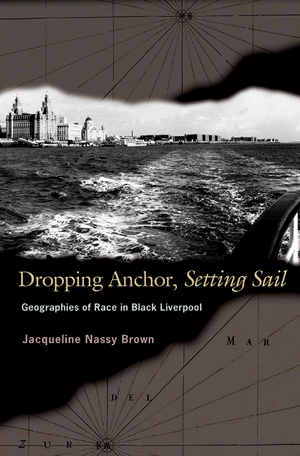
Dropping Anchor, Setting Sail: Geographies of Race in Black Liverpool

Posted in Africa, Anthropology, Books, Media Archive, Monographs, Slavery, United Kingdom on 2013-02-21 19:47Z by Steven

Dropping Anchor, Setting Sail: Geographies of Race in Black Liverpool

Princeton University Press
2005
312 pages
6 x 9
ISBN: 978-1-4008-2641-4

Jacqueline Nassy Brown, Associate Professor of Anthropology
Hunter College of the City University of New York

The port city of Liverpool, England, is home to one of the oldest Black communities in Britain. Its members proudly date their history back at least as far as the nineteenth century, with the global wanderings and eventual settlement of colonial African seamen. Jacqueline Nassy Brown analyzes how this worldly origin story supports an avowedly local Black politic and identity—a theme that becomes a window onto British politics of race, place, and nation, and Liverpool’s own contentious origin story as a gloriously cosmopolitan port of world-historical import that was nonetheless central to British slave trading and imperialism.

This ethnography also examines the rise and consequent dilemmas of Black identity. It captures the contradictions of diaspora in postcolonial Liverpool, where African and Afro-Caribbean heritages and transnational linkages with Black America both contribute to and compete with the local as a basis for authentic racial identity. Crisscrossing historical periods, rhetorical modes, and academic genres, the book focuses singularly on “place,” enabling its most radical move: its analysis of Black racial politics as enactments of English cultural premises. The insistent focus on English culture implies a further twist. Just as Blacks are racialized through appeals to their assumed Afro-Caribbean and African cultures, so too has Liverpool–an Irish, working-class city whose expansive port faces the world beyond Britain–long been beyond the pale of dominant notions of authentic Englishness. Dropping Anchor, Setting Sail studies “race” through clashing constructions of “Liverpool.”

Read the entire first chapter for free here in HTML or PDF format.  Excerpts are below.

“TO UNDERSTAND Black people, you’ve got to understand Liverpool.” So argued my friend Scott, a sixty-year-old Black man born and raised in that city…

…In the midst of describing the center’s aims he stopped short, interrupting himself to say, “To understand Black people, you’ve got to understand Liverpool.” He explained that Stanley House was established by charitable White people.  But their charter referred to the children of African seamen and the White women to whom they were often married as “half-castes,” a much despised term now…

Variations of that question were being posed in seaports all over Britain and in the overlapping arenas of social work, philanthropy, and academia, which would, in the mid to late nineteenth century, include physical anthropology and ethnology.  In contrast to eighteenth-century British ideas about human variation, which considered religion and clothing as key indices of civilization and posited climate as an explanation of different human potentials, the 1840s saw the emergence of a more biological argument (Wheeler 2000; Hamer 1996).  Physical types, which were correlated with areas of geographic origin, became the basis of racial distinctions and served to explain differential human capacities. Classificatory schema abounded. In this respect, Brontë’s mysterious, somewhat monstrous representation of the racially ambiguous Heathcliff is intriguing; it accords with the fearful image of the half-caste conjured up in Gothic literature and other discursive contexts.  As H. L. Malchow provocatively explains, “[O]ne may define [the Gothic] genre by characteristics that resonate strongly with racial prejudice, imperial exploration and sensational anthropology—themes and images that are meant to shock and terrify, that emphasize chaos and excess, sexual taboo and barbarism, and a style grounded in techniques of suspense and threat” (1996: 102).  Just as the unpredictable and brooding Heathcliff posed an ever-present danger, so too were the “hundreds of half-caste children” in 1920s Cardiff said to have “vicious tendencies.” These children also confused the categories of science, exhibiting, according to the press, a “disharmony of physical traits and mental characteristics” (Rich 1986: 131). In an era when science had attained unprecedented legitimacy (Lorimer 1996), the racially ambiguous or mixed person was a threat to the social order. Again, Malchow writes, “The terms ‘half-breed’ and ‘half-caste’ are double, hyphenated constructions resonating with other linguistic inadequacies and incompletes—with ‘half-wit’ or ‘half-dead’, with ‘half-naked’ or ‘half-truth’, and of course with ‘half-civilized’” (1996: 104). The person of mixed race was a pathology to be studied from both literary and “scientific” points of view. Their sexuality was of particular concern. It was one thing to be born of immoral unions in immoral circumstances; but as freaks of nature themselves, what moral predilections would they reproduce? Could they reproduce? (Malchow 1996; Young 1995)…

…Into a milieu defined, at the very least, by the above-described dynamics of colonialism, race, nationality, place, sexuality, class, and gender entered one Muriel Fletcher, infamous in present-day Liverpool for a study she conducted in 1928 under the auspices of the Liverpool Association for the Welfare of Half- Caste Children. Fletcher was trained in social research at the Liverpool University School of Social Science, where her circle included eugenicist anthropologists (Rich 1986).  The subjects of Fletcher’s research were White women who were formerly involved with African men and their “half-caste” children. She published her conclusions in Report on an Investigation into the Colour Problem in Liverpool and Other Ports. Ultimately, the Fletcher Report, as it is commonly called, concludes that “the colour problem” in that city owed not to the racist structuring of British society, the ideologies promulgated by the British state and its institutions, nor those circulating within Liverpool’s social welfare establishment, nor to the everyday racism of White Liverpudlians who routinely subjected colored seamen to violence. Rather, Fletcher attributed the colour problem in Liverpool to African seamen. It would be hard to state emphatically enough how thoroughly racial politics in Liverpool/Britain reflect the legacy of the Fletcher Report….

…The African man creates the White woman’s problems, while they both create the myriad crises said to befall their “half-caste” children. Fletcher uses the term half-caste in various ways. At times she distinguishes between “Anglo-Negroid” and “Anglo-Chinese” children; yet both of these groups belong to the half-caste category. Fletcher remarks at the outset, however, that “Anglo-Chinese” children are quite well-adjusted.  Since they pose no problem, we need not hear anything more about them.  As well, in the early pages, Fletcher uses the term Anglo-Negroid for children of African men and White women.  In detailing the minute phenotypical features of “half-caste” children, the Fletcher Report marks some of them “English,” as in “30 per cent. had English eyes… A little over 50 per cent. had hair negroid in type and colour. 25 per cent. had English, while the remaining 25 per cent. exhibited some curious mixtures… About 12 per cent. had lips like the average English child” (27).   She refers to these children’s social characteristics in similar terms. While she does not suggest that biological inheritance is at work, the children nevertheless manifest a troubling duality, exhibiting the worst trait of each parent.  Here speaking about “half-caste” girls, Fletcher argues, “From her mother the half-caste girl is liable to inherit a certain slackness, and from her father a happy-go-lucky attitude towards life” (34). The problems of half-caste children are not of their own making, then. They are victims. They attend earnestly to their schoolwork and seem amiable enough. But the immorality that characterizes their home life, given the low character of both parents, cannot help but be reproduced in these hapless children….

Read the entire first chapter for free here in HTML or PDF format.

Tags: , , , , , , , ,