Remember Me to Miss Louisa: Hidden Black-White Intimacies in Antebellum America

Posted in Books, History, Literary/Artistic Criticism, Media Archive, Monographs, Slavery, United States, Women on 2017-03-08 00:48Z by Steven

Remember Me to Miss Louisa: Hidden Black-White Intimacies in Antebellum America

Northern Illinois University Press
June 2015
200 pages
21 illus.
6×9
Paper ISBN: 978-0-87580-723-2

Sharony Green, Assistant Professor of American History
University of Alabama

Barbara “Penny” Kanner Prize, Western Association of Women Historians, 2016

It is generally recognized that antebellum interracial relationships were “notorious” at the neighborhood level. But we have yet to fully uncover the complexities of such relationships, especially from freedwomen’s and children’s points of view. While it is known that Cincinnati had the largest per capita population of mixed race people outside the South during the antebellum period, historians have yet to explore how geography played a central role in this outcome. The Mississippi and Ohio Rivers made it possible for Southern white men to ferry women and children of color for whom they had some measure of concern to free soil with relative ease.

Some of the women in question appear to have been “fancy girls,” enslaved women sold for use as prostitutes or “mistresses.” Green focuses on women who appear to have been the latter, recognizing the problems with the term “mistress,” given its shifting meaning even during the antebellum period. Remember Me to Miss Louisa moves the life of the fancy girl from New Orleans, where it is typically situated, to the Midwest. The manumission of these women and their children occurred as America’s frontiers pushed westward, and urban life followed in their wake. Indeed, Green’s research examines the tensions between the urban Midwest and the rising Cotton Kingdom. It does so by relying on surviving letters, among them those from an ex-slave mistress who sent her “love” to her former master. This relationship forms the crux of the first of three case studies. The other two concern a New Orleans young woman who was the mistress of an aging white man, and ten Alabama children who received from a white planter a $200,000 inheritance (worth roughly $5.1 million in today’s currency). In each case, those freed people faced the challenges characteristic of black life in a largely hostile America.

While the frequency with which Southern white men freed enslaved women and their children is now generally known, less is known about these men’s financial and emotional investments in them. Before the Civil War, a white Southern man’s pending marriage, aging body, or looming death often compelled him to free an African American woman and their children. And as difficult as it may be for the modern mind to comprehend, some kind of connection sometimes existed between these individuals. This study argues that such men were hidden actors in freedwomen’s and children’s attempts to survive the rigors and challenges of life as African Americans in the years surrounding the Civil War. Green examines many facets of this phenomenon in the hope of revealing new insights about the era of slavery.

Historians, students, and general readers of US history, African American studies, black urban history, and antebellum history will find much of interest in this fascinating study.
Tags: ,

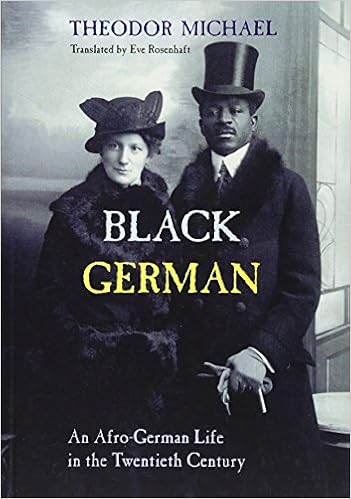
Black German: An Afro-German Life in the Twentieth Century

Posted in Autobiography, Books, Europe, History, Media Archive, Monographs on 2017-03-07 18:32Z by Steven

Black German: An Afro-German Life in the Twentieth Century

Liverpool University Press
2017-03-01
216 Pages
210 x 147 mm
29 B&W illustrations
Paperback ISBN: 9781781383117

Theodor Michael

Translated by:

Eve Rosenhaft, Professor of German Historical Studies
University of Liverpool

This is the first English translation of an important document in the history of the black presence in Germany and Europe: the autobiography of Theodor Michael. Theodor Michael is the last surviving member of the first generation of ‘Afro-Germans’: Born in Germany in 1925 to a Cameroonian father and a German mother, he grew up in Berlin in the last days of the Weimar Republic. As a child and teenager he worked in circuses and films and experienced the tightening knot of racial discrimination under the Nazis in the years before the Second World War. He survived the war as a forced labourer, founding a family and making a career as a journalist and actor in post-war West Germany. Since the 1980s he has become an important spokesman for the black German consciousness movement, acting as a human link between the first black German community of the inter-war period, the pan-Africanism of the 1950s and 1960s, and new generations of Germans of African descent.

Theodor Michael’s life story is a classic account of coming to consciousness of a man who understands himself as both black and German; accordingly, it illuminates key aspects of modern German social history as well as of the post-war history of the African diaspora. The text has been translated by Eve Rosenhaft, Professor of German Historical Studies at the University of Liverpool and an internationally acknowledged expert in black German studies. It is accompanied by a translator’s preface, explanatory notes, a chronology of historical events and a guide to further reading, so that the book will be accessible and useful both for general readers and for undergraduate students.

Tags: , , , , , ,

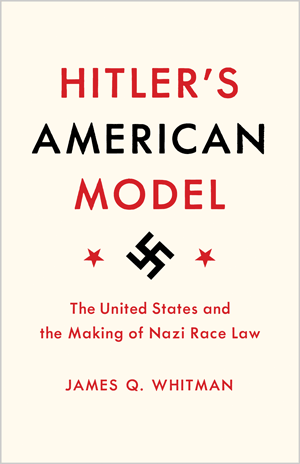
Hitler’s American Model: The United States and the Making of Nazi Race Law

Posted in Books, Europe, History, Law, Media Archive, Monographs, United States on 2017-03-07 01:51Z by Steven

Hitler’s American Model: The United States and the Making of Nazi Race Law

Princeton University Press
March 2017
224 pages
5 1/2 x 8 1/2
7 halftones
Hardcover ISBN: 9780691172422
eBook ISBN: 9781400884636

James Q. Whitman, Ford Foundation Professor of Comparative and Foreign Law
Yale Law School

Nazism triumphed in Germany during the high era of Jim Crow laws in the United States. Did the American regime of racial oppression in any way inspire the Nazis? The unsettling answer is yes. In Hitler’s American Model, James Whitman presents a detailed investigation of the American impact on the notorious Nuremberg Laws, the centerpiece anti-Jewish legislation of the Nazi regime. Contrary to those who have insisted that there was no meaningful connection between American and German racial repression, Whitman demonstrates that the Nazis took a real, sustained, significant, and revealing interest in American race policies.

As Whitman shows, the Nuremberg Laws were crafted in an atmosphere of considerable attention to the precedents American race laws had to offer. German praise for American practices, already found in Hitler’s Mein Kampf, was continuous throughout the early 1930s, and the most radical Nazi lawyers were eager advocates of the use of American models. But while Jim Crow segregation was one aspect of American law that appealed to Nazi radicals, it was not the most consequential one. Rather, both American citizenship and antimiscegenation laws proved directly relevant to the two principal Nuremberg Laws—the Citizenship Law and the Blood Law. Whitman looks at the ultimate, ugly irony that when Nazis rejected American practices, it was sometimes not because they found them too enlightened, but too harsh.

Indelibly linking American race laws to the shaping of Nazi policies in Germany, Hitler’s American Model upends understandings of America’s influence on racist practices in the wider world.

Tags: , , , , , ,

Loving vs. Virginia: A Documentary Novel of the Landmark Civil Rights Case

Posted in Books, History, Law, Media Archive, Novels, United States, Virginia on 2017-03-06 23:03Z by Steven

Loving vs. Virginia: A Documentary Novel of the Landmark Civil Rights Case

Chronicle Books
2017-01-31
260 pages
7-1/4 x 10 in
Hardcover ISBN: 9781452125909

Patricia Hruby Powell

Illustrated by Shadra Strickland

From acclaimed author Patricia Hruby Powell comes the story of a landmark civil rights case, told in spare and gorgeous verse. In 1955, in Caroline County, Virginia, amidst segregation and prejudice, injustice and cruelty, two teenagers fell in love. Their life together broke the law, but their determination would change it. Richard and Mildred Loving were at the heart of a Supreme Court case that legalized marriage between races, and a story of the devoted couple who faced discrimination, fought it, and won.

Tags: , , , ,

What if the Court in the Loving Case Had Declared Race a False Idea?

Posted in Articles, History, Law, Media Archive, United States, Virginia on 2017-03-06 19:17Z by Steven

What if the Court in the Loving Case Had Declared Race a False Idea?

The New York Times
2017-03-06

Brent Staples


Mildred Loving greeting her husband Richard on their front porch in Virginia.
Credit Estate of Grey Villet

Gov. Terry McAuliffe of Virginia struck a resonant historical note last year when he proclaimed June 12 “Loving Day,” in commemoration of Loving v. Virginia, the 1967 Supreme Court decision that invalidated state laws across the country that restricted interracial marriage.

That Virginia would celebrate the decision was symbolically rich, given that Richmond had been the capital of the Confederacy under Jefferson Davis and the seat of a virulently racist legislature that diligently translated white supremacist aspirations into law.

The Loving decision turns 50 this summer, which will give the annual festivals, picnics and house parties held in its honor a special gravity. But the recent re-emergence of white supremacist ideology in political discourse lends an inescapably political cast to this celebration of interracialism.

As this drama unfolds, historians and legal scholars are criticizing aspects of the Loving decision, including the court’s failure to repudiate the myth of white racial “purity” upon which Virginia’s statute was based…

Read the entire article here.

Tags: , , , , ,

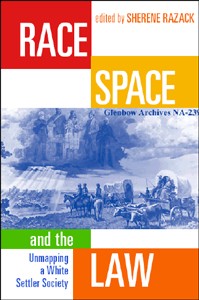
Race, Space, and the Law: Unmapping a White Settler Society

Posted in Anthologies, Books, Campus Life, Canada, History, Law, Media Archive, Native Americans/First Nation, Politics/Public Policy, Religion, Women on 2017-03-06 03:16Z by Steven

Race, Space, and the Law: Unmapping a White Settler Society

Between The Lines
April 2002
320 pages
Paperback ISBN: 9781896357591

Edited by:

Sherene Razack, Distinguished Professor of Gender Studies
University of California, Los Angeles

Race, Space, and the Law belongs to a growing field of exploration that spans critical geography, sociology, law, education, and critical race and feminist studies. Writers who share this terrain reject the idea that spaces, and the arrangement of bodies in them, emerge naturally over time. Instead, they look at how spaces are created and the role of law in shaping and supporting them. They expose hierarchies that emerge from, and in turn produce, oppressive spatial categories.

The authors’ unmapping takes us through drinking establishments, parks, slums, classrooms, urban spaces of prostitution, parliaments, the main streets of cities, mosques, and the U.S.-Canada and U.S.-Mexico borders. Each example demonstrates that “place,” as a Manitoba Court of Appeal judge concluded after analyzing a section of the Indian Act, “becomes race.”

Contents

  • Introduction: When Place Becomes Race / Sherene H. Razack
  • Chapter 1: Rewriting Histories of the Land: Colonization and Indigenous Resistance in Eastern Canada / Bonita Lawrence
  • Chapter 2: In Between and Out of Place: Mixed-Race Identity, Liquor, and the Law in British Columbia, 1850-1913 / Renisa Mawani
  • Chapter 3: Cartographies of Violence: Women, Memory, and the Subject(s) of the “Internment” / Mona Oikawa
  • Chapter 4: Keeping the Ivory Tower White: Discourses of Racial Domination / Carol Schick
  • Chapter 5: Gendered Racial Violence and Spatialized Justice: The Murder of Pamela George /Sherene H. Razack
  • Chapter 6: The Unspeakability of Racism: Mapping Law’s Complicity in Manitoba’s Racialized Spaces / Sheila Dawn Gill
  • Chapter 7: Making Space for Mosques: Struggles for Urban Citizenship in Diasporic Toronto / Engin F. Isin and Myer Siemiatycki
  • Chapter 8: The Space of Africville: Creating, Regulating, and Remembering the Urban “Slum” / Jennifer J. Nelson
  • Chapter 9: Delivering Subjects: Race, Space, and the Emergence of Legalized Midwifery in Ontario / Sheryl Nestel
  • Notes
  • Bibliography
  • Index
  • Contributors
Tags: , , , , , , , , , , ,

Why You Can’t Ever Call an Enslaved Woman a “Mistress”

Posted in Articles, History, Media Archive, Slavery, United States on 2017-03-05 22:16Z by Steven

Why You Can’t Ever Call an Enslaved Woman a “Mistress”

Teen Vogue
2017-02-27

Lincoln Blades

This is an important Black History Month PSA.

In the black community, many different opinions abound regarding the usefulness of Black History Month. For some, it is viewed as a necessary and critical tool for cultural celebration and propagating the importance of our collective historical achievements, which otherwise would go unnoticed. For others, it feels like a reductive display of forced lip service conducted during the shortest and coldest month of the year, in lieu of providing us with a more sustained and inclusive role in the everyday curriculum. But what we all can agree on is that presenting our history in a wholly accurate and factual manner delivered with the correct context is of the utmost importance, which is why we react so strongly to inaccurate and/or misrepresentative claims.

That irritation was inflamed this past weekend when The Washington Post published an article about a restoration that would be occurring at Monticello, the plantation of America’s third president, Thomas Jefferson, which is operated as a museum. The restoration to be completed will involve unmasking a bathroom installed in 1941 just steps from Jefferson’s bedroom to reveal what the room really was: Sally Hemings’s bedroom…

Read the entire article here.

Tags: , , , , ,

For decades they hid Jefferson’s relationship with her. Now Monticello is making room for Sally Hemings.

Posted in Articles, Biography, History, Media Archive, Slavery, United States, Virginia, Women on 2017-03-05 21:59Z by Steven

For decades they hid Jefferson’s relationship with her. Now Monticello is making room for Sally Hemings.

The Washington Post
2017-02-19

Krissah Thompson


By excavating and restoring areas where the slave community lived and worked, Monticello is trying to more fully integrate their stories at the historic plantation. A special focus will be placed on Sally Hemings, whose room in the house will soon be on display for the first time.

CHARLOTTESVILLE — The room where historians believe Sally Hemings slept was just steps away from Thomas Jefferson’s bedroom. But in 1941, the caretakers of Monticello turned it into a restroom.

The floor tiles and bathroom stalls covered over the story of the enslaved woman, who was owned by Jefferson and had a long-term relationship with him. Their involvement was a scandal during his life and was denied for decades by his descendants. But many historians now believe the third president of the United States was the father of her six children.

Time, and perhaps shame, erased all physical evidence of her presence at Jefferson’s home here, a building so famous that it is depicted on the back of the nickel.

Now the floor tiles have been pulled up and the room is under restoration — and Hemings’s life is poised to become a larger part of the story told at Monticello…

Read the entire article here.

Tags: , , , ,

The film “A United Kingdom” reminds us of the progress made with interracial marriage

Posted in Africa, Articles, History, Media Archive, United Kingdom, United States on 2017-03-02 01:25Z by Steven

The film “A United Kingdom” reminds us of the progress made with interracial marriage

The State Press
Tempe, Arizona
2017-02-23

Guillermo Mijares, Political Reporter


Photo by Karen Ta | The State Press
“People shouldn’t be uncomfortable seeing an interracial couple.” Illustration published on Thursday, Feb. 23, 2017.

I believe we are undoubtedly the most progressive generation so far. This past weekend I went to see a film that reminded me of that.

A United Kingdom” reminds us that it wasn’t too long ago that skin color was a barrier to overcome for some couples. In fact, it wasn’t until the year 2000 when the state of Alabama finally changed its decision and lifted the ban on the right to an interracial marriage in the state.

Just 55 years ago, Arizona repealed its ban on interracial marriages. Many of our parents lived to witness this repeal, yet we tend to forget this unfortunate part of history.

This film reminds us that a visual image today of an interracial couple is almost entirely a non-issue, certainly among millennials. As a college student at ASU, I witness many interracial couples daily, which is something past generations could not witness.

Despite the flaws our world has when it comes to race relations, I believe people, especially younger people and students, are leading the way to a more accepting society…

…Though the film addressed a racial issue, it wouldn’t address why people were so uncomfortable seeing an interracial couple.

Author and Time magazine contributor Arica L. Coleman Ph.D, said that this has been an on-going problem with the film industry.

She said she gives credit to the industry for highlighting important and progressive moments in historical films, but she also finds a problem in those same films for not presenting the full picture to the public when it comes down to race.

“They are problematic — they sell an illusion — and a problem I have with the topic of interracial marriage is the whole notion of using interracial marriage as a sign of progress with race, but it also can be used as an eraser,” she said. “Also, just like most of the time with Hollywood, it’s almost always the black man with the exotic white woman, which continues to show that the lack for black women is still present.”…

Read the entire article here.

Tags: , , ,

How a man of mixed race helped create British Columbia

Posted in Articles, Biography, Canada, History, United States on 2017-03-01 02:12Z by Steven

How a man of mixed race helped create British Columbia

The Vancouver Courier
2017-02-14

Martha Perkins, Editor-in-Chief


Sir James Douglas, who became governor of Vancouver Island in 1851, was born in Guyana to a Creole mother and Scottish father.

To celebrate Black History Month we profile the Hudson Bay Company’s Sir James Douglas

In 1803 in what was then British Guyana, James Douglas was born. His father was a Scottish merchant and his mother was what they called “free coloured” — a Creole woman of mixed African and European heritage.

Unlike his younger sister, who was as dark skinned as their mother, Douglas appeared to be Caucasian. But his later actions, including marrying a woman of Cree ancestry, have led amateur historian (and former Vancouver mayor) Sam Sullivan to believe that when Douglas built Fort Victoria, his aim was to create an inclusive society where everyone had an opportunity to thrive…

Read the entire article here.

Tags: , , , , , ,