One Drop of Love at the Straz Center

Posted in Arts, Autobiography, Census/Demographics, History, Live Events, Media Archive, Social Science, United States on 2014-11-07 17:47Z by Steven

One Drop of Love at the Straz Center

Straz Center for the Performing Arts
Jaeb Theater
1010 N. W.C. MacInnes Place
Tampa, Florida 33602
Saturday, 2014-11-08, 19:30 EST (Local Time)

Produced by Ben Affleck and Matt Damon, this extraordinary one-woman show by Fanshen Cox DiGiovanni incorporates filmed images, photographs and animation to tell the story of how the notion of ‘race’ came to be in the United States and how it affected her relationship with her father. This show is a moving memoir that takes audiences from the 1600s to the present, to cities all over the U.S. and West and East Africa, where both father and daughter spent time in search of their ‘racial’ roots. Funny and provocative, One Drop of Love is a spellbinding and honest journey into the heart of finding one’s place in the world and in the complicated microcosm of one’s family.

For more information, click here.

Tags: , , , , , ,

‘A Chosen Exile,’ by Allyson Hobbs: review

Posted in Articles, Book/Video Reviews, History, Media Archive, Passing, United States on 2014-11-07 17:24Z by Steven

‘A Chosen Exile,’ by Allyson Hobbs: review

San Francisco Chronicle
2014-11-01

Imani Perry, Professor, Center for African American Studies
Princeton University

Allyson Hobbs, A Chosen Exile: History of Racial Passing in American Life (Cambridge: Harvard University Press, 2014)

Family across the color line: It is now a popular enough theme that it qualifies as a subgenre of memoir. This contemporary motif has a companion in American literary history. Fiction writers beginning in the 19th century took up the phenomenon of black people so light-skinned that they chose to cross over into whiteness permanently. Passing narratives are what such stories are called. In those works, it was an almost universally tragic choice, marking an essential loss of identity.

Stanford historian Allyson Hobbs’ book “A Chosen Exile” lies between those two genres and yet is something else altogether. It is a book that is at once literary, cultural, archival and social, crossing the borders of various approaches to the study of history in order to create a collage of a fascinating yet elusive phenomenon. Intrigued by the story of a distant relative who crosses the color line, Hobbs has followed this interest to explore the practice of passing with detail and rigor. Her writing is elegant, bubbling with curiosity even as it is authoritative and revelatory.

In order to cover this subject, Hobbs had to be innovative. It’s impossible to know how many African Americans passed for white, and how many crossed back over. A creative intellectual, she uses unpublished family histories, anthropological projects, sociological journals, personal papers, correspondence, court cases, newspapers, literature and film to reveal an important set of stories caught in the thicket of race in the United States…

Read the entire review here.

Tags: , ,

Matthew McConaughey & Gary Ross Mount Civil War Saga; Bob Simonds’ STX In Talks To Finance

Posted in Articles, Arts, Biography, History, Media Archive, Mississippi, Slavery, United States on 2014-11-07 03:00Z by Steven

Matthew McConaughey & Gary Ross Mount Civil War Saga; Bob Simonds’ STX In Talks To Finance

Deadline Hollywood
2014-11-05

Mike Fleming Jr., Film Editor

Anita Busch, Film Editor

EXCLUSIVE: Matthew McConaughey and writer-director Gary Ross are the catalysts for a project called Free State Of Jones, which is getting some serious attention from STX Entertainment, the new mini-studio founded by investors TPG Growth, Gigi Pritzker, Hony and Robert Simonds. We hear that company reps, financial partner IM Global (who is handling foreign), and the filmmakers are heading to AFM this afternoon to discuss pre-sales. This is one of many projects STX is considering pushing through as part of its first slate. They are looking to go before the cameras in the first quarter of 2015.

Free State Of Jones is based on the untold and extraordinary story of Newton Knight, the leader of one of the greatest rebellions in Civil War history, and we hear that STX may finance (up to $20M) for the $65M-budgeted story of one of the most controversial men from the that era. McConaughey is in talks to play the Mississippian, who defected from the Confederate Army, banded together with a group of like-minded soldiers, and set out to form their own State known as the Free State Of Jones.

Knight would later have a common-law marriage to a former slave, one of the first outwardly mixed racial unions in the South — unheard of at the time. The rebellious Knight actually fought against the Confederates from within the state and after the war freed children still enslaved after a daring raid…

Note from Steven F. Riley: For more about the Knight family, please read Victoria E. Bynum’s superb monograph, The Free State of Jones: Mississippi’s Longest Civil War.

Read the entire article here.

Tags: , , , , , , ,

‘One Drop of Love’ star Fanshen Cox DiGiovanni talks race, family and more

Posted in Articles, Arts, Census/Demographics, History, Identity Development/Psychology, Media Archive, Social Science on 2014-11-06 21:37Z by Steven

‘One Drop of Love’ star Fanshen Cox DiGiovanni talks race, family and more

The Tampa Bay Times
St. Petersburg, Florida
2014-11-05

Robbyn Mitchell, Times Staff Writer


Fanshen Cox DiGiovanni: “Race is like a religion to us.”

It’s been an interesting year in race relations for America. In just over 10 months, there have been communities violently protesting loss of due process, NBA owners losing their teams over racist remarks and anti-immigration zealots blockading school buses full of brown children because they were presumed to be foreign.

It’s a climate — not of change, as was promised by the election of President Barack Obama, but of an overwhelming dedication to fight change.

“People believe in race so strongly they’re faithful to it. Race is like a religion to us,” said Fanshen Cox DiGiovanni, writer and performer of One Drop of Love, a one-woman multimedia show coming to the Straz Center for the Performing Arts Saturday night.

As a woman with parents who identify themselves as different races — her father is black and her mother is white — Cox DiGiovanni says she has the had the privilege to move between two different spheres of American society and decide for herself how she would be defined.

“The way I identify myself is as a culturally mixed woman searching for racial answers,” she said. “I care about justice and that’s more important than racial identity.”…

Read the entire article here.

Tags: , , , , ,

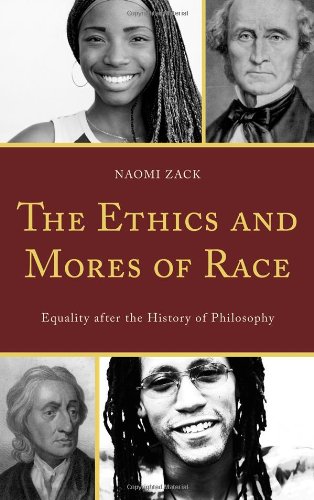
The Ethics and Mores of Race: Equality after the History of Philosophy

Posted in Books, History, Media Archive, Monographs, Philosophy, Slavery on 2014-11-06 16:32Z by Steven

The Ethics and Mores of Race: Equality after the History of Philosophy

Rowman & Littlefield
July 2011
216 pages
Size: 6 3/4 x 9 1/2
Hardback ISBN: 978-1-4422-1125-4
eBook ISBN: 978-1-4422-1127-8

Naomi Zack, Professor of Philosophy
University of Oregon

Preeminent philosopher, Naomi Zack, brings us an indispensable work in the ethics of race through an inquiry into the history of moral philosophy. Beginning with Plato and a philosophical tradition that has largely ignored race, The Ethics and Mores of Race: Equality After the History of Philosophy enters into a web of ideas, ethics, and morals that untangle our evolving ideas of racial equality straight into the twenty-first century. The dichotomy between ethics and mores has long aided the separation of what is right with ideas of equality. Zack tackles the co-existence of slavery with the classic moral systems and continues to show how our society has evolved and our mores with it. An ethics of race my not exist yet, but this book gives us twelve discerning requirements to establish it.

Table of Contents

  • Acknowledgments
  • Introduction: Ethics, Mores, and Race
  • Chapter 1: Plato and Aristotle’s Invention of Race
  • Chapter 2: Cosmopolitan Contributions to an Ethics of Race
  • Chapter 3: Natural Law and Inequality
  • Chapter 4: Moral Law and Slavery
  • Chapter 5: Christian Metaphysics and Inequality
  • Chapter 6: Social Contract Theory and the Sovereign Nation State
  • Chapter 7: Deontology, Utilitarianism, and Rights
  • Conclusion: Egalitarian Humanism and Requirements for an Ethics of Race
  • Select Bibliography
  • About the Author
Tags: ,

St Martin de Porres

Posted in Articles, Arts, Caribbean/Latin America, History, Media Archive, Religion on 2014-11-04 19:19Z by Steven

St Martin de Porres

Victoria and Albert Museum: The world’s greatest museum of art and design
London, United Kingdom
2014-11-03

William Newton, Assistant Curator

Today on Sanctus Ignotum we have a case study in race relations, and our first South American saint. Born in Lima, Peru in 1579, the illegitimate son of a Spanish knight and a liberated black slave, Martin was initially apprenticed to a barber-surgeon. He initially joined the Dominican Order as a lay-helper, though his dedication to the poor and hallowed nature meant that he was soon invited to join the order as a full-time lay-brother.

He frequently experienced bouts of religious ecstasy, having spent nights in prayer. He kept himself very busy as monastic gardener and barber (two related skills), and as a counselor (some barbers may also believe this is a native skill), as well as attending to the sick and the poor. It was said that most of his cures came from a simple glass of water (presumably not part his barber’s training). Being of mixed race parentage himself, he was not as discerning as some of his colleagues in offering spiritual and physical comfort. The other Brothers did, however, dub him the ‘Father of Charity’ although he, being humble and saintly, preferred to call himself ‘Mulatto Dog’. Martin’s commitment to everyone’s wellbeing, no matter their colour or creed, does not appear to have been complemented by a reforming attitude to social conditions. Once, when his monastery encountered financial difficulties, he suggested that they sell him into slavery in order to make ends meet. Happily, they declined to do so…

Read the entire article here.

Tags: , , ,

A Letter and the Legacy of “Not White” in the USA

Posted in Articles, History, Media Archive, Politics/Public Policy, Slavery, Social Science, United States on 2014-11-04 18:29Z by Steven

A Letter and the Legacy of “Not White” in the USA

Nursing Clio: Because the Personal is Historical
2014-11-04

Adam Turner, Co-founder and Technical Editor

With the events of the past months, and as Austin McCoy discussed here on Nursing Clio last week, it should be clear that white privilege is still alive and well in the United States. Despite the optimism following President Obama’s election six years ago, and the Republican Party’s tweets, we do not yet live in a society where the color of your skin doesn’t matter. To make matters worse, while the discussion should be about how best to fix the problems of racial injustice and economic oppression in the United States, substantial numbers of people refuse to even accept that it’s a problem. They prefer to believe that those who suffer from systemic poverty, police violence, and a biased justice system get only what they’ve earned by being lazy, or breaking the law, or acting badly.

This message comes most clearly from pundits like Bill O’Reilly, who continue to argue that white privilege died with the end of legal segregation in the 1950s and 1960s. More than that, they assert that white Americans are the new victims of discrimination. Going after O’Reilly feels like a cliché at this point, but unfortunately his arguments aren’t nearly as fringe as they should be. People who argue that white privilege doesn’t exist often do a few things:

  1. They point out that state-sanctioned slavery and segregation are over.
  2. They use anecdotes to try to prove systemic change, such as that “the most powerful man in the world is a black American, and the most powerful woman in the world — Oprah Winfrey — is black!” (that’s O’Reilly again).
  3. They suggest that people of color who are not African American benefit from policies designed to address the legacy of slavery that also discriminate against white Americans.

All of these arguments assume that more than 300 years of discrimination and racism can be wiped out by one generation’s worth of civil rights protections (and very little effort to address economic equality). The Supreme Court certainly seemed to believe this when they started dismantling the Voting Rights Act. Based on this assumption, they conclude that white privilege no longer exists, and therefore policies designed to break cycles of inequality discriminate against white Americans. For many white-identified Americans, these conclusions make a lot of sense, especially in light of the economic recession.

This assumption, and the denial of white privilege, misunderstand both the depth and the breadth of racial injustice in the United States.

To get a sense of what I mean, let’s step back 90 years to 1924 to glimpse the long and personal echoes of racism in America. In the spring of that year, a new mother in Virginia received a letter from the head of the state’s Bureau of Vital Statistics. It read:

This is to give you warning that this is a mulatto child and you cannot pass it off as white. A new law passed by the last legislature says that if a child has one drop of negro blood in it, it cannot be counted as white. You will have to do something about this matter and see that the child is not allowed to mix with white children, it cannot go to white schools and can never marry a white person in Virginia. It is an awful thing

The head of the Virginia Bureau of Vital Statistics, and the man who sent this heartbreakingly cruel letter, was Walter Ashby Plecker. Plecker, along with two other men, led Virginia’s most powerful white supremacist organization, the Anglo-Saxon Club. Together they played a key role in the passage of Virginia’s 1924 Act to Preserve Racial Integrity (the “new law” to which he refers in this letter). The 1924 law, one in a series of laws passed in Virginia during the 1920s based on racism, nativism, and eugenics ideology of the time, explicitly divided people into just two racial categories, “white” and “colored,” and forbade marriage (and thus implicitly sex) between the two. Virginia wasn’t the only state with such a law, but it became famous as the origin of the 1967 Loving v. Virginia case that overturned these laws…

Read the entire article here.

Tags: , , , , , ,

Allyson Hobbs – “A Chosen Exile”

Posted in Audio, History, Media Archive, Passing, United States on 2014-11-02 01:46Z by Steven

Allyson Hobbs – “A Chosen Exile”

The Tavis Smiley Show
2014-10-31

Between the 18th and mid-20th centuries, countless fair-skinned African Americans abandoned families, friends and communities to forge new lives as white people. In her new book, “A Chosen Exile: A History of Racial Passing in American Life”, Stanford University historian Allyson Hobbs explores the ways in which passing was a strategy for survival and an avenue to loss.


Listen to the episode here.

Tags: , , ,

Shows: One Drop of Love

Posted in Arts, Census/Demographics, History, Identity Development/Psychology, Live Events, Media Archive, Social Science, United States on 2014-10-31 22:53Z by Steven

Shows: One Drop of Love

Mesa Arts Center
Nesbitt/Elliott Playhouse
One East Main Street
Mesa, Arizona 85201
Box Office: (480) 644.6500

Performing Live Series
Saturday, 2014-11-01, 15:00 & 19:30 MT (Local Time)

Produced by Ben Affleck, Matt Damon and the show’s writer/performer Fanshen Cox DiGiovanni, One Drop of Love is a multimedia one woman show. It incorporates film, photographs, and animation to examine how ‘race’ has been constructed in the United States and how it can influence our most intimate relationships.

For more information, click here.

Tags: , ,

ArtsBlast: One resonating drop of Fanshen

Posted in Articles, Arts, Census/Demographics, History, Identity Development/Psychology, Media Archive, Social Science, United States on 2014-10-31 00:48Z by Steven

ArtsBlast: One resonating drop of Fanshen

Examiner.com
2014-10-29

Jennifer Haaland

One conversation with Fanshen Cox DiGiovanni was all it took. After her Examiner interview yesterday, filled with embracing words and vibrant kindness, it was clear that a whole lot more than One Drop of Love is coming to the Phoenix Valley and gracing the Mesa Arts Center stage this weekend.

“The crowd can’t just sit back and watch. Everyone is involved in this story,” said Cox DiGiovanni of the inclusive environment the show exudes. “I’ll be playing lots of characters, sometimes coming out into the house, talking to and asking questions of the audience.”

Ben Affleck and Matt Damon are notable among the show’s past participants. As producers of Cox DiGiovanni’s One Drop of Love, a dynamic multimedia live, solo performance that explores how race has been constructed in the United States, they too were deeply affected by the message conveyed…

Read the entire article here.

Tags: , , , , ,