Go Stand Upon The Rock with Samuel Michael Lemon, Ed.D.

Posted in Audio, History, Live Events, Media Archive, Slavery, United States on 2014-11-20 00:20Z by Steven

Go Stand Upon The Rock with Samuel Michael Lemon, Ed.D.

Research at the National Archives and Beyond
BlogTalk Radio
Thursday, 2014-11-20, 21:00 EST (Friday, 2014-11-21, 02:00Z)

Bernice Bennett, Host

Go Stand Upon the Rock (2014) is a deeply moving Civil War-era novel based on stories handed down by Sam Lemon’s grandmother about the lives of her grandparents who were once runaway slaves from Virginia. It is a tale of unsettling plantation life, courageous women, dramatic Civil War battles, heroes, hoodoo, and the indomitable strength of the human spirit. The book is supported by historical and genealogical research, photographs, and documents from his doctoral dissertation. This is a compelling and emotionally engaging history that comes alive through the lives of real people and events.

Dr. Sam Lemon grew up in Media, Pennsylvania, where his maternal great-great grandparents arrived as runaway slaves during the Civil War. Given refuge and support by local Quakers, his ancestors prospered and became prominent members of the community. He is currently an assistant professor and the director of a graduate program at Neumann University in Pennsylvania, and formerly worked in the fields of social services, education, and public television at WHYY in Philadelphia.

For more information, click here.

Tags: , , , , , ,

The Case for Black With a Capital B

Posted in Articles, Census/Demographics, History, Slavery, United States on 2014-11-19 20:45Z by Steven

The Case for Black With a Capital B

The New York Times
2014-11-18

Lori L. Tharps, Associate Professor of Journalism
Temple University, Philadelphia, Pennsylvania

PHILADELPHIA — I WAS sitting in my office at Temple University when I overheard an exchange between a colleague and his student. The student had come to see her professor to go over a paper, and he was patiently explaining that the abundance of grammatical mistakes detracted from her compelling content. I sympathized with my colleague as he pointed out error after error. Until he came to this one.

“Why did you capitalize black and white people?” he asked. “I thought I’d seen it written that way before,” the girl stammered. “Come on,” he said. “Why would you capitalize black or white?”…

…After emancipation, as many individuals replaced their slave surnames with ones of their own devising, like Freedman or Freeman, they still bore the painful legacy of the labels they’d been given: black, negro and colored.

It wasn’t only Black people who didn’t know what to call the nearly four million newly freed citizens of the United States. The government itself fumbled its way through names, categories and labels for Black people. Between 1850 and 1920, the United States census classified those of African descent as black, negro, mulatto, quadroon or octoroon — depending on the visual assessment of the census taker. By 1930, the Census Bureau offered just one of these categories: negro.

This wasn’t solely an issue of identity politics. In a 2008 article on the census for Studies in American Political Development, Jennifer L. Hochschild and Brenna M. Powell wrote, “Over the course of almost a century, the U.S. government groped its way through extensive experimentation — reorganizing and reimaging the racial order, with corresponding impact on individuals’ and groups’ life chances.” These names matter…

Read the entire article here.

Tags: , , ,

‘Empire of Sin,’ by Gary Krist

Posted in Articles, Book/Video Reviews, History, Louisiana, Media Archive, United States on 2014-11-19 20:25Z by Steven

‘Empire of Sin,’ by Gary Krist

The New York Times
Sunday Book Review
2014-11-06

Walter Isaacson, President and CEO
Aspen Institute

Empire of Sin: A Story of Sex, Jazz, Murder, and the Battle for Modern New Orleans By Gary Krist; Illustrated. 416 pp. Crown Publishers. $26.

When Tom Anderson’s saloon opened in 1901, at the entrance to the recently designated sin district known as Storyville on the edge of New Orleans’s French Quarter, people from all over town came to marvel at its opulence. Its cherrywood bar stretched half a block and was lit by a hundred electric lights. With Anderson’s encouragement, high-class brothels were soon flourishing down Basin Street. Josie Arlington, his business partner, had a four-story Victorian mansion with a domed cupola, mirrored parlor and Oriental statues. The exotic, mixed-race Lulu White built a brick palace that specialized in interracial sex and featured the jazz pioneer Jelly Roll Morton at the piano. Another octoroon (the appellation given to people considered to be one-eighth black), Willie V. Piazza, passed herself off as a countess and sported both a monocle and a diamond choker. Anderson, whose civic spirit earned him the title “the Mayor of Storyville,” published a Blue Book that contained photos and descriptions of the area’s better prostitutes, annotated with symbols (“w” for white, “c” for colored, “J” for Jewish and “oct.” for octoroon). It was all a vivid expression of the city’s tolerance and diversity…

…Through much of the 19th century, New Orleans had been racially progressive, especially for Creoles of color, most of them French-speaking Roman Catholics descended from families that had intermarried with Europeans. From the early 1870s onward, blacks could vote and serve on juries; marriage between different races was legal; and schools, lakefront beach areas and many neighborhoods were integrated. But the advent of Jim Crow laws after Reconstruction created a new dynamic. The reformers of the city’s elite took the lead in passing segregation laws as well as in cracking down on prostitution. In 1908, the State Legislature passed a bill that barred musical performances in saloons, prohibited blacks and whites from being served in the same establishment and excluded women from bars…

Read the entire review here.

Tags: , , , , ,

Sesquicentennial Event Addresses Colorado Inequality

Posted in Articles, Asian Diaspora, History, Law, Media Archive, Slavery, United States on 2014-11-18 22:21Z by Steven

Sesquicentennial Event Addresses Colorado Inequality

Clarion: The University of Denver’s Newwspaper Since 1892
Denver, Colorado
2014-10-21

Carissa Cherpes

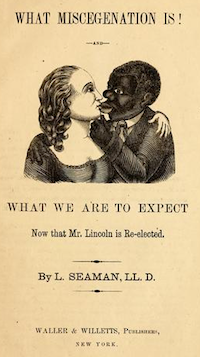
DU hosted a Sesquicentennial Conversation entitled Miscegenation Law, Marriage Equality, and the West 1864-2014 on Oct. 15 in the Sturm College of Law.

Over 50 students, faculty and others gathered to listen to three panelists lecture on how Miscegenation Laws and inequality affected our region throughout history. Miscegenation Laws banned marriages or relationships between mixed raced couples.

The three panelists were Rachel Moran, Ronald J. Stephens and Anna N. Martinez. The moderator was Bill Convery, who holds the position of Colorado State Historian

…Next to present was Moran. She described how Miscegenation Laws originated in the South when concern over mixed race slave children became an issue. The popular opinion was that “mixed race children were black,” and therefore could not be considered free or have rights.

She then went on to talk about California’s Miscegenation Laws, which targeted Asian immigrants. In California, the laws were designed to force Chinese, Japanese and Filipino immigrants to return to their native country.

Moran then discussed how the Colorado territory had Miscegenation Laws as well, but only after additional land was acquired from Mexico. Because the people living in the territory had different customs and laws, there was an invisible boundary where mixed race couples were more accepted. She concluded by explaining how it was not until the 1960s that the Supreme Court decided Miscegenation Laws were unfair

Read the entire article here.

Tags: , , , , , , , , , ,

‘William Wells Brown,’ by Ezra Greenspan

Posted in Articles, Biography, Book/Video Reviews, History, Media Archive, Slavery, United States on 2014-11-18 19:41Z by Steven

‘William Wells Brown,’ by Ezra Greenspan

The New York Times
Sunday Book Review
2014-11-14

Nell Irvin Painter, Edwards Professor of American History, Emerita
Princeton University

Greenspan, Ezra, William Wells Brown: An African American Life (New York: W. W. Norton & Company, 2014)

If the publishing industry reflects the American zeitgeist, things have changed when it comes to black American historical figures. As a graduate student at Harvard decades ago, I came across William Wells Brown, the fugitive slave, abolitionist, lecturer, travelogue writer, novelist and performer whose wide-ranging intelligence turned a gaze on white people (for a change). Back then he was to be found in only one full-length biography, William Edward Farrison’s “William Wells Brown: Author and Reformer” (1969). Published by the University of Chicago Press in the twilight of the “second Reconstruction” and at the dawning of African-American studies, it depicted Brown as a representative black American. In the absence of the biographical scholarship coming after 1969, Brown’s colleagues remained ill defined. Farrison’s biography was reviewed only in publishing trade papers and a couple of history journals. What was the problem?

It wasn’t Brown’s lack of an interesting life: more on that momentarily. The main problem was that 20th-century American culture accommodated only one 19th-­century black man, a spot already taken by the monumental, best-selling Frederick Douglass. Another problem was theoretical: Farrison published his biography before the flowering of two other fields crucial to a full appreciation of Brown’s public life — the history of the book and performance art…

…The child who would be William Wells Brown was born enslaved in Kentucky, in about 1814, the son of his owner’s cousin. In St. Louis, given the job of tending a young charge also called William, his name was changed to Sandford with the carelessness characteristic of slave naming. As Sandford he worked in his owner’s medical office and on the Mississippi River’s ships and docks. After several unsuccessful attempts at escape, one with his mother, he finally fled St. Louis at about age 19. He retook his own name William and added Wells Brown in honor of the Quaker who had rescued him from starving and freezing in Ohio

Read the entire review here.

Tags: , , , ,

“Western Zombies and Their Killers: Exceptionalism, the Empty West, and Mixed Race Families” a lecture by Dr. Anne Hyde

Posted in History, Live Events, Native Americans/First Nation, United States on 2014-11-15 17:59Z by Steven

“Western Zombies and Their Killers: Exceptionalism, the Empty West, and Mixed Race Families” a lecture by Dr. Anne Hyde

Colorado State University
Cherokee Park Ballroom, Lory Student Center
Fort Collins, Colorado
2014-12-04, 16:30-18:30 MST (Local Time)

Please join us for a public lecture and book signing/reception by Dr. Anne Hyde, William R. Hochman Professor of History at Colorado College. The title of her talk is drawn from her prize-winning book, Empires, Nations, and Families: The North American West, 1800-1860, which won the 2012 Bancroft Prize and was a finalist for a Pulitzer…

For more information, click here.

Tags: , , ,

Fanshen Cox DiGiovanni on Growing Up with Matt Damon and Ben Affleck, Race, and What It Takes to Do a One-Woman Show

Posted in Articles, Arts, Census/Demographics, History, Identity Development/Psychology, Interviews, Media Archive, Social Science, United States on 2014-11-15 12:50Z by Steven

Fanshen Cox DiGiovanni on Growing Up with Matt Damon and Ben Affleck, Race, and What It Takes to Do a One-Woman Show

Phoenix New Times
2014-10-30

Zaida Dedolph

Fanshen Cox DiGiovanni stars in a one-woman show written by her and produced by Matt Damon and Ben Affleck.

Fanshen Cox DiGiovanni wants to talk about race in America — and she’s got an idea of where she wants to start. The writer-actor-director-producer extraordinaire will bring her one-woman show, One Drop of Love, to Mesa Arts Center on Saturday, November 1.

Inspired by her own experiences with race, family, and reconciliation, One Drop of Love endeavors to explore these concepts in a funny, relatable way. In addition to giving two performances, Cox DiGiovanni will be hosting a panel discussion and community dialogue on Thursday, October 31, at the Arizona Opera Center. We spoke with the creative about her performance, her history, and her first-ever visit to Arizona.

Zaida Dedolph: Fanshen, you seem to wear a lot of hats. Where did you learn to do all of these things?

Fanshen Cox DiGiovanni: I mostly see myself as an actor — that’s why I moved to Los Angeles and what I’ve been pursuing for the longest time in a creative capacity. I’ve known I wanted to be an actor since I was very young, but at the mean time I had all these other interests. So I joined the Peace Corps in West Africa and that got me into teaching, so I balanced teaching and acting.

As an actor, especially in LA, I started to notice that I wasn’t booking but I also was auditioning for things that I didn’t feel good about or proud of, so it was hard to bring my all to an audition when I felt like the roles were demeaning or just not me. As much as I think it’s good to stretch as an actor, it’s also good to know that you’ve got at least a base that you can work from. So I started to learn about writing.

It helps that I grew up with Matt Damon and Ben Affleck and was incredibly fortunate to watch them take a story that they believed in, then write that story, and write themselves into lead roles in that story, and then turn it into Good Will Hunting. So I had some people close to me to model the fact that I could write characters that I could feel good about and be proud of.

I started learning about writing, did some stand-up, wrote a couple feature-length screenplays, so now I had this writing and some characters I was proud of, but then I asked “what’s next, how do I get these characters out there?” and realized I needed to learn how to produce as well. I joined a program in Los Angeles called Project Involve [a faction of Film Independent that works to support filmmakers from backgrounds that are not frequently represented in the film industry] and learned a little more about producing.

My husband was researching MFA schools and found the most affordable one in the country was at California State University [at] Los Angeles, so I followed him into the program. That’s where I really learned hands on producing. One Drop of Love was my thesis for the MFA program, so I got to put all the things that I learned together. That’s how I ended up producing and performing and writing…

..ZD: When it comes to the American discussion of race, what issues do you think we are focusing too much attention on? Which ones do you think we should be paying more mind to?

FCD: I hope people walk away from the show [understanding] that we tend to focus too much on our differences when it comes to race. In the show I try to make it clear that race doesn’t exist genetically, and yes, we’ve all kind of come to a place where we believe in it culturally and politically, but genetically there is zero difference, as was proven by Human Genome Project.

In the show, I take the racial categories from the first U.S. Census in the 1790s. It had three racial categories and has been changed 24 times since then, now there are so many racial categories on the census. Anything that can change that easily can’t have any real, strong bearing on anything! Unfortunately, we’ve let it become so important.

I hope people will focus less on what our differences in race are and focus on what we all have in common, which is that none of us want racism. We created race to oppress people, so let’s not focus on these differences and instead focus on where we can unify…

Read the entire interview here.
Tags: , , , , ,

Ormonde: Windrush’s Forgotten Forerunner

Posted in Books, Caribbean/Latin America, History, Media Archive, Poetry, United Kingdom on 2014-11-12 00:21Z by Steven

Ormonde: Windrush’s Forgotten Forerunner

Hannah Lowe

Hercules Editions
2014-11-05
36 pages
125 x 140 mm, full colour throughout
ISBN: ISBN 978-0-9572738-2-5

Ormonde is a chapbook by the award-winning writer Hannah Lowe, which brings together a cycle of poems and unique personal and historical archives to chart the 1947 journey of SS Ormonde, the first post-WW2 ship (more than a year before SS Empire Windrush) to carry immigrants from Jamaica to the UK.

On board was the poet’s father, R. Lowe, ready to start a new life in a new country. His daughter writes poignantly of his hopes and aspirations, of his fellow passengers, and the issues faced by immigrants arriving in Britain at the time.

The book includes a foreword by the author explaining her personal quest to find out more about this forgotten ship, and her influences and process in writing the poems. An afterword by the acclaimed writer and historian Mike Phillips puts the history of the Ormonde into the wider context of black British immigration.

The chapbook is published in a limited edition of 300, and is signed by the author. A special edition, available only through our Indiegogo campaign, includes an additional signed poem.

Tags: , , , , ,

Two Chowan Discovery Panels in Chicago

Posted in History, Live Events, Media Archive, My Articles/Point of View/Activities, United States on 2014-11-11 23:59Z by Steven

Two Chowan Discovery Panels in Chicago

Chowan Discovery Group
Press Release
2014-10-27

Marvin T. Jones, Executive Director

Thursday, 2014-11-13, 09:00 CST (Local Time) and Friday, 2014-11-14, 16:00 CST (Local Time)

For the second consecutive conference, Chowan Discovery Group is hosting two panels at the Critical Mixed Race Studies Conference at DePaul University in Chicago. Address is DePaul University Center, 2250 N. Sheffield at the Fullerton CTA station.

  • Thursday, November 13 from 2:15 to 3:45pm, Room 325: “Mobility and Definition in Mixed-Race History.” The moderator is Mayola Cotterman, retired professor, Northwestern University. The panelists are:
    • Dr. Arwin D. Smallwood (North Carolina A&T University): “Documenting and Exploring the Early History of Mixed Race Peoples: Over Five Hundred Years of the Merging of Native American, African, and European Peoples in North America from the 1500s to Present”
    • Ainsworth Tracy (New York College – CUNY): “Documenting the Intersections and History of African-Americans and Native Americans in Colonial America: American Marronage: An Examination of Eastern North Carolina.”
    • Marvin T. Jones (Chowan Discovery Group): “Measurements of a Mixed-Race Community – the Winton Triangle.” Jones’ presentation will give the audience the size and scope of the Winton Triangle by showing numbers of large houses, stores, churches, acreages, professionals and educators.
  • Friday, November 14 from 1:45 to 3:15pm, Room 314A: “Beginnings and Transitions of Mixed Race People in North Carolina.” The Moderator is Steven F. Riley of www.mixedracestudies.org. Panelists are:
    • Lars Adams (Independent Writer): “The Algonquians of North Carolina: Ethnic Transformation and Identity Retention in the Nineteenth and Twentieth Centuries”
    • Dr. Arwin D. Smallwood (North Carolina A&T University): “One of America’s First Mixed Race Peoples: A Study of the Tuscarora and the Indian Woods, Reservation Established in Bertie County, North Carolina in 1717.”
    • Marvin T. Jones (Chowan Discovery Group): “A Mixed Race Family at War – The Robbins Family.” We are still in the time of the 150th anniversary observances of the Civil War. This story is about one Mixed Race Family and its role in the War and beyond.

For last minute information call 202.236.2030.

Tags: , , , , , , , , ,

Only history maligns Malaga Island

Posted in Articles, History, Media Archive, United States on 2014-11-09 22:33Z by Steven

Only history maligns Malaga Island

The Portland Press Herald
Portland, Maine
2014-10-26

Dierdre Fleming, Outdoor Reporter

The Casco Bay island’s future needn’t be lost in a painful past marked by intolerance.

MALAGA ISLAND — The tragic story of Malaga Island has been told many times since the tiny isle off Phippsburg was sold in 2001 to the Maine Coast Heritage Trust and archaeologists began to unearth the remains of its disenfranchised community.

But there’s still much pain for the descendants of Malaga Island, despite the fact this wild, pristine island in the Gulf of Maine is now visited by boaters and coastal hikers.

“I hope as time goes on it becomes easier for people to talk about, because the island as a physical place does carry a lot of significance to the descendants,” said Kate McMahon, a doctoral student at Howard University, who gives historic tours on the island for the Heritage Trust.

“It’s really important to them. It’s important to them that the kiosk on the island … presents the history of the island in a respectful way, because it’s a living memorial to them. It’s the only thing they have left of the people that lived here.”

During the mid-1860s a small, racially diverse community inhabited the north end of the island to fish and eke out a living as many coastal communities did back then. The community grew to 40 islanders by the early 20th century.

In 1912 the state, in the interest of growing tourism along the coast, evicted the residents, who included black, white and interracial families. In addition, relatives buried on the island were exhumed and re-interred at the Maine School for the Feeble-Minded, now the site of Pineland Farms. Another eight residents were institutionalized there against their will.

A century later, in 2010, a ceremony was held on the island at which Gov. John Baldacci publicly apologized for his predecessors’ decision in 1912…

Read the entire article here.

Tags: , , , , ,