One Drop of Love at New York University

Posted in Arts, Autobiography, Census/Demographics, History, Live Events, Media Archive, Social Science, United States on 2015-04-16 23:10Z by Steven

One Drop of Love at New York University

New York University’s Skirball Center for the Performing Arts
566 LaGuardia Place
New York, New York 10012
Friday, 2015-04-17, 20:00 EDT (Local Time)

One Drop of Love is a multimedia solo show written and performed by Fanshen Cox DiGiovanni. It asks audiences to consider: how does our belief in ‘race’ affect our most intimate relationships? The show travels near and far, in the past and present, to explore family, race, love and pain – and a path towards reconciliation. Audiences will go on a journey from the 1700s to the present, to cities all over the U.S, and to West and East Africa, where both the narrator and her father spent time in search of their racial roots.

Produced by Ben Affleck, Matt Damon, and Fanshen Cox DiGiovanni.

One Drop of Love is the closing program for NYU Ally Week.

For more information click here. To purchase tickets, click here.

Tags: , , ,

One Drop Of Love Solo Show April 15, 2015

Posted in Arts, Census/Demographics, History, Media Archive, Social Science, United States on 2015-04-15 02:47Z by Steven

One Drop Of Love Solo Show April 15, 2015

Amherst Togther Presents: One Drop of Love by Fanshen Cox DiGiovanni

Amherst Regional Middle School Auditorium
170 Chestnut Street
Amherst, Massachusetts 01002
Phone: (413) 362-1820
Wednesday, 2015-04-15, 19:00 EDT (Local Time)

Admission is free and open to the public

Produced by Ben Affleck and Matt Damon, this extraordinary one-woman show by Fanshen Cox DiGiovanni incorporates filmed images, photographs and animation to tell the story of how the notion of race came to be in the United States and how it affected her relationship with her father. To tell her story, DiGiovanni travels back in time to the first US census in 1790, to cities across the United States, and to West and East Africa, where both father and daughter spent time in search of their racial roots.

An award-winning actor, producer and educator, Cox DiGiovanni has been featured in the New York Times and on NPR as a spokesperson on using the arts to explore racial identity. She served as a Peace Corps Volunteer in Cape Verde, West Africa, and has designed curricula for and taught English as a Second Language to students from all over the world. She has been honored with the Peace Corps’ Franklin H. Williams Award and with Peace Corps Fellows and Hollywood Foreign Press Association scholarships. She holds a bachelor of arts in Spanish and education, a master of arts in TESOL (Teaching English to Speakers of Other Languages) and a master of fine arts in television, film and theater. DiGiovanni developed “One Drop of Love” as the thesis project for her Master of Fine Arts degree in film, television, and theater from California State University Los Angeles. DiGiovanni, who appeared in the Academy Award-winning film “Argo,” is also the co-creator, co-producer, and co-host of the award-winning weekly podcast Mixed Chicks Chat, and co-founder and co-producer of the Mixed Roots Film & Literary Festival.

“There are many different kinds of conversations occurring in our community regarding identity,” says Carol Ross. “Not everything is black or white, literally and figuratively. What Fanshen Cox DiGiovanni brings to the table is a moving and insightful microscope to our belief that there is such a thing as race and how the assignment of identity plays out in destructive ways that impact each and every one of us. This is a critical component that often gets missed in our attempts to dismantle this social construct.”

Tags: , , ,

The Trouble With Race

Posted in Africa, Articles, Europe, History, Law, Media Archive, Philosophy, Politics/Public Policy, Social Science, South Africa, United States on 2015-04-13 00:38Z by Steven

The Trouble With Race

Foreign Affairs
March/April 2015

Gideon Rose, Editor

Everybody knows that racial tensions have been at the center of American political debate in recent months, but the story of racial and ethnic division is actually a global one, with a long and tortured history. For the lead package in the March/April issue, therefore, we decided to do a deep dive into racial issues in comparative and historical perspective.

Kwame Anthony Appiah kicks it off with a sweeping review of the rise and fall of race as a concept, tracing how late-nineteenth-century scientists and intellectuals built up the idea that races were biologically determined and politically significant, only to have their late-twentieth-century counterparts tear it down. Unfortunately, he concludes, recognizing that racial categories are socially constructed rather than innate doesn’t make racial problems easier to solve.

Fredrick Harris and Robert Lieberman explore the paradox of a United States in which stark racial inequalities persist even as official and individual-level racism have dramatically declined: a country that might be postracist but is hardly postracial. They point to the influence of historical legacies that baked the racism of previous eras into the cake of contemporary institutions and practices, from housing to finance to criminal justice…

Read the entire article here.

Tags: , , , , , , ,

Was pro baseball’s first African-American player passing for white?

Posted in Articles, Biography, History, Media Archive, Passing, United States on 2015-04-12 01:55Z by Steven

Was pro baseball’s first African-American player passing for white?

Vox
2015-04-11

Jenée Desmond-Harris


William Edward White on the 1879 Brown baseball team. White is in the second row, seated and wearing a hat. (Source: Brown University Archives via Slate)

A story about professional baseball’s little-known first black player (well, possible first black player) raises as many questions about racial identity as it does about the official list of African-American sports pioneers.

In a fascinating February 2014 piece for Slate, Peter Morris and Stefan Fatsis explain that William Edward White, who played one game for the National League’s Providence Grays in 1879, publicly identified as white but was actually born to a white Georgia man and an enslaved biracial woman.

William Edward White was born in 1860 to a Georgia businessman and one of his slaves, who herself was of mixed race. That made White, legally, black and a slave. But his death certificate and other information indicate that White spent his adult life passing as a white man. Since the 1879 game was unearthed a decade ago, questions about White’s race have clouded his legacy.

The laws in most states at the time would have categorized someone like White — who had one black-identified parent and roughly one-quarter African ancestry — black. But he was identified as “white” on his death certificate and several census forms, and according to Slate’s reporting, it’s unlikely that even his wife knew he was the child of a mixed-race mother.

So should he be considered the first African-American baseball player? Should we start celebrating him among other black trailblazers every February, right along with Jackie Robinson?…

Read the entire article here.

Tags: , , , , , ,

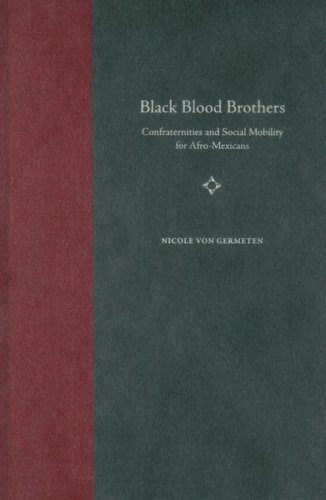
Black Blood Brothers: Confraternities and Social Mobility for Afro-Mexicans

Posted in Books, Caribbean/Latin America, History, Media Archive, Mexico, Monographs, Religion on 2015-04-12 01:30Z by Steven

Black Blood Brothers: Confraternities and Social Mobility for Afro-Mexicans

University Press of Florida
2006-05-30
304 pages
6 x 9
Hardback ISBN 13: 978-0-8130-2942-9

Nicole von Germeten, Associate Professor of History
Oregon State University

Celebrating the African contribution to Mexican culture, this book shows how religious brotherhoods in New Spain both preserved a distinctive African identity and helped facilitate Afro-Mexican integration into colonial society. Called confraternities, these groups provided social connections, charity, and status for Africans and their descendants for over two centuries.

Often organized by African women and dedicated to popular European and African saints, the confraternities enjoyed prestige in the Baroque religious milieu of 17th-century New Spain. One group, founded by Africans called Zapes, preserved their ethnic identity for decades even after they were enslaved and brought to the Americas. Despite ongoing legal divisions and racial hierarchies, by the end of the colonial era many descendants from African slaves had achieved a degree of status that enabled them to move up the social ladder in Hispanic society. Von Germeten reveals details of the organization and practices of more than 60 Afro-Mexican brotherhoods and examines changes in the social, family, and religious lives of their members. She presents the stories of individual Africans and their descendants—including many African women and the famous Baroque artist Juan Correa—almost entirely from evidence they themselves generated. Moving the historical focus away from negative stereotypes that have persisted for almost 500 years, this study is the first in English to deal with Afro-Mexican religious organizations.

Tags: , , ,

Harlem and After: African American Literature 1925-present (EAS3241)

Posted in Course Offerings, History, Literary/Artistic Criticism, Media Archive, Passing, Politics/Public Policy, Social Science, United Kingdom, United States on 2015-04-12 01:15Z by Steven

Harlem and After: African American Literature 1925-present (EAS3241)

University of Exeter
Exeter, Devon, United Kingdom
2015-02-08

Taking as its point of departure the landmark special issue of Survey Graphic that announced the arrival on the artistic scene of the “New Negro” (1925), this module provides a historical survey of African American writing, 1925 to present. Through close readings of works by both canonical and emerging writers, it encourages students to situate these texts within their historical, social, political and literary contexts. Emphasising key literary and political movements and moments (the Harlem Renaissance; the Civil Rights Movement; Black Power; Hurricane Katrina) and recurring themes and motifs (lynching and racial violence; racial passing and mixed race subjectivity; the legacies of the Great Migration; the significance of music in African American culture; minstrelsy and the commodification of blackness), it invites students to consider the range and diversity of African American literature (poetry; short stories; essays; fiction; graphic novel) published from 1925 to today.

For more information, click here.

Tags:

A real-life Lucious Lyon: The former slave who built a Beale Street “Empire” and transformed Memphis

Posted in Articles, Biography, History, Media Archive, United States on 2015-04-09 01:27Z by Steven

A real-life Lucious Lyon: The former slave who built a Beale Street “Empire” and transformed Memphis

Salon
2015-04-04

Preston Lauterbach


Bob Church (Credit: University of Memphis Special Collections)

Memphis — and music as we know it — wouldn’t be the same without Robert Church’s legacy of vice, virtue and power

Depending on which critic or fan you ask, Fox TV’s “Empire” is somewhere between Shakespeare’s drama “King Lear” and Norman Lear’s campy “Good Times.” Less apparent to the show’s legions of viewers is how the story of Lucious Lyon and Empire Entertainment echoes the original black empire, a real-life dynasty of vice, virtue, and power, built in the heart of the old Confederacy just after the Civil War by a former slave who became monarch, Robert Church.

Like Lucious Lyon, who must plan for the future of his empire after being diagnosed with a crippling, often fatal, ailment, Bob Church had plenty of reasons to consider his legacy. It wasn’t so much that a specific death sentence loomed over Church—he just happened to find himself in life threatening situations, often. By his early 30s, Church had survived two gunshot wounds to his head, a steamboat disaster, a Civil War naval battle that he escaped by swimming the Mississippi River and an assassination attempt that backfired when a shotgun aimed at him exploded toward the shooter. Had Bob Church not been the combination of tough and lucky that saved him in these fateful scrapes, legendary Beale Street in Memphis, Tennessee, might be just another strip of concrete. Instead, it gained such an extraordinary reputation that Memphis entertainer Rufus Thomas would crack, “If you could be black on Beale Street one Saturday night, you’d never want to be white no more.”

Beale Street’s birth as an alternate universe for black America, a center of political clout and cultural fertility that changed America, all began with Church…

…Understanding the uncertainty of the vice-lord life in a hell-roaring river town, Church knew he must cultivate an heir. His eldest son Thomas lived in New York, passing for white, some have said. Thomas wouldn’t do. Eldest daughter Mary had become a steadfast leader in her own right, the first black woman on Washington, D.C.’s board of education and a founder of the NAACP. She could not be compromised. As with Lucious Lyon’s three sons, there was some competition among the Church children—they all would have liked to keep his money—but unlike “Empire’s” twisted succession plot, old man Church had no doubt who to choose: his youngest son, Robert Jr…

Read the entire article here.

Tags: , , , , , , ,

One Drop of Love is coming to Massachusetts and New York in April

Posted in Arts, Census/Demographics, History, Identity Development/Psychology, Live Events, Media Archive, United States on 2015-04-09 01:12Z by Steven

One Drop of Love is coming to Massachusetts and New York in April

One Drop of Love: A Daughter’s Search for Her Father’s Racial Approval
2015-04-07


Photo by Jeff Lorch

“What Fanshen Cox DiGiovanni brings to the table is a moving and insightful microscope to our belief that there is such a thing as race and how the assignment of identity plays out in destructive ways that impact each and every one of us. This is a critical component that often gets missed in our attempts to dismantle this social construct.”Carol Ross, Media and Climate Communications Specialist for Amherst, Massachusetts.

For more information, click here.

Tags: , ,

How one man has made a mark on history in northeast N.C.

Posted in Articles, History, Media Archive, Native Americans/First Nation on 2015-04-07 01:21Z by Steven

How one man has made a mark on history in northeast N.C.

The Outer Banks Voice
2015-04-04

Ed Beckley


Marvin T. Jones has a passion for local heritage and is responsible for a half dozen historical markers in the area.

Our region’s rich history is brought to the fore each time someone who passes a historical marker on the side of the road, stops, reads and ponders. But who dreams up these visual reminders of our times gone by and makes them appear before our eyes?

They’re people such as Marvin T. Jones, who grew up in rural Hertford County, “taking much notice of them (as a small boy) and pleased when my first school, C.S. Brown, received one in the 1980’s.”

Jones has a passion for local heritage and is responsible for a half dozen historical markers in the area, including The Roanoke Island Freedmen’s Colony, the Algonquian Village of Dasemunkepeuc in Dare County and four others inland.

The North Carolina Highway Historical Marker Program reports more than 1,400 markers in place in the state since 1936. Twenty-five are in Dare County. They are not only a tribute to the places and patriots of the past, but to the people who work to place them for posterity. Jones is squarely in that category…

…He has a rich diverse racial background, as is the case of so many others in that area. It was his mother’s mention of her ancestor, a Chowanoke Native-American leader, which impelled him to research the area’s history all the way back to the first English colonists in 1584. Jones is a mix of mostly Chowanoke, Tuscarora, European and African descent, with roots as far away as India…

Read the entire article here.

Tags: , , , , , ,

Cast Into Racial Limbo: The Histories, Experiences, and Intricacies of Racial Passing in Twentieth Century America

Posted in Articles, History, Media Archive, Passing, United States on 2015-04-03 20:26Z by Steven

Cast Into Racial Limbo: The Histories, Experiences, and Intricacies of Racial Passing in Twentieth Century America

Strigidae: A Journal of Undergraduate Writing in the Arts and Humanities
Volume 1: Issue 1 Written Bodies/Writing Selves (January 2015)
Article 3
8 pages

Hersch Rothmel
Keene State College, Keene, New Hampshire

The deep, complex, and contradictory layers that manifest through the intricate and subtle art of passing provide a catalyst for a greater understanding of how black identities have been constructed over time. Understanding passing as a historical, cultural, political, and social marker is necessary in assessing racial histories of America, and this understanding makes it possible to cultivate new perspectives and deeper critical analyses of how race has evolved and survived U.S. history.

Read the entire article here.

Tags: , ,