Mixed Race Marriages

Posted in Articles, Barack Obama, Census/Demographics, New Media, Politics/Public Policy, Social Science, United States on 2009-11-04 20:08Z by Steven

Mixed Race Marriages

The Milken Institute Review
Second Quarter 2009

William “Bill” H. Frey, Senior Fellow in Demography/Senior Fellow in Metropolitan Policy
Milken Institute
Brookings Institution in Washington

While Barack Obama’s election was a signal event for many reasons, the fact that Americans chose someone of mixed race isn’t quite as startling as it first appears. New Census data show that 7.7 percent of marriages in 2007 were of mixed race – nearly twice as many as in 1990. The ongoing infusion of immigrants combined with more tolerant public attitudes have taken us a long way since 1967, when the Supreme Court finally barred race-based restrictions on marriage…

…Variance across states is striking. Hawaii, where three in 10 marriages are interracial, leads; New Mexico and other intermountain West states follow. At the other end of the spectrum: Mississippi, along with Vermont and Maine – two states with very small minority populations. Note, however, that many of the states with a low incidence of intermarriage are now experiencing surges, suggesting that intermarriage is leaping regional barriers…

Read the entire “Charticle” here.

Tags: , , ,

“Miscegenation” Making Race in America

Posted in Books, History, Media Archive, Monographs, Politics/Public Policy, Slavery, Social Science, United States on 2009-11-02 16:59Z by Steven

“Miscegenation” Making Race in America

University of Pennsylvania Press
2002
216 pages
6 x 9, 19 illus.
Cloth: ISBN 978-0-8122-3664-4
Paper ISBN: 978-0-8122-2064-3

Elise Lemire, Professor of Literature
Purchase College, State University of New York

In the years between the Revolution and the Civil War, as the question of black political rights was debated more and more vociferously, descriptions and pictorial representations of whites coupling with blacks proliferated in the North. Novelists, short-story writers, poets, journalists, and political cartoonists imagined that political equality would be followed by widespread inter-racial sex and marriage. Legally possible yet socially unthinkable, this “amalgamation” of the races would manifest itself in the perverse union of “whites” with “blacks,” the latter figured as ugly, animal-like, and foul-smelling. In Miscegenation, Elise Lemire reads these literary and visual depictions for what they can tell us about the connection between the racialization of desire and the social construction of race.

Previous studies of the prohibition of interracial sex and marriage in the U.S. have focused on either the slave South or the post-Reconstruction period. Looking instead to the North, and to such texts as the Federalist poetry about Thomas Jefferson and Sally Hemings, James Fenimore Cooper‘s Last of the Mohicans, Edgar Allan Poe‘s “Murders in the Rue Morgue,” and the 1863 pamphlet in which the word “miscegenation” was first used, Lemire examines the steps by which whiteness became a sexual category and same-race desire came to seem a biological imperative.

Table of Contents

  • List of Illustrations
  • Introduction: The Rhetorical Wedge Between Preference and Prejudice
  • 1. Race and the Idea of “Preference” in the New Republic: The Port Folio Poems About Thomas Jefferson and Sally Hemings
  • 2. The Rhetoric of Blood and Mixture: Cooper’s “Man Without a Cross”
  • 3. The Barrier of Good Taste: Avoiding A Sojourn in the City of Amalgamation in the Wake of Abolitionism
  • 4. Combating Abolitionism with the Species Argument: Race and Economic Anxieties in Poe’s Philadelphia
  • 5. Making “Miscegenation”: Alcott‘s Paul Frere and the Limits of Brotherhood After Emancipation
  • Epilogue: “Miscegenation” Today
  • Notes
  • Bibliography
  • Index
  • Acknowledgments
Tags: , , , , , , , , ,

Mestizo Democracy: The Politics of Crossing Borders

Posted in Books, Caribbean/Latin America, Media Archive, Monographs, Politics/Public Policy, Social Science, United States on 2009-11-02 16:45Z by Steven

Mestizo Democracy: The Politics of Crossing Borders

Texas A&M University Press
2003
320 pages
6.125 x 9.25
Paper ISBN: 978-1-58544-346-8

John Francis Burke, Professor of Political Science and Chair
University of St. Thomas, Houston

Foreword by Virgilio Elizondo

It can come as no surprise that the ethnic makeup of the American population is rapidly changing. That there are political repercussions from these changes is also self-evident. How the changes can, must, and should alter our very understanding of democracy, though, may not be obvious. Political theorist John Burke addresses these issues by offering a “mestizo” theory of democracy and tracing its implications for public policy.

The challenge before the United States in the coming century, Burke posits, will be to articulate a politics that neither renders cultures utterly autonomous from each other nor culminates in their homogeneous assimilation. Fortuitously or ironically, the way to do this comes from the very culture that is now necessitating the change.

Mestizo is a term from the Mexican socio-political experience. It means “mixture” and implies a particular kind of mixture that has resulted in a blend of indigenous, African, and Spanish genes and cultures in Latin America. This mixture is not a “melting pot” experience, where all eventually become assimilated; rather, it is a mixture in which the influences of the different cultures remain identifiable but not static. They all evolve through interaction with the others, and the resulting larger culture also evolves as the parts do. Mestizaje (the collective noun form) is thus process more than condition.

John Burke analyzes both American democratic theory and multiculturalism within political theology to develop a model for cultivating a democratic political community that can deal constructively with its cultural diversity. He applies this new model to a number of important policy issues: official language(s), voting and participation, equal employment opportunity, housing, and free trade. He then presents an intensive case study, based on a parish “multicultural committee” and choir in which he has been a participant, to show how the “engaged dialogue” of mestizaje might work and what pitfalls await it.

Burke concludes that in the United States we are becoming mestizo whether we know it or not and whether we like it or not. By embracing the communitarian but non-assimilationist stance of intentional mestizaje, we can forge a future together that will be not only greater than the sum of its parts but also freer and more just than its past.

John Francis Burke is a professor of political science and chair of the department at the University of St. Thomas in Houston. He is an active lay minister in a Houston Catholic parish characterized by diversity. With a Ph.D. from the University of Notre Dame, he brings strong training in western political philosophy and religious studies to his study of mestizo culture in the United States.

Tags: , ,

Mulattas and Mestizas: Representing Mixed Identities in the Americas, 1850–2000

Posted in Books, Caribbean/Latin America, History, Latino Studies, Media Archive, Mexico, Monographs, Politics/Public Policy, Social Science, United States on 2009-11-02 16:30Z by Steven

Mulattas and Mestizas: Representing Mixed Identities in the Americas, 1850–2000

University of Georgia Press
2003-01-27
284 pages
Trim size: 6 x 9
Cloth ISBN: 978-0-8203-2325-1
Paper ISBN: 978-0-8203-2781-5

Suzanne Bost, Associate Professor of English
Loyola University

In this broadly conceived exploration of how people represent identity in the Americas, Suzanne Bost argues that mixture has been central to the definition of race in the United States, Mexico, and the Caribbean since the nineteenth century. Her study is particularly relevant in an era that promotes mixed-race musicians, actors, sports heroes, and supermodels as icons of a “new” America. Bost challenges the popular media’s notion that a new millennium has ushered in a radical transformation of American ethnicity; in fact, this paradigm of the “changing” face of America extends throughout American history.

Working from literary and historical accounts of mulattas, mestizas, and creoles, Bost analyzes a tradition, dating from the nineteenth century, of theorizing identity in terms of racial and sexual mixture. By examining racial politics in Mexico and the United States; racially mixed female characters in Anglo-American, African American, and Latina narratives; and ideas of mixture in the Caribbean, she ultimately reveals how the fascination with mixture often corresponds to racial segregation, sciences of purity, and white supremacy. The racism at the foundation of many nineteenth-century writings encourages Bost to examine more closely the subtexts of contemporary writings on the “browning” of America.

Original and ambitious in scope, Mulattas and Mestizas measures contemporary representations of mixed-race identity in the United States against the history of mixed-race identity in the Americas. It warns us to be cautious of the current, millennial celebration of mixture in popular culture and identity studies, which may, contrary to all appearances, mask persistent racism and nostalgia for purity.

Tags: , , , ,

Crossing Lines: Race and Mixed Race Across the Geohistorical Divide

Posted in Anthologies, Arts, Books, History, Identity Development/Psychology, Media Archive, Politics/Public Policy, Social Science on 2009-10-31 00:15Z by Steven

Crossing Lines: Race and Mixed Race Across the Geohistorical Divide

Rowman & Littlefield
Paper: 0-9700-3841-0 / 978-0-9700-3841-8
June 2005
190 pages

Edited by

Marc Coronado
DeAnza College

Rudy P. Guevarra
University of California, Santa Barbara

Jeffrey A. S. Moniz, Associate Professor and Director
University of Hawai’i

Laura Furlan Szanto
University of California, Santa Barbara

Crossing Lines addresses the issues of race and mixed race at the turn of the 21st century. Representing multiple academic disciplines, including history, ethnic studies, art history, education, English, and sociology, the volume invites readers to consider the many ways that identity, community, and collectivity are formed, while addressing the challenges that multiracial identity poses to our understanding of race and ethnicity. The authors examine such subjects as social action, literary representations of multiracial people, curriculum development, community formation, Whiteness, and demographic changes.

List of Contributors
Marc Coronado (DeAnza College), Carina Evans (UC Santa Barbara), Melinda Gandara (UC Santa Barbara), Rudy P. Guevarra, Jr. (UC Santa Barbara), Tomas Jimenez (Harvard University), George Lipsitz (UC San Diego), Jeffrey Moniz (University of Hawai’i), Paul Spickard (UC Santa Barbara), Laura Furlan Szanto (UC Santa Barbara), and Nicole Marie Williams (UC Santa Barbara).

Table of Contents

  • Introduction
  • Noises in the Blood: Culture, Conflict, and Mixed Race Identities
    George Lipsitz
  • Does Multiraciality Lighten? Me-Too Ethnicity and the Whiteness Trap
    Paul Spickard
  • “My Father? Gabacho?” Ethnic Doubling in Gloria Lopez Stafford’s A Place in El Paso
    Marc Coronado
  • Burritos and Bagoong: Mexipinos and Multiethnic Identity in San Diego, California
    Rudy P. Guevarra, Jr.
  • Challenging the Hegemony of Multiculturalism: The Matter of the Marginalized Multiethnic
    Jeffrey A.S. Moniz
  • Beyond Disobedience
    Nicole M. Williams
  • “Fictive Imaginings”: Constructing Biracial Identity and Senna’s Caucasia
    Carina A. Evans
  • The Beginning
    Laura Furlan Szanto
  • Los Angeles Museum of Art: Looking Forward
    Melinda Gandara
  • Multiethnic Mexican Americans in Demographic and Ethnographic Perspectives
    Tomas R. Jimenez
Tags: , , , , , , , , , ,

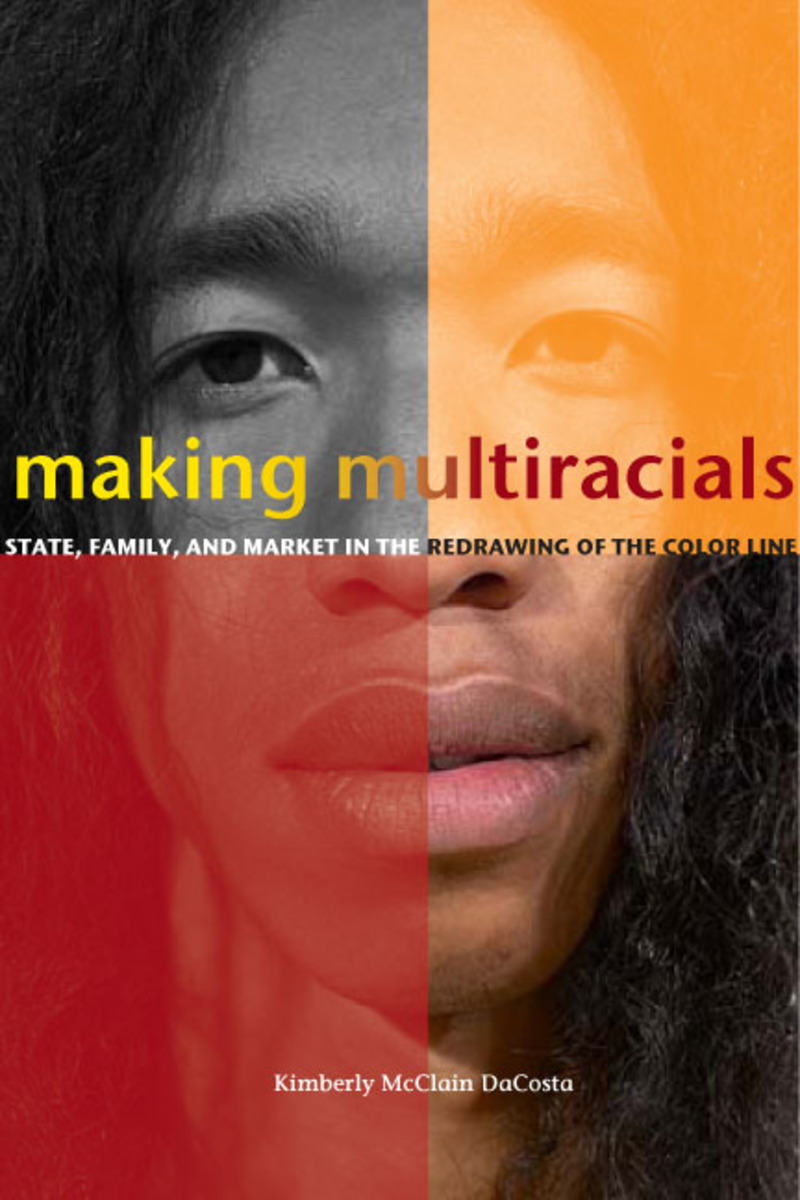
Making Multiracials: State, Family, and Market in the Redrawing of the Color Line

Posted in Anthropology, Books, Economics, Family/Parenting, Identity Development/Psychology, Media Archive, Monographs, Politics/Public Policy, Social Science, United States on 2009-10-29 03:28Z by Steven

Making Multiracials: State, Family, and Market in the Redrawing of the Color Line

Stanford University Press
2007
280 pages
3 tables, 2 figures, 4 illustrations.
Cloth ISBN-10: 0804755450; ISBN-13: 9780804755450
Paper ISBN-10: 0804755469; ISBN-13: 9780804755467

Kimberly McClain DaCosta, Associate Professor
Gallatin School of Individualized Study, New York University

When in 1997 golfer Tiger Woods described his racial identity on Oprah as “cablinasian,” it struck many as idiosyncratic. But by 2003, a New York Times article declared the arrival of “Generation E.A.”—the ethnically ambiguous. Multiracial had become a recognizable social category for a large group of Americans.

Making Multiracials tells the story of the social movement that emerged around mixed race identity in the 1990s. Organizations for interracial families and mixed race people—groups once loosely organized and only partially aware of each other—proliferated. What was once ignored, treated as taboo, or just thought not to exist quickly became part of the cultural mainstream.

How did this category of people come together? Why did the movement develop when it did? What is it about “being mixed” that constitutes a compelling basis for activism? Drawing on extensive interviews and fieldwork, the author answers these questions to show how multiracials have been “made” through state policy, family organizations, and market forces.

Table of Contents

  • Tables, Figures and Photos
  • Acknowledgements
  • The Making of a Category
  • Becoming a Multiracial Entrepreneur: Four Stories
  • Making Multiracial Families
  • Creating Multiracial Identity and Community
  • Consuming Multiracials
  • Redrawing the Color Line?: The Problems and Possibilities of Multiracial Families and Group Making
  • Appendix A: List of Respondents
  • Appendix B: Methodology
  • Appendix C: Situating Multiracial Group Making in the Literature on Social Movements, Race, and the Work of Pierre Bourdieu
  • Notes
  • Bibliography
  • Index

For the press release, click here.
For an excerpt of chapter 2, click here.

Tags: , , , ,

Race Mixing: Black-White Marriage in Postwar America

Posted in Books, Family/Parenting, History, Media Archive, Monographs, Politics/Public Policy, Social Science, United States on 2009-10-29 03:15Z by Steven

Race Mixing: Black-White Marriage in Postwar America

Harvard University Press
April 2003
382 pages
11 halftones, 1 line drawing
ISBN 13: 978-0-674-01033-8
ISBN 10: 0-674-01033-7

Renee C. Romano, Professor of History, Comparative American Studies, and Africana Studies
Oberlin College

Marriage between blacks and whites is a longstanding and deeply ingrained taboo in American culture. On the eve of World War II, mixed-race marriage was illegal in most states, politicians argued for segregated facilities in order to prevent race mixing, and interracial couples risked public hostility, legal action, even violence. Yet, sixty years later, black-white marriage is no longer illegal or a divisive political issue, and the number of such couples and their mixed-race children has risen dramatically. Renee Romano explains how and why such marriages have gained acceptance, and what this tells us about race relations in contemporary America.

Although significant numbers of both blacks and whites still oppose interracial marriage, larger historical forces have greatly diminished overt racism and shaped a new consciousness about mixed-race families. The social revolutions of the 1950s and ’60s (with their emphasis on individualism and nonconformity), the legal sanctions of new civil rights laws, and a decline in the institutional stability of marriage have all contributed to the growing tolerance for interracial relationships. Telling the powerful stories of couples who married across the color line, Romano shows how cultural shifts are lived by individuals, and how they have enabled mixed couples to build supportive communities for themselves and their children.

However, Romano warns that the erosion of this taboo does not mean that racism no longer exists. The history of interracial marriage helps us understand the extent to which America has overcome its racist past, and how much further we must go to achieve meaningful racial equality.

Tags: , , ,

Mixed Feelings: The Complex Lives of Mixed-Race Britons

Posted in Books, Media Archive, Monographs, Politics/Public Policy, Social Science, United Kingdom on 2009-10-27 22:02Z by Steven

Mixed Feelings: The Complex Lives of Mixed-Race Britons

The Women’s Press
2001
336 pages
9.1 x 6.1 x 0.7 inches
Paperback ISBN-10: 0704347067; ISBN-13: 978-0704347069

Yasmin Alibhai-Brown

Yasmin Alibhai-Brown’s new book offers the sharpest and most informed insight yet on mixed-race Britain. Opening with an historical perspective, she traces up to the twenty-first century the reactions – often rabid – to mixed-race relationships, and the influences of imperialism and large-scale immigration. With research drawn from coupls, parents and children, she offers unique insight into the stresses as well as the strengths of links across the racial divide. In a penetrating, constantly questioning text, she asks why social policy makers have been so slow to deal with the particular problems of this growing and significant group.

The influence of race on national identity is a crucial current debate and this book gives voice to the issue, addressing difficult dilemmas but also suggesting positive solutions to the often instinctive reactions aroused by the breaking down of old barriers. An essential report into the future of the nation.

Tags: ,

Racial Mixture and Affirmative Action: The Cases of Brazil and the United States

Posted in Articles, Brazil, Caribbean/Latin America, History, Media Archive, Politics/Public Policy, Social Science, United States on 2009-10-26 01:59Z by Steven

Racial Mixture and Affirmative Action: The Cases of Brazil and the United States

The American Historical Review
Volume 108, Number 5
December 2003

Thomas E. Skidmore, Carlos Manuel de Céspedes Professor of History Emeritus
Brown University

For me, as a historian of Brazil, North America’s “one-drop rule” has always seemed odd. No other society in this hemisphere has defined its racial types in such absolutist terms. David Hollinger, like many American historians before him, is clearly intrigued by this apparently unique “approach to the question of ethnoracial mixture.” How can we account for it? How could such a different racial classification have arisen in North America and not in any of the many other European colonial experiments in the New World?

Hollinger cites three features that in combination allegedly made U.S. racial evolution different. The first is a regime that tolerated slavery and thereby produced a significant population of slave descent. The second is massive immigration that enriched American society. The third is survival of an Indian population, even if only in token numbers.

But Hollinger examines the influence of these three factors on racial attitudes and behavior in the United States alone. If we add one other country, Brazil, to the picture, we find something rather startling. All three of Hollinger’s conditions also obtained in Brazil. Yet they did not produce the one-drop rule. Something else must have been at work.

If I had been writing this commentary a half century ago, I would have stressed the enormous difference between the two countries in the racial status given to the offspring of mixed unions.  Throughout the United States (multi-racial societies emerged in Charleston and New Orleans, but only temporarily), the one-drop rule defined mixed bloods (even the lightest mulattos) as black. In Brazil, by contrast, racial attribution depended on how the person looked and on the particular circumstances of that person, which led to the racial fluidity for which Brazil is famous

Read the entire article here.

Tags: , , , , ,

A Contested Identity: An Exploration of the Competing Social and Political Discourse Concerning the Identification and Positioning of Young People of Inter-Racial Parentage

Posted in Articles, Media Archive, Politics/Public Policy, Social Work, United Kingdom on 2009-10-25 02:33Z by Steven

A Contested Identity: An Exploration of the Competing Social and Political Discourse Concerning the Identification and Positioning of Young People of Inter-Racial Parentage

British Journal of Social Work
Volume 36, Number 8 (2006)
pages 1309-1324
DOI: 10.1093/bjsw/bch390

Ravinder Barn, Professor of Social Policy and Social Work
Royal Holloway, University of London

Vicki Harman, Lecturer in the Centre for Criminology and Sociology
Royal Holloway, University of London

The development of racial and ethnic identity of minority ethnic children and young people in contemporary multi-racial Western society remains an important academic concern. More recently, a relatively new debate about the identity and ‘correct’ labelling of children of inter-racial relationships has been brewing in British academic literature. Nowhere is this more vociferous and intense than in the field of social work. This paper identifies two competing perspectives vying for position in this ideological and political battle. It is argued that whilst overall consensus may not be possible or even desirable, it is important to explore these ideological positions as they play a key role in influencing social work policy and practice.

Tags: , ,