Double-barrelled race system to start on Saturday

Posted in Articles, Asian Diaspora, New Media, Politics/Public Policy on 2010-12-31 03:55Z by Steven

Double-barrelled race system to start on Saturday

Today Online
2010-12-31

Zul Othman

SINGAPORE – From Saturday, the Immigration and Checkpoints Authority (ICA) will implement the registration of dual heritage options for children with parents of different races. This means these children will be able to share dual heritages on their identity cards (ICs), by way of “double-barrelled” races.

This change was first announced in Parliament in January; giving mixed marriage couples—a Caucasian-Chinese, for example—the flexibility to decide how their children’s race should be recorded instead of categorising them as Chinese, Caucasian, or Eurasian.

The ICA says that there will not be any advantages in terms of policy considerations for those who register either a double-barrelled or singular race…

…As for the HDB’s [Housing and Development Board’s] Ethnic Integration Policy—which puts a cap on the number of families of each race in a HDB block to ensure a balanced mix of races—it has previously said that it may be more flexible towards mixed-race couples…

Read the entire article here.

Tags: , ,

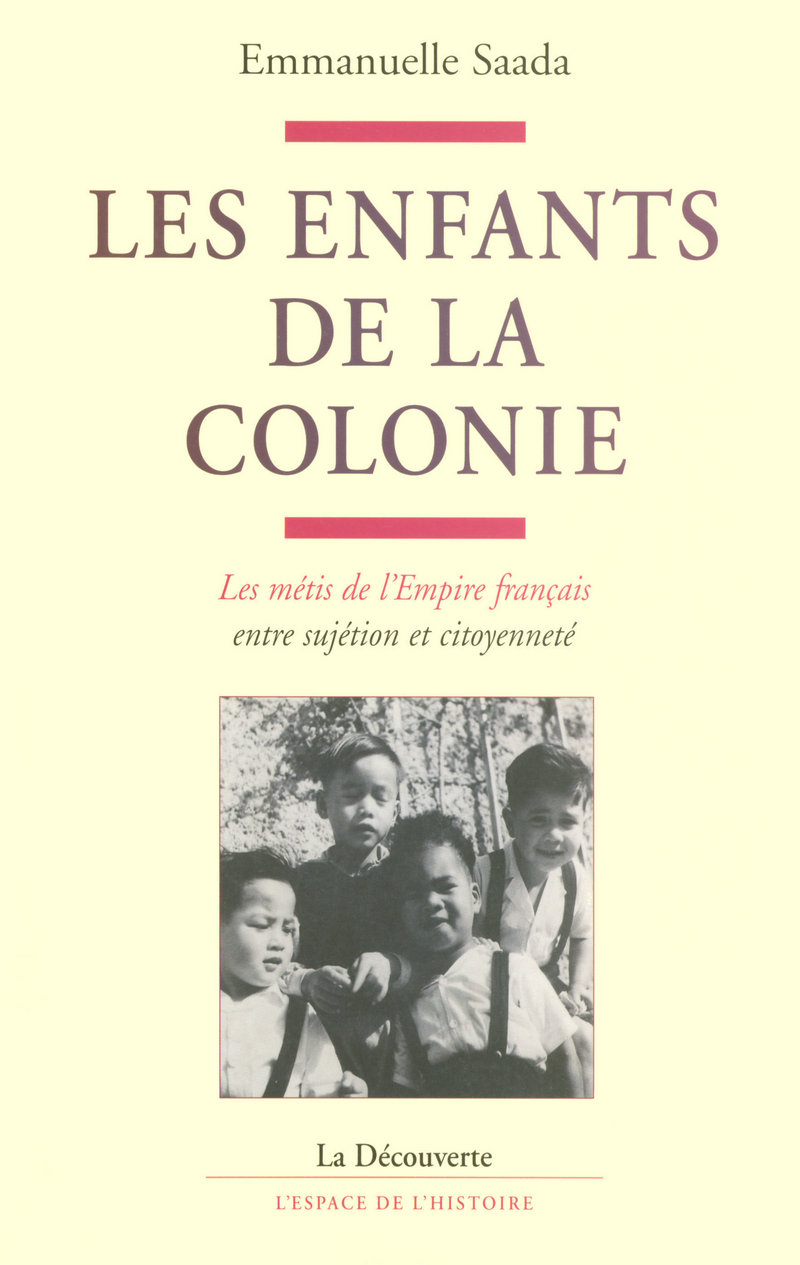
Les Enfants de la colonie: Les métis de l’Empire français entre sujétion et citoyenneté / Children of The Colonies: The Métis of the French Empire: Citizens or Subjects?

Posted in Asian Diaspora, Books, Europe, History, Media Archive, Monographs, Politics/Public Policy, Social Science on 2010-12-29 19:12Z by Steven

Les Enfants de la colonie: Les métis de l’Empire français entre sujétion et citoyenneté / Children of The Colonies: The Métis of the French Empire: Citizens or Subjects?

Éditions La Découverte
2007
336 pages
Dimensions: 155 * 240 mm
ISBN: 9782707139825

Emmanuelle Saada, Associate Professor and Director of the Center for French and Francophone Studies
Columbia University

The colonial encounter in the French Empire produced tens of thousands of ‘métis’ children. Most were the product of short-term relationships between European men and native women. Many were abandoned by their fathers, and condemned to illegitimacy. Colonial elites considered them a threat because they blurred the sharp distinction between citizens and subjects on which the colonial order rested. Colonial authorities met this challenge with an array of social and legal efforts to resolve this ambiguity—to «reclassify» the « métis problem » out of existence. Education and culture played a key role in this process, as métis children were placed in special orphanages devoted to « straightening out their heredity », turning them into French citizens of « soul and quality ». This book explores the forgotten history of these children of the colonies, and of their central place in larger strategies of imperial domination and the management of colonial sexuality. It pays special attention to Indochina, which served as a laboratory for the “métis question”, but it is also an account of a global Empire marked by the persistent challenge of maintaining boundaries between citizen and subject. In exploring this intersection between sexuality, race and citizenship in the colonial context, this book challenges and revises the ‘republican model’ of nationhood that has dominated histories of France since the 19th century.

Pendant la colonisation française, des dizaines de milliers d’enfants sont nés d’« Européens » et d’« indigènes ». Souvent illégitimes, non reconnus puis abandonnés par leur père, ces métis furent perçus comme un danger parce que leur existence brouillait la frontière entre « citoyens » et « sujets » au fondement de l’ordre colonial. Leur situation a pourtant varié : invisibles en Algérie, ils ont été au centre des préoccupations en Indochine. La « question métisse » a également été posée à Madagascar, en Afrique et en Nouvelle-Calédonie.

Retraçant l’histoire oubliée de ces enfants de la colonie, cet ouvrage révèle une face cachée, mais fondamentale, de l’histoire de l’appartenance nationale en France : il montre comment les tentatives d’assimilation des métis ont culminé, à la fin des années 1920, avec des décrets reconnaissant la citoyenneté à ceux qui pouvaient prouver leur « race française ». Aux colonies, la nation se découvrait sous les traits d’une race.

Cette législation bouleversa le destin de milliers d’individus, passant soudainement de la sujétion à la citoyenneté : ainsi, en Indochine, en 1954, 4 500 enfants furent séparés de leur mère et « rapatriés » en tant que Français. Surtout, elle introduisait la race en droit français, comme critère d’appartenance à la nation. Cela oblige à revoir le « modèle républicain » de la citoyenneté, fondé sur la figure d’un individu abstrait, adhérant volontaire à un projet politique commun et à souligner les liens entre filiation, nationalité et race.

Table of Contents

  • Préface, par Gérard Noiriel
  • Introduction
  • I / Le métissage : une question sociale coloniale
  • 1. Une question impériale – Nouvel empire, nouvelle question – Hybrides et bâtards – Géographie de la question métisse – Un problème impérial – Les chiffres du métissage
  • 2. Menace pour l’ordre colonial – Légionnaires, filles de peu et parias – Déracinés et déclassés – Le spectacle du désordre – Dignité et prestige en situation coloniale
  • 3. « Reclasser » les métis – Produire des métis en leur portant secours ? – De la nécessité d’intervenir – Vers une prise en charge par l’État colonial – Notables vs. prolétaires de la colonisation – Dépister, signaler et secourir – Passer les frontières – Vers une demande de droit
  • II / La question métisse saisie par le droit
  • 4. Nationalité et citoyenneté en situation coloniale – Les enjeux d’une condition juridique – Les juristes et l’indigène – La citoyenneté française en pratique – Les métis entre sujétion et citoyenneté
  • 5. La controverse des « reconnaissances frauduleuses » – Les « reconnaissances frauduleuses », « fraudes » à la citoyenneté – Destin d’une controverse juridique – La production d’un droit impérial – Paternité, citoyenneté et ordre politique
  • 6. La recherche de paternité aux colonies – La recherche de paternité en métropole : un texte de compromis – Un débat colonial – Paternité et citoyenneté : nature et volonté – Paternité et race
  • 7. Citoyens en vertu de la race – Le droit hors de lui – La « question métisse » saisie par le droit – Le retournement de la jurisprudence – La fabrique du droit colonial – Vérité sociologique/vérité biologique, « droit reflet »/« droit instituant » – Mise en œuvre d’un droit racial
  • III / La force du droit
  • 8. Le passage du droit : les effets de la citoyenneté sur la catégorie de « métis » – La racialisation des pratiques administratives – Renforcement de la prise en charge des métis – Les métis, des cadres de la colonisation – Une question postcoloniale
  • 9. Des identités saisies par le droit – Des Français des colonies – Vers un multiculturalisme impérial ? – Catégorie juridique et sentiment d’identité
  • 10. Le statut des métis, miroir de la nationalité et de la citoyenneté françaises ? – La race dans la loi – Métis coloniaux et métis juifs – La question métisse et les « modèles républicains » de la nationalité et de la citoyenneté
  • Conclusion – Sources – Bibliographie.
Tags: , ,

The New Nadir: The Political Economy of the Contemporary Black Racial Formation

Posted in Articles, Media Archive, Politics/Public Policy, Social Science, United States on 2010-12-24 15:20Z by Steven

The New Nadir: The Political Economy of the Contemporary Black Racial Formation

The Black Scholar
2010-03-22

Sundiata Keita Cha-Jua, Associate Professor of History and African American Studies
University of Illinois, Urbana-Champaign

IN “THE NEW NADIR: The Political Economy of the Contemporary Black Racial Formation,” using the Marxist method of historical materialism analyze the period after Turner’s investigation, that is, from the early 1990s to the present. Like Turner and Mendenhall, attend to history, economy, politics, and ideology. I explore how the transformation to financialized global racial capitalism has structured the lives of contemporary African Americans. My main thesis is that the transformation to a new capitalist accumulation structure has reversed or mitigated most of the socioeconomic, but not the political gains achieved by the civil rights and Black Power movements. In the context of the pivotal events in the transformation of the U.S. and world political economies, I highlight four seminal events in the construction of the New Nadir. They are: (1) the suppression of black voters in Florida in the 2000 presidential election; (2) the racialized social catastrophe caused by Hurricane Katrina in 2005; (3) the devastating loss of African American wealth due to the subprime foreclosure crisis in 2007; and (4) the election of Barack Obama as the nation’s first African American president in 2008. These events illustrate the contradictory nature of the contemporary black racial formation. Dividing the effects on African America into their primary economic and political impacts, I explore ten major transformations that financialized global racial capitalism has wrought on African America. Like Mendenhall and Turner, I suggest that the way forward from this moment of devastation, rollback, and retreat lies through a (re)engagement with Marxism. Until capitalism can be destroyed, what is needed are fully developed black Marxist critiques of “the paradox of the contemporary conjuncture” and the construction of radical strategies for black liberation and social transformation in the age of financialized global racial capitalism.

ON MAY 9, 1865, Frederick Douglass addressed the last meeting of the American Anti-Slavery Society. In an atmosphere bursting with excitement and pride of accomplishment, Douglass offered a cautionary note. He speculated that emancipation would witness the metamorphosis, rather than the end of “Slavery.” According to Douglass:

“Slavery has been fruitful in giving itself names. It has been called ‘the peculiar institution,’ ‘the social system,’ and the ‘impediment.’ It has been called by a great many names, and it will call itself by yet another name; and you and I and all of us had better wait and see what new form this old monster will assume, in what new skin this old snake will come forth next.”

Douglass knew slavery was merely one form through which a more fundamental and durable phenomenon manifested itself. Though he did not name it, Douglass was conceptualizing black racial oppression, the systematic, pervasive, and persistent domination of people of African descent in the United States of America. (1)

Black racial oppression has undergone three transformations since Douglass observed its chameleon-like capacity to transform itself. (2) The contemporary black racial formation, the New Nadir is a consequence of the transformation to financialized global racial capitalism, a new stage of capitalist accumulation which is characterized by three interconnected processes: globalization of production and markets; neoliberal(ism) social policies; and financialization, the shift of investment from production to monetary “products.” (3)…

…The repudiation of “blackness” or African American identity is another significant aspect of the political fragmentation occurring within African America. The ideological assault “blackness” is rooted in colorblind racial ideology and its desire to promote a post-black identity or allegedly to move beyond race. The push to transcend racial identity is a joint project of two overlapping sets of political actors, neoconservatives and the bi- or multiracial identity movement. This collective enterprise has alternatively challenged the use of racial categories in public policy, research, college admissions, and in employment. Yet they have also labored to expand the racial categories on the census and throughout U.S. society, further undermining racial political solidarity. The mixed-race identity movement casts African American identity as an atavistic essentialism, a fiction based totally on the notion of hypodescent or the “one drop rule.” Mixed-race philosopher Naomi Zack and other leaders of the multiracial movement suggest that African Americans have colluded with Euro-Americans to suppress “mixed-race” persons’ right to “self-identification” and “selfhood,” by denying them the right to embrace the fullness of their parental background or “racial” heritage. Rather than constitute a move to destroy racial categories, the creation of a bi- and multiracial classification represents an attempt to construct a new “racial” group. To shift the U.S. biracial classificatory schema and racial order to a multiracial system would locate light-skinned persons of mixed race in a space above African Americans, and perhaps Latinos/as, Asian Americans, but definitely below whites. It would represent what sociologist Eduardo Bonilla-Silva has called “the Latin Americanization of racial classification in the USA.” (39)

GIVEN ITS ASPIRATIONS, it is ironic that the multiracial identity movement is a consequence of the Civil Rights movement, specifically three of its partial successes, Loving v. Virginia (1967), Affirmative Action, and the 1968 Fair Housing Act and its 1988 enhancements. The Loving decision abolished miscegenation law. Affirmative Action provided a generation of African Americans greater access to education and to newly created positions in the expanding technical-managerial sectors of the U.S. political economy or business set-asides for their entrepreneurial ventures. The 1968 Fair Housing Act provided a mechanism for exacerbating the class-based spatial division within African America. It also owes much to the 1965 Immigration and Nationality Act, which eliminated the nationality quotas that were legislated by the 1924 Immigration Act.

According to historian Minkah Makalani: (40)

“Following 1967, when anti-miscegenation laws were declared unconstitutional, more than one million persons were born of mixed parentage in the United States. In the 1990s alone, these births (more than 300,000) were 1.4 percent of total U.S. births, 8.9 percent of all births with at least one black parent, and 43 percent of all births with parents from two different racial groups. On the 2000 U.S. census, only 784,764 persons (0.6 percent of the U.S. population) marked black and white as their racial designation.”

In 2000, the census identified only 784,764 individuals as having one black parent and one non-black parent. Additionally, bi- or multiracial-identified individuals constituted only about 2.1 percent of the 36.4 million African American people. This meager figure is not surprising, since exogamy among blacks is extremely low—6 percent for men and 2 percent for women. Nor is it surprising that 43 percent of such individuals are the product of a relationship between a black and a white person. Asians and Latinos/as, regardless of nationality, rarely marry or have children with African Americans or other blacks in the United States. Sociologist Steven Steinberg discovered that 40 percent of the children of Asian immigrants and a third of U.S. born Latinos/as between ages twenty-five and thirty-four marry non-Latino whites. In truth, the African American and black communities in the U.S. remain shockingly inassimilable. Generally, only other blacks find African Americans, West Indians, and Africans worth marrying. Given the smallness of their numbers, why has the contemporary mixed-race phenomenon received so much scholarly and popular attention? (41)

THE MIXED-RACE issue among African Americans derives its significance from its class and ideological implications for the new black racial formation, not its size. The fact is that a disproportionate number of those adopting this designation or having it thrust upon them are middle-class. Like Africans and Caribbean blacks, individuals identified as mixed-race seem to be supplanting those designated as African American in high profile economic, social, and political positions. This is especially so with student admissions at the nation’s elite universities and increasingly so among the professoriate and the intelligentsia. In many ways, it represents a return to a pre-Black Power intraracial class hierarchy. Given the material conditions of black racial oppression and the contemporary racial ideology of colorblindness, this move would result in further solidifying the historic relationship between light skin color and class in the African American community. Correspondingly, it would further fracture its already frayed class relations. Several scholars have documented the legacy of the color-class connection in African American history. Richard Seltzer and Robert Smith, for instance, have demonstrated that, “the black community continues to exhibit a degree of class stratification based on color, with lighter-skin blacks exhibiting higher education and occupational attainments.” A successful multiracial identity project would make it easier for a comparably wealthy sector of African American society to adopt conservative political positions supporting their privileged economic status, rather than policies more closely linked to that of the black majority…

Read the entire article here.
Tags: , , , , ,

Les Enfants de la colonie: Les métis de l’Empire français entre sujétion et citoyenneté [Book Review]

Posted in Anthropology, Articles, Book/Video Reviews, Europe, History, Law, Media Archive, Politics/Public Policy on 2010-12-22 22:23Z by Steven

Les Enfants de la colonie: Les métis de l’Empire français entre sujétion et citoyenneté [Book Review]

H-France Review (Society for French Historical Studies)
Volume 8, Number 162 (November 2008)
pages 654-657

Marie-Paule Ha
The University of Hong Kong

Emmanuelle Saada, Les Enfants de la colonie: Les métis de l’Empire français entre sujétion et citoyenneté. Paris: Editions de la Découverte, 2007. 335 pp. Notes and bibliography. 24€. ISBN 978-2-7071-3982-5.

While the question of métissage has in the last two decades generated a significant volume of scholarly works from a diverse range of disciplinary and interdisciplinary perspectives, Emmanuelle Saada’s monograph, which grew out of her 2001 doctoral dissertation at the École des Hautes Études en Sciences Sociales, is quite unique in that it provides the first systematic and in-depth investigation of the judicial aspects of what was referred to as “la question métisse.”[1] Drawing on a wide array of materials ranging from archival and juridical sources to works from legal studies, history, anthropology and sociology, the author reconstructs the highly complex and tortuous trajectory that transformed the legal status of the empire’s métis from that of native subjects to being French citizens during the first quarter of the twentieth century. Given the book’s focus, the term “métis” in Les Enfants de la colonie is used to refer not to mixed-race children in general, but to the métis non reconnus, that is, those born out of wedlock that had not been legally recognized by their European fathers and were abandoned by them. As a result, this group of métis was given by default the status of native subjects. It was the plight of this particular category of illegitimate and racially mixed progeny of European men that became the object of the interventions of administrators, philanthropists and legal professionals in the colonies.

The starting point of Saada’s investigation of “the métis problem” is the 8 November 1928 decree which made it possible for the métis non reconnus born in Indochina to be granted French citizenship if one of their parents, legally unknown, could be presumed to be of “French race.” According to the decree, this presumption could be established “par tous les moyens,” which include “le nom que porte l’enfant, le fait qu’il a reçu une formation, une éducation et une culture françaises, sa situation dans la société” (p.13). The momentous interest of this legal text was twofold. On the one hand, it constituted the first occurrence of the word “race” in French legislation. On the other hand, the term was deployed not for an exclusive purpose, but rather to justify the integration of certain subjects of the empire in French citizenry…

Read the entire review here.

Tags: , , ,

Erasure of Euro-Asian: Recovering Early Radicalism and Feminism in South Asia

Posted in Asian Diaspora, Books, History, Media Archive, Monographs, Politics/Public Policy, Social Science on 2010-12-20 21:19Z by Steven

Erasure of Euro-Asian: Recovering Early Radicalism and Feminism in South Asia

Women Unlimited
2009
312 pages
8.6 x 5.8 x 1.1 inches
ISBN-10: 8188965405; ISBN-13: 978-8188965403

Kumari Jayawardena, Emeritus Associate Professor
University of Colombo

This book, focuses on the interaction between Asia and Europe in the wake of Portuguese, Dutch, French and British imperialism. It emphasises the vanguard role of the Euro-Asian communities in South Asia, the Burghers, Anglo-Indians and Eurasians, in struggles for democratic rights, long before colonial conditions were ripe for radical social and political change. With their utopian vision of a future democratic society, they agitated for widespread reforms such as worker and peasant rights, early radicalism, proto-nationalism, secularism and gender equality. Jayawardena brings the path-breaking efforts of these Euro-Asian pioneers from the footnotes of history into the main text, asks why their contributions have been ‘hidden from history’ and suggests that the obsession with ‘purity’ of race, both in South Asia and Europe, led to erasing the importance of this radical intelligentsia of mixed origin.

Tags: ,

Defying the Civil Rights Lobby: The American Multiracial Movement

Posted in Census/Demographics, Media Archive, Papers/Presentations, Politics/Public Policy, Social Science, United States on 2010-12-16 00:31Z by Steven

Defying the Civil Rights Lobby: The American Multiracial Movement

Benjamin L. Hooks Institute for Social Change
University of Memphis
April 2007
35 pages

Kim M. Williams, Associate Professor of Public Policy
Harvard University

Throughout the 1990s a handful of advocates argued to stunning if partial success that it was both inaccurate and an affront to force multiracial Americans into monoracial categories. They called for the addition of a multiracial designator on the U.S. Census to bolster the self-esteem of multiracial children; furthermore, they maintained that the recognition of racial mixture could help defuse American racial polarization. Fearing the potential dilution of minority numbers and political power, ironically, civil rights groups emerged as the staunchest opponents of the multiracial category effort. Nevertheless, from 1992 to 1998, six states passed legislation to add a multiracial category on state forms. Further, in 1997 the Office of Management and Budget (OMB) announced an unprecedented “mark one or more” (MOOM) decision, which did not add a multiracial category to the census, but nevertheless, allowed Americans to identify officially with as many racial groups as they saw fit. Although in some ways its immediate impact might seem negligible, I argue in in Race Counts: American Multiracialism & Post-Civil Rights Politics [Mark One or More: Civil Rights in Multiracial America] (The University of Michigan Press, Forthcoming) that MOOM will eventually reach deeply into the nation’s civil rights agenda. Ultimately this recent restructuring of the American racial classification system, in tandem with coexisting trends, could push the nation to rethink the logic of civil rights enforcement.

The multiracial movement started with a handful of adult-based groups that formed on the West Coast in the late 1970s and early 1980s. Currently there are approximately thirty active adult-based multiracial organizations across the United States and about the same number of student organizations on college campuses. Most of the adult-based groups are oriented toward social support more than political advocacy, but in 1988, a number of these local organizations joined forces to create the Association for Multi-Ethnic Americans (AMEA). At that point, the primary political goal of this new umbrella group was to push the Census Bureau to add a multiracial category on the 1990 census. Soon after the establishment of AMEA, two other national umbrella organizations formed: Project RACE (Reclassify All Children Equally) and A Place for Us. Beyond agenda setting, this small, disorganized social movement exerted little to no influence over the aforementioned outcomes. At the height of movement activity it involved no more than 1,000 individuals in a loose network of groups (Figure 5.1) scattered across the country and only twenty or so core, committed activists at the helm

Read the entire paper here.

Tags: ,

Race Classification at the University of KwaZulu-Natal: Purposes, Sites and Practices

Posted in Africa, Campus Life, Media Archive, Politics/Public Policy, Reports, South Africa on 2010-12-03 18:35Z by Steven

Race Classification at the University of KwaZulu-Natal: Purposes, Sites and Practices

IOLS‐Research, Dr. Shaun Ruggunan and ccrri
For: Centre for Critical Research on Race and Identity (ccrri)
University of Kwazulu-Natal
2010-11-08
59 pages

Race classification has long been a feature of South African life, in daily life and its cognitive processes, and also in formal state-driven bureaucratic forms. In the post-apartheid period, classification of individuals on the basis of race has continued despite a stated commitment to principles of non-racialism. Primarily, this is justified in its formal manifestation because of the acknowledged need for redress of apartheid generated inequalities both in the labour market and in access to opportunities and resources (such as higher education).

Investigating the purposes and practices of race classification in an institution of higher learning in South Africa—in this case, the University of KwaZulu-Natal as one of the largest employers in the province of KwaZulu-Natal, as well as one of the largest national universities—offers a particularly interesting insight into these issues and provides an example of sites where this occurs. The research project has three key aims. Firstly it seeks broadly to identify the purpose of race classification, secondly the project investigates the processes followed in classifying people according to race, thirdly the study is interested in the effects, if any, of both classifying and being classified (from the perspective of the classifier) and the challenges involved in race classification. The project concludes by suggesting alternatives to race based classification.

7. Challenges of classification

The challenges of classification on the basis of race at UKZN identified by interviewees mainly relate to ‘misclassifications’ (a term that holds true only if there is a notion of true/accurate classification of race). These cases of misclassification result from a myriad of problems including:

  1. Problems with inaccurate data capturing. For example the data capturer could accidentally misclassify someone, or even make a subjective judgement call and change the person’s self classification to match a racial category deemed more appropriate by the data capturer.
  2. The difficulties in making judgements of race classification in a society that is increasingly integrated and becoming increasing racially mixed. This problem extends beyond the mixed race category of ‘coloured’ (Erasmus, 2007).
  3. The problem presented by the current four categories in use (African, Indian, Coloured and White). The use of these four categories has meant that Chinese South Africans, for example, have seen their identity collapsed under the generic category of Black. Racial classification in this sense assumes an economic currency and imperative (see Erasmus and Park, 2008) when related to Broad-Based Black Economic Empowerment (BBBEE) for example.
  4. The challenges related to race classification where it is perceived to relate to access to jobs, funding or placement at University were noted…

7.2. The ‘Coloured’ question

Classifying people of ‘mixed race’ heritage is becoming more and more difficult and this challenge was noted by a number of respondents. ‘Coloured’ in South Africa may be understood to refer to people of ‘mixed race’ heritage but it is also sometimes seen as tied to a particular cultural identity, that of ‘Cape Coloured’; or of specific races in the mix. As a result, people of mixed race heritage that do not belong to this cultural formation that is tied to a ‘black-white’ racial heritage may feel uncomfortable adopting this category for classification. Interviewees observed:

The one might be when it comes to this classification of coloured which is a bit of a, you know, what does it mean (Interview Fihlela, 2009).

If they want to keep the mixed box or the bi-racial box they can maybe have subsections under that because I think that is really going to grow in the future. There’s more interracial families […] coming forward (Interview Van Soelen et al, 2009).

Read the entire report here.

Tags: , , , ,

Destabilizing Racial Classifications Based on Insights Gleaned from Trademark Law

Posted in Articles, Law, Media Archive, Politics/Public Policy, United States on 2010-12-01 23:22Z by Steven

Destabilizing Racial Classifications Based on Insights Gleaned from Trademark Law

California Law Review
Volume 84, Number 4 (July, 1996)
pages 887-952

Alex M. Johnson, Jr., Perre Bowen Professor of Law; Thomas F. Bergin Teaching Professor of Law and Director, Center for the Study of Race and Law
University of Virginia

Analogy to trademark law offers solutions to the problematic binary system of race classification in the US by exposing and deconstructing the notion of whiteness as a property right. Maintaining the racial dichotomy between blacks and whites preserves whiteness as the position of privilege and blackness as the marginalized other. Promotion of multi-racial categories would make racial identification generic and would destroy the value of marking as a way of protecting the property right of being white. Ethnic identities could be retained because of the benefits of voluntary identification.

Tags: , ,

Race Categorization and the Regulation of Business and Science

Posted in Articles, Health/Medicine/Genetics, Law, Media Archive, Politics/Public Policy on 2010-11-22 02:33Z by Steven

Race Categorization and the Regulation of Business and Science

Law & Society Review
Volume 44, Issue 3-4 (September/December 2010)
pages 617–650
DOI: 10.1111/j.1540-5893.2010.00418.x

Catherine Lee, Assistant Professor of Sociology
Institute for Health, Health Care Policy, and Aging Research
Rutgers University

John D. Skrentny, Director, Center for Comparative Immigration Studies and Professor of Sociology
University of California, San Diego

Despite the lack of consensus regarding the meaning or significance of race or ethnicity amongst scientists and the lay public, there are legal requirements and guidelines that dictate the collection of racial and ethnic data across a range of institutions. Legal regulations are typically created through a political process and then face varying kinds of resistance when the state tries to implement them. We explore the nature of this opposition by comparing responses from businesses, scientists, and science-oriented businesses (pharmaceutical and biotechnology companies) to U.S. state regulations that used politically derived racial categorizations, originally created to pursue civil rights goals. We argue that insights from cultural sociology regarding institutional and cultural boundaries can aid understanding of the nature of resistance to regulation. The Food and Drug Administration’s guidelines for research by pharmaceutical companies imposed race categories on science-based businesses, leading to objections that emphasized the autonomy and validity of science. In contrast, similar race categories regulating first business by the Equal Employment Opportunity Commission (EEOC) and later scientific research sponsored by the National Institutes of Health (NIH) encountered little challenge. We argue that pharmaceutical companies had the motive (profit) that NIH-supported scientists lacked and a legitimate discourse (boundary work of science) that businesses regulated by the EEOC did not have. The study suggests the utility of a comparative cultural sociology of the politics of legal regulation, particularly when understanding race-related regulation and the importance of examining legal regulations for exploring how the meaning of race or ethnicity are contested and constructed in law.

…Drug companies and their industry association representatives argued that other conflicts could arise in using these categories outside the United States. Test subjects outside the United States would be unwilling, they claimed, to answer questions that many Americans might not find objectionable. A number of the pharmaceutical companies commented that in clinical studies conducted outside the United States, the Latino or Hispanic ethnicity question would render meaningless information from places such as Spain, where all subjects could be classified as Hispanic but whose cultural experiences and history may be more in alignment with France than with those of American Hispanics. Equally troubling as the Hispanic question was the lack of group specificity for the Asian category and uncertainty related to how multiracial subjects should be counted. In raising these concerns about how to identify and count Australian Aborigines, Spaniards, or Asians, these companies and organizations challenged the scientific integrity, applicability, and generalizability of the OMB categories. The lack of external validity violated a central tenet of the scientific method…

Read the entire article here.

Tags: , , , , ,

Video from 2010 Critical Mixed Race Studies Conference at DePaul now available on iTunes U

Posted in Anthropology, Arts, Census/Demographics, Identity Development/Psychology, Live Events, New Media, Politics/Public Policy, Social Science, United States, Videos on 2010-11-16 19:58Z by Steven

Video from 2010 Critical Mixed Race Studies Conference at DePaul now available on iTunes U

If you missed the Nov 5-6, 2010 “Emerging Paradigms in Critical Mixed Race Studies” conference or any of the keynote talks or the welcoming address, you can now download the videos via Apple’s iTunes U.

Here is a link to the following videos:

  • November 5th (00:19:48): Welcoming Remarks by DePaul’s Liberal Arts & Sciences Dean Charles Suchar and conference organizers Camilla Fojas, Wei Ming Dariotis, and Laura Kina.
  • November 5th (00:50:36): Keynote Address by Andrew Jolivette, “Critical Mixed Race Studies: New Directions in the Politics of Race and Representation”
  • November 6th(01:00:04): Keynote Address by Mary Beltrán, “Everywhere and Nowhere: Mediated Mixed Race and Mixed Race Critical Studies”
  • November 6th (00:57:08): Keynote Address by Louie Gong, “Halfs and Have Nots”

Please note that your computer must have Apple’s iTunes installed in order to view the video.  It can be download here.

Tags: , , , , , , , ,