The Concept of Post-Racial: How Its Easy Dismissal Obscures Important Questions

Posted in Articles, Census/Demographics, Media Archive, Politics/Public Policy, Social Science, United States on 2011-09-13 04:33Z by Steven

The Concept of Post-Racial: How Its Easy Dismissal Obscures Important Questions

Dædalus
Volume 140, Issue 1 (Winter 2011 – Race in the Age of Obama, volume 1)
pages 174–182
DOI: 10.1162/DAED_a_00069

David A. Hollinger, Preston Hotchkis Professor of American History
University of California, Berkeley

Nearly all of today’s confident dismissals of the notion of a “post-racial” America address the simple question, “Are we beyond racism or not?” But most of the writers who have used the terms post-racial or post-ethnic sympathetically have explored other questions: What is the significance of the blurring of ethnoracial lines through cross-group marriage and reproduction? How should we interpret the relatively greater ability of immigrant blacks as compared to standard “African Americans” to overcome racist barriers? What do we make of increasing evidence that economic and educational conditions prior to immigration are more powerful determinants than “race” in affecting the destiny of population groups that have immigrated to the United States in recent decades? Rather than calling constant attention to the undoubted reality of racism, this essay asks scholars and anti-racist intellectuals more generally to think beyond “the problem of the color line” in order to focus on “the problem of solidarity.” The essay argues that the most easily answered questions are not those that most demand our attention.

…In this essay, I focus on two highly diversifying demographic trends that continue to inspire post-ethnic/post-racial writers, and that get short shrift in the competition to show just how bad racism still is. One is the extent and character of cross-group marriage, cohabitation, and reproduction. The second is the extent and character of recent immigration, especially of dark-skinned peoples…

Yet marriage statistics do not measure the full extent of the blurring of color lines. Sociologists Joel Perlmann and Mary C. Waters argue convincingly that these statistics underestimate the rates of ethnoracially mixed families, especially when black people are involved. “Low levels of black marriage and higher levels of black-white cohabitation than of black-white marriage,” they explain, “radically complicate the interpretation of intermarriage rates.”

One of the most distinctive and revealing yet rarely cited of the relevant studies calculates the percentage of families who had a mixed race marriage within their extended kinship network. Demographer Joshua Goldstein found that among U.S. Census-identified whites, by the year 2000 about 22 percent of white Americans had within their kinship network of ten marriages over three generations at least one white–non-white marriage; in that same year, nearly 50 percent of Census-identified black Americans had a black–non-black marriage in their kinship system. The percentage for Asian Americans with Asian–non-Asian families was 84 percent. These figures rose dramatically from earlier Censuses. In 1960, only about 2 percent of Census-identified whites and 9 percent of Census-identified blacks had in their kinship network a single marriage across the color line. As late as 1990, these figures were only 9 percent for Census-identified whites and 28 percent for Census identified blacks.14 Goldstein’s statistics suggest that acceptance of crossboundary marriage and reproduction, already registered in popular culture and opinion polls, will continue to increase. Our social psychologists tell us that hostility to mixed race couplings, like opposition to same-sex relationships, diminishes with intimate familiarity: when someone in your own family is in one of these traditionally stigmatized relationships, the stigma loses some of its power…

Read the entire article here.
Tags: , ,

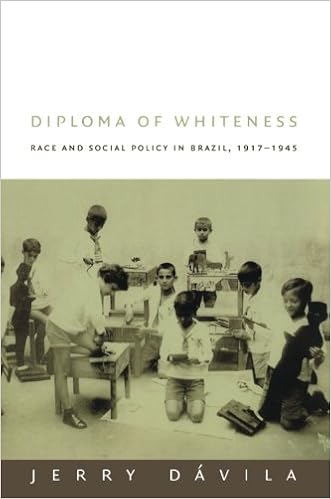
Diploma of Whiteness: Race and Social Policy in Brazil, 1917–1945

Posted in Books, Brazil, Caribbean/Latin America, History, Media Archive, Monographs, Politics/Public Policy, Social Science on 2011-09-10 19:57Z by Steven

Diploma of Whiteness: Race and Social Policy in Brazil, 1917–1945

Duke University Press
2003
312 pages, 41 illustrations
Paperback ISBN: 978-0-8223-3070-7
Cloth ISBN: 978-0-8223-3058-5

Jerry Dávila, Professor of History
University of North Carolina, Charlotte

In Brazil, the country with the largest population of African descent in the Americas, the idea of race underwent a dramatic shift in the first half of the twentieth century. Brazilian authorities, who had considered race a biological fact, began to view it as a cultural and environmental condition. Jerry Dávila explores the significance of this transition by looking at the history of the Rio de Janeiro school system between 1917 and 1945. He demonstrates how, in the period between the world wars, the dramatic proliferation of social policy initiatives in Brazil was subtly but powerfully shaped by beliefs that racially mixed and nonwhite Brazilians could be symbolically, if not physically, whitened through changes in culture, habits, and health.

Providing a unique historical perspective on how racial attitudes move from elite discourse into people’s lives, Diploma of Whiteness shows how public schools promoted the idea that whites were inherently fit and those of African or mixed ancestry were necessarily in need of remedial attention. Analyzing primary material—including school system records, teacher journals, photographs, private letters, and unpublished documents—Dávila traces the emergence of racially coded hiring practices and student-tracking policies as well as the development of a social and scientific philosophy of eugenics. He contends that the implementation of the various policies intended to “improve” nonwhites institutionalized subtle barriers to their equitable integration into Brazilian society.

Table of Contents

  • Acknowledgments
  • Introduction
  • 1. Building the “Brazilian Man”
  • 2. Educating Brazil
  • 3. What Happened to Rio’s Teachers of Color?
  • 4. Elementary Education
  • 5. Escola Nova no Estado Novo: The New School in the New State
  • 6. Behaving White: Rio’s Secondary Schools
  • Epilogue: The Enduring Brazilian Fascination with Race
  • List of Abbreviations
  • Notes
  • Bibliography
  • Index
Tags: , ,

Caught up in a scientific racism designed to breed out the black

Posted in Articles, History, Media Archive, Oceania, Politics/Public Policy on 2011-09-10 01:07Z by Steven

Caught up in a scientific racism designed to breed out the black

The Sydney Morning Herald
2008-02-14

Debra Jopson

She was removed as a toddler and raped as a ward of the state. Valerie Linow knows only too well the tragedy of assimilation policy, writes Debra Jopson.

The stolen child Valerie Linow is certain she knows why she and thousands of fellow Aborigines were taken from their families and placed in institutions or with white foster families.
 
“It was because of the colour of their skin, to make the country whiter and whiter. The way to do it was to get the half-castes out of the way,” she says.
 
Compassionate Australians recoil from that idea, but the historical record shows that this humble pensioner from Miller, near Liverpool, transported to Bomaderry Children’s Home when she was just two, is right….

…In 1933 a Sunday newspaper quoted Dr Cecil Evelyn Cook, dazzlingly qualified as an anthropologist, biologist, bacteriologist, chief medical officer and “chief protector” of Aborigines in North Australia, who pronounced there was no “throwback” to the black once enough white blood was bred in. “Generally by the fifth and invariably by the sixth generation, all native characteristics of the Australian Aborigine are eradicated. The problem of our half-castes will be quickly eliminated by the complete disappearance of the black race, and the swift submergence of their progeny in the white,” he said.

“The Australian native is the most easily assimilated race on earth, physically and mentally. A blending with the Asiatic, though tending to increase virility, is not desirable. The quickest way out is to breed him white,” Cook said.
 
Scientists and social scientists who calibrated how many drops of white blood made a person civilised gave politicians throughout Australia who were worrying about the “half-caste problem” the arguments needed to remove indigenous children from their families.
 
The Melbourne University ethnographer Professor Baldwin Spencer, who was made chief protector of Aborigines in the Northern Territory in 1911-12, said: “No half-caste children should be allowed to remain in any native camp.”
 
In an official 1913 report he wrote: “In practically all cases, the mother is a full-blooded Aborigine, the father may be a white man, a Chinese, a Japanese, a Malay or a Filipino.
 
“The mother is of very low intellectual grade, while the father most often belongs to the coarser and more unrefined members of the higher races. The consequence of this is that the children of such parents are not likely to be, in most cases, of much greater intellectual calibre than the more intelligent natives, though, of course, there are exceptions to this.”
 
It seemed only right to give children with enough drops of white blood a chance to join the superior race and for 50 years, from 1919, the NSW Government used its power to take indigenous young from their families and make them wards of the state…

Read the entire article here.

Tags: , , , ,

Protest and Accommodation: Ambiguities in the Racial Politics of the APO, 1909-1923

Posted in Africa, Articles, History, Media Archive, Politics/Public Policy, South Africa on 2011-09-09 01:18Z by Steven

Protest and Accommodation: Ambiguities in the Racial Politics of the APO, 1909-1923

Kronos: Journal of Cape History
Number 20 (November 1993)
pages 92-106

Mohamed Adhikari, Associate Professor of Historical Studies
University of Cape Town

Historical writing on the coloured community of South Africa has tended to accept coloured identity as given and to portray it as a fixed entity. The failure to take cognizance of the fluidity of coloured self-definition and the ambiguities inherent to the process has resulted in South African historiography presenting an over-simplified image of the phenomenon. The problem stems partly from an almost exclusive focus on coloured protest politics which has had the effect of exaggerating the resistance of coloureds to white racism and the advance of segregationism. Furthermore, little consideration has been given to the nature of coloured identity or to the manner in which it shaped political consciousness within the coloured community. This is particularly true of analyses of the period following the inauguration of the Union of South Africa in 1910, a time when the legitimacy of coloured identity was not in any way questioned within the coloured community and when coloured protest politics was dominated by one body, the African Political Organization (APO).

These inadequacies are clearly evident in recent academic writing on coloured history. Richard van der Ross, in his account of the history of coloured political organization, for example, appears oblivious of the need to investigate these issues despite previously having written a polemical book on coloured racial identity. Gavin Lewis view that coloured identity is a ‘white imposed categorization’ is a simplistic formulation which ignores a wide range of evidence to the contrary. Ian Goldin’s book, written from a neo-Marxist perspective, at one point acknowledges the complexity of coloured identity but then proceeds to treat it as little more than a ploy the white supremacist state used to divide and rule the black population.

By exploring how ambiguities and contradictions within coloured identity helped shape the political consciousness of coloureds this article seeks to draw attention to complexities of their political experience hitherto neglected by historians. It thereby also hopes to contribute to a more nuanced understanding of a crucial period in the political history of the coloured community. Special emphasis is placed on the ways in which the marginality and the intermediate status of this social group resulted in ambivalences in their political outlook. The APO, the first newspaper to be directed specifically at a coloured readership, is an ideal vehicle for such an enquiry. As the mouthpiece of an organization at the very heart of coloured communal life at a time when the direct testimony of coloured people in the historical record is scarce, the APO provides unique insights into the social identity and political attitudes within the coloured community…

Read the entire article here.

Tags: , , ,

ASEM 2535: The Multiracial Individual

Posted in Course Offerings, History, Identity Development/Psychology, Politics/Public Policy, Social Science, United States on 2011-09-07 22:11Z by Steven

ASEM 2535: The Multiracial Individual

The Womens College, University of Denver
Fall Quarter, 2011

Arthur C. Jones, Clinical Professor and Chair of Culture and Psychology

From the beginning of its history, the United States has always been a place where bi-ethnic and bi-racial romantic alliances have been common, producing children with multi-ethnic and multi-racial roots. This was inevitable in a country that evolved as an international “melting pot,” including Native American peoples, enslaved Africans, and successive waves of immigrants and refugees from around the world. Yet, it was not until the year 2000 that the U.S. Census included a category that allowed respondents to indicate a bi-racial or multi-racial heritage/identity. This course will explore the historical racial tensions in the U.S. that have made it difficult to acknowledge the reality of multi-racial peoples in its midst, and will trace the trends in culture and national consciousness that made it possible for a change to occur in the 2000 Census. We will survey the varying ways in which multiracial people have been regarded by the larger society in different social contexts, as well as the ways in which the sociological, psychological, and political dynamics of multiracial identity have changed over time, and have impacted the experience of multiracial people themselves. Finally, we will examine the contemporary social and psychological dynamics of race and ethnicity in the U.S., including the continuing controversy surrounding the very idea of a multiracial identity.

For more information, click here.

Tags: , ,

Emerging Voices in Academia: Critical Mixed Race Theory

Posted in Live Events, Media Archive, Politics/Public Policy, Social Science on 2011-09-06 03:01Z by Steven

Emerging Voices in Academia: Critical Mixed Race Theory

Little Theater, Building 1200
Nappa Vally College
Napa, California
2011-09-22, 16:00 PDT (Local Time)

Andrew Jolivétte, Associate Professor of American Indian Studies (Also see biographies at Speak Out! and Native Wiki.)
Center for Health Disparities Research and Training
San Fransisco State University

Dr. Andrew Jolivétte is an accomplished educator, writer, speaker, and social/cultural critic. His work spans many different social and political arenas – from education reform and LGBT/Queer community of color identity issues to mixed-race identity, critical whiteness studies, gay marriage, and AIDS disparities among people of color. Jolivétte is currently an assistant professor in the American Indian Studies Department and also teaches in the Ethnic Studies Program at San Francisco State University. He recently completed a Ford Foundation Postdoctoral Fellowship through the National Academy of Sciences. Professor Jolivétte is a mixed-race studies specialist with a particular interest in Comparative Race Relations, Creole studies, Black-Indians, critical mixed-race movement building, and mixed-race health disparities. He is the author of, Obama and the Biracial Factor: The Battle for a New American Majority (Policy Press, February 2012), Cultural Representation in Native America (AltaMira Press, July 2006) which is a part of the Contemporary Native American Communities Series and Louisiana Creoles: Cultural Recovery and Mixed Race Native American Identity (Lexington Books, January 2007).

For more information, click here.

Tags: , ,

Are you white enough?

Posted in Articles, Barack Obama, Book/Video Reviews, Law, Media Archive, Politics/Public Policy, Social Science, United States on 2011-09-05 21:01Z by Steven

Are you white enough?

Salon.com
2008-11-10

Laura Miller, Senior Writer

From Jim Crow laws to workplace discrimination, the history of race and the American courtroom is incendiary.

Come January, Barack Obama will be sworn in as either the first black president of the United States or the 44th white one, or both, or neither, depending on how you interpret his race. Race is such a monumental force in American culture and politics that the idea that it has to be interpreted may strike many people as bizarre. Of course Obama is black, some might argue, judging by his appearance, or by his self-identification as an African-American or even by his marriage and important relationships with other African-Americans. Yet more than one commentator has complained that he isn’t “black enough,” by which they may mean that his complexion isn’t dark enough, or that he was raised by whites, or that his African father provided him with no heritage in North American slavery, or that he doesn’t sufficiently align himself with the policies of a certain portion of African-American political leadership.

The problem with race as Americans understand it is that it doesn’t really exist. It is a brutal fact of life for millions of citizens, and an inescapable problem for the rest, but it is also, as Ariela J. Gross writes in her densely researched “What Blood Won’t Tell: A History of Race on Trial in America,” a “moving target,” whose definition and meaning is always in flux. Many of us can avoid encountering this strange truth in the imprecise realms of cultural and social life, but when it comes to the law, imprecision just doesn’t cut it. Gross’ book, a history of cases in which people have challenged their official racial designation, eloquently demonstrates just how difficult it can be to say what race—mine, yours, anybody’s—actually consists of…

Read the entire article here.

Tags: , , ,

White Weddings: The incredible staying power of the laws against interracial marriage

Posted in History, Law, Media Archive, Politics/Public Policy, Social Science, United States on 2011-09-04 16:57Z by Steven

White Weddings: The incredible staying power of the laws against interracial marriage

Slate
1999-06-15

David Greenberg, Associate Professor History, Journalism & Media Studies
Rutgers University

Last week, the Alabama Senate voted to repeal the state’s constitutional prohibition against interracial marriage, 32 years after the Supreme Court struck down Virginia’s similar ban. Hadn’t these archaic laws gone out with Bull Connor? I asked myself as I read the news account. And haven’t we been hearing that America has rediscovered the melting pot, that in another generation or two we’ll all be “cablinasian,” like Tiger Woods?…

…When you think about it, it makes sense that some Alabamians found it hard to jettison overnight a 300-year-old custom. Laws against interracial marriage—and the taboos against black-white sex that they codify—have been the central weapon in the oppression of African-Americans since the dawn of slavery. President Abraham Lincoln’s detractors charged him in the 1864 presidential campaign with promoting the mongrelization of the races (that’s where the coinage “miscegenation,” which now sounds racist, comes from). Enemies of the 20th-century civil rights movement predicted that the repeal of Jim Crow laws would, as one Alabama state senator put it, “open the bedroom doors of our white women to black men.” Fears of black sexuality have been responsible for some of the most notorious incidents of anti-black violence and persecution, from the Scottsboro Boys to Emmett Till.

Intermarriage bans arose in the late 1600s, when tobacco planters in Virginia needed to shore up their new institution of slavery. In previous decades, before slavery took hold, interracial sex was more prevalent than at any other time in American history. White and black laborers lived and worked side by side and naturally became intimate. Even interracial marriage, though uncommon, was allowed. But as race slavery replaced servitude as the South’s labor force, interracial sex threatened to blur the distinctions between white and black—and thus between free and slave. Virginia began categorizing a child as free or slave according to the mother’s status (which was easier to determine than the father’s), and so in 1691 the assembly passed a law to make sure that women didn’t bear mixed-race children. The law banned “negroes, mulatto’s and Indians intermarrying with English, or other white women, [and] their unlawfull accompanying with one another.” Since the society was heavily male, the prohibition on unions between white women and nonwhite men also lessened the white men’s competition for mates. (In contrast, sex between male slave owners and their female slaves–which often meant rape—was common. It typically met with light punishment, if any at all.)…

Read the entire article here.

Tags: , , ,

Blood Simple: The politics of miscegenation

Posted in Articles, Brazil, Media Archive, Politics/Public Policy, Social Science, United States on 2011-09-03 17:33Z by Steven

Blood Simple: The politics of miscegenation

Slate Magazine
1996-08-22

Eric Liu

The “Negro problem,” wrote Norman Podhoretz in 1963, would not be solved unless color itself disappeared: “and that means not integration, it means assimilation, it means—let the brutal word come out—miscegenation.” Coming after a lengthy confession of his tortured feelings toward blacks—and coming at a time when 19 states still had anti-miscegenation statutes on the books—Podhoretz’s call for a “wholesale merging of the two races” seemed not just bold but desperate. Politics had failed us, he was conceding; now we could find hope only in the unlikely prospect of intermarriage.

Podhoretz’s famous essay was regarded as bizarre at the time, but 33 years later, it seems like prophecy. We are indeed intermarrying today, in unprecedented numbers. Between 1970 and 1992, the number of mixed-race marriages quadrupled. Black-white unions now represent 12 percent of all marriages involving at least one black, up from 2.6 percent in 1970. Twelve percent of Asian men and 25 percent of Asian women are marrying non-Asians. Fully a quarter of married U.S.-born Latinos in Los Angeles have non-Latino spouses. We are mixing our genes with such abandon that the Census Bureau is now considering whether to add a new “multiracial” category to the census in the year 2000. This orgy of miscegenation has not yet brought the racial harmony for which Podhoretz longed. But recent publicity about the intermarriage figures has stirred hope once again that our racial problems might be dissolving in the gene pool…

…Race, you see, is a fiction. As a matter of biology, it has no basis. Genetic variations within any race far exceed the variations between the races, and the genetic similarities among the races swamp both. The power of race, however, derives not from its pseudoscientific markings but from its cultural trappings. It is as an ideology that race matters, indeed matters so much that the biologists’ protestations fall away like Copernican claims in the age of Ptolemy. So the question, as always, is whether it is possible to break that awful circle in which myth and morphology perpetually reinforce one another…

…One possibility is that all multiracials, over time, will find themselves the intermediate race, a new middleman minority, less stigmatized than “pure” blacks (however defined) but less acceptable than “pure” whites. Their presence, like that of the “coloreds” in old South Africa, wouldn’t subvert racialism; it would reinforce it, by fleshing out the black-white caste system. Again, however, the sheer diversity of the multiracials might militate against this kind of stratification.

Yet this same diversity makes it possible that multiracials will replicate within their ranks the “white-makes-right” mentality that prevails all around them. Thus we might expect a hierarchy of multiracials to take hold, in which a mixed child with white blood would be the social better of a mixed child without such blood. In this scenario, multiracials wouldn’t be a distinct group—they would just be distributed across a continuum of color.

Sociologist Pierre van den Berghe argues that such a continuum is preferable to a simple black-white dichotomy. Brazilians, for instance, with their mestizo consciousness and their many gradations of tipo, or “type,” behold with disdain our crude bifurcation of race. Yet no amount of baloney-slicing changes the fact that in Brazil, whitening remains the ideal. It is still better for a woman to be a branca (light skin, hair without tight curls, thin lips, narrow nose) than a morena (tan skin, wavy hair, thicker lips, broader nose); and better to be a morena than a mulata (darker skin, tightly curled hair). Subverting racial labels is not the same as subverting racism.

Still another possibility is that whites will do to multiracials what the Democrats or Republicans have traditionally done to third-party movements: absorb their most “desirable” elements and leave the rest on the fringe. It’s quite possible, as Harvard Professor Mary Waters suggests, that the ranks of the white will simply expand to engulf the “lighter” or more “culturally white” of the multiracials. The Asian American experience may offer a precedent: As growing numbers of Asian Americans have entered the mainstream over the last decade, it is increasingly said—sometimes with pride, sometimes with scorn—that they are “becoming white.”…

…These cautionary scenarios demonstrate that our problem is not just “race” in the abstract. Our problem is the idea of the “white race” in particular. Scholar Douglas Besharov may be right when he calls multiracial kids “the best hope for the future of American race relations.” But even as a “multiracial” category blurs the color line, it can reaffirm the primacy of whiteness. Whether our focus is interracial adoption or mixed marriages or class-climbing, so long as we speak of whiteness as a norm, no amount of census reshuffling will truly matter…

Read the entire article here.

Tags: , , , , , ,

The Too Black, Too White Presidency

Posted in Articles, Barack Obama, Book/Video Reviews, Media Archive, Politics/Public Policy, Social Science, United States on 2011-09-03 04:34Z by Steven

The Too Black, Too White Presidency

The New York Times
2011-09-02

Brent Staples

Randall Kennedy, The Persistence of the Color Line: Racial Politics and the Obama Presidency, New York: Pantheon Books, 2011. 322 pp.

The next time you see Barack Obama gliding into a White House press conference, take note of that jazzy walk. It is a dead ringer for the strut that was the bearing of choice among ­inner-city cool guys in the 1960s, when Barry Obama was still a tyke growing up in the exotic precincts of Hawaii and Indonesia. The Obama glide represents his embrace of a black aesthetic that was not his by circumstance of birth. It speaks on an intimate frequency to African-­American men, who have been smiling in recognition and rating it for style ever since he stepped into the national spotlight. President Obama is acutely aware of how to deploy the physical self to excellent effect. If we looked back closely at 2008, we would no doubt notice him amping up the glide for black audiences and dialing it back elsewhere…

…The messianic glow that surrounded Obama’s candidacy—Kennedy and others call it “Obamamania”—precluded closer scrutiny of his pronouncements, especially those having to do with race. The widely held notion that the now-famous race speech, “A More Perfect Union,” ranked with the Gettysburg Address or “I Have a Dream” strikes Kennedy as delusional. The speech, he writes, was little more than a carefully calibrated attempt to defuse the public relations crisis precipitated by the Wright affair. Far from frank, it understated the extent of the country’s racial divisions and sought to blame blacks and whites equally for them, when in fact, Kennedy writes, “black America and white America are not equally culpable. White America enslaved and Jim Crowed black America (not the other way around).” The speech was in keeping with the candidate’s wildly successful race strategy, which involved making white voters feel better about themselves whenever possible.

The cornerstone essay, “Obama Courts Black America,” is a breath of fresh air on many counts, not least of all because it offers a fully realized portrait of the black political opinion—left, right, center, high and low—that was brought to bear during the campaign. This is the most comprehensive document I’ve yet read on the near street fight that erupted over the question of how Obama should identify himself racially. There were those who viewed him as “too white” to be legitimately seen as black; those who had no problem with his origins; those who viewed the attempt to portray him as “mixed race” as a way of trying to “whiten” him for popular consumption; and those who accused Obama of throwing his white mother under the bus when it became clear that he regarded himself as African-American…

Read the entire article here.

Tags: , ,