A.C.T.O.R. presents Dorothy Roberts

Posted in Health/Medicine/Genetics, Live Events, Media Archive, Politics/Public Policy, United States on 2012-10-03 13:50Z by Steven

A.C.T.O.R. presents Dorothy Roberts

Busboys and Poets
14th & V Streets, NW
Washington, D.C.
Langston Room
2012-10-07, 17:00-19:00 EDT (Local Time)

Dorothy Roberts, George A. Weiss University Professor of Law and Sociology; Raymond Pace and Sadie Tanner Mossell Alexander Professor of Civil Rights
University of Pennsylvania

Dorothy Roberts is author of “Fatal Invention: How Science, Politics, and Big Business Re-create Race in the Twenty-First Century.”

A.C.T.O.R. A Continuing Talk on Race – Open discussion. The A.C.T.O.R series is hosted by Busboys and Poets as a community service. This discussion  series provides the opportunity for people to come together and speak openly and honestly about issues of race.  The intent is that each person walks away from the discussion feeling something: challenged, educated, uncomfortable, enlightened, refreshed, reassured and hopefully inspired and moved to action!  Regular discussions take place the first Sunday  of each  month a new topic is discussed, with Busboys and Poets sponsoring a facilitator.

For more information, click here.

Tags: , ,

French MP Harlem Désir set to become first black man to lead a major European political party

Posted in Articles, Europe, Media Archive, Politics/Public Policy on 2012-10-02 03:57Z by Steven

French MP Harlem Désir set to become first black man to lead a major European political party

The Independent
London, England
2012-09-12

John Lichfield

The French Euro MP Harlem Désir appears certain next month to become the first black man to lead a major European political party.

After weeks of wrangling, Mr Désir, 52, was today named as the official choice of the hierarchy of the French Socialist party to replace Martine Aubry as its “first secretary” or national leader. The ruling party’s annual conference, set to take place between 26 and 28 October, is expected to endorse the choice overwhelmingly, giving Mr Désir a position once held by the late President François Mitterrand, the former Prime Minister Lionel Jospin and the current President, François Hollande.

Mr Désir is seen as a safe pair of hands and competent administrator rather than a man likely to emerge as Mr Hollande’s successor as a “French Obama” or the Next Big thing on the Left. His choice is, nonetheless, a significant event in a country in which racial minorities have only recently started to play leading political roles.

Born “Jean-Philippe” in Paris in 1959, with a West Indian father and a Jewish mother, Mr Désir emerged in the 1980s as a Trotskyist, student and anti-racist activist. He changed his first name to “Harlem” in homage to African-American political leaders…

Read the entire article here.

Tags: , , ,

Race and a Political Race

Posted in Articles, Native Americans/First Nation, New Media, Politics/Public Policy, Social Science, United States on 2012-09-28 21:33Z by Steven

Race and a Political Race

Everyday Sociology Blog
2012-09-28

Jonathan R. Wynn, Assistant Professor of Sociology
University of Massachusetts, Amherst

Dwanna L. Robertson
University of Massachusetts, Amherst

The Massachusetts Senate race between incumbent Scott Brown and Harvard Law Professor Elizabeth Warren took an unexpected sharp turn this week. Shades of racialized language (reminiscent of the 2008 Presidential campaign) seeped in. This actually started in April, when Brown’s staffers uncovered that Warren claimed she was a minority, implicating her as committing ethnic fraud because she lacked proof of a Native American ancestry.
 
During their first political debate, Brown went straight at this issue in a prepared remark, saying, “Professor Warren claimed she was a Native American, a person of color—And as you can see, she’s not.” With this statement, Brown contends he can identify Native Americans—and other people of color—just by looking at them.

It would be humorous—Did she accidentally forget to braid her hair and wear her moccasins?—if it didn’t have serious undertones cutting at the heart of race and politics in the U.S.. Brown suggests Warren received special consideration for claiming she was part Cherokee. “When you are a U.S. Senator,” he stated, “you have to pass a test and that’s one of character and honesty and truthfulness. I believe and others believe she’s failed that test.” But did Warren fail the test?…

..Back to Brown’s assertion idea that our eyes can tell us a person’s race. Sociologist Mary Campbell has been working on misclassification of race based upon skin tone, finding not only that American Indians experience a high level of misidentification, but that in the process they also experience higher levels of psychological distress…

There is, however, a real challenge when it comes to speaking of how indigenous folk look. It is not just that it’s a bad idea to think facial features are satisfactory markers of race. It is that the emphasis on perception also indicates a complete misunderstanding of U.S. History: People who claim First Nation Heritage are of a mixed ethnic background due to generations of attempted racial extermination, cultural oppression, and a breaking of tribal links to land and community…

Read the entire article here.

Tags: , , , , , , , ,

Obama’s America: A Transformative Vision of Our National Identity

Posted in Barack Obama, Books, Media Archive, Monographs, Politics/Public Policy, United States on 2012-09-27 17:35Z by Steven

Obama’s America: A Transformative Vision of Our National Identity

Potomac Books
July 2012
270 pages
6″ x 9″; Notes; Bibliography; Index
Clothbound ISBN: 978-1-61234-472-0

Ian Reifowitz, Associate Professor of History
Empire State College of the State University of New York

What it means to be an American today

Our national identity is defined by what it means to be an American and whom we include and why when we talk about “the American people.” A country’s national identity is fluid, and Ian Reifowitz argues that President Barack Obama, by emphasizing the ideals Americans hold dear, hopes to redefine ours in a fundamental way. Obama’s conception of America emphasizes two principles of national unity: First, all Americans, regardless of their heritage and cultural traditions, should identify with America as their country, based upon shared democratic values, a shared history, and a shared fate. Second, America should embrace all its citizens as active participants in one “family.” Reifowitz explores Obama’s belief that strengthening our common bonds will encourage Americans to rectify the injustices and heal the racial divisions that still plague our country.

We have the opportunity to demonstrate to the world that a society of many races and cultures can truly become one people. In facing terrorism, violent fundamentalism, and other security issues, Obama’s response centers on a powerful, inspiring, and truly inclusive American narrative. By bolstering America’s identity as diverse yet unified, he aims both to counter the anxieties and fears that radicalism stokes and give proponents of religious and political freedom a model they can defend. The stakes couldn’t be any higher in determining America’s future.

Table of Contents

  • Foreword by Ellis Cose
  • Preface
  • Acknowledgments
  • Introduction
  • 1. American National Identity: From the Revolution through the 1960s
  • 2. Since the 1960s: Radical Multiculturalism, Its Critics, and How Obama Fits In
  • 3. Obama’s Search for His Own Identity
  • 4. Obama on Racial Discrimination: Causes, Effects, and Policies to Combat It
  • 5. Candidate and President Obama’s Broader Rhetoric on Race
  • 6. Obama’s Vision of National Identity and National Unity
  • 7. Obama’s Narrative of American History and Our Place in the World
  • 8. Rejecting Obama’s America: Right-Wing Exclusionists and Left-Wing Race Critics
  • Conclusion
  • Notes
  • Selected Bibliography
  • Index
  • About the Author
Tags: ,

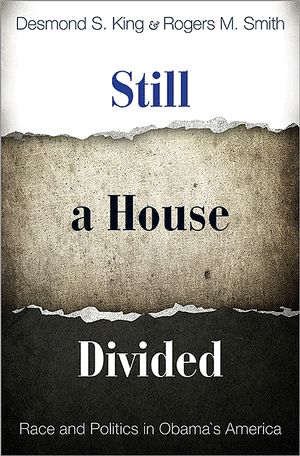
Still a House Divided: Race and Politics in Obama’s America

Posted in Barack Obama, Books, Media Archive, Monographs, Politics/Public Policy, United States on 2012-09-27 03:44Z by Steven

Still a House Divided: Race and Politics in Obama’s America

Princeton University Press
2011
320 pages
6 x 9; 5 halftones; 36 tables
Cloth ISBN: 9780691142630
eBook ISBN: 9781400839766

Desmond S. King, Andrew W. Mellon Professor of American Government
University of Oxford

Rogers M. Smith, Christopher H. Browne Distinguished Professor of Political Science
University of Pennsylvania

Why have American policies failed to reduce the racial inequalities still pervasive throughout the nation? Has President Barack Obama defined new political approaches to race that might spur unity and progress? Still a House Divided examines the enduring divisions of American racial politics and how these conflicts have been shaped by distinct political alliances and their competing race policies. Combining deep historical knowledge with a detailed exploration of such issues as housing, employment, criminal justice, multiracial census categories, immigration, voting in majority-minority districts, and school vouchers, Desmond King and Rogers Smith assess the significance of President Obama’s election to the White House and the prospects for achieving constructive racial policies for America’s future.

Offering a fresh perspective on the networks of governing institutions, political groups, and political actors that influence the structure of American racial politics, King and Smith identify three distinct periods of opposing racial policy coalitions in American history. The authors investigate how today’s alliances pit color-blind and race-conscious approaches against one another, contributing to political polarization and distorted policymaking. Contending that President Obama has so far inadequately confronted partisan divisions over race, the authors call for all sides to recognize the need for a balance of policy measures if America is to ever cease being a nation divided.

Presenting a powerful account of American political alliances and their contending racial agendas, Still a House Divided sheds light on a policy path vital to the country’s future.

TABLE OF CONTENTS

  • List of Figures and Tables
  • Acknowledgments
  • PART ONE: Obama’s Inheritance
  • PART TWO: The Making and Unmaking of Racial Hierarchies
    • CHAPTER 2 “That is the last speech he will ever make”: The Antebellum Racial Alliances
    • CHAPTER 3 “We of the North were thoroughly wrong”: How Racial Alliances Mobilized Ideas and Law
  • PART THREE: The Trajectory of Racial Alliances
    • CHAPTER 4 “This backdrop of entrenched inequality”: Affirmative Action in Work
    • CHAPTER 5 To “affi rmatively further fair housing”: Enduring Racial Inequalities in American Homes and Mortgages
    • CHAPTER 6 “To Elect One of Their Own”: Racial Alliances and Majority-Minority Districts
    • CHAPTER 7 “Our goal is to have one classification-American” Vouchers for Schools and the Multiracial Census
    • CHAPTER 8 “We can take the people out of the slums, but we cannot take the slums out of the people”: How Today’s Racial Alliances Shape Laws on Crime and Immigration
  • PART FOUR: America’s Inheritance
    • CHAPTER 9 Prospects of the House Divided
  • Notes
  • Index
Tags: , , , ,

David Domke & Christopher Parker: Obama, the Tea Party, and Racism

Posted in Barack Obama, Live Events, Media Archive, Politics/Public Policy, United States on 2012-09-24 23:54Z by Steven

David Domke & Christopher Parker: Obama, the Tea Party, and Racism

Town Hall Seattle
Great Hall; enter on Eight Avenue
2012-09-24, 19:30-21:00 PDT (Local Time)

David Domke, Chair of the University of Washington Department of Communications and a winner of the school’s Distinguished Teaching Award, believes President Barack Obama has been subjected to historically unprecedented disrespect by legislators and many citizens. Is this evidence of racism toward our first African-American president? What role has the Tea Party played in this animosity? What does public-opinion data tell us; what do we learn from public rhetoric; and what does news coverage suggest? Speaking to the data, UW Professor of Social Justice and Political Science and author of the forthcoming book Change They Can’t Believe In, Christopher Parker joins Dr. Domke in a candid, evidence-based conversation around this explosive topic. Presented as part of the Town Hall Civic series, with Elliott Bay Book Company. 

For more information, click here.

Tags: , ,

Prestigious grant award for research on President Obama

Posted in Articles, Barack Obama, Campus Life, Media Archive, Politics/Public Policy, United Kingdom, United States on 2012-09-23 19:19Z by Steven

Prestigious grant award for research on President Obama

Edge Hill University
Ormskirk, Lancashire, United Kingdom
News
2010-06-04

Edge Hill University and key partners have been awarded a prestigious grant to develop a research network on The Presidency of Barack Obama.

The Arts and Humanities Research Council has given an award of £31,320 to the institution in collaboration with the University of Manchester.

The special two-year project, which will run from January 2011 to December 2012, is particularly unique because the research will be undertaken while Obama is still in office and will cover topical issues and developments as they happen.

It will provide a unique opportunity to analyse key issues President Obama has had to deal with around race relations, foreign policies, the economy crisis and Obama’s wars. The funding will also be used to organise a series of high-profile lectures, the creation of an interactive website, a book, new teaching tools, a schools’ conference to run alongside the actual American presidential election in 2012, an exhibition and other community events.

Professor Kevern Verney, Associate Head of the History Department at Edge Hill, explained: “The election of Barack Obama in November 2008 was a key moment in the history of the United States as he was the first African American President. It attracted enormous popular and scholarly interest not just in America but around the world. The inspirational ideas and rhetoric of the Obama campaign generated high expectations of change. In sharp contrast to such high expectations the political realities confronting the new President could hardly have been more discouraging. From the outset his administration faced unprecedented domestic and foreign policy challenges, including the worst national and international economic crisis since the 1930s and involvement in two costly unresolved foreign wars, in Iraq and Afghanistan. Race also remains an issue.

“The success or failure of the Obama administration in addressing these issues will have profound implications not just for the citizens of the United states but also for governments and people around the world. This important project will discuss a number of key issues as they unfold and in the wake of either his continued presidency or his legacy.”…

Read the entire news release here.

Tags: ,

For minorities in France, Obama still casts a spell

Posted in Articles, Barack Obama, Europe, Media Archive, Politics/Public Policy, United States on 2012-09-22 21:02Z by Steven

For minorities in France, Obama still casts a spell

France 24: International News
2012-08-09

Jon Frosch

Though his reputation among blacks and Arabs in France is showing ever-so-slight signs of wear and tear, US President Barack Obama remains a powerful symbol for French citizens of colour. France24.com takes a closer look.

When Barack Obama was elected in 2008, Anthony Borval, a black Frenchman of Caribbean descent, was elated.

“It was intense, I felt almost American,” the 29-year-old office manager confided. “Obama indirectly sent us a message that anything was possible, a message of hope for minorities in France, where it’s difficult for us to succeed.”

Four years later, as Obama spends the end of his tumultuous first term fighting a tough re-election battle against Republican challenger Mitt Romney, the US president is still a hero for Borval. “His victory taught French people of colour to believe in ourselves,” he said. “Today, I still feel great pride that an African-American is running the world’s superpower.”

…Perhaps more common than that bluntly pragmatic view is a sense among some French minorities that Obama is an admirable figure who has not fully lived up to his promise. Aziz Senni, 36, is a Moroccan-born Frenchman who founded an investment fund specialising in economic development in the “banlieue”. Like many people of colour in France, Senni says he was captivated by Obama’s rise and impressed with Americans for voting a black man into the White House just decades after the civil rights movement.

But Senni also noted that “like all new things, time goes by, the shine fades, and there are disappointments”. He cited Obama’s failure to advance the Mideast peace process, something that has tarnished the US president’s image among Arabs around the world. “We had a lot of hope after his Cairo speech, but he’s mainly been the same as his predecessors on the Israeli-Palestinian conflict,” Senni assessed. “That’s the reality of being an American president.”…

…French mistrust of multiculturalism has deep roots: since the French Revolution, the country has clung to the notion that a common French identity could override differences in race and creed. The problem, according to Ndiaye, is that “Frenchness” has not always been as inclusive in practice as it is in principle. “After France’s colonies became independent, France thought of itself as essentially white,” the historian stated. “And many French people feared that immigration from former colonies would cause the republic to be fractured.”

The result is a theoretically colour-blind country in which close-knit ethnic and religious groups are often viewed warily, politicians avoid referring to specific communities of voters, and disdain for affirmative action (known here as “positive discrimination”) is common on both sides of the political aisle.

According to Ndiaye, however, it is affirmative action that could eventually help France create conditions from which a French Obama might one day emerge. “Obama didn’t come out of nowhere,” he explained. “There is a critical mass of 10,000 elected black officials in America, from sheriffs to mayors to Congressmen to the president. Affirmative action helped. We need that in France.”…

Read the entire article here.
Tags: , ,

Why Affirmative Action Remains Essential in the Age of Obama

Posted in Articles, Barack Obama, Law, Media Archive, Politics/Public Policy, United States on 2012-09-15 22:03Z by Steven

Why Affirmative Action Remains Essential in the Age of Obama

Campbell Law Review
Volume 31, Issue 3 (2009)
pages 503-533

Reginald T. Shuford, Senior Staff Attorney, Racial Justice Program
American Civil Liberties Union Foundation

With the election of Barack Obama to the most powerful position in the world, the presidency of the United States of America, many opined that America finally conquered her racial demons, some trumpeting the term “post-racial” as though it were a fait accompli. That an African-American man-much less one with such a nontraditional name-could ascend to the highest office in the land, they argue, clearly signals that America’s racist history is a thing of the past. Gone. Over. Kaput. Slate wiped clean. Concomitant with their notion of a post-racial America is the strong belief that complaints of racism lack merit, and measures to remedy past and current exclusionary practices are no longer necessary. But saying it is so does not make it so. There can be no doubt that Obama’s election represents a singular moment in American history and demonstrates significant and welcome progress in America’s notoriously fraught racial relations. That said, claims that America is truly post-racial are decidedly premature. Indeed, during this very election season, some voters conceded that Obama’s race was an issue impacting whether they would vote for him.

It also bears noting, at the risk of stating the obvious, while it is true that Obama’s victory shattered the ultimate political glass ceiling, he, black or otherwise, is not your “Average Political Joe.” As such, whether his election portends a future where African-American candidates, and other candidates of color, will be elected to the highest office in the land with any degree of regularity is debatable. For generations, African-American parents preparing their children for the harsh realities of racism have told them that they are required to be twice as good and work twice as hard as everybody else, just to stand a fighting chance at leading successful and productive lives. President Obama may personify that concept better than most. Among his many notable accomplishments, Obama is the graduate of two Ivy League schools, Columbia University and Harvard Law School, where he graduated magna cum laude. At Harvard, he served as the first African- American president of the Harvard Law Review. Obama is also the author of two best-selling books, Dreams from My Father and The Audacity of Hope. He was a constitutional law professor at the University of Chicago. His well-known political successes include his career-defining delivery of the keynote address at the 2004 Democratic National Convention, which catapulted him onto the national and, perhaps, international stage. During his tenure in the Senate, Obama was the sole African-American.

Beyond his academic and professional accomplishments, President Obama possesses a combination of personal traits-powerful oratorical skills, discipline, equanimity, self-confidence, and the ability to connect with and inspire a broad range of people-that undoubtedly have contributed to his phenomenal success and uniquely qualified him to be the right person for the job at this particular moment in our history. Even Obama’s biracial background advantages him, for example, with the ability, evident in his Speech on Race, to speak credibly from both sides of the racial divide. His background might also have benefited him in another way: Perhaps, he was not “too black” for certain skittish voters. In light of his eminent qualifications, many wondered whether Obama’s racial background at least partly accounted for the relative closeness of much of the race between him and John McCain

Read the entire article here.

Tags: , ,

Brendon Ayanbadejo, Baltimore Ravens Linebacker, Talks Gay Marriage And LGBT Rights

Posted in Articles, Gay & Lesbian, Interviews, Media Archive, Politics/Public Policy, United States on 2012-09-15 17:57Z by Steven

Brendon Ayanbadejo, Baltimore Ravens Linebacker, Talks Gay Marriage And LGBT Rights

The Huffington Post
2012-09-12

Michelangelo Signorile

Baltimore Ravens linebacker Brendon Ayanbadejo is going “full steam ahead” after his battle with Maryland legislator C. Emmett Burns Jr., who last week wrote a letter calling on the team’s owner to silence Ayanbadejo regarding his public advocacy of gay marriage, only to back down amid a national uproar. (Listen to the full interview below)

“The Ravens reached out to me,” Ayanbadejo said. “[Ravens president] Dick Cass and [Ravens] owner Steve Bisciotti said, ‘Brendon, you’re a great person. Keep doing your thing. We believe in you. This is not a team that believes in discrimination in any way, shape, or form. You have this tremendous platform here. Use it. And go ahead and continue to be you, and grow and shape and change the world while you have the ability to do it.’”…

…Discussing what motivates him to take up the cause of LGBT equality and gay marriage, Ayanbadejo pointed to his upbringing.

“I’m a product of two biracial parents — so actually, I’m not biracial, but I’m a product of it,” he said, laughing. “My dad is Nigerian. My mom is Irish-American. So I kind of never really fit in. From the black community, I was considered white. From the white community, I was considered black. And then from my own Nigerian community, I wasn’t considered Nigerian. I was considered a black American. I kind of never fit in, kind of had to find my own niche and find my own way. So I’ve experienced discrimination at a young age, and it’s made me the person who I am today.”…

Read the entire article here.

Tags: , , , , , , , ,