Daughter of the Empire State: The Life of Judge Jane Bolin

Posted in Biography, Books, Law, Media Archive, Monographs, United States, Women on 2014-03-30 14:58Z by Steven

Daughter of the Empire State: The Life of Judge Jane Bolin

University of Illinois Press
December 2011
168 pages
6 x 9 in.
4 black & white photographs
Cloth ISBN: 978-0-252-03657-6
Ebook ISBN: 978-0-252-09361-6

Jacqueline A. McLeod, Associate Professor of History and African & African American Studies
Metropolitan State College of Denver
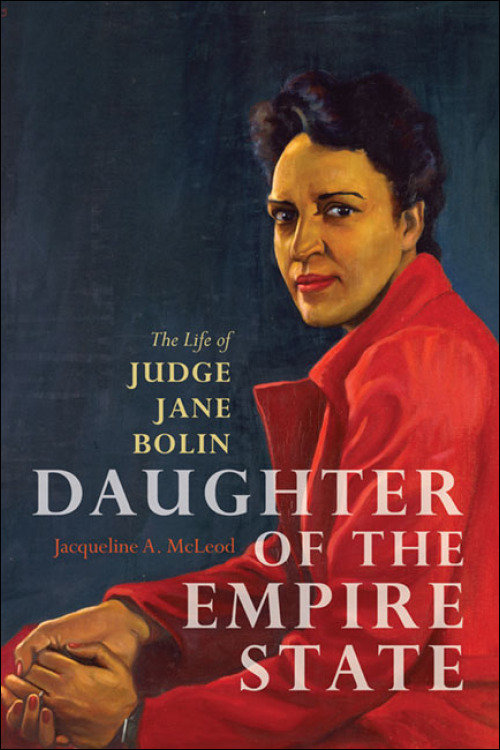
The trailblazing work of the first African American woman judge

This long overdue biography of the nation’s first African American woman judge elevates Jane Matilda Bolin to her rightful place in American history as an activist, integrationist, jurist, and outspoken public figure in the political and professional milieu of New York City before the onset of the modern Civil Rights movement.

Bolin was appointed to New York City’s domestic relations court in 1939 for the first of four ten-year terms. When she retired in 1978, her career had extended well beyond the courtroom. Drawing on archival materials as well as a meeting with Bolin in 2002, historian Jacqueline A. McLeod reveals how Bolin parlayed her judicial position to impact significant reforms of the legal and social service system in New York.

Beginning with Bolin’s childhood and educational experiences at Wellesley and Yale, Daughter of the Empire State chronicles Bolin’s relatively quick rise through the ranks of a profession that routinely excluded both women and African Americans. Deftly situating Bolin’s experiences within the history of black women lawyers and the historical context of high-achieving black New Englanders, McLeod offers a multi-layered analysis of black women’s professionalization in a segregated America.

Linking Bolin’s activist leanings and integrationist zeal to her involvement in the NAACP, McLeod analyzes Bolin’s involvement at the local level as well as her tenure on the organization’s national board of directors. An outspoken critic of the discriminatory practices of New York City’s probation department and juvenile placement facilities, Bolin also co-founded, with Eleanor Roosevelt, the Wiltwyck School for boys in upstate New York and campaigned to transform the Domestic Relations Court with her judicial colleagues. McLeod’s careful and highly readable account of these accomplishments inscribes Bolin onto the roster of important social reformers and early civil rights trailblazers.

Table of Contents

  • Preface
  • Acknowledgments
  • 1. Her Standing in Poughkeepsie: Family Lineage and Legacy
  • 2. On Her Own: The Years at Wellesley and Yale
  • 3. Politics of Preparation: The Making of the Nation’s First African American Woman Judge
  • 4. Politics of Practice: An African American Woman Judge on the Domestic Relations Court
  • 5. Speaking Truth to Power: A View from the Benchof Judge Jane Bolin
  • 6. Persona Non Grata: Jane Bolin and the NAACP, 1931–50
  • Epilogue
  • Notes
  • Index
Tags: , , , , ,

When it Comes to Diversity, Who Counts?

Posted in Articles, Campus Life, Census/Demographics, Media Archive, United States on 2014-03-27 15:19Z by Steven

When it Comes to Diversity, Who Counts?

The Huffington Post
The Blog
2014-03-26

Martha S. Jones, Arthur F Thurnau Professor, Associate Professor of History and Afroamerican and African Studies
University of Michigan

When talking diversity at colleges and universities, the numbers count. Still, when it comes to mixed-race students, too often they do not count at all. This is a missed opportunity. University leaders rely upon statistics for a measure of where students of color stand on campus. Data on those who self-identify as Black, Latino and Native American are said to reflect how well diversity goals are being met. What about those who check more than one box? Their numbers and their contributions to campus diversity are largely overlooked.

On my campus, the University of Michigan, numbers matter. This past fall, student activists set off a debate. Their movement began with a Twitter speak-out known by its hashtag #BBUM, Being Black at the University of Michigan. The declining number of Black students has been much discussed, and with good reason. Black students were 7.8 percent of the student body in 2004. Ten years later, their number has dropped to 4.8 percent. As we respond to this challenge, administrators, faculty, staff and students all recognize that the numbers reflect a diminishment in campus diversity. And as student testimony makes plain, there is a correlation between dropping enrollments and the increasing marginalization of Black students.

At Michigan, we also count mixed-race students. Since 2010, students have had the opportunity to check more than one box when reporting their race. The numbers have remained steady. 3.3 percent of the university’s 37,000 students report that they are mixed-race. This new demographic parallels what we know from the United States census. There, in the year 2000, respondents were given the option of checking more than one box for the first time. By 2010, over 9 million people self-identified as more than one race, nearly three percent of the population. By these numbers mixed-race people have become visible…

Read the entire article here.

Tags: , ,

Jean Toomer and Cultural Pluralism

Posted in Articles, Literary/Artistic Criticism, Media Archive, United States on 2014-03-27 01:52Z by Steven

Jean Toomer and Cultural Pluralism

Gino Michael Pellegrini: Education, Race, Multiraciality, Class & Solidarity
2014-03-21

Gino Michael Pellegrini, Adjunct Assistant Professor of English
Pierce College, Woodland Hills, California

[This short paper was originally written for “Jean Toomer and Politics,” a Special Session Roundtable at the 2012 MLA Conference in Seattle. I have made a few edits.]

In disagreeing with Rudolph Byrd and Henry Louis Gates Jr., I will not directly critique their support and rhetorical strategies. Instead, I will put forth my own interpretation of Toomer’s political vision. Toomer saw literature as his means to address socioeconomic inequalities, transform himself, and influence people in a manner that would advance the promise of democracy in America. We should ask then, not whether he identified as black or white, but what his political vision is, what it is not, and what it entails. Specifically, I argue that his political vision conflicts with the cultural pluralisms of his mentors, Alain Locke and Waldo Frank, and anticipates some postethnic, cosmopolitan, and multiracial perspectives that have emerged in recent history in strong opposition to the limitations and problems of multiculturalism…

Read the entire paper here.

Tags: , , ,

Jane Bolin, the Country’s First Black Woman to Become a Judge, Is Dead at 98

Posted in Articles, Biography, Law, Media Archive, United States, Women on 2014-03-26 20:10Z by Steven

Jane Bolin, the Country’s First Black Woman to Become a Judge, Is Dead at 98

The New York Times
2007-01-10

Douglas Martin

Jane Bolin, whose appointment as a family court judge by Mayor Fiorello H. La Guardia in 1939 made her the first black woman in the United States to become a judge, died on Monday in Queens. She was 98 and lived in Long Island City, Queens.

Her death was announced by her son, Yorke B. Mizelle.

Judge Bolin was the first black woman to graduate from Yale Law School, the first to join the New York City Bar Association, and the first to work in the office of the New York City corporation counsel, the city’s legal department.

In January 1979, when Judge Bolin had reluctantly retired after 40 years as a judge, Constance Baker Motley, a black woman and a federal judge, called her a role model.

In her speech, Judge Motley said, “When I thereafter met you, I then knew how a lady judge should comport herself.”.

The “lady judge” was frequently in the news at the time of her appointment with accounts of her regal bearing, fashionable hats and pearls. But her achievements transcended being a shining example. As a family court judge, she ended the assignment of probation officers on the basis of race and the placement of children in child-care agencies on the basis of ethnic background.

Jane Matilda Bolin was born on April 11, 1908, in Poughkeepsie, N.Y. Her father, Gaius C. Bolin, was the son of an American Indian woman and an African-American man. Her mother, the former Matilda Emery, was a white Englishwoman…

Read the entire obituary here.

Tags: , , , , ,

Butterfield featured on ‘Colbert Report’

Posted in Articles, Interviews, Media Archive, Politics/Public Policy, United States on 2014-03-26 19:21Z by Steven

Butterfield featured on ‘Colbert Report’

The Wilson Times
Wilson, North Carolina
Tuesday, 2014-03-25

Corey Friedman, Times Online Editor

Comic pundit Stephen Colbert argued Obamacare and the Racial Justice Act with U.S. Rep. G.K. Butterfield while bashing North Carolina barbecue in a playful segment spotlighting Wilson’s congressional district.

Butterfield, a Democrat representing the state’s 1st District, appeared on Comedy Central’s “The Colbert ReportMonday night, the latest installment in a series of interviews with House members. Colbert asked Butterfield whether Obamacare was a “great train wreck or greatest train wreck.”

“Let me tell you, when the history of this period is written, you will see that the Affordable Care Act has been one of the most significant pieces of legislation that’s ever been passed,” Butterfield said.

Colbert asked whether President Barack Obama was lying when he told Americans that if they liked their health insurance plans, they could keep them…

…Colbert profiles congressional representatives and their constituents in his occasional “Better Know a District” segment. He’s known for using satire and deliberately taking some comments out of context for comedic effect in the often offbeat interviews…

…Racial identity framed the opening of Colbert’s segment, when he introduced Butterfield as a “prominent African-American congressman and civil rights leader,” then appeared visibly surprised upon meeting Butterfield, who is light-skinned.

“What’s happening?” Colbert asks someone off-camera. “Can someone tell me what’s happening? Is this the guy? You said he was black.”

“I have been for 66 years,” Butterfield said.

“My mistake,” replied Colbert. “I don’t see race.”

“We come in all shades,” said Butterfield. “How about that?”

“I really thought you were a white guy,” Colbert mused. “My apologies.”

The Comedy Central host teased Butterfield for supporting a plan to fund pre-kindergarten education with a tax increase of 94 cents on each pack of cigarettes, implying that the proposal would make smoking more expensive for preschoolers.

“Those who smoke cigarettes can afford to pay a little bit more to help us invest in education,” Butterfield said.

“Even a 6-year-old?” asked Colbert…

Read the entire article here.

Tags: , , , , , ,

Zines from the Borderlands: Storytelling about Mixed-Heritage

Posted in Gay & Lesbian, Live Events, Media Archive, United States on 2014-03-26 17:20Z by Steven

Zines from the Borderlands: Storytelling about Mixed-Heritage

Brooklyn Historical Society
Great Hall
128 Pierrepont Street
Brooklyn, New York
2014-04-24, 19:00-21:00 EST (Local Time)

How can zines create new narratives and representations for mixed-heritage people, LGBTQ communities, and people of color who are stereotyped or ignored in mainstream media?

What is the role of zines, DIY and self-publishing within marginalized communities?

How can zine culture open up space for intersectional conversations about identity and cultural hybridity?

Come participate in a vibrant conversation about race, gender, sexuality and media with four zinesters, activists and media-makers. Multimedia panel presentations will touch on themes such as: telling inclusive and intersectional stories; DIY and self-publishing; zine creation, production, and distribution; leveraging zine culture for racial and LGBTQ justice and movement building, and more.

Panelists include:

For more information, click here.

Tags: , , , ,

Before Green and Bouchet, another African American Yale College grad. Maybe.

Posted in Articles, Campus Life, History, Media Archive, Religion, United States on 2014-03-25 21:41Z by Steven

Before Green and Bouchet, another African American Yale College grad. Maybe.

Yale Alumni Magazine
2014-03-07

Mark Alden Branch ’86

Just last Friday, we told you that the first African American to graduate from Yale College was not Edward Bouchet in 1874, but Richard Henry Green in 1857. Since then, though, we’ve been reminded of two other nineteenth-century alumni whose histories complicate—or problematize, as they like to say in the academy—our attempt to name the first African American graduate.

The most fascinating case surrounds Moses Simons, Class of 1809, who is, oddly enough, considered to be Yale’s first Jewish graduate. (Dan Oren ’79, ’84MD, makes that case for Simons in his book Joining the Club: A History of Jews at Yale.) But two scholars, relying almost exclusively on an account of an 1818 criminal assault trial in New York, have advanced the claim that Simons was African American—most likely, they say, the son of a Jewish man, also named Moses Simons, and of an African American mother…

Read the entire article here.

Tags: , , , , , ,

Yale College’s first black grad: it’s not who you think

Posted in Articles, Campus Life, History, Media Archive, United States on 2014-03-25 21:31Z by Steven

Yale College’s first black grad: it’s not who you think

Yale Alumni Magazine
2014-02-28

Carole Bass ’83, ’97MSL
Mark Alden Branch ’86

In 1874, Edward Bouchet became the first African American to graduate from Yale College. Or so the university’s histories tell us—and we’ve reported it ourselves more than once.

Yet that very year, a Quaker publication from Philadelphia recognized an earlier pioneer:

“The first colored graduate of the Academical Department of Yale,” it says, “was Richard Henry Green, in 1857.” At least two other newspapers published similar items around the same time in 1874.

Green, a New Haven native who died in 1877 at age 43, seems to have been lost from Yale history. Now he has been found again, thanks to research by an archivist at Swann Auction Galleries in New York City.

“It’s a fascinating story,” the archivist, Rick Stattler, says in a phone interview. “I sort of stumbled across it by accident” while researching Green family papers that will be auctioned in April.

When he discovered that Richard Henry Green “may have been a pioneer African American student at Yale, I was a little skeptical,” Stattler says. “But it turned out to be true.”

A “Mulatto” Clerk

How Green’s race was viewed at Yale—by the college, by his classmates, and by Green himself—is unknown. Yale records don’t mention his race, and no images or physical descriptions of him have been found, says Judith Schiff, the university’s chief research archivist and author of the Yale Alumni Magazine‘s “Old Yale” column.

But the 1850 US census lists Richard Henry Green as a 17-year-old “mulatto” clerk, living in New Haven with other “mulatto” family members. The 1860 census records Green’s race as “black.”

And in 1874, while Green was still alive and with Edward Bouchet seemingly making history, somebody at the Society of Friends in Philadelphia knew that Green was actually “the first colored graduate” of Yale College…

Read the entire article here.

Tags: , , , , , ,

Stephen Colbert Is Confused About G. K. Butterfield’s Race In Latest ‘Better Know A District’

Posted in Interviews, Politics/Public Policy, United States, Videos on 2014-03-25 20:33Z by Steven

Stephen Colbert Is Confused About G. K. Butterfield’s Race In Latest ‘Better Know A District’

The Huffington Post
2014-03-25

Carol Hartsell, Senior Comedy Editor

Stephen Colbert unveiled a new edition of “Better Know A District” on Monday’s show, and it was chock-full of racial misunderstandings, confusing questions and barbecue taste tests… like all of his best segments, really.

Sitting down with North Carolina Representative G. K. Butterfield, things got off to an awkward start when Colbert was confused by the congressman’s race (Butterfield is the son of mixed-race parents and identifies as African-American). But once that was over, Colbert got right to the tough questions: why Butterfield is prejudiced against the 1% (the real minority in America) and why he wants to make six-year-olds pay more for cigarettes.

Watch the full segment above or here.

Tags: , , , , , ,

Toni Morrison and the Burden of the Passing Narrative

Posted in Articles, Literary/Artistic Criticism, Media Archive, Passing, United States on 2014-03-20 21:33Z by Steven

Toni Morrison and the Burden of the Passing Narrative

African American Review
Volume 35, Number 2 (Summer, 2001)
pages 205-217

Juda Bennett, Associate Professor of English
The College of New Jersey

Passing for white, a phenomenon that once captivated writers as diverse as Charles Chesnutt, Sinclair Lewis, Nella Larsen, and Mark Twain, no longer seems to engage contemporary novelists. The long list of authors from the first half of the twentieth century, which includes canonical writers like William Faulkner and forgotten stars like Edna Ferber, is hardly balanced by the short list of contemporary writers who have addressed this figure of racial ambiguity. In considering the relative disappearance of the passing figure from contemporary literature, this essay begins with neither a clear and substantial presence nor a complete absence of passing in the work of one of our most important novelists, Toni Morrison.

In each of her seven novels and in her sole short story, Toni Morrison invokes the passing myth, sometimes in only one or two paragraphs and often with indirection. The Bluest Eye, for example, features a dark-skinned child who cannot possibly pass for white, yet Pecola ignores biology and becomes (if only to herself) a blue-eyed Shirley Temple. Although some might consider Pecola’s delusion a weak or perhaps specious representation of passing for white, The Bluest Eye artfully reinforces its interest in racial passing by alluding to Peola, the passing figure in Imitation of Life. This intertextual play effectively evokes the myth without actually representing the phenomenon of passing, and in this way
Morrison decenters and deforms the traditional passing figure. Why?

It is my hope that this overview, although focused on Morrison, will be suggestive of larger shifts in culture, politics, and aesthetics. Why, for example, has the passing figure, after holding a central place in the imaginations of early-twentieth-century writers, been consigned to the margins of late-twentieth-century novels concerned with race? Why did Nella Larsen and Langston Hughes address the subject directly, even entitling works Passing and “Who’s Passing for Who?” while Morrison approaches the subject indirectly and often in a subplot or through an allusion? Are there certain stories that are considered embarrassing, passe, or even dangerous? Are there stories, furthermore, that simply cannot be told or, rather, cannot be told simply?…

Read the entire article here.

Tags: , , , ,