The “Passing” of Elsie Roxborough

Posted in Articles, Biography, Media Archive, Passing, United States, Women on 2014-06-05 01:50Z by Steven

The “Passing” of Elsie Roxborough

Michigan Quarterly Review
Volume 23, Issue 2 (Spring 1984)
pages 155-170
ISSN 0026-2420 (Print)
ISSN 1558-7266 (Online)

Kathleen A. Hauke (1935-2004)
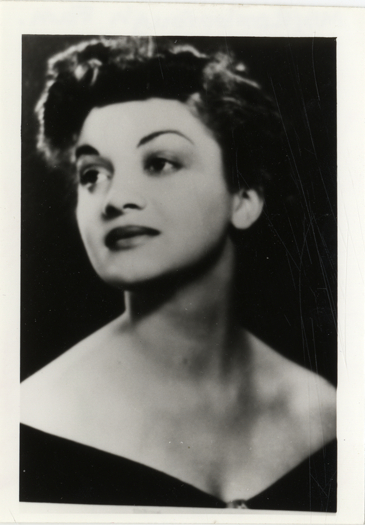

Elsie Roxborough (Photograph from the University of Michigan Archive)

Driving her fashionable Ford roadster from Detroit to Ann Arbor, Elsie Roxborough arrived at the University of Michigan as a freshman fifty years ago last fall. She was the first Negro student to live in a University dormitory. Her classmate Arthur Miller, an aspiring playwright and fellow reporter on the campus newspaper, called her “a beauty, the most striking girl in Ann Arbor. She was light-skinned and very classy. To a kid like me, she seemed svelte, knowing, witty, sexy.” With her own group in Detroit, the Roxane Players, she produced Langston Hughes’s play Drums of Haiti, and charmed Hughes as she had charmed boxer Joe Louis some years earlier. Elsie Roxborough was “the girl I was in love with” in 1937, Hughes wrote in his autobiography. Upon graduation, Roxborough “passed” into the white world. The next time most of her friends heard of her was in 1949 when an eight-column headline in the black newspaper Michigan Chronicle announced her death from an overdose of sleeping pills. Hughes kept her photograph over his writing table for the rest of his life.

Who was Elsie Roxborough? What became of her, and what did she represent? A piecing together of her life suggests that her fate was to dramatize the truth of Hughes’s poem “House in the World”:

I’m looking for a house
In the world
Where the white shadows
Will not fall.

There is no house,
Dark brother,
No such house
At all.

Elsie Roxborough started out to shake the stigma of color; when that proved impossible, she joined step with the oppressor. Her life as a disguised alien in the middle reaches of the white social register did not satisfy her ambition or her pride. Perhaps no happy ending awaited her. The welcome thawings of racial prejudice after the war, and the first signs of a civil rights movement, would only have mocked and embittered her in the years of her deception. A happy child become desperate, she is a case study of the “dark sister” excluded by the American Dream…

Read the entire article here.
Tags: , , , , ,

Possessions of Whiteness: Settler Colonialism and Anti-Blackness in the Pacific

Posted in Articles, History, Media Archive, Oceania, United States on 2014-06-04 19:22Z by Steven

Possessions of Whiteness: Settler Colonialism and Anti-Blackness in the Pacific

Decolonization: Indigeneity, Education & Society
June 2014 (2014-06-02)

Maile Arvin, Assistant Professor of Ethnic Studies
University of California, Riverside

I confess: I avoided watching the 2011 Oscar award-winning movie The Descendants (directed by the acclaimed Alexander Payne of Sideways and Nebraska, starring George Clooney) for a long time. I had read the book of the same name, by Kaui Hart Hemmings, on which the movie is based. I have complicated feelings about the book—a witty and often wrenching portrayal of a rich Native Hawaiian family that doesn’t seem to feel, look, or know much about being Native Hawaiian. Though I recognize such struggles, about feeling or being disconnected from your own culture and nation, as a very Native story (or perhaps, more precisely, as the story of settler colonialism), I don’t recognize the ending of Hemmings’ story. After much turmoil, the protagonist of her novel decides not to sell the land he has inherited from his family. It is hard to connect with the rich protagonists of Hemmings’ novel because I don’t know any Native Hawaiians who have land to be inherited. I don’t know any Native Hawaiians who frequent yacht clubs. And I don’t know any Native Hawaiians who seem so completely unaware of the truly amazing achievements of recent cultural revitalization efforts in the Native Hawaiian community—from language revitalization to traditional seafaring (our beloved Hōkūleʻa has set sail on a round-the-world voyage this past week). But, to each her own, I thought.

When I did finally watch the movie, despite the fact that I knew the story, despite the fact that I spend most of my time writing, researching and thinking about whiteness and settler colonialism in the Pacific, and despite the fact that I attended (for a time) the very same, very white-dominated private high school in Honolulu that Hemmings (and, incidentally, President Obama) attended, I was stunned. In the film, the residents of Hawaiʻi are shown to be, almost entirely, white people…

…Another way that settler colonialism and white supremacy buttress each other, but are not exactly the same, is that “racial mixture” is encouraged under settler colonialism, in order to make Indigenous peoples, and their particular claims to land, less distinct from settlers. Any kind of “mixture” allows Indigenous peoples to be seen as less “authentic,” as “dying out.” However, the goal of settler colonialism is to mix the population in such a way that it is closer in proximity to whiteness. These ideologies filter down into Indigenous communities in subtle and sometimes surprising ways. For example, many Native Hawaiians are multiracial, and are widely accepted within Native Hawaiian communities if their “racial mix” includes white or Asian. Being Native Hawaiian and black, however, is often less embraced, less recognizable, and less valorized…

Read the entire article here.

Tags: , , , , , ,

Was the Cat in the Hat Black?: Exploring Dr. Seuss’s Racial Imagination

Posted in Articles, Literary/Artistic Criticism, Media Archive, United States on 2014-06-04 18:53Z by Steven

Was the Cat in the Hat Black?: Exploring Dr. Seuss’s Racial Imagination

Children’s Literature
Volume 42, 2014
pages 71-98
DOI: 10.1353/chl.2014.0019

Philip Nel, Distinguished Professor of English
Kansas State University

In 1955, Dr. Seuss and William Spaulding—director of Houghton Mifflin’s educational division—stepped into the publisher’s elevator at 2 Park Street in Boston. As Seuss’s biographers tell us, the elevator operator was an elegant, petite woman who wore white gloves and a secret smile (Morgan and Morgan 154). They don’t mention that she was Annie Williams, nor do they say that she was African American (Silvey). Seuss was on that elevator because Spaulding thought he could solve the Why Johnny Can’t Read crisis by writing a better reading primer. When Seuss sketched this book’s feline protagonist, he gave him Mrs. Williams’s white gloves, her sly smile, and her color. However, she is but one African American influence on Seuss’s most famous character. One source for that red bow tie is Krazy Kat, the black, ambiguously gendered creation of biracial cartoonist George Herriman (Cohen 325). Seuss, who admired what he called “the beautifully insane sanities” of Krazy Kat (qtd. in Nel, Dr. Seuss 70), also draws upon the traditions of minstrelsy—an influence that emerges first in a minstrel show he wrote for his high school. The Cat in the Hat is racially complicated, inspired by blackface performance, racist images in popular culture, and actual African Americans. The Cat’s influences help us to track the evolution of the African American cultural imaginary in Seuss’s work, but also, more importantly, to exemplify how children’s literature conceals its own racialized origins. Considering the Cat’s racial complexity both serves as an act of desegregation, acknowledging the “mixed bloodlines” (to borrow Shelley Fisher Fishkin’s phrase) of canonical children’s literature, and highlights how during the 1950s—a turning point for African Americans in children’s literature—picture books were a site where race, representation, and power were actively being contested.

Decades before the birth of his Cat in the Hat, racial caricature was an accepted part of Theodor Seuss Geisel’s childhood. D. W. Griffith’s acclaimed Birth of a Nation (1915), released the month Geisel turned eleven, offered a popular and racist depiction of the Civil War and Reconstruction. The Jazz Singer (1927), the first feature-length “talking picture,” starred Al Jolson in blackface. One of Geisel’s favorite childhood books, Peter Newell’s The Hole Book (1908), follows a bullet’s comically disruptive journey through its pages, including one where a black mammy points to the hole in the watermelon, and addresses, in dialect, a group of wide-eyed black children: “‘Who plugged dat melon?’ mammy cried, / As through the door she came. / ‘I’d spank de chile dat done dat trick / Ef I could learn his name’” (fig. 1). Seuss remembered this book so well that sixty years after reading it, he could still quote its opening verse by heart (Nel, Dr. Seuss 18). If, as Tony Watkins has argued, “books tells stories that contribute to children’s unconscious sense of the ‘homeland’” (193), then these stories may have embedded racist caricature in Geisel’s unconscious, as an ordinary part of his visual imagination…

Tags: , , , ,

Seeking Roots in Shifting Ground–Dr. Laura Tugman’s topic for 18th Union, June 28

Posted in Anthropology, History, Live Events, Media Archive, Tri-Racial Isolates, United States on 2014-06-04 18:03Z by Steven

Seeking Roots in Shifting Ground–Dr. Laura Tugman’s topic for 18th Union, June 28

Melungeon Heritage Association: One People, All Colors
2014-05-20

18th Melungeon Union
Vardy, Tennessee and Big Stone Gap, Virginia
2014-06-27 through 2014-06-28

Dr. Laura Tugman will discuss her doctoral dissertation, entitled Seeking Roots in Shifting Ground: Ethnic Identity Development and the Melungeons of Southern Appalachia. Her research examined the experience of Melungeon ethnic identity development through ethnographic interviews with Melungeon individuals in Southern Appalachia. Her study concluded that the identity development process and group dynamics occurring within the Melungeons present challenges to the current multicultural psychology literature regarding ethnic identity development. As recently as the early 1990s, many believed that the Melungeons would soon be completely assimilated into mainstream white America. More recently, the formation of the Melungeon Heritage Association has renewed ethnic pride for many Melungeons who have either previously concealed their heritage—or were not even aware of it—due to a long-standing generational practice of concealing Melungeon heritage. Dr. Tugman examined the ethnic identity development process and life experiences of Melungeons, particularly the impact of social dynamics, both within and outside the group, on self-identification.

For more information, click here.

Tags: , ,

Skin Tone Stratification among Black Americans, 2001–2003

Posted in Articles, Economics, Media Archive, Social Science, United States on 2014-06-04 14:17Z by Steven

Skin Tone Stratification among Black Americans, 2001–2003

Social Forces
Volume 92, Number 4, June 2014
pages 1313-1337

Ellis P. Monk Jr., Provost’s Postdoctoral Scholar in Sociology
University of Chicago

In the past few decades, a dedicated collection of scholars have examined the matter of skin tone stratification within the black American population and found that complexion has significant net effects on a variety of stratification outcomes. These analyses relied heavily on data collected between 1950 and 1980. In particular, many scholars have utilized the National Survey of Black Americans (1979–1980). This leaves the question of whether or not the effect of skin tone on stratification outcomes remains decades later. Newly available data from the National Survey of American Life (2001–2003) are used to examine this question. I find that skin tone is significantly associated with black Americans’ educational attainment, household income, occupational status, and even the skin tone and educational attainment of their spouses. Consequently, this study demonstrates that skin tone stratification among black Americans persists into the 21st century. I conclude by discussing the implications of these findings for the study of ethnoracial inequality in the United States and beyond.

Tags: , , ,

“You Just Said ‘We’”: The complexity of not being White and not being a person of color.

Posted in Articles, Identity Development/Psychology, Media Archive, Passing, United States on 2014-06-02 19:51Z by Steven

“You Just Said ‘We’”: The complexity of not being White and not being a person of color.

Nick Franco
May 2014

Nick Franco, Coordinator for the Student Affairs/SOLES Collaborative
University of San Diego

This past Tuesday night, I did a mock presentation of my dissertation proposal for my dissertation seminar course. It went fairly well, and feedback from the professor and my colleagues was really, really helpful.

During the Q&A/debrief portion of my presentation, I talked about White people and said “we,” suggesting that I was a White person speaking on behalf of my fellow White people. A colleague pointed it out, and I really wasn’t surprised or upset about it. I simply responded with, “Well, my own racial identity is a separate dissertation.”…

Read the entire article here.

Tags:

Mo Asumang: Confronting racism face-to-face

Posted in Articles, Europe, Media Archive, United States, Videos on 2014-06-01 18:21Z by Steven

Mo Asumang: Confronting racism face-to-face

BBC News Magazine
2014-05-13

Mo Asumang is the daughter of a black Ghanaian father and a white German mother.

As a well-known TV presenter in Germany she became the target of racist extreme right-wingers and neo-Nazis, who based their attacks on Asumang’s “non-Aryan” background.

So she decided to look into the racist ideology and to find out more about those who consider themselves “Aryan“.

In her new documentary, The Aryans, she confronts racists, both in Germany and among the Ku Klux Klan in America.

Mo Asumang spoke to BBC News about her experiences making the film…

Tags: , , ,

Almost Free: A Story about Family and Race in Antebellum Virginia by Eva Sheppard Wolf (reweiw) [Watkins]

Posted in Articles, Book/Video Reviews, History, Media Archive, Slavery, United States, Virginia on 2014-06-01 17:38Z by Steven

Almost Free: A Story about Family and Race in Antebellum Virginia by Eva Sheppard Wolf (reweiw) [Watkins]

Journal of the Early Republic
Volume 33, Number 3, Fall 2013
pages 575-577
DOI: 10.1353/jer.2013.0062

Andrea S. Watkins

Wolf, Eva Sheppard, Almost Free: A Story about Family and Race in Antebellum Virginia (Athens: University of Georgia Press, 2012)

The tenuous status of free blacks within antebellum Virginia is examined by Eva Sheppard Wolf through the life of Samuel Johnson, a slave who purchased his own freedom and struggled over the course of the rest of his life to free his family and keep them together. His attempts to work within the legal framework established by the state and his own connections to powerful Virginia citizens illustrates the nebulous place free blacks held within antebellum society, as well as the role of personal relationships between black and white residents in achieving freedom and prosperity.

Wolf, associate professor of history at San Francisco State University, has pieced together a story of Johnson’s adulthood and family life through local court records and Virginia legislative petitions. The specifics of Samuel Johnson’s birth are not known, but his identification as “mulatto” in records indicates he had a slave mother and white father. Wolf suggests that Johnson’s white father may have found his mulatto slave son work in Norris Tavern in Warrenton, Virginia, the county seat for Fauquier County. As a tavern servant Johnson had the opportunity to forge relationships with white members of the community who came to Warrenton for court business and to save tip money to purchase his freedom. Johnson entered an agreement with his owner Edward Digges in 1802 to purchase his freedom for five hundred dollars. Virginia law regarding manumission of slaves changed in 1806. The new law established that freed slaves must leave the state within one year of liberation. Johnson had a choice to either continue to save and purchase his freedom with the knowledge he must leave or remain enslaved. The decision was not an easy one as he was married with two children by 1811, when he had collected the five hundred dollars.

Johnson’s choice demonstrates the importance of personal relationships in understanding race relations in the antebellum period. Over time Johnson had established ties with important white men within Warrenton, Fauquier County, and beyond. He was known as a hard-working slave and was viewed by many as an asset to the community. To leave Fauquier County, or Virginia, was to face a life of uncertainty. Would he find such valuable work in another state or find a place in a new community equal to the one he had in Warrenton? Thus, Johnson chose to petition the state legislature to allow him to remain in Virginia and he enlisted the help of various white citizens as witnesses to his character. His petition was passed by the legislature, and eventually Samuel Johnson became a free man on August 25, 1812. The fact that Johnson called on white slave owners to attest to his hard work, character, and value to the community reveals how often the relationships between blacks and whites in the early nineteenth century do not match the rhetoric of speeches and legislation critical and fearful of the presence of free blacks.

Wolf recounts how in the following years Johnson purchased his wife and two children, but their position was precarious as they could be sold for payment of Johnson’s debts, and he could not free them without fear that officials would expel them from the state one year after manumission. Johnson submitted petition after petition to the state’s authorities requesting that his family be allowed to remain with him when freed, and again and again those petitions failed to pass. Wolf successfully portrays the frustrations of trying to navigate the legal system of the time, but also the high stakes for Johnson and his family if he acted without legal provision. Johnson’s resourcefulness in garnering support throughout the white community is evident in his 1826 petition for his daughter Lucy that had the signatures of 226 people including white women and two U.S. congressmen. Johnson successfully purchased a home and land on the edge of Warrenton, and the family established a comfortable lifestyle until his death in 1842. At that time only his daughter and her children were still living. Johnson had already freed Lucy, taking the chance that his own standing and her ties to the local community would forestall any attempts to have…

Tags: , , , ,

Mixed Remixed Festival Reveals 2014 Schedule

Posted in Articles, Live Events, Media Archive, United States on 2014-06-01 14:08Z by Steven

Mixed Remixed Festival Reveals 2014 Schedule

Mixed Remixed Festival
March 2014

Heidi Durrow

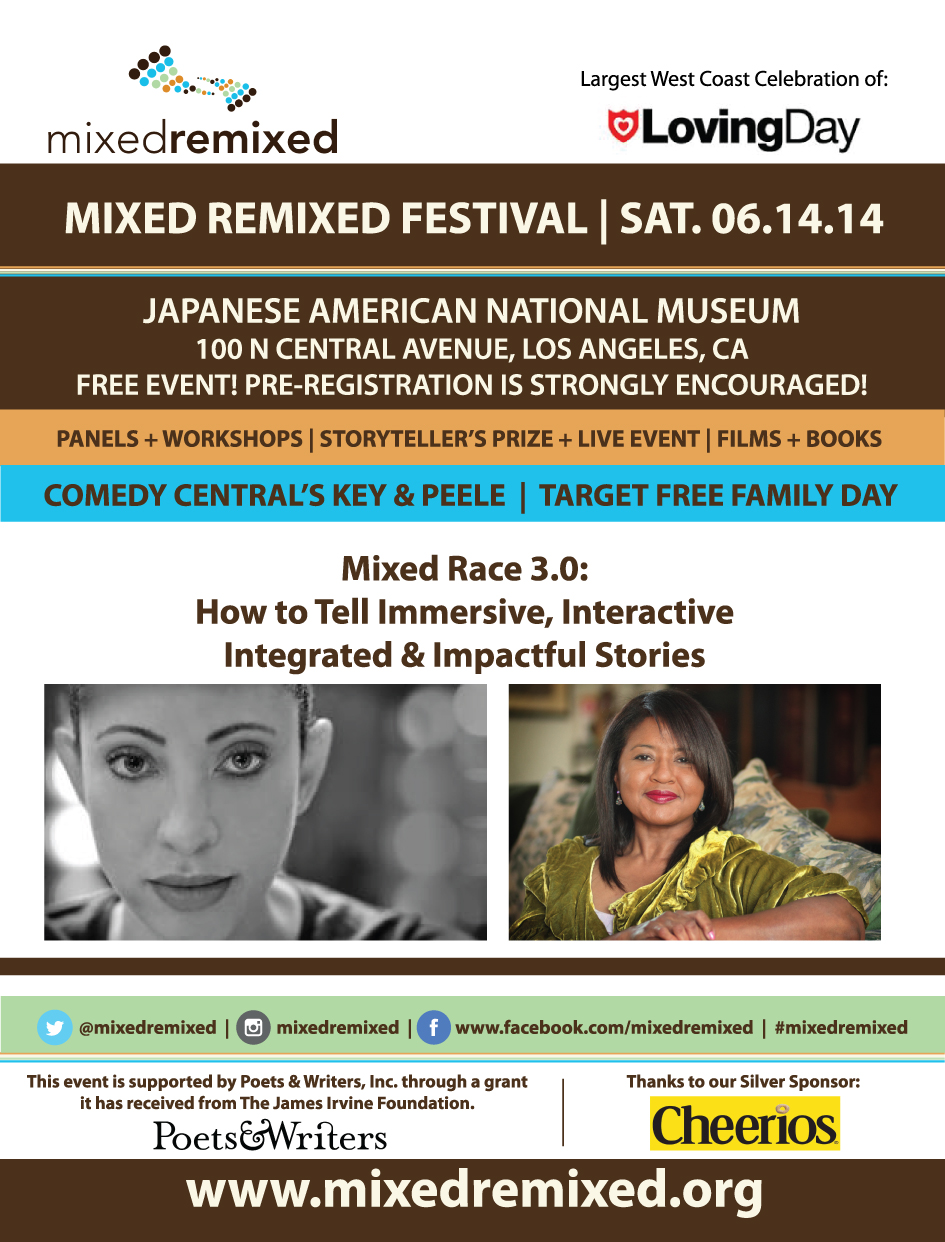
(Los Angeles, CA) The Mixed Remixed Festival will take place at the Japanese American National Museum in downtown Los Angeles (100 N. Central Avenue), June 14, 2014.

The Festival celebrates stories of the Mixed experience and stories of multiracial Americans, the fastest growing demographic in the U.S. A free public event, the Festival brings together film and book lovers, innovative and emerging artists, and multiracial and multicultural families and individuals for workshops, readings, performances, and film screenings…

…The event is free and open to the public; however, pre-registration is strongly encouraged. The complete Festival schedule can be found online at www.mixedremixed.org.

Read the entire press release here.

Tags: , ,

“Loving Day” with founder, Ken Tanabe

Posted in Live Events, Media Archive, United States on 2014-05-31 14:31Z by Steven

“Loving Day” with founder, Ken Tanabe

A.C.T.O.R. (A Continuing Talk on Race)
Busboys and Poets
Langston Room
14 & V, N.W.
Washington, D.C.
2014-06-01, 17:00-19:00 EDT (Local Time)

This month A.C.T.O.R. presents a celebration and discussion about “Loving Day” with founder, Ken Tanabe. Join us for an enlightening discussion on multiracial identity and interracial relationships!

Loving Day commemorates the anniversary of the 1967 United States Supreme Court decision Loving v. Virginia, which struck down all laws prohibiting interracial marriage.

The A.C.T.O.R. (A Continuing Talk on Race) open discussion series is produced and hosted by Busboys and Poets as a community service. It provides the opportunity for people to come together and speak openly and honestly about issues of race. The intent is that each person walks away from the discussion feeling something: challenged, educated, uncomfortable, enlightened, refreshed, reassured and hopefully inspired and moved to action! Each month there is a new topic for discussion with a Busboys and Poets-sponsored facilitator.

For more information, click here.

Tags: , ,