Now We Will Be Happy

Posted in Books, Caribbean/Latin America, Novels, United States on 2014-08-05 18:04Z by Steven

Now We Will Be Happy

University of Nebraska Press
September 2014
140 pages
Paperback ISBN: 978-0-8032-5539-5

Amina Gautier
Department of English
University of Miami
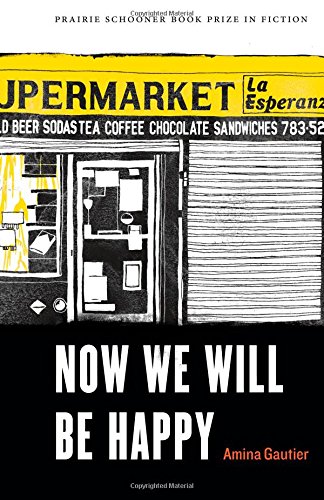
Winner of the 2013 Prairie Schooner Book Prize in Fiction

Now We Will Be Happy is a prize-winning collection of stories about Afro-Puerto Ricans, U.S.-mainland-born Puerto Ricans, and displaced native Puerto Ricans who are living between spaces while attempting to navigate the unique culture that defines Puerto Rican identity. Amina Gautier’s characters deal with the difficulties of bicultural identities in a world that wants them to choose only one.

The characters in Now We Will Be Happy are as unpredictable as they are human. A teenage boy leaves home in search of the mother he hasn’t seen since childhood; a granddaughter is sent across the ocean to broker peace between her relatives; a widow seeks to die by hurricane; a married woman takes a bathtub voyage with her lover; a proprietress who is the glue that binds her neighborhood cannot hold on to her own son; a displaced wife develops a strange addiction to candles.

Crossing boundaries of comfort, culture, language, race, and tradition in unexpected ways, these characters struggle valiantly and doggedly to reconcile their fantasies of happiness with the realities of their existence.

Read an excerpt here.

Tags: ,

‘Everything I Never Told You’ Exposed In Biracial Family’s Loss

Posted in Articles, Asian Diaspora, Audio, Autobiography, Book/Video Reviews, Interviews, United States on 2014-08-04 18:54Z by Steven

‘Everything I Never Told You’ Exposed In Biracial Family’s Loss

Code Switch: Frontiers of Race, Culture and Ethnicity
National Public Radio
2014-06-28

Arun Rath
All Things Considered

It’s May, 1977, in small-town Ohio, and the Lee family is sitting down at breakfast. James is Chinese-American and Marilyn is white, and they have three children — two girls and a boy. But on this day, their middle child Lydia, who is also their favorite, is nowhere to be found.

That’s how Celeste Ng’s new novel, Everything I Never Told You, begins.

It’s soon discovered that Lydia has drowned in a nearby lake, in what looks like a suicide. The incident pulls the family into an emotional vortex and reveals deep cracks in their relationships with each other.

This all takes place an era when interracial marriages are only recently legal (the Supreme Court struck down interracial marriage bans in 1967). Lydia’s death forces members of the Lee family to confront their individual insecurities and grapple with their identity as a biracial family in the Midwest.

But would it be very different for them today? Ng answered that question for NPR’s Arun Rath, host of All Things Considered.

Ng, who is a first-generation Asian-American Midwesterner, also spoke about her own experiences growing up and about the state of the American conversation on race…

Read the article here. Listen to the interview here. Download the interview here.

Tags: , , , , ,

Everything I Never Told You: A Novel

Posted in Asian Diaspora, Books, Media Archive, Novels, United States on 2014-08-04 17:35Z by Steven

Everything I Never Told You: A Novel

Penguin Press
2014-06-26
304 pages
Hardcover ISBN: 9781594205712

Celeste Ng

Lydia is dead. But they don’t know this yet . . . So begins the story of this exquisite debut novel, about a Chinese American family living in 1970s small-town Ohio. Lydia is the favorite child of Marilyn and James Lee; their middle daughter, a girl who inherited her mother’s bright blue eyes and her father’s jet-black hair. Her parents are determined that Lydia will fulfill the dreams they were unable to pursue—in Marilyn’s case that her daughter become a doctor rather than a homemaker, in James’s case that Lydia be popular at school, a girl with a busy social life and the center of every party.

When Lydia’s body is found in the local lake, the delicate balancing act that has been keeping the Lee family together tumbles into chaos, forcing them to confront the long-kept secrets that have been slowly pulling them apart. James, consumed by guilt, sets out on a reckless path that may destroy his marriage. Marilyn, devastated and vengeful, is determined to find a responsible party, no matter what the cost. Lydia’s older brother, Nathan, is certain that the neighborhood bad boy Jack is somehow involved. But it’s the youngest of the family—Hannah—who observes far more than anyone realizes and who may be the only one who knows the truth about what happened.

A profoundly moving story of family, history, and the meaning of home, Everything I Never Told You is both a gripping page-turner and a sensitive family portrait, exploring the divisions between cultures and the rifts within a family, and uncovering the ways in which mothers and daughters, fathers and sons, and husbands and wives struggle, all their lives, to understand one another.

Tags: ,

After the ‘White Lie’ Implodes, a Rich Narrative Unfurls

Posted in Articles, Autobiography, Book/Video Reviews, Identity Development/Psychology, Judaism, Media Archive, Passing, Religion, United States on 2014-08-02 16:59Z by Steven

After the ‘White Lie’ Implodes, a Rich Narrative Unfurls

The New York Times
2014-08-01

Felicia R. Lee

‘Little White Lie,’ Lacey Schwartz’s Film About Self-Discovery

Lacey Schwartz, a 37-year-old Harvard Law School graduate turned filmmaker, moves with ease in circles in which her identity as both black and Jewish seems unremarkable. What makes her biography striking is that Ms. Schwartz, a woman with light brown skin and a cascade of dark curls, grew up believing she was white.

How and why that happened is the subject of her film, “Little White Lie,” which has its premiere on Sunday at the San Francisco Jewish Film Festival, its first stop on the festival circuit before being broadcast on PBS next year. With Ms. Schwartz narrating, the camera travels to a funeral, girlfriend gab sessions and even her therapy appointments. At each stop, in raw conversations with family and friends, Ms. Schwartz asks over and over, how and why did she pass as white?

“I come from a long line of New York Jews,” she says early in the film, as photographs of her white relatives flash across the screen. “My family knew who they were, and they defined who I was.”

Ms. Schwartz was an only child who grew up in the mostly white town of Woodstock, N.Y. Her parents, Peggy and Robert Schwartz, told her that she favored her father’s swarthy Sicilian grandfather. It was not until she went off to college that she learned the truth.

Before starting college, “I was already questioning my whiteness because of what other people said and because I was aware that I looked different from my family,” she said in a recent interview. Then, based on the photograph accompanying her application, Georgetown University passed her name along to the black student association, which contacted her.

The university “gave me permission” to explore a black identity, Ms. Schwartz said…

…Bliss Broyard explored similar territory in a memoir about her father, the book critic Anatole Broyard, a black man who passed as white. She has said she was raised white but learned the truth about her father on his deathbed. But Ms. Broyard, unlike Ms. Schwartz, grew up with her biological father.

Jenifer L. Bratter, director of the Program for the Study of Ethnicity, Race and Culture at Rice University, said the film’s twisting tale was part of “a larger story about race in America.”

“Biological race trumps cultural race,” she added. “Race is something we’re really invested in validating or comprehending. It’s about how we understand race as a marker of difference, something that a story about ancestry can’t resolve.”..

Read the entire review here.

Tags: , , , , , ,

One Drop of a Father’s Love

Posted in Articles, Census/Demographics, History, Literary/Artistic Criticism, Media Archive, United States on 2014-08-02 16:51Z by Steven

One Drop of a Father’s Love

Biracials Learning About African-American Culture (B.L.A.A.C)
Sunday, 2014-06-15

Zebulon Miletsky, Assistant Professor of Africana Studies
Stony Brook University, State University of New York

This week I had the pleasure of attending a one-woman show by Television and Film actress, Fanshen Cox DiGiovanni, called “One Drop of Love” a multimedia solo performance put on at the Brooklyn Historical Society. It was phenomenal. Not only was it brilliant in its exposition of the social and historical dimensions of race, but it alsobrought a human dimension to the oft-complicated question of mixed race in America.  The context alone was compelling.  In the next room, the critically praised exhibit on Brooklyn Abolitionists entitled “In Pursuit of Freedom”, rich with the documentation and exhibits about slavery and its abolition, much of it the raw material and subtext of the play we were about to witness. The day of the performancealso happened to be “Loving Day”, an annual celebration ofthe anniversary of the 1967 United States Supreme Court decision “Loving v. Virginia” which struck down all anti-miscegenation laws in the U.S. The decision was followed by an increase in interracial marriages, although not necessarily all “black/white” ones, and it is commemorated annually on what is now Loving Day, June the 12th…

Read the entire review here.

Tags: , , ,

Mixed roots, common bonds

Posted in Articles, Family/Parenting, Media Archive, United States on 2014-07-30 22:00Z by Steven

Mixed roots, common bonds

The Kansas City Star
Kansas City, Missouri
2014-07-21

Jeneé Osterheldt

Her first year at KU [University of Kansas], Jasmin Moore noticed the black students sat together. The Hispanic students sat together. And everyone else did the same. This was over a decade ago.

“For the first time, I was trying to figure out where I belonged,” she says. Her mom is white and her dad is black, and students pulled her in different directions, wanting her to declare herself. She found herself gravitating toward the Hispanic students. She looked like them. At the time, it was easier.

As she and her husband pursued graduate programs, they moved to Little Rock, Ark., where things are still very segregated and being mixed is an anomaly.

“People didn’t know what to make of me,” she says. “I got stares. I realized that for people in other places, being biracial is still a unique experience, and it’s important to support others.”

And that’s why, now that she’s back in town, she is helping rebuild the Multiracial Family Circle, now called Kansas City Mixed Roots…

Read the entire article here.

Tags: , , , ,

Fatal Invention with Dorothy Roberts

Posted in Audio, Health/Medicine/Genetics, History, Interviews, Live Events, Media Archive, Politics/Public Policy, United States on 2014-07-30 20:49Z by Steven

Fatal Invention with Dorothy Roberts

Research at the National Archives and Beyond
BlogTalk Radio
Thursday, 2014-07-24, 21:00 EDT, (Friday, 2014-07-25, 01:00Z)

Bernice Bennett, Host

Dorothy Roberts, George A. Weiss University Professor of Law and Sociology; Raymond Pace and Sadie Tanner Mossell Alexander Professor of Civil Rights
University of Pennsylvania

Fatal Invention: How Science, Politics, and Big Business Re-create Race in the Twenty-first Century

Dorothy Roberts, an acclaimed scholar of race, gender and the law, joined the University of Pennsylvania as its 14th Penn Integrates Knowledge Professor with a joint appointment in the Department of Sociology and the Law School where she also holds the inaugural Raymond Pace and Sadie Tanner Mosell Alexander chair. Her pathbreaking work in law and public policy focuses on urgent contemporary issues in health, social justice, and bioethics, especially as they impact the lives of women, children and African-Americans. Her major books include Fatal Invention: How Science, Politics, and Big Business Re-create Race in the Twenty-first Century (New Press, 2011); Shattered Bonds: The Color of Child Welfare (Basic Books, 2002), and Killing the Black Body: Race, Reproduction, and the Meaning of Liberty (Pantheon, 1997). She is the author of more than 80 scholarly articles and book chapters, as well as a co-editor of six books on such topics as constitutional law and women and the law.

Popular History Internet Radio with BerniceBennett on BlogTalkRadio

Download the episode here.

Tags: , , ,

The Invisible Line: A Secret History of Race in America – Daniel J. Sharfstein

Posted in Audio, History, Interviews, Live Events, Media Archive, Passing, United States on 2014-07-30 20:15Z by Steven

The Invisible Line: A Secret History of Race in America – Daniel J. Sharfstein

Research at the National Archives and Beyond
BlogTalk Radio
Thursday, 2014-06-26, 21:00 EDT, (Friday, 2014-06-27, 01:00Z)

Bernice Bennett, Host

Daniel J. Sharfstein, Professor of Law
Vanderbilt University, Nashville, Tennessee

Join author, Daniel J. Sharfstein for a discussion of his book and research – The Invisible Line – Three American Families and the Secret Journey from Black to White.

Defining their identities first as people of color and later as whites, these families provide a lens for understanding how people thought about and experienced race and how these ideas and experiences evolved—how the very meaning of black and white changed—over time. Cutting through centuries of myth, amnesia, and poisonous racial politics, The Invisible Line will change the way we talk about race, racism, and civil rights.

Daniel J. Sharfstein is a professor of law at Vanderbilt University. A graduate of Harvard College and Yale Law School, he has been awarded fellowships for his research on the legal history of race in the United States from Harvard, New York University, and the National Endowment for the Humanities. His book is available in paperback as The Invisible Line: A Secret History of Race in America, and it has won three prizes: the J. Anthony Lukas Prize for narrative non-fiction, the Cromwell Book Prize from the American Society for Legal History, and the Hurst Prize from the Law and Society Association. Daniel has also spent the past year as a Guggenheim Fellow, working on a new book.

Defining their identities first as people of color and later as whites, these families provide a lens for understanding how people thought about and experienced race and how these ideas and experiences evolved—how the very meaning of black and white changed—over time. Cutting through centuries of myth, amnesia, and poisonous racial politics, The Invisible Line will change the way we talk about race, racism, and civil rights.

Check Out History Podcasts at Blog Talk Radio with BerniceBennett on BlogTalkRadio

Download the episode here.

Tags: , , ,

Census Data Confusion, Manipulation, and Latinos of Mixed Ancestry or “Should Latino be a Race?”

Posted in Census/Demographics, Latino Studies, Media Archive, Politics/Public Policy, United States, Videos on 2014-07-30 14:23Z by Steven

Census Data Confusion, Manipulation, and Latinos of Mixed Ancestry or “Should Latino be a Race?”

Presented at The Second Annual Mixed Heritage Conference
University of California, Los Angeles
2014-04-16

Thomas Lopez, President
Multiracial Americans of Southern California (MASC)

Multiracial Americans President Thomas Lopez delivers a talk on changing the Census categories to allow Latino to become a race. In this episode, the talk is introduced with a brief history of the Census. Special emphasis is made on how Hispanic became a Census category and mixed race people succeeded in checking one or more racial categories.

Tags: , , ,

Loving v. Virginia in Historical Context

Posted in Articles, History, Law, United States on 2014-07-29 00:34Z by Steven

Loving v. Virginia in Historical Context

Crossing Borders, Bridging Generatons
Brooklyn Historical Society
June 2014

Renee Romano, Associate Professor of History
Oberlin College

Renee Romano teaches history at Oberlin College and she is the author of Race Mixing: Black-White Marriage in Postwar America (Harvard University Press, 2003), and co-editor of The Civil Rights Movement in American Memory (University of Georgia Press, 2006). Her new book, Racial Reckoning: Prosecuting America’s Civil Rights Murders (forthcoming from Harvard University Press in fall 2014) explores the contemporary prosecutions of civil rights era crimes.

On June 12, 1967, the U.S. Supreme Court delivered a groundbreaking decision in the aptly named case, Loving v. Virginia. Responding to a challenge to a Virginia law that barred interracial marriages, the Supreme Court ruled that state laws that made it illegal for whites and nonwhites to marry were unconstitutional.

There can be no doubt that restricting the freedom to marry solely because of racial classifications violates the central meaning of the Equal Protection clause,” Chief Justice Earl Warren wrote in the unanimous decision.

With the stroke of a pen, the Supreme Court overturned centuries of common practice and its own legal precedent.

The colony of Virginia had enacted the first law punishing interracial marriage in 1691 in an attempt to prevent what it called the “abominable mixture and spurious issue” produced by unions between whites and nonwhites. Miscegenation laws proved vital for establishing racial boundaries and for constructing a racial hierarchy that placed whites above people of color. All but nine of the fifty states outlawed interracial marriage at some time in their history. These laws were not limited to the South—they existed at different historical moments in states ranging from Massachusetts to California, and they variously outlawed marriages between whites and those defined as black, Asian and American Indian. What they had in common was a shared intent in protecting the status of whites and communicating the subordinate position of nonwhite groups…

Read the entire article here.

Tags: , , ,