Don’t Forget the Accent Mark: A Memoir

Posted in Autobiography, Books, Latino Studies, Media Archive, Monographs, United States on 2012-01-31 01:40Z by Steven

Don’t Forget the Accent Mark: A Memoir

University of New Mexico Press
2011
110 pages
5.5 x 8 in.; 15 halftones
Paperback ISBN: 978-0-8263-5047-3

David Sánchez, Professor of Mathematics (Retired)
University of New Mexico
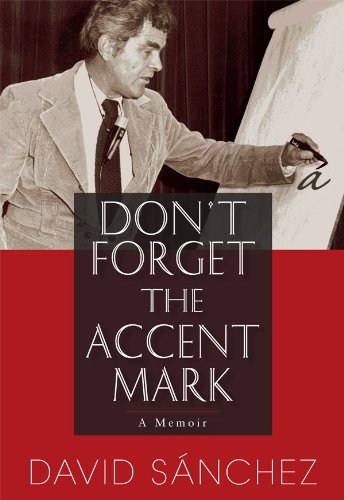
Raised in a Mexican home in an Anglo neighborhood, David Sánchez was fair-skinned and fluent in Spanish and English when he entered kindergarten. None of this should have had any influence on the career path he chose, but at certain moments it did. With the birth of the Chicano Movement and affirmative action, a different and sometimes disturbing significance became attached to his name. Sánchez’s story chronicles his life and those moments.

No matter how we transcend our origins, they remain part of our lives. This autobiography of an outstanding mathematician, dedicated to others, whose career included stints as a senior university and federal administrator, is also the story of a young man of mixed Mexican and American parentage.

Contents

  • PROLOGUE
  • Chapter One: EARLY DAYS
  • Chapter Two: SECONDARY SCHOOL DAYS
  • Chapter Three: COLLEGE: THE FIRST TWO YEARS
  • Chapter Four: NEW MEXICO: VISIT ONE
  • Chapter Five: ANN ARBOR: VISIT ONE
  • Chapter Six: SEMPER FI: THE FIRST YEAR
  • Chapter Seven: SEMPER FI: SAYONARA
  • Chapter Eight: ANN ARBOR: VISIT TWO
  • Chapter Nine: THE WINDY CITY AND ENGLISH LIFE
  • Chapter Ten: WESTWOOD DAYS
  • Chapter Eleven: NEW MEXICO: VISIT TWO
  • Chapter Twelve: PAPFR-PUSHING DAYS: PRIVATE AND FEDFRAL
  • Chapter Thirteen: A BRIEF TEXAS INTERLUDE
  • Chapter Fourteen: ACADEME AND NEW MEXICO: THE FINAL VISIT
  • APPENDIX

Chapter 1: EARLY DAYS

Sanchez is a pretty common name in the southwestern United States. More properly it should be spelled Sánchez, as I was informed by my grandfather Cecilio shortly after I moved into my Mexican grandparents’ home in San Diego, California, at the age of three. I asked him what was the funny mark above our name, and he sternly replied, “Asi se escribe nuestro nombre en esta familia” (In this family that is the way our name is written). Don Cecilio was not a person to be disobeyed, so whenever I sign my name, the accent mark is always there—a little symbol of my Mexicanness in the Anglo world in which I was raised.

Growing up, the accent was not a problem, except for a few raised eyebrows now and then because I look more Irish or Welsh than Mexican. But when I was in training in the Marine Corps, we were required to stencil our names on our utility shirts. I decided to add the accent mark, which really angered one of my drill instructors. He asked me what it was, and I replied as my grandfather had done. He loudly accused me of being some kind of a French pervert or a communist sympathizer; uniformity is a very strict requirement of Marine Corps training, even on stencils. I stood rigidly at the best USMC attention, just as loudly repeated my reason, and after a few more insults, the DI stormed off. I never heard any more about it.

Nowadays you see the name Sánchez everywhere. There are writers, artists, entertainers, military personnel at all levels, news commentators, athletes, politicians, and scholars, many of them with the first name David. But well into my early middle age, I rarely encountered a namesake, and I regarded myself as a typical American but with the advantage of being bilingual. No English was spoken in my grandparents’ house. When I arrived, I only spoke English, but my grandfather insisted that every Sunday we have a Spanish lesson, using some of the old primers he used as a boy in Mexico in the late eighteen hundreds. When I entered kindergarten, I could already read and speak Spanish. Since there were only two Mexican families in our neighborhood, Mission Hills (middle to upper class then, but now much more posh), it was English out the door and Spanish in the door.

In the thirties and early forties, San Diego had a population of about two hundred thousand, with a sizeable Mexican population largely living in the Logan Heights neighborhood. We would visit friends there frequently; many of them were families whose parents had fled Mexico during the Mexican Revolution, just as my grandparents had done. Birthday and holiday fiestas, lively events in which I enthusiastically participated, were packed with our Mexican friends, which certainly enhanced my appreciation and acceptance of my heritage.

Statistics on the composition of today’s Latino households shows many families in which the grandparents are raising the children, usually for reasons such as an illegitimate birth or a broken marriage. Many of these grandparents are trying to protect the family structure and reputation and want to insure that the child is raised in a loving environment with attention being paid to its education. The Mexican grandparental culture is a strong, supportive one from which I certainly benefited.

How did I acquire the name Sánchez? I was born in 1933 in San Francisco, probably out of wedlock, the son of Berta Sánchez and a man I prefer not to identify. (I did not know his name until I was seventeen, when my grandmother had to emotionally provide my birth certificate in order for me to apply to the Navy Reserve.) When I was three years old, my mother decided to move back to Mexico; she was bilingual and a skilled secretary, so there were good job opportunities. But she had no confidence in the Mexican medical system and did not wish the stigma of being an unwed mother. So she arranged for me to be raised in San Diego by my grandparents, Cecilio and Concepcion Sánchez…
Tags: ,

Sui Sin Far / Edith Maude Eaton: A Literary Biography

Posted in Asian Diaspora, Biography, Books, Canada, Caribbean/Latin America, Literary/Artistic Criticism, Media Archive, Monographs, United States, Women on 2012-01-30 03:10Z by Steven

Sui Sin Far / Edith Maude Eaton: A Literary Biography

University of Illinois Press
1995
288 pages
ISBN-10: 0252021134; ISBN-13: 978-0252021138

Annette White-Parks, Professor Emeritus of English
University of Wisconsin, LaCrosse

Foreword by Roger Daniels

Winner of the Association for Asian American Studies Outstanding Book Award in Cultural Studies.

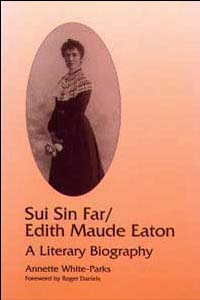
This first full-length biography of the first published Asian North American fiction writer portrays both the woman and her times.

The eldest daughter of a Chinese mother and British father, Edith Maude Eaton was born in England in 1865. Her family moved to Quebec, where she was removed from school at age ten to help support her parents and twelve siblings. In the 1880s and 1890s she worked as a stenographer, journalist, and fiction writer in Montreal, often writing under the name Sui Sin Far (Water Lily). She lived briefly in Jamaica and then, from 1898 to 1912, in the United States. Her one book, Mrs. Spring Fragrance, has been out of print since 1914.

Today Sui Sin Far is being rediscovered as part of American literature and history. She presented portraits of turn-of-the-century Chinatowns, not in the mode of the “yellow peril” literature in vogue at the time but with an insider’s sympathy. She gave voice to Chinese American women and children, and she responded to the social divisions and discrimination that confronted her by experimenting with trickster characters and tools of irony, sharing the coping mechanisms used by other writers who struggled to overcome the marginalization to which their race, class, or gender consigned them in that era.

Table of Contents

  • Foreword by Roger Daniels
  • Preface
  • Introduction
  • 1. A Bird on the Wing
  • 2. Montreal: The Early Writings
  • 3. Pacific Coast Chinatown Stories
  • 4. Boston: The Mature Voice and Its Art
  • 5. Mrs. Spring Fragrance
  • Conclusion
  • Bibliography
  • Index
Tags: , , , , ,

Race, Sex, and Social Order in Early New Orleans

Posted in Books, History, Law, Louisiana, Media Archive, Monographs, Slavery, United States on 2012-01-30 01:15Z by Steven

Race, Sex, and Social Order in Early New Orleans

Johns Hopkins University Press
2009
352 pages
7 halftones
Hardback ISBN: 9780801886805

Jennifer M. Spear, Associate Professor of History
Simon Fraser University, Burnaby, British Columbia, Canada

Winner, 2009 Kemper and Leila Williams Prize in Lousiana History, The Historic New Orleans Collection and the Louisiana Historical Association

A microcosm of exaggerated societal extremes—poverty and wealth, vice and virtue, elitism and equality—New Orleans is a tangled web of race, cultural mores, and sexual identities. Jennifer Spear’s examination of the dialectical relationship between politics and social practice unravels the city’s construction of race during the eighteenth and early nineteenth centuries.

Spear brings together archival evidence from three different languages and the most recent and respected scholarship on racial formation and interracial sex to explain why free people of color became a significant population in the early days of New Orleans and to show how authorities attempted to use concepts of race and social hierarchy to impose order on a decidedly disorderly society. She recounts and analyzes the major conflicts that influenced New Orleanian culture: legal attempts to impose racial barriers and social order, political battles over propriety and freedom, and cultural clashes over place and progress. At each turn, Spear’s narrative challenges the prevailing academic assumptions and supports her efforts to move exploration of racial formation away from cultural and political discourses and toward social histories.

Strikingly argued, richly researched, and methodologically sound, this wide-ranging look at how choices about sex triumphed over established class systems and artificial racial boundaries supplies a refreshing contribution to the history of early Louisiana.

Table of Contents

  • Ackowledgements
  • Introduction
  • 1. Indian Women, French Women, and the Regulation of Sex
  • 2. Legislating Slavery in French New Orleans
  • 3. Affranchis and Sang-Mêlé
  • 4. Slavery and Freedom in Spanish New Orleans
  • 5. Limpieza de Sangre and Family Formation
  • 6. Negotiating Racial Identities in the 1790s
  • 7. Codification of a Tripartite Racial System in Anglo-Louisiana
  • Epilogue
  • Notes
  • Glossary
  • Essay on Sources
  • Index
Tags: , , , ,

Louis Riel and the Creation of Modern Canada: Mythic Discourse and the Postcolonial State

Posted in Biography, Books, Canada, History, Media Archive, Monographs, Native Americans/First Nation, Religion on 2012-01-27 03:02Z by Steven

Louis Riel and the Creation of Modern Canada: Mythic Discourse and the Postcolonial State

University of Manitoba Press
November 2008
314 pages
6 × 9
Paper, ISBN: 978-0-88755-734-7

Jennifer Reid, Professor of Religion
University of Maine, Farmington

Politician, founder of Manitoba, and leader of the Métis, Louis Riel led two resistance movements against the Canadian government: the Red River Uprising of 1869–70, and the North-West Rebellion of 1885, in defense of Métis and other minority rights.

Against the backdrop of these legendary uprisings, Jennifer Reid examines Riel’s religious background, the mythic significance that has consciously been ascribed to him, and how these elements combined to influence Canada’s search for a national identity. Reid’s study provides a framework for rethinking the geopolitical significance of the modern Canadian state, the historic role of Confederation in establishing the country’s collective self-image, and the narrative space through which Riel’s voice speaks to these issues.

Table of Contents

  • Foreword
  • Chapter 1: Setting the Stage: The North-West to 1885
  • Chapter 2: Canadian Myths and Canadian Identity
  • Chapter 3: Nation-states and National Discourses
  • Chapter 4: Violence and State Creation
  • Chapter 5: Revolution, Identity, and Canada
  • Chapter 6: Riel and the Canadian State
  • Chapter 7: Heterogeneity and the Postcolonial State
  • Conclusion
  • Notes
Tags: , , ,

Barack Obama: The Road from Moneygall

Posted in Barack Obama, Biography, Books, Europe, History, Media Archive, Monographs on 2012-01-24 23:37Z by Steven

Barack Obama: The Road from Moneygall

Brandon Books
June 2010
288 pages
ISBN: 9780863224065 (hb); 9780863224133 (pb)

Steve MacDonogh (1949-2010), Editorial Director

A unique exploration of the president’s Irish ancestral origins.

In his presidential election acceptance speech, Barack Obama evoked a story of great change in America, and an America made up of many strands. In this book it is the strand of his own Irish background and ancestry that tells a story of emigration to escape hunger and of the struggle to build new lives in the land of opportunity.

“Our family’s story is one that spans miles and generations; races and realities,” Barack Obama has said. “It’s the story of farmers and soldiers; city workers and single moms. It takes place in small towns and good schools, in Kansas and Kenya, on the shores of Hawaii and the streets of Chicago. It’s a varied and unlikely journey, but one that’s held together by the same simple dream. And that is why it’s American.”

But it is an Irish story, too. Falmouth Kearney, Obama’s great-great-great-grandfather, was born in Moneygall, County Offaly in 1831, lived as a child through the apocalyptic famine years, and left a decimated, devastated country for America in 1850, aged 19. Here we learn for the first time the story of the Kearney family, of the Ireland they came from and the state of County Offaly in the dreadful famine years.

We learn, too, of how two students met in 1960 and married and had a child: Ann Dunham from Wichita, Kansas, a direct descendant of Falmouth Kearney, and Barack Obama, Sr., a Kenyan from Nyang’oma Kogelo, Nyanza Province.

Tags: , ,

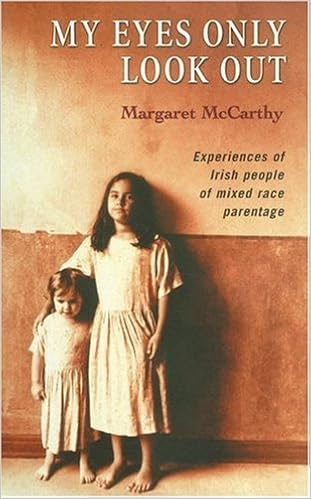
My Eyes Only Look Out

Posted in Autobiography, Books, Europe, Media Archive, Monographs on 2012-01-24 23:21Z by Steven

My Eyes Only Look Out

Brandon Books
October 2001
236 pages
ISBN: 9780863222849

Margaret McCarthy

Irish people describe the realities of being of mixed race in a mostly white society In the first book of its kind, Irish people describe, in a series of compelling interviews, the realities of being of mixed race in a mostly white society which is only now trying to adjust to the beginnings of the creation of a multicultural society.

Amongst those featured are:

  • Andrew: “I’m blessed to be a mixed-race boy.” Son of a South African mother and English father, he grew up in Galway and now lives in Handsworth, Birmingham.
  • Teresa: “I am still an outsider, but now it feels OK.” Daughter of a German mother and a Nigerian father, Teresa moved as a child to a mainly white area of London, where she was ostracised because of her colour. Now she lives in rural Ireland.
  • Lorna: “If you are mixed race, whether it is a quarter of you or whatever, you are black.” Reared in Ireland, she left for London in her teens, but she always yearned for America, and in her mid-thirties she moved to Miami.
  • Curtis: “A black Irishman, that’s me. Nobody can take that away from me.” A professional footballer with a passion for the game and a deep loyalty to his old clubs and mentors as well as to his present club.
  • Sean: “I rarely, if ever, had any trouble on the pitch.” A Gaelic football and hurling star, he is a graduate in Finance through Irish.
  • Lisa: “In my mind I was always Lisa the dancer.” A bright and popular shop assistant, Lisa’s adoptive parents and natural mother are dead, and she knows little about her natural father, whom she believes was Ghanaian.
  • Ian: “Celebrated as “the first coloured policeman in Ireland”, Ian experiences confusion about his identity.
  • Luzveminda: “I had an ordinary kind of childhood.” A science graduate, she was crowned Rose of Tralee and launched Trí³caire’s African campaign.
Tags: , ,

The End of Race? Obama, 2008, and Racial Politics in America

Posted in Barack Obama, Books, Media Archive, Monographs, Politics/Public Policy, United States on 2012-01-24 22:21Z by Steven

The End of Race? Obama, 2008, and Racial Politics in America

Yale University Press
2011-12-12
320 pages
6 1/8 x 9 1/4; 32 b/w illus.
ISBN: 9780300175196

Donald R. Kinder, Philip E. Converse Collegiate Professor of Political Science; Professor of Psychology
University of Michigan

Allison Dale-Riddle, Doctoral Candidate of Political Science
University of Michigan

How did race affect the election that gave America its first African American president? This book offers some fascinating, and perhaps controversial, findings. Donald R. Kinder and Allison Dale-Riddle assert that racism was in fact an important factor in 2008, and that if not for racism, Barack Obama would have won in a landslide. On the way to this conclusion, they make several other important arguments. In an analysis of the nomination battle between Obama and Hillary Clinton, they show why racial identity matters more in electoral politics than gender identity. Comparing the 2008 election with that of 1960, they find that religion played much the same role in the earlier campaign that race played in ’08. And they argue that racial resentment—a modern form of racism that has superseded the old-fashioned biological variety—is a potent political force.

Tags: , , ,

Freedom’s Child: The Life of a Confederate General’s Black Daughter

Posted in Biography, Books, History, Media Archive, Monographs, Slavery, United States, Women on 2012-01-24 20:58Z by Steven

Freedom’s Child: The Life of a Confederate General’s Black Daughter

Algonquin Books
1998
288 pages
ISBN: 9781565121867

Carrie Allen McCray (1913-2008)

When Carrie Allen McCray was a child, she was afraid to ask about the framed photograph of a white man on her mother’s dresser. Years later she learned that he was her grandfather, a Confederate general, and that her grandmother was a former slave. In her late seventies, Carrie McCray went searching for her history and found the remarkable story of her mother, Mary [Rice Allen], the illegitimate daughter of General J. R. Jones, of Lynchburg, Virginia. Jones would later be cast out of Lynchburg society for publicly recognizing his daughter. Freedom’s Child is a loving remembrance of how Mary spent her life beating down the kind of thinking that ostracized her father. She was a leader in the founding of the NAACP and hosted the likes of Langston Hughes and W.E.B. Du Bois as they plotted the war against discrimination at her kitchen table. Carrie McCray’s memories reward us with an extraordinarily vivid and intimate portrait of a remarkable woman.

Tags: , , , ,

Multiple Realities: Reconsidering Multiracialism in Singapore

Posted in Asian Diaspora, Books, Media Archive, Monographs, Social Science on 2012-01-22 17:13Z by Steven

Multiple Realities: Reconsidering Multiracialism in Singapore

World Scientific Publishing
Summer 2012
150 pages
ISBN: 978-981-270-604-1; 981-270-604-6

Eugene K. B. Tan, Assistant Professor of Law
Singapore Management University, Singapore

How has Singapore’s multiracialism policy evolved, and how has it impacted on ethnic relations and nation-building in a secure, yet perpetually vulnerable, Singapore? This important book addresses these important questions through a critical analysis of ethnic markers in key facets of Singaporean life, such as elections and race quotas in public housing, national service, ethnic self-help groups, the rise of “Chineseness” and increased religious piety. The author challenges the conventional wisdom that multiracialism in Singapore is unequivocally race-blind or nonethnic in its approach. Instead, he argues that Singapore is an ethnic-conscious state wherein race, culture and language are instrumentally mobilized as key resources in nation-building and political governance. This could have potentially ethnic/racial enhancing or polarizing effects, thus undermining the stability of the multiracial framework in Singapore.

Contents:

  • Introduction — The Multiple Realities of Multiracialism
  • Race and Multiracialism as a Mode of Governance in Singapore
  • Institutionalizing Multiracialism: The Legal, Institutional Framework and the Periodization of Ethnic Relations
  • Electoral Politics: Electing Race Consciousness?
  • The Citizen’s Army: The Dilemmas of Faith, Loyalty and Citizenship
  • The Essence of Self-Help and the Dilemmas of Ethnic Essentialism
  • Multiracialism and the Growing Assertion of Chineseness: Ethnic Consciousness as a Cultural Resource
  • The Specter of Religious Extremism: Veiled Threats, Fearful Faithful Piety and Enlarging the Common Space
  • The Impoverishment of Multiracialism: The Lack of Shared Institutions
  • Conclusion: The Way Ahead
Tags: , ,

Creating a New Racial Order: How Immigration, Multiracialism, Genomics, and the Young Can Remake Race in America

Posted in Barack Obama, Books, Latino Studies, Media Archive, Monographs, Politics/Public Policy, Social Science, United States on 2012-01-21 19:51Z by Steven

Creating a New Racial Order: How Immigration, Multiracialism, Genomics, and the Young Can Remake Race in America

Princeton University Press
March 2012
282 pages
6 x 9; 17 halftones. 14 line illus. 10 tables
Cloth ISBN: 9780691152998
eBook ISBN: 9781400841943

Jennifer L. Hochschild, Henry LaBarre Jayne Professor of Government and Professor of African and African American Studies
Harvard University

Vesla M. Weaver, Assistant Professor
The Woodrow Wilson Department of Politics
University of Virginia

Traci R. Burch, Assistant Professor of Political Science
Northwestern University

The American racial order—the beliefs, institutions, and practices that organize relationships among the nation’s races and ethnicities—is undergoing its greatest transformation since the 1960s. Creating a New Racial Order takes a groundbreaking look at the reasons behind this dramatic change, and considers how different groups of Americans are being affected. Through revealing narrative and striking research, the authors show that the personal and political choices of Americans will be critical to how, and how much, racial hierarchy is redefined in decades to come.

The authors outline the components that make up a racial order and examine the specific mechanisms influencing group dynamics in the United States: immigration, multiracialism, genomic science, and generational change. Cumulatively, these mechanisms increase heterogeneity within each racial or ethnic group, and decrease the distance separating groups from each other. The authors show that individuals are moving across group boundaries, that genomic science is challenging the whole concept of race, and that economic variation within groups is increasing. Above all, young adults understand and practice race differently from their elders: their formative memories are 9/11, Hurricane Katrina, and Obama’s election—not civil rights marches, riots, or the early stages of immigration. Blockages could stymie or distort these changes, however, so the authors point to essential policy and political choices.

Portraying a vision, not of a postracial America, but of a different racial America, Creating a New Racial Order examines how the structures of race and ethnicity are altering a nation.

Contents

  • List of Figures and Tables
  • Introduction
  • PART I: THE ARGUMENT
    • 1. Destabilizing the American Racial Order
  • PART II: CREATING A NEW ORDER
    • 2. Immigration
    • 3. Multiracialism
    • 4. Genomics
    • 5. Cohort Change
    • 6. Blockages to Racial Transformation
  • PART III: POSSIBILITIES
    • 7. The Future of the American Racial Order
  • Notes
  • References
  • Index

Introduction

A racial order—the set of beliefs, assumptions, rules, and practices that shape the way in which groups in a given society are connected with one another—may seem fixed. Racial orders do change, however. The change may be gradual, as when America evolved over two centuries from being a society with slaves to a slave society, or cataclysmic as when slavery or serfdom is abolished or apartheid instituted. A racial order can change for some groups but not others; the Immigration Act of 1924 denied all Asians and most Kuropcans and Africans, but not Latin Americans, the right of entry to the United States. Change in a racial order is most visible when it results from severe struggle, but it may also occur unintentionally through thousands of cumulative small acts and thoughts. And a racial order can change in some but not all dimensions; American Indians gained U.S. citizenship in 1924 but few have reacquired the land lost through centuries of conquest and appropriation.

Variation in pace, direction, activity, and object makes it difficult to see major change while it is occurring. Nevertheless, we argue that the racial order of the late twentieth century that emerged from the 1960’s civil rights movement, opening of immigration, and Great Society is undergoing a cumulative, wide-ranging, partly unintentional and partly deliberate transformation. The transformation is occurring in locations and laws, beliefs and practices. Its starting point was the abolition of institutional supports and public commitments of the pre-1960s racial order, such as intermarriage bans, legally mandated segregation, unembarrassed racism, and racial or ethnic discrimination. Once those props were removed, the changes broadly signaled by “the 1960s” could develop over the next forty years. They included a rise in immigration, Blacks’ assertion of pride and dignity, Whites’ rejection of racial supremacy (at least in public), a slow opening of schools, jobs, and suburbs to people previously excluded, and a shift in government policy from promoting segregation and hierarchy and restricting interracial unions to promoting (at least officially) integration and equality and allowing interracial unions.

As a consequence, in the first decade of the twenty-first century, new institutions and practices have been moving into place: official records permit people to identify with more than one race, anti-discrimination policies are well established in schools and workplaces, and some non-Whites hold influential political positions. At the same time, the late twentieth century’s understanding of the very meaning of race—a few exhaustive and mutually exclusive groups—is becoming less and less tenable as a consequence of new multiracial identities, immigrants’ rejection of conventional American categories, and genomic science. Social relations, particularly among young Americans, are less driven by stereotypes, more fluid and fragmented, and more susceptible to creation rather than acquiescence. Even deeply seated hierarchies of income, educational attainment and achievement, prestige, and political power are easing for some groups and in some dimensions of life. Race or ethnicity, though still important, is less likely to predict a young person’s life chances than at any previous point in American history; today’s young adults will move through adulthood with the knowledge that one need not be White in order to become the most powerful person in the world…

…Thus the late twentieth-century racial order captures less and less of the way in which race and ethnicity are practiced in the United States today and may be practiced in the foreseeable future. If transformative forces persist and prevail, the United States can finally move toward becoming the society that James Madison envisioned in Federalist #10, one in which no majority faction, not even native-born European Americans, dominates the political, economic, or social arena.

The Madisonian vision must not blind us to two concerns. If it persists, creation of a new racial order will not have only beneficial results. Some Americans are likely to be harmed by these changes and will thereby suffer relative or even absolute losses. Continuing the venerable American pattern, they will be disproportionately African American or Native American, supplemented by undocumented immigrants. All Americans are likely to lose some of the joys and advantages of a strong sense of group identity and rootedness. The greater concern, however, is that the newly created racial order will not persist and prevail. Black poverty and alienation may be too deep; White supremacy may be too tenacious; institutional change may be too shallow; undocumented immigrants may not attain a path to belonging; genomic research may usher in a new era of eugenic discrimination. In short, Americans may in the end lack the political will to finish what demographic change, scientific research, young adults’ worldviews, and the momentum of the past decade have
started…

…Our exploration of transformative forces and their blockages is spread over three parts and seven chapters. Part 1, “The Argument,” has one chapter. Chapter 1 explicates the five components of a societal racial order and suggests what is at stake in the ongoing reinvention of the American racial order. Examples show how immigration, multiracialism, genomics, and cohort change are transforming each component of the late twentieth-century racial order. Chapter 1 also points to elements of American society that could distort or block transformation of the racial order. Perhaps most important, it provides analytic justification for our expectation that creative forces will outweigh blockages, so long as Americans take steps to incorporate those now in danger of exclusion and to improve the life chances of those at the bottom.

Part 2, “Creating a New Order,” consists of five chapters. Chapters 2 through 5 respectively analyze immigration, multiracialism, genomics, and cohort change, in each case using the five components of a racial order to organize the discussion. Despite variation in the content and process of change, a consistent pattern emerges: each transformative force independently (and all of them interactively) is changing how Americans understand what a race is, how individuals are classified, how groups are relatively positioned, how state actions affect people’s freedom of choice, and how people relate to one another in the society. Chapter 6 looks at the opposite side of the creative dynamic—that is, features of the American racial order that reinforce the late twentieth-century order of clear racial and ethnic boundaries, relatively fixed group positions, intermittently prohibitive state actions, and hostile social relations. Chapter 6 focuses on four issues that directly challenge the transformative forces—the costs of a loss in group identity, wealth disparities, unprecedented levels of Black and Latino incarceration, and the possibility that illegal immigrants or Muslims might become the new pariah group. It warns that effective creation of a new racial order can itself deepen the disadvantage of the worst off even while moving toward a more racially inclusive polity.

Finally, part 3, “Possibilities,” consists of one chapter. Chapter 7 concludes by considering the likelihood that the current American racial order will look very different by the time our children reach old age. It also sketches some political and policy directions necessary to promote transformation, expand its benefits, and reduce the proportion of Americans who arc left out or harmed…

Tags: , , , , , , ,