Segregation’s Science: Eugenics and Society in Virginia

Posted in Books, Health/Medicine/Genetics, History, Law, Media Archive, Monographs, Politics/Public Policy, Social Science, United States, Virginia on 2012-04-26 03:57Z by Steven

Segregation’s Science: Eugenics and Society in Virginia

University of Virginia Press
November 2008
312 pages
6.125 x 9.25
Cloth ISBN: 9780813927558
Ebook ISBN: 9780813930343

Gregory Michael Dorr, Visiting Assistant Professor in Law, Jurisprudence, and Social Thought
Amherst College

Blending social, intellectual, legal, medical, gender, and cultural history, Segregation’s Science: Eugenics and Society in Virginia examines how eugenic theory and practice bolstered Virginia’s various cultures of segregation—rich from poor, sick from well, able from disabled, male from female, and black from white and Native American. Famously articulated by Thomas Jefferson, ideas about biological inequalities among groups evolved throughout the nineteenth century. By the early twentieth century, proponents of eugenics—the “science” of racial improvement–melded evolutionary biology and incipient genetics with long-standing cultural racism. The resulting theories, taught to generations of Virginia high school, college, and medical students, became social policy as Virginia legislators passed eugenic marriage and sterilization statutes. The enforcement of these laws victimized men and women labeled “feebleminded,” African Americans, and Native Americans for over forty years. However, this is much more than the story of majority agents dominating minority subjects. Although white elites were the first to champion eugenics, by the 1910s African American Virginians were advancing their own hereditarian ideas, creating an effective counter-narrative to white scientific racism. Ultimately, segregation’s science contained the seeds of biological determinism’s undoing, realized through the civil, women’s, Native American, and welfare rights movements. Of interest to historians, educators, biologists, physicians, and social workers, this study reminds readers that science is socially constructed; the syllogism “Science is objective; objective things are moral; therefore science is moral” remains as potentially dangerous and misleading today as it was in the past.

Contents

  • Acknowledgments
  • Introduction: “You Are Your Brother’s Keeper!”
  • 1. “The Sacrifice of a Race” Virginia’s Proto-eugenicists Survey Humanity
  • 2. “Rearing the Human Thoroughbred” Progressive Era Eugenics in Virginia
  • 3. “Defending the Thin Red Line” Academics and Eugenics
  • 4. “Sterilize the Misfits Promptly” Virginia Controls the Feebleminded
  • 5. “Mongrel Virginians” Eugenics and the “Race Question”
  • 6. “A Healthier and Happier America” Persistent Eugenics in Virginia
  • 7. “They Saw Black All Over” Eugenics, Massive Resistance, and Punitive Sterilization
  • Conclusion: “I Never Knew What They’d Done with Me”
  • Notes
  • Bibliography
  • Index
Tags: , , ,

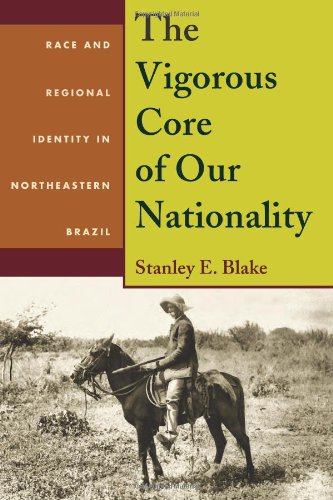
The Vigorous Core of Our Nationality: Race and Regional Identity in Northeastern Brazil

Posted in Anthropology, Books, Brazil, Caribbean/Latin America, History, Identity Development/Psychology, Media Archive, Monographs on 2012-04-25 01:05Z by Steven

The Vigorous Core of Our Nationality: Race and Regional Identity in Northeastern Brazil

University of Pittsburgh Press
March 2011
328 pages
6 x 9
Paper ISBN: 9780822961338

Stanley E. Blake, Assistant Professor of History
Ohio State University, Lima

The Vigorous Core of Our Nationality explores conceptualizations of regional identity and a distinct population group known as nordestinos in northeastern Brazil during a crucial historical period. Beginning with the abolition of slavery and ending with the demise of the Estado Novo under Getúlio Vargas, Stanley E. Blake offers original perspectives on the paradoxical concept of the nordestino and the importance of these debates to the process of state and nation building. Since colonial times, the Northeast has been an agricultural region based primarily on sugar production. The area’s population was composed of former slaves and free men of African descent, indigenous Indians, European whites, and mulattos. The image of the nordestino was, for many years, linked with the predominant ethnic group in the region, the Afro-Brazilian. For political reasons, however, the conception of the nordestino later changed to more closely resemble white Europeans. Blake delves deeply into local archives and determines that politicians, intellectuals, and other urban professionals formulated identities based on theories of science, biomedicine, race, and social Darwinism. While these ideas served political, social, and economic agendas, they also inspired debates over social justice and led to reforms for both the region and the people. Additionally, Blake shows how debates over northeastern identity and the concept of the nordestino shaped similar arguments about Brazilian national identity and “true” Brazilian people.

Contents

  • Preface
  • 1. Introduction: Nordeste and Nation
  • 2. The Nineteenth-Century Origins of the Nordestino, 1850–1870
  • 3. Racial Science in Pernambuco, 1870–1910
  • 4. The Medicalization of Nordestinos, 1910–1925
  • 5. Social Hygiene: The Science of Reform, 1925–1940
  • 6. Mental Hygiene: The Science of Character, 1925–1940
  • 7. Inventing the Homem de Nordeste: Race, Region, and the State, 1925–1940
  • Notes
  • Glossary
  • Bibliography
  • Index

In 1921, a future Brazilian bureaucrat named Agamemnon Magalhães asserted in a thesis written for an academic appointment that the northeastern region of Brazil was “a distinct ‘habitat,’ characterized by the rigor of its ecological conditions. Nature is reflected in man, imprinting his features, sculpting his form, forming his spirit.” Magalhães wrote about the Northeast and nordestinos, as peoples of the region were called, as if they had long been thought of as a distinct political and geographic region and people. This was most certainly not the case. Just six years before, in 1915, Brazilian geographers had gathered in Recife, the capital of the northeastern state of Pernambuco, for the Fourth Brazilian Congress of Geography. In the official sessions and papers presented there, geographers referred only to the “states of the North,” the “problem of the North,” and the “droughts of the North.” Magalhães also employed climatic, geographic, and racial determinism to describe nordestinos, calling them the product of interaction between rugged terrain, a harsh climate, and European, Indian, and African cultural and racial influences. Furthermore, he considered the peoples of the region to be “the producers of Brazilian nationality.” In other words, for Magalhães, the mixed-race nordestino was the quintessential Brazilian. This notion ran contrary to conventional wisdom. During Brazil’s First Republic (1889–1930), intellectuals and politicians advanced new understandings of Brazilian national identity that idealized European immigration and racial whitening…

Read the Introduction here.

Tags: , ,

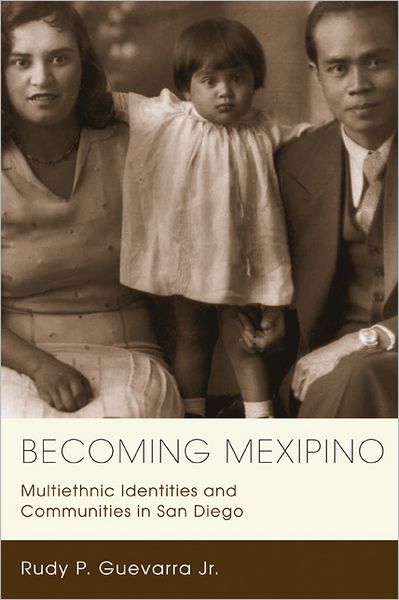
Becoming Mexipino: Multiethnic Identities and Communities in San Diego

Posted in Anthropology, Asian Diaspora, Books, History, Identity Development/Psychology, Latino Studies, Media Archive, Monographs, United States on 2012-04-24 12:19Z by Steven

Becoming Mexipino: Multiethnic Identities and Communities in San Diego

Rutgers University Press
June 2012
256 pages
Hardcover ISBN-13: 9780813552835, ISBN: 0813552834
Paperback ISBN-13: 9780813552842, ISBN: 0813552842

Rudy P. Guevarra, Jr., Associate Professor, Asian Pacific American Studies, School of Social Transformation, College of Liberal Arts and Sciences
Arizona State University, Tempe

Becoming Mexipino is a social-historical interpretation of two ethnic groups, one Mexican, the other Filipino, whose paths led both groups to San Diego, California. Rudy Guevarra traces the earliest interactions of both groups with Spanish colonialism to illustrate how these historical ties and cultural bonds laid the foundation for what would become close interethnic relationships and communities in twentieth-century San Diego as well as in other locales throughout California and the Pacific West Coast.

Through racially restrictive covenants and other forms of discrimination, both groups, regardless of their differences, were confined to segregated living spaces along with African Americans, other Asian groups, and a few European immigrant clusters. Within these urban multiracial spaces, Mexicans and Filipinos coalesced to build a world of their own through family and kin networks, shared cultural practices, social organizations, and music and other forms of entertainment. They occupied the same living spaces, attended the same Catholic churches, and worked together creating labor cultures that reinforced their ties, often fostering marriages. Mexipino children, living simultaneously in two cultures, have forged a new identity for themselves.  Their lives are the lens through which these two communities are examined, revealing the ways in which Mexicans and Filipinos interacted over generations to produce this distinct and instructive multiethnic experience. Using archival sources, oral histories, newspapers, and personal collections and photographs, Guevarra defines the niche that this particular group carved out for itself.

Tags: , , , , , ,

Sweeter the Juice: A Family Memoir in Black and White

Posted in Autobiography, Books, Media Archive, Monographs, United States, Women on 2012-04-24 04:10Z by Steven

Sweeter the Juice: A Family Memoir in Black and White

Simon & Schuster
January 1995
272 pages
ISBN-10: 0671899333
ISBN-13: 9780671899332

Shirlee Haizlip

The Sweeter the Juice is a provocative memoir that goes to the heart of our American identity. Shirlee Taylor Haizlip, in an effort to reconcile the dissonance between her black persona and her undeniably multiracial heritage, started on a journey of discovery that took her over thousands of miles and hundreds of years. While searching for her mother’s family, Haizlip confronted the deeply intertwined but often suppressed tensions between race and skin color.

We are drawn in by the story of an African-American family. Some members chose to “cross over” and “pass” for white while others enjoyed a successful black life. Their stories weave a tale of tangled ancestry, mixed blood, and identity issues from the 17th century to the present. The Sweeter the Juice is a memoir, a social history, a biography, and an autobiography. Haizlip gives to us the quintessential American story, unveiling truths about race, about our society, and about the ways in which we all perceive and judge one another.

Tags: , , ,

Navigating Interracial Borders: Black-White Couples and Their Social Worlds

Posted in Books, Family/Parenting, Media Archive, Monographs, Social Science, United States on 2012-04-20 02:28Z by Steven

Navigating Interracial Borders: Black-White Couples and Their Social Worlds

Rutgers University Press
2005-05-18
264 pages
Paper ISBN: 978-0-8135-3586-9
Cloth ISBN: 978-0-8135-3585-2
eBook ISBN: 978-0-8135-3757-3

Erica Chito Childs, Associate Professor of Sociology
Hunter College, City University of New York

Is love color-blind, or at least becoming increasingly so? Today’s popular rhetoric and evidence of more interracial couples than ever might suggest that it is. But is it the idea of racially mixed relationships that we are growing to accept or is it the reality? What is the actual experience of individuals in these partnerships as they navigate their way through public spheres and intermingle in small, close-knit communities?

In Navigating Interracial Borders, Erica Chito Childs explores the social worlds of black-white interracial couples and examines the ways that collective attitudes shape private relationships. Drawing on personal accounts, in-depth interviews, focus group responses, and cultural analysis of media sources, she provides compelling evidence that sizable opposition still exists toward black-white unions. Disapproval is merely being expressed in more subtle, color-blind terms.

Childs reveals that frequently the same individuals who attest in surveys that they approve of interracial dating will also list various reasons why they and their families wouldn’t, shouldn’t, and couldn’t marry someone of another race. Even college students, who are heralded as racially tolerant and open-minded, do not view interracial couples as acceptable when those partnerships move beyond the point of casual dating. Popular films, Internet images, and pornography also continue to reinforce the idea that sexual relations between blacks and whites are deviant.

Well-researched, candidly written, and enriched with personal narratives, Navigating Interracial Borders offers important new insights into the still fraught racial hierarchies of contemporary society in the United States.

Table of Contents

Acknowledgments
Introduction: The Interracial Canary
1. Loving across the Border: Through the Lens of Black-White Couples
2. Constructing Racial Boundaries and White Communities
3. Crossing Racial Boundaries and Black Communities
4. Families and the Color Line: Multiracial Problems for Black and White Families
5. Racialized Spaces: College Life in Black and White
6. Black_White.com: Surfing the Interracial Internet
7. Listening to the Interracial Canary
Appendix: Couples Interviewed
Notes
Bibliography
Index

Tags: ,

The Croatan Indians of Sampson County, North Carolina: Their Origin and Racial Status. A Plea for Separate Schools (Electronic Edition)

Posted in Books, History, Identity Development/Psychology, Media Archive, Monographs, Native Americans/First Nation, United States on 2012-04-20 00:41Z by Steven

The Croatan Indians of Sampson County, North Carolina: Their Origin and Racial Status. A Plea for Separate Schools (Electronic Edition)

The Seeman Printery, Durham, North Carolina
1916
65 pages

George Edwin Butler (1868-1941)

Text transcribed by Apex Data Services, Inc.
Images scanned by Tampathia Evans
Text encoded by Apex Data Services, Inc., Tampathia Evans and Jill Kuhn Sexton
First edition, 2002

CONTENTS

  • A Petition of the Indians of Sampson County
  • HISTORICAL SKETCH
    • Historical
    • The Croatans
    • White’s Lost Colony
    • Their Wanderings and Location
    • Political and Educational History
    • First Separate Schools for Croatans
    • Marriage with Negroes Forbidden
    • Separate Schools in Other Counties
    • Separate Schools in Sampson
    • Why the Indian School in Sampson was Repealed
    • Indian Tax Payers in Sampson
    • Easily Recognized as Indians
    • They Were Never Slaves
    • Formerly Eroneously Classed as Negroes
    • Laws of State Recognize Them as Separate Race
    • State Provides Colleges for Whites and Negroes but not for Indians
    • Indians Justly Proud of Their History
    • Better Educational Facilities Should be Provided
    • Indian Taxes in Sampson
    • Sampson Exceeds all Other Counties, Except Robeson, in Indian Polls and Property
    • Family Relationship Between Robeson and Sampson Croatans
    • New Bethel Indian School
    • Shiloh Indian School
    • The Indian Photographs and Pictures
  • SKETCH OF PROMINENT INDIAN FAMILIES OF SAMPSON
    • The Emanuel Family
    • The Maynor Family
    • The Brewington Family
    • The Jones Family
    • The Simmons Family
    • The Jacobs Family
    • Indian Families of Sampson

ILLUSTRATIONS

  • The Croatan Normal School at Pembroke Frontispiece
  • New Bethel Indian School
  • Shiloh Indian Sunday School
  • Jonah Manuel and Family
  • Enoch Manuel and Wife
  • William J. Bledsole and Wife
  • Luther Bledsole and Children and Henry Bledsole and Wife
  • Hardy A. Brewington
  • Group of Boys and Girls
  • Lee Locklear, Steve Lowrey, French Locklear
  • Levander Manuel
  • June Brewington
  • C. D. Brewington
  • Jonathan Goodman
  • William Simmons
  • Betsy J. Simmons
  • Enoch Manuel, Jr., and Family
  • Henry Bledsole and Wife

Read the entire book here.

Tags: , , ,

Biracial in America: Forming and Performing Racial Identity

Posted in Barack Obama, Books, Identity Development/Psychology, Media Archive, Monographs, Social Science, United States on 2012-04-16 01:17Z by Steven

Biracial in America: Forming and Performing Racial Identity

Lexington Books (a division Rowman & Littlefield publishing group)
2011-08-28
224 pages
Cloth ISBN: 0-7391-4574-6 / 978-0-7391-4574-6
Electronic ISBN: 0-7391-4576-2 / 978-0-7391-4576-0

Nikki Khanna, Associate Professor of Sociology
University of Vermont

Elected in 2008, Barack Obama made history as the first African American President of the United States. Though recognized as the son of his white Kansas-born mother and his Kenyan father, the media and public have nonetheless pigeonholed him as black, and he too self-identifies as such. Obama’s experiences as a biracial American with black and white ancestry, although compelling because of his celebrity, however, is not unique and raises several questions about the growing number of black-white biracial Americans today: How are they perceived by others with regard to race? How do they tend to identify? And why? Taking a social psychological approach, this book identifies influencing factors and several underlying processes shaping racial identity. Unlike previous studies which examine racial identity as if it was a one-dimensional concept, this book examines two dimensions of identity—a public dimension (how they identify themselves to others) and an internalized dimension (how they see themselves internally)—noting that both types of identity may not mesh, and in fact, they may be quite different from one another. Moreover, this study investigates the ways in which biracial Americans perform race in their day-to-day lives. One’s race isn’t simply something that others prescribe onto the individual, but something that individuals “do.” The strategies and motivations for performing black, white, and biracial identities are explored.

Table of Contents

  • Chapter 1: Questions of Identity
  • Chapter 2: Black and White in America: Then and Now
  • Chapter 3: Through the “Looking Glass”: Reflected Appraisals and the One Drop Rule
  • Chapter 4: The Push and Pull of Day-to-Day Interactions
  • Chapter 5: Social Comparisons and Social Networks
  • Chapter 6: Identity Work: Strategies and Motivations
  • Chapter 7: Concluding Thoughts
Tags: ,

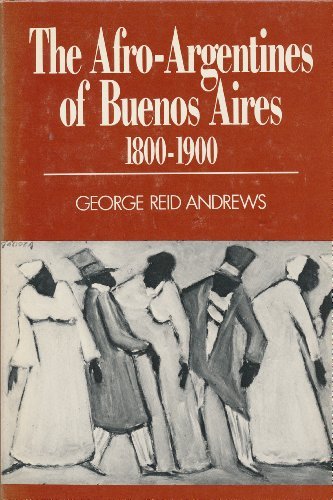
The Afro-Argentines of Buenos Aires, 1800–1900

Posted in Books, Caribbean/Latin America, History, Media Archive, Monographs on 2012-04-08 22:10Z by Steven

The Afro-Argentines of Buenos Aires, 1800–1900

University of Wisconsin Press
November 1980
308 pages
6 x 9, 15 illus. or photos, several tables
ISBN-10: 0299082903
ISBN-13: 978-0299082901

George Reid Andrews, Distinguished Professor of History
University of Pittsburgh

George Reid Andrews has given us a major revision and reconstruction of black history in Argentina since the time of independence, making an exciting and important contribution to both Latin American and Afro-American history. Along the way, he explodes long-held myths, solves a major historical mystery, and documents contributions of blacks to a society that has, in its pursuit of “whiteness,” virtually denied their existence.

While historians have devoted much attention to Afro-Latin American slavery of the colonial period, Andrews is among the first to examine the history of the post-abolition period. He illuminates the social, economic, and political roles of black people in the evolving societies of the national period, effectively destroying the myths that the Afro-Argentines virtually disappeared over the course of a century, that they played no significant role in Argentine history after the independence, and that they were quietly and peacefully integrated into the larger society. While similar studies have been carried out for the black experience in the United States, this is the first such attempt for any Spanish American country.

Tags: , , , , ,

Afro-Latin America, 1800-2000

Posted in Books, Caribbean/Latin America, History, Media Archive, Monographs, Slavery on 2012-04-08 20:24Z by Steven

Afro-Latin America, 1800-2000

Oxford University Press
May 2004
304 pages
15 illus. & 3 maps; 6-1/8 x 9-1/4
Hardback ISBN13: 9780195152326; ISBN10: 0195152328
Paperback ISBN13: 978-0-19-515233-3; ISBN10: 0-19-515233-6

George Reid Andrews, Distinguished Professor of History
University of Pittsburgh

Winner of the Arthur P. Whitaker Prize of the Middle Atlantic Council of Latin American Studies

While the rise and abolition of slavery and ongoing race relations are central themes of the history of the United States, the African diaspora actually had a far greater impact on Latin and Central America. More than ten times as many Africans came to Spanish and Portuguese America as the United States.

In this, the first history of the African diaspora in Latin America from emancipation to the present, George Reid Andrews deftly synthesizes the history of people of African descent in every Latin American country from Mexico and the Caribbean to Argentina. He examines how African peoples and their descendants made their way from slavery to freedom and how they helped shape and responded to political, economic, and cultural changes in their societies. Individually and collectively they pursued the goals of freedom, equality, and citizenship through military service, political parties, civic organizations, labor unions, religious activity, and other avenues.

Spanning two centuries, this tour de force should be read by anyone interested in Latin American history, the history of slavery, and the African diaspora, as well as the future of Latin America.

Table of Contents

  • Introduction
  • Chapter 1: i8oo
  • Chapter 2: “An Exterminating Bolt of Lightning”: The Wars for Freedom, 1810-1890
  • Chapter 3: “Our New Citizens, the Blacks”: The Politics of Freedom, 1810-1890
  • Chapter 4: “A Transfusion of New Blood”: Whitening, 1880-1930
  • Chapter 5: Browning and Blackening, 1930-2000
  • Chapter 6: Into the Twenty-First Century: 2000 and Beyond
  • Appendix: Population Counts, 1800-2000
  • Glossary
  • Notes
  • Selected Bibliography
  • Index
Tags: , , ,

Before Haiti: Race and Citizenship in French Saint-Domingue

Posted in Books, Caribbean/Latin America, History, Media Archive, Monographs, Slavery on 2012-04-04 23:23Z by Steven

Before Haiti: Race and Citizenship in French Saint-Domingue

Palgrave Macmillan
June 2006
408 pages
5 1/2 x 8 1/4 inches
Hardcover ISBN: 978-1-4039-7140-1, ISBN10: 1-4039-7140-4
Trade Paperback ISBN: 978-0-230-10837-0, ISBN10: 0-230-10837-7

John D. Garrigus, Associate Professor of History
University of Texas, Arlington


Winner of the Society for French Historical Studies 2007 Gilbert Chinard Prize!

In 1804 French Saint-Domingue became the independent nation of Haiti after the only successful slave uprising in world history. When the Haitian Revolution broke out, the colony was home to the largest and wealthiest free population of African descent in the New World. Before Haiti explains the origins of this free colored class, exposes the ways its members both supported and challenged slavery, and examines how they created their own New World identity in the years from 1760 to 1804.

Table of Contents

  • The Development of Creole Society on the Colonial Frontier
  • Race and Class in Creole Society: Saint-Domingue in the 1760s
  • Freedom, Slavery, and the French Colonial State
  • Reform and Revolt after the Seven Years’ War
  • Citizenship and Racism in the New Republic Sphere
  • The Rising Economic Power of Free People of Color in the 1780s
  • Proving Free Colored Virtue
  • Free People of Color in the Southern Peninsula and the Origins of the Haitain Revolution
  • Revolution and Republicanism in Aquin Parish
Tags: , , , ,