Uneven Encounters: Making Race and Nation in Brazil and the United States

Posted in Anthropology, Books, Brazil, Caribbean/Latin America, Media Archive, Monographs, United States on 2012-11-23 16:31Z by Steven

Uneven Encounters: Making Race and Nation in Brazil and the United States

Duke University Press
2009
408 pages
19 photographs
Paperback ISBN: 978-0-8223-4440-7
Hardback ISBN: 978-0-8223-4426-1

Micol Seigel, Associate Professor of African-American and African Diaspora Studies
Indiana University

In Uneven Encounters, Micol Seigel chronicles the exchange of popular culture between Brazil and the United States in the years between the World Wars, and demonstrates how that exchange affected ideas of race and nation in both countries. From Americans interpreting advertisements for Brazilian coffee or dancing the Brazilian maxixe, to Rio musicians embracing the “foreign” qualities of jazz, Seigel traces a lively, cultural back and forth. Along the way, she shows how race and nation for both elites and non-elites are constructed together, and driven by global cultural and intellectual currents as well as local, regional, and national ones.

Seigel explores the circulation of images of Brazilian coffee and of maxixe in the United States during the period just after the imperial expansions of the early twentieth century. Exoticist interpretations structured North Americans’ paradoxical sense of themselves as productive “consumer citizens.” Some people, however, could not simply assume the privileges of citizenship. In their struggles against racism, Afro-descended citizens living in Rio de Janeiro, São Paulo, New York, and Chicago encountered images and notions of each other, and found them useful. Seigel introduces readers to cosmopolitan Afro-Brazilians and African Americans who rarely traveled far from home but who nonetheless absorbed ideas from abroad. She suggests that studies comparing U.S. and Brazilian racial identities as two distinct constructions are misconceived. Racial formation transcends national borders; attempts to understand it must do the same.

Table of Contents

  • Illustrations
  • Preface
  • Note on Language
  • Acknowledgments
  • Introduction
  • 1. Producing Consumption: Coffee and Consumer Citizenship
  • 2. Maxixe’s Travels: Cultural Exchange and Erasure
  • 3. Playing Politics: Making the Meanings of Jazz in Rio de Janeiro
  • 4. Nation Drag: Uses of the Exotic
  • 5. Another “Global Vision”: (Trans)Nationalism in the Sao Paulo Black Press
  • 6. Black Mothers, Citizen Sons
  • Conclusion
  • Abbreviations
  • Notes
  • Discography
  • Bibliography
  • Index
Tags: ,

“At This Defining Moment”: Barack Obama’s Presidential Candidacy and the New Politics of Race

Posted in Barack Obama, Books, Media Archive, Monographs, Politics/Public Policy, Social Science, United States on 2012-11-14 17:41Z by Steven

“At This Defining Moment”: Barack Obama’s Presidential Candidacy and the New Politics of Race

New York University Press
October 2011
229 pages
Hardback ISBN: 9780814752975
Paperback ISBN: 9780814752982

Enid Lynette Logan, Associate Professor of Sociology
University of Minnesota, Minneapolis

In January 2009, Barack Obama became the 44th president of the United States.  In the weeks and months following the election, as in those that preceded it, countless social observers from across the ideological spectrum commented upon the cultural, social and political significance of “the Obama phenomenon.” In “At this Defining Moment,” Enid Logan provides a nuanced analysis framed by innovative theoretical insights to explore how Barack Obama’s presidential candidacy both reflected and shaped the dynamics of race in the contemporary United States.

Using the 2008 election as a case study of U.S. race relations,  and based on a wealth of empirical data that includes an analysis of over 1,500 newspaper articles, blog postings, and other forms of public speech collected over a 3 year period, Logan claims that while race played a central role in the 2008 election, it was in several respects different from the past. Logan ultimately concludes that while the selection of an individual African American man as president does not mean that racism is dead in the contemporary United States, we must also think creatively and expansively about what the election does mean for the nation and for the evolving contours of race in the 21st century.  

Contents

  • Acknowledgments
  • 1. Introduction: The Landscape of Race in the 21st Century
  • 2. Post-race American Triumphalism and the Entrenchment of Colorblind Racial Ideology
  • 3. Rooted in the Black Community but Not Limited to It: The Perils and Promises of the New Politics of Race
  • 4. Contesting Gender and Race in the 2008 Democratic Primary
  • 5. The Trope of Race in Obama’s America
  • 6. Asian and Latino Voters in the 2008 Election: The Politics of Color in the Racial Middle
  • 7. In Defense of the White Nation: The Modern Conservative Movement and the Discourse of Exclusionary Nationalism
  • 8. Racial Politics under the First Black President
  • Notes
  • References
  • Index
  • About the Author
Tags: , , ,

Afro-Brazilians: Cultural Production in a Racial Democracy

Posted in Anthropology, Books, Brazil, Caribbean/Latin America, History, Literary/Artistic Criticism, Media Archive, Monographs on 2012-11-06 02:33Z by Steven

Afro-Brazilians: Cultural Production in a Racial Democracy

University of Rochester Press (an imprint of Boydell & Brewer)
2009-04-01
443 pages
9 x 6
Hardback ISBN: 9781580462624
eBook ISBN: 9781580467100

Niyi Afolabi, Professor of African & African Diaspora Studies
University of Texas, Austin

Brazil, the most racially diverse Latin American country, is also the most contradictory: for centuries it has maintained fantasy as reality through the myth of racial democracy. Enshrined in that mythology is the masking of exclusionism that strategically displaces and marginalizes Afro-Brazilians from political power.

In this absorbing new study, Niyi Afolabi exposes the tensions between the official position on racial harmony and the reality of marginalization experienced by Afro-Brazilians by exploring Afro-Brazilian cultural production as a considered response to this exclusion. The author examines major contributions in music, history, literature, film, and popular culture in the nineteenth and twentieth centuries to reveal how each performance by an Afro-Brazilian artist addresses issues of identity and racism through a variety of veils that entertain, ridicule, invoke, provoke, protest, and demand change at the same time.

Raising cogent questions such as the vital role of Afro-Brazilians in the making of Brazilian national identity; the representation of Brazilian women as hapless, exploited, and abandoned; the erosion of the influence of black movements due to fragmentation and internal disharmony; and the portrayal of Afro-Brazilians on the national screen as domestics, Afolabi provides insightful, nuanced analyses that tease out the complexities of the dilemma in their appropriate historical, political, and social contexts.

Contents

  1. Negotiating Cultural Production in a Racial Democracy
  2. Two Faces of Racial Democracy
  3. Quilombhoje as a Cultural Collective
  4. Beyond the Curtains: Unveiling Afro-Brazilian Women Writers
  5. (Un)Broken Linkages
  6. The Tropicalist Legacy of Gilberto Gil
  7. Afro-Brazilian Carnival
  8. Film and Fragmentation
  9. Ancestrality and the Dynamics of Afro-Modernity
  10. The Forerunners of Afro-Modernity
  11. (Un)Transgressed Tradition
  12. Ancestrality, Memory, and Citizenship
  13. Quilombo without Frontiers
  14. Ancestral Motherhood of Leci Brandao
  15. The Future of Afro-Brazilian Cultural Production
Tags: , ,

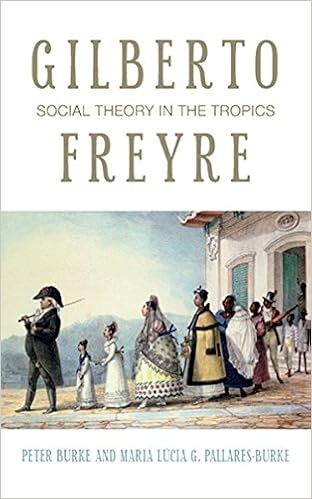
Gilberto Freyre: Social Theory in the Tropics

Posted in Biography, Books, Brazil, Caribbean/Latin America, History, Media Archive, Monographs, Social Science on 2012-10-26 02:48Z by Steven

Gilberto Freyre: Social Theory in the Tropics

Peter Lang
2008
261 pages
Hardcover ISBN: 978-1-906165-09-3
Softcover ISBN: 978-1-906165-04-8

Peter Burke
University of Cambridge

Maria Lúcia G. Pallares-Burke
Centre for Latin American Studies
University of Cambridge

Gilberto Freyre was arguably the most famous intellectual of twentieth-century Latin America. He was active as a sociologist, a historian, a journalist, a deputy in the Brazilian Assembly, a novelist, poet and artist. He was a cultural critic, with a good deal to say about architecture, past and present, and a public intellectual, whose pronouncements on race, region and empire – not to mention sex – made him famous in some quarters and notorious in others.

The Masters and the Slaves, his most famous work, went through forty editions and has been translated into nine languages, made into a comic book and a television miniseries, while two directors (one of them Robert Rossellini) planned to turn it into a film. Yet he is not well known outside Brazil. Freyre was a major social thinker, one of the few who have not come from Western Europe or the USA, and this book argues that we should take account of the pioneering work of this gifted intellectual. His ideas are of particular relevance today for both political and academic reasons. His interest in gender, ethnicity, hybridity, identity, globalization, and capitalism ensures that his ideas are still provocative and topical, and ready to be introduced to a wider audience.

Contents

  • The Importance Of Being Gilberto
  • Portrait of the Artist as a Young Man
  • Masters and Slaves
  • A Public Intellectual
  • Empire and Republic
  • The Social Theorist
  • Gilberto Our Contemporary
Tags: , , ,

Race, Religion and Law in Colonial India: Trials of an Interracial Family

Posted in Asian Diaspora, Books, History, Law, Media Archive, Monographs on 2012-10-26 01:57Z by Steven

Race, Religion and Law in Colonial India: Trials of an Interracial Family

Cambridge University Press
November 2011
286 pages
6 b/w illus. 3 maps
228 x 152 mm; 0.51kg
Hardback ISBN: 9781107012615
Adobe eBook ISBN: 9781139181242
Mobipocket eBook: ISBN:9781139184861

Chandra Mallampalli, Associate Professor of History
Westmont College, Santa Barbara, California

How did British rule in India transform persons from lower social classes? Could Indians from such classes rise in the world by marrying Europeans and embracing their religion and customs? This book explores such questions by examining the intriguing story of an interracial family who lived in southern India in the mid-nineteenth century. The family, which consisted of two untouchable brothers, both of whom married Eurasian women, became wealthy as distillers in the local community. When one brother died, a dispute arose between his wife and brother over family assets, which resulted in a landmark court case, Abraham v. Abraham. It is this case which is at the center of this book, and which Chandra Mallampalli uses to examine the lives of those involved and, by extension, of those – 271 witnesses in all – who testified. In its multilayered approach, the book sheds light not only on interracial marriage, class, religious allegiance, and gender, but also on the British encounter with Indian society. It shows that far from being products of a “civilizing mission” who embraced the ways of Englishmen, the Abrahams were ultimately – when faced with the strictures of the colonial legal system – obliged to contend with hierarchy and racial difference.

Features

  • A singular court case from the nineteenth century is at the heart of this intriguing book on race and hierarchy in colonial India
  • A rich and engaging multi-layered approach which interrogates legal documents and interviews with witnesses to unveil social history of the period
  • For students and scholars of colonial India, and legal and social historians

Table of Contents

  • Introduction
  • 1. Remembering family
  • 2. Embodying ‘Dora-hood’: the brothers and their business
  • 3. A crisis of trust: sedition and the sale of arms in Kurnool
  • 4. Letters from Cambridge
  • 5. The path to litigation
  • 6. Litigating gender and race: Charlotte sues at Bellary
  • 7. Francis appeals: the case for continuity
  • 8. Choice, identity, and law: the decision of London’s Privy Council.
Tags: , ,

Blackface Cuba, 1840-1895

Posted in Books, Caribbean/Latin America, Literary/Artistic Criticism, Media Archive, Monographs on 2012-10-25 16:52Z by Steven

Blackface Cuba, 1840-1895

University of Pennsylvania Press
2005
288 pages
6 x 9
Cloth ISBN: 978-0-8122-3867-9

Jill Lane, Associate Professor of  Theater and Performance Studies
New York University

Blackface Cuba, 1840-1895 offers a critical history of the relation between racial impersonation, national sentiment, and the emergence of an anticolonial public sphere in nineteenth-century Cuba. Through a study of Cuba’s vernacular theatre, the teatro bufo, and of related forms of music, dance, and literature, Lane argues that blackface performance was a primary site for the development of mestizaje, Cuba’s racialized national ideology, in which African and Cuban become simultaneously mutually exclusive and mutually formative.

Popular with white Cuban-born audiences during the period of Cuba’s anticolonial wars, the teatro bufo was celebrated for combining Spanish elements with supposedly African rhythms and choreography. Its wealth of short comic plays developed a well-loved repertory of blackface stock characters, from the negrito to the mulata, played by white actors in blackface. Lane contends that these practices were embraced by white audiences as especially national forms that helped define Cuba’s opposition to Spain, at the same time that they secured prevailing racial hierarchies for a future Cuban nation. Comparing the teatro bufo to related forms of racial representation, particularly those created by black Cubans in theatres and in the press, Lane analyzes performance as a form of social contestation through which an emergent Cuban national community struggled over conflicting visions of race and nation.

Table of Contents

  • Preface. On the Translation of Race
  • Introduction. ImpersoNation in Our America
  • Chapter 1. Blackface Costumbrismo, 1840-1860
  • Chapter 2. Anticolonial Blackface, 1868
  • Chapter 3. Black(face) Public Spheres, 1880-1895
  • Chapter 4. National Rhythm, Racial Adulteration, and the Danzón, 1881-82
  • Chapter 5. Racial Ethnography and Literate Sex, 1888
  • Conclusion. Cubans on the Moon, and Other Imagined Communities
  • Notes
  • Bibliography
  • Index
  • Acknowledgments
Tags: , ,

Master of the Mountain: Thomas Jefferson and His Slaves

Posted in Biography, Books, History, Media Archive, Monographs, Slavery, United States, Virginia on 2012-10-19 21:34Z by Steven

Master of the Mountain: Thomas Jefferson and His Slaves

Farrar, Straus and Giroux an imprint of Macmillan
2012-10-16
352 pages
Hardback ISBN-10: 0374299560; ISBN-13: 978-0374299569

Henry Wiencek

Is there anything new to say about Thomas Jefferson and slavery? The answer is a resounding yes. Master of the Mountain, Henry Wiencek’s eloquent, persuasive book—based on new information coming from archaeological work at Monticello and on hitherto overlooked or disregarded evidence in Jefferson’s papers—opens up a huge, poorly understood dimension of Jefferson’s world. We must, Wiencek suggests, follow the money.

So far, historians have offered only easy irony or paradox to explain this extraordinary Founding Father who was an emancipationist in his youth and then recoiled from his own inspiring rhetoric and equivocated about slavery; who enjoyed his renown as a revolutionary leader yet kept some of his own children as slaves. But Wiencek’s Jefferson is a man of business and public affairs who makes a success of his debt-ridden plantation thanks to what he calls the “silent profits” gained from his slaves—and thanks to a skewed moral universe that he and thousands of others readily inhabited. We see Jefferson taking out a slave-equity line of credit with a Dutch bank to finance the building of Monticello and deftly creating smoke screens when visitors are dismayed by his apparent endorsement of a system they thought he’d vowed to overturn. It is not a pretty story. Slave boys are whipped to make them work in the nail factory at Monticello that pays Jefferson’s grocery bills. Parents are divided from children—in his ledgers they are recast as money—while he composes theories that obscure the dynamics of what some of his friends call “a vile commerce.”

Many people of Jefferson’s time saw a catastrophe coming and tried to stop it, but not Jefferson. The pursuit of happiness had been badly distorted, and an oligarchy was getting very rich. Is this the quintessential American story?

The thunderstorm that shook the mountain during the telling of Peter Fossett’s story passed. We tourists were deposited back into the present, with shafts of sunlight illuminating a peaceful scene–a broad pathway stretching into the distance, disappearing over the curve of the hillside. Jefferson named it Mulberry Row for the fast-growing shade trees he planted here in the 1790s. One thousand yards long, it was the main street of the African-American hamlet atop Monticello Mountain. The plantation was a small town in everything but name, not just because of its size, but in its complexity. Skilled artisans and house slaves occupied cabins on Mulberry Row alongside hired white workers; a few slaves lived in rooms in the mansion’s south dependency wing; some slept where they worked. Most of Monticello’s slaves lived in clusters of cabins scattered down the mountain and on outlying farms. In his lifetime Jefferson owned more than 600 slaves. At any one time about 100 slaves lived on the mountain; the highest slave population, in 1817, was 140…

…Jefferson made his emancipation proposal around the same time he took on an intriguing legal case, Howell v. Netherland, that illuminates the shifting, increasingly ambiguous racial borderland in colonial Virginia, where strict enforcement of racial laws could have the effect of making white people black.

In the winter of 1769, Samuel Howell, a mixed-race indentured servant who had escaped from his master, sought a lawyer in Williamsburg to represent him in suing for freedom. His grandmother was a free white woman, but his grandfather was black, so Howell had become entrapped in a law that prescribed indentured servitude to age thirty-one for certain mixed-race people “to prevent that abominable mixture of white men or women with negroes or mulattoes.” Howell, aged twenty-seven, was not indentured forever, since he would be freed in about four years, but nonetheless Jefferson felt angry enough over this denial of rights that he took Howell’s case pro bono.

Jefferson later became famous for his diatribes against racial mixing, but his arguments on behalf of Howell, made more than a decade before he wrote down his infamous racial theories, suggest that the younger Jefferson harbored doubts about the supposed “evil” of miscegenation. The word “seems” in the following sentence suggests that he did not quite accept the prevailing racial ideology: “The purpose of the act was to punish and deter women from that confusion of species, which the legislature seems to have considered as an evil.”

Having just one black grandparent, Howell probably appeared very nearly white. But with the full knowledge that Howell had African blood, Jefferson argued to the justices that he should be immediately freed. He made his case partly on a strict reading of the original law, which imposed servitude only on the first generation of mixed-race children and could not have been intended, Jefferson argued, “to oppress their innocent offspring.” He continued: “it remains for some future legislature, if any shall be found wicked enough, to extend [the punishment of servitude] to the grandchildren and other issue more remote.” Jefferson went further, declaring to the court: “Under the law of nature, all men are born free,” a concept he derived from his reading of John Locke and other Enlightenment thinkers, the concept that would later form the foundation of the Declaration of Independence. In the Howell case, Jefferson deployed it in defense of a man of African descent…

Read the entire excerpt here.

Tags: , ,

American Dilemma: The Negro problem and Modern Democracy

Posted in Anthropology, Books, Health/Medicine/Genetics, History, Law, Media Archive, Monographs, Passing, Politics/Public Policy, Religion, Slavery, Social Science, United States on 2012-10-08 17:31Z by Steven

American Dilemma: The Negro problem and Modern Democracy

Harper and Brothers Publishing
1944
822 pages

Gunnar Myrdal (1898-1987)

With the Assistance of

Richard Sterner and Arnold Rose

This landmark effort to understand African-American people in the New World provides deep insight into the contradictions of American democracy as well as a study of a people within a people. The touchstone of this classic is the jarring discrepancy between the American creed of respect for the inalienable rights to freedom, justice, and opportunity for all and the pervasive violations of the dignity of blacks.

CONTENTS

  • Foreword, by Frederick P. Keppel
  • Author’s Preface
  • Introduction
    1. The Negro Problem as a Moral Issue
    2. Valuations and Beliefs
    3. A White Man’s Problem
    4. Not an Isolated Problem
    5. Some Further Notes on the Scope and Direction of This Study
    6. A Warning to the Reader
  • PART I. THE APPROACH
    • Chapter 1. American Ideals and the American Conscience
      1. Unity of Ideals and Diversity of Culture
      2. American Nationalism
      3. Some Historical Reflections
      4. The Roots of the American Creed in the Philosophy of Enlightenment
      5. The Roots in Christianity
      6. The Roots in English Law
      7. American Conservatism
      8. The American Conception of Law and Order
      9. Natural Law and American Puritanism
      10. The Faltering Judicial Order
      11. Intellectual Defeatism
      12. “Lip-Service”
      13. Value Premises in This Study
    • Chapter 2. Encountering the Negro Problem
      1. On the Minds of the Whites
      2. To the Negroes Themselves
      3. Explaining the Problem Away
      4. Explorations in Escape
      5. The Etiquette of Discussion
      6. The Convenience of Ignorance
      7. Negro and White Voices
      8. The North and the South
    • Chapter 3. Facets of the Negro Problem
      1. American Minority Problems
      2. The Anti-Amalgamation Doctrine
      3. The White Man’s Theory of Color Caste
      4. The “Rank Order of Discriminations”
      5. Relationships between Lower Class Groups
      6. The Manifoldness and the Unity of the Negro Problem
      7. The Theory of the Vicious Circle
      8. A Theory of Democracy
  • PART II. RACE
    • Chapter 4. Racial Beliefs
      1. Biology and Moral Equalitarianism
      2. The Ideological Clash in America
      3. The Ideological Compromise
      4. Reflections in Science
      5. The Position of the Negro Writers
      6. The Racial Beliefs of the Unsophisticated
      7. Beliefs with a Purpose
      8. Specific Rationalization Needs
      9. Rectifying Beliefs
      10. The Study of Beliefs
    • Chapter 5. Race and Ancestry
      1. The American Definition of “Negro”
      2. African Ancestry
      3. Changes in Physical Appearance
      4. Early Miscegenation
      5. Ante-Bellum Miscegenation
      6. Miscegenation in Recent Times
      7. Passing
      8. Social and Biological Selection
      9. Present and Future Genetic Composition Trends
    • Chapter 6. Racial Characteristics
      1. Physical Traits
      2. Biological Susceptibility to Disease
      3. Psychic Traits
      4. Frontiers of Constructive Research
  • PART III. POPULATION AND MIGRATION
    • Chapter 7. Population
      1. The Growth of the Negro Population
      2. Births and Deaths
      3. Summary
      4. Ends and Means of Population Policy
      5. Controlling the Death Rate
      6. The Case for Controlling the Negro Birth Rate
      7. Birth Control Facilities Tor Negroes
    • Chapter 8. Migration
      1. Overview
      2. A Closer View
      3. The Great Migration to the Urban North
      4. Continued Northward Migration
      5. The Future of Negro Migration
  • PART IV. ECONOMICS
    • Chapter 9. Economic Inequality
      1. Negro Poverty
      2. Our Main Hypothesis: The Vicious Circle
      3. The Value Premises
      4. The Conflict of Valuations
    • Chapter 10. The Tradition of Slavery
      1. Economic Exploitation
      2. Slavery and Caste
      3. The Land Problem
      4. The Tenancy Problem
    • Chapter 11. The Southern Plantation Economy and the Negro Farmer
      1. Southern Agriculture as a Problem
      2. Overpopulation and Soil Erosion
      3. Tenancy, Credit and Cotton
      4. The Boll Weevil
      5. Main Agricultural Classes
      6. The Negro Landowner
      7. Historical Reasons for the Relative Lack of Negro Farm Owners
      8. Tenants and Wage Laborers
      9. The Plantation Tenant
    • Chapter 12. New Blows to Southern Agriculture During the Thirties: Trends and Policies
      1. Agricultural Trends during the ‘Thirties
      2. The Disappearing Sharecropper
      3. The Role of the A.A.A. in Regard to Cotton
      4. A.A.A. and the Negro
      5. The Local Administration of the A.A.A.
      6. Mechanization
      7. Labor Organizations
      8. The Dilemma of Agricultural Policy
      9. Economic Evaluation of the A.A.A.
      10. Social Evaluation of the A.A.A.
      11. Constructive Measures
      12. Farm Security Programs
    • Chapter 13. Seeking Jobs Outside Agriculture
      1. Perspective on the Urbanization of the Negro People
      2. In the South
      3. A Closer View
      4. Southern Trends during the Thirties
      5. In the North
      6. A Closer View on Northern Trends
      7. The Employment Hazards of Unskilled Work
      8. The Size of the Negro Labor Force and Negro Employment
      9. Negro and White Unemployment
    • Chapter 14. The Negro in Business, the Professions, Public Service and Other White Collar Occupations
      1. Overview
      2. The Negro in Business
      3. Negro Finance
      4. The Negro Teacher
      5. The Negro Minister
      6. The Negro in Medical Professions
      7. Other Negro Professionals
      8. Negro Officials and White Collar Workers in Public Service
      9. Negro Professionals on the Stage, Screen and Orchestra
      10. Note on Shady Occupations
    • Chapter 15. The Negro in the Public Economy
      1. The Public Budget
      2. Discrimination in Public Service
      3. Education
      4. Public Health
      5. Recreational Facilities
      6. Public Housing Policies
      7. Social Security and Public Assistance
      8. Specialized Social Welfare Programs during the Period After
      9. The Social Security Program
      10. Assistance to Special Groups
      11. Work Relief
      12. Assistance to Youth
      13. General Relief and Assistance in Kind
    • Chapter 16. Income, Consumption and Housing
      1. Family Income
      2. Income and Family Size
      3. The Family Budget
      4. Budget Items
      5. Food Consumption
      6. Housing Conditions
    • Chapter 17. The Mechanics of Economic Discrimination as a Practical Problem
      1. The Practical Problem
      2. The Ignorance and Lack of Concern of Northern Whites
      3. Migration Policy
      4. The Regular Industrial Labor Market in the North
      5. The Problem of Vocational Training
      6. The Self-Perpetuating Color Bar
      7. A Position or “Indifferent Equilibrium”
      8. In the South
    • Chapter 18. Pre-War Labor Market Controls and Their Consequences for the Negro
      1. The Wages and Hours Law and the Dilemma of the Marginal Worker
      2. Other Economic Policies
      3. Labor Unions and the Negro
      4. A Weak Movement Getting Strong Powers
    • Chapter 19. The War Boom—and Thereafter
      1. The Negro Wage Earner and the War Boom
      2. A Closer View
      3. Government Policy in Regard to the Negro in War Production
      4. The Negro in the Armed Forces
      5. …And Afterwards?
  • PART V. POLITICS
    • Chapter 20. Underlying Factors
      1. The Negro in American Politics and as a Political Issue
      2. The Wave of Democracy and the Need for Bureaucracy
      3. The North and the South
      4. The Southern Defense Ideology
      5. The Reconstruction Amendments
      6. Memories of Reconstruction
      7. The Tradition of Illegality
    • Chapter 21. Southern Conservatism and Liberalism
      1. The “Solid South”
      2. Southern Conservatism
      3. Is the South Fascist?
      4. The Changing South
      5. Southern Liberalism
    • Chapter 22. Political Practices Today
      1. The Southern Political Scene
      2. Southern Techniques for Disfranchising the Negroes
      3. The Negro Vote m the South
      4. The Negro in Northern Politics
      5. What the Negro Gets Out of Politics
    • Chapter 23. Trends and Possibilities
      1. The Negro’s Political Bargaining Power
      2. The Negro’s Party Allegiance
      3. Negro Suffrage in the South as an Issue
      4. An Unstable Situation
      5. The Stake of the North
      6. Practical Conclusions
  • PART VI. JUSTICE
    • Chapter 24. Inequality of Justice
      1. Democracy and Justice
      2. Relative Equality in the North
      3. The Southern Heritage
    • Chapter 25. The Police and Other Public Contacts
      1. Local Petty Officials
      2. The Southern Policeman
      3. The Policeman in the Negro Neighborhood
      4. Trends and Outlook
      5. Another Type of Public Contact
    • Chapter 26. Courts, Sentences and Prisons
      1. The Southern Courts
      2. Discrimination in Court
      3. Sentences and Prisons
      4. Trends and Outlook
    • Chapter 27. Violence and Intimidation
      1. The Pattern of Violence
      2. Lynching
      3. The Psychopathology of Lynching
      4. Trends and Outlook
      5. Riots
  • PART VII. SOCIAL INEQUALITY
    • Chapter 28. The Basis of Social Inequality
      1. The Value Premise
      2. a. The One-Sidedness of the System of Segregation
      3. The Beginning in Slavery
      4. The Jim Crow Laws
      5. Beliefs Supporting Social Inequality
      6. The Popular Theory of “No Social Equality”
      7. Critical Evaluation of the “No Social Equality” Theory
      8. Attitudes among Different Classes of Whites in the South
      9. Social Segregation and Discrimination in the North
    • Chapter 29. Patterns of Social Segregation and Discrimination
      1. Facts and Beliefs Regarding Segregation and Discrimination
      2. Segregation and Discrimination in interpersonal Relations
      3. Housing Segregation
      4. Sanctions for Residential Segregation
      5. The General Character of Institutional Segregation
      6. Segregation in Specific Types of Institutions
    • Chapter 30. Effects of Social Inequality
      1. The Incidence of Social Inequality
      2. Increasing Isolation
      3. Interracial Contacts
      4. The Factor of Ignorance
      5. Present Dynamics
  • PART VIII. SOCIAL STRATIFICATION
    • Chapter 31. Caste and Class
      1. The Concepts “Caste” and “Class”
      2. The “Meaning” of the Concepts “Caste” and “Class”
      3. The Caste Struggle
      4. Crossing the Caste Line
    • Chapter 32. The Negro Class Structure
      1. The Negro Class Order in the American Caste System
      2. Caste Determines Class
      3. Color and Class
      4. The Classes in the Negro Community
  • PART IX. LEADERSHIP AND CONCERTED ACTION
    • Chapter 33. The American Pattern of Individual Leadership and Mass Passivity
      1. “Intelligent Leadership”
      2. “Community Leaders”
      3. Mass Passivity
      4. The Patterns Exemplified in Politics and throughout the American Social Structure
    • Chapter 34. Accommodating Leadership
      1. Leadership and Caste
      2. The Interests of Whites and Negroes with Respect to Negro leadership
      3. In the North and on the National Scene
      4. The “Glass Plate”
      5. Accommodating Leadership and Class
      6. Several Qualifications
      7. Accommodating Leaders in the North
      8. The Glamour Personalities
    • Chapter 35. The Negro Protest
      1. The Slave Revolts
      2. The Negro Abolitionists and Reconstruction Politicians
      3. The Tuskegee Compromise
      4. The Spirit of Niagara and Harper’s Ferry
      5. The Protest Is Still Rising
      6. The Shock of the First World War and the Post-War Crisis
      7. The Garvey Movement
      8. Post-War Radicalism among Negro Intellectuals
      9. Negro History and Culture
      10. The Great Depression and the Second World War
    • Chapter 36. The Protest Motive and Negro Personality
      1. A Mental Reservation
      2. The Struggle Against Defeatism
      3. The Struggle for Balance
      4. Negro Sensitiveness
      5. Negro Aggression
      6. Upper Class Reactions
      7. The “Function” of Racial Solidarity
    • Chapter 37. Compromise Leadership
      1. The Daily Compromise
      2. The Vulnerability of the Negro Leader
      3. Impersonal Motives
      4. The Protest Motive
      5. The Double Role
      6. Negro Leadership Techniques
      7. Moral Consequences
      8. Leadership Rivalry
      9. Qualifications
      10. In Southern Cities
      11. In the North
      12. On the National Scene
    • Chapter 38. Negro Popular Theories
      1. Instability
      2. Negro Provincialism
      3. The Thinking on the Negro Problem
      4. Courting the “Best People Among the Whites”
      5. The Doctrine of Labor Solidarity
      6. Some Critical Observations
      7. The Pragmatic “Truth” of the Labor Solidarity Doctrine
      8. “The Advantages of the Disadvantages”
      9. Condoning Segregation
      10. Boosting Negro Business
      11. Criticism of Negro Business Chauvinism
      12. “Back to Africa”
      13. Miscellaneous Ideologies
    • Chapter 39. Negro Improvement and Protest Organizations
      1. A General American Pattern
      2. Nationalist Movements
      3. Business and Professional Organizations
      4. The National Negro Congress Movement
      5. The National Association for the Advancement of Colored People
      6. The N.A.A.C.P. Branches
      7. The N.A.A.C.P. National Office
      8. The Strategy of the N.A.A.C.P.
      9. Critique of the N.A.A.C.P.
      10. The Urban League
      11. The Commission on Interracial Cooperation
      12. The Negro Organizations during the War
      13. Negro Strategy
    • Chapter 40. The Negro Church
      1. Non-Political Agencies for Negro Concerted Action
      2. Some Historical Notes
      3. The Negro Church and the General American Pattern of
      4. Religious Activity
      5. A Segregated Church
      6. Its Weakness
      7. Trends and Outlook
    • Chapter 41. The Negro School
      1. Negro Education as Concerted Action
      2. Education in American Thought and Life
      3. The Development of Negro Education in the South
      4. The Whites’ Attitudes toward Negro Education
      5. “Industrial” versus “Classical” Education of Negroes
      6. Negro Attitudes
      7. Trends and Problems
    • Chapter 42. The Negro Press
      1. An Organ for the Negro Protest
      2. The Growth of the Negro Press
      3. Characteristics of the Negro Press
      4. The Controls of the Negro Press
      5. Outlook
  • PART X. THE NEGRO COMMUNITY
    • Chapter 43. Institutions
      1. The Negro Community as a Pathological Form of an American Community
      2. The Negro Family
      3. The Negro Church in the Negro Community
      4. The Negro School and Negro Education
      5. Voluntary Associations
    • Chapter 44. Non-Institutional Aspects of the Negro Community
      1. “Peculiarities” of Negro Culture and Personality
      2. Crime
      3. Mental Disorders and Suicide
      4. Recreation
      5. Negro Achievements
  • PART XI. AN AMERICAN DILEMMA
    • Chapter 45. America Again at the Crossroads in the Negro Problem
      1. The Negro Problem and the War
      2. Social Trends
      3. The Decay of the Caste Theory
      4. Negroes in the War Crisis
      5. The War and the Whites
      6. The North Moves Toward Equality
      7. Tension in the South
      8. International Aspects
      9. Making the Peace
      10. America’s Opportunity
  • Appendix 1. A Methodological Note on Valuations and Beliefs
    1. The Mechanism of Rationalization
    2. Theoretical Critique of the Concept “Mores”
    3. Valuation Dynamics
  • Appendix 2. A Methodological Note on Facts and Valuations in Social Science
    1. Biases in the Research on the American Negro Problem
    2. Methods of Mitigating Biases in Social Science
    3. The History and Logic of the Hidden Valuations in Social Science
    4. The Points of View Adopted in This Book
  • Appendix 3. A Methodological Note on the Principle of Accumulation
  • Appendix 4. Note on the Meaning of Regional Terms as Used in This Book
  • Appendix 5. A Parallel to the Negro Problem
  • Appendix 6. Pre-War Conditions of the Negro Wage Earner in Selected Industries and Occupations
    1. General Characteristics of Negro Jobs
    2. Domestic Service
    3. Other Service Occupations
    4. Turpentine Farms
    5. Lumber
    6. The Fertilizer Industry
    7. Longshore Work.
    8. Building Workers
    9. Railroad Workers
    10. Tobacco Workers
    11. Textile Workers
    12. Coal Miners
    13. Iron and Steel Workers
    14. Automobile Workers
    15. The Slaughtering and Meat Packing Industry
  • Appendix 7. Distribution of Negro Residences in Selected Cities
  • Appendix 8. Research on Caste and Class in a Negro Community
  • Appendix 9. Research on Negro Leadership
  • Appendix 10. Quantitative Studies of Race Attitudes
    1. Existing Studies of Race Attitudes
    2. The Empirical Study of Valuations and Beliefs
    3. “Personal” and “Political” Opinions
    4. The Practical Study of Race Prejudice
  • List of Books, Pamphlets, Periodicals, and Other Material Referred to in This Book
  • Numbered Footnotes
  • Index

From pages 102-106

If white Americans can believe that Negro Americans belong to a lower biological species than they themselves, this provides a motivation for their doctrine that the white race should be kept pure and that amalgamation should, by all means, be prevented. The theory of the inborn inferiority of the Negro people is, accordingly, used as an argument for the antiamalgamation doctrine. This doctrine, in its turn, has, as we have seen, a central position in the American system of color caste. The belief in biological inferiority is thus another basic support, in addition to the no-social-equality, anti-amalgamation doctrine, of the system of segregation and discrimination. Whereas the anti-amalgamation doctrine has its main importance in the “social” field, the belief in the Negro’s biological inferiority is basic to discrimination in all fields. White Americans have an interest in deprecating the Negro race in so far as they identify themselves with the prevailing system of color caste. They have such an interest, though in a lower degree, even if their only attachment to the caste order is that they do not stand up energetically as individuals and citizens to eradicate it…

…In adhering to this biological rationalization, specified in the six points stated above, the white man meets certain difficulties. A factual difficulty to begin with is that individual Negroes and even larger groups of Negroes often, in spite of the handicaps they encounter, show themselves to be better than they ought to be according to the popular theory. A whole defense system serves to minimize this disturbance of the racial dogma, which insists that all Negroes are inferior. From one point of view, segregation of the Negro people fulfills a function in this defense system. It is, of course, not consciously devised for this purpose, and it serves other purposes as well, but this does not make its defense function less important. Segregation isolates in particular the middle and upper class Negroes,” and thus permits the ordinary white man in America to avoid meeting an educated Negro. The systematic tendency to leave the Negro out when discussing public affairs and to avoid mentioning anything about Negroes in the press except their crimes also serves this purpose. The aggressive and derogatory altitude toward “uppity” Negroes and, in particular, the tendency to relegate all educated Negroes to this group also belongs to the defense system.

Since he has a psychological need to believe the popular theory of Negro racial inferiority, it is understandable why the ordinary white man is disincline to hear about good qualities or achievements of Negroes. ‘The merits of Negro soldiers should not be too warmly praised, especially in the presence of Americans,” reads one of the advices which the French Military Mission, stationed with the American Expeditionary Army during the First World War, circulated but later withdrew. It should be added that white people who work to help the Negro people and to improve race relations see the strategic importance of this factor and direct their work toward spreading information about Negroes of quality among the whites.

Another difficulty has always been the mulatto. White Americans want to keep biological distance from the out-race and will, therefore, be tempted to discount the proportion of mulattoes and believe that a greater part of the Negro people is pure bred than is warranted by the facts. A sort of collective guilt on the part of white people for the large-scale miscegenation, which has so apparently changed the racial character of the Negro people enforces this interest.

The literature on the Negro problem strengthens this hypothesis. Only some exceptional authors, usually Negroes, gave more adequate estimates of the proportion of mixed breeds, and it was left to Hrdlicka and Herskovits in the late ‘twenties to set this whole problem on a more scientific basis. The under-enumeration of mulattoes by the census takers decade after decade and also, until recently, the rather uncritical utilization of this material, indicate a tendency toward bias. The observations of the present author have, practically without exception, indicated that the nonexpert white population shows a systematic tendency grossly to underestimate the number of mulattoes in the Negro population.

It may, of course, be said against this assumption of a hidden purpose that one should not assume the ability of uninformed and untrained persons to distinguish a mulatto from a pure bred Negro. But the facts of historical and actual miscegenation are fairly well known, at least in the South, and are discussed with interest everywhere. And if a wrong estimate systematical goes in the same direction, there is reason to ask for a cause. It has also been observed that the ordinary white American gets disturbed when encountering the new scientific estimates that the great majority of American Negroes are not of pure African descent. Similarly, the ordinary white American is disturbed when he hears that Negroes sometimes pass for white. He wants, and he must want, to keep biological distance.

But the mulatto is a disturbance to the popular race theory not only because of his numbers. The question is also raised: Is the mulatto a deteriorated or an improved Negro? In fact, there seems never to have been popular agreement among white Americans whether the mulatto is worse than the pure bred Negro, or whether he is better because of his partially white ancestry. The former belief should per se strengthen the anti-amalgamation doctrine, in fact, make adherence to it to the interest of the entire society. The second belief can serve a purpose of explaining away Negro accomplishments which are, with few exceptions, made by mulattoes and which then could be ascribed to the white blood. Actually, I have often heard the same man use both arguments…

Read the entire book here.

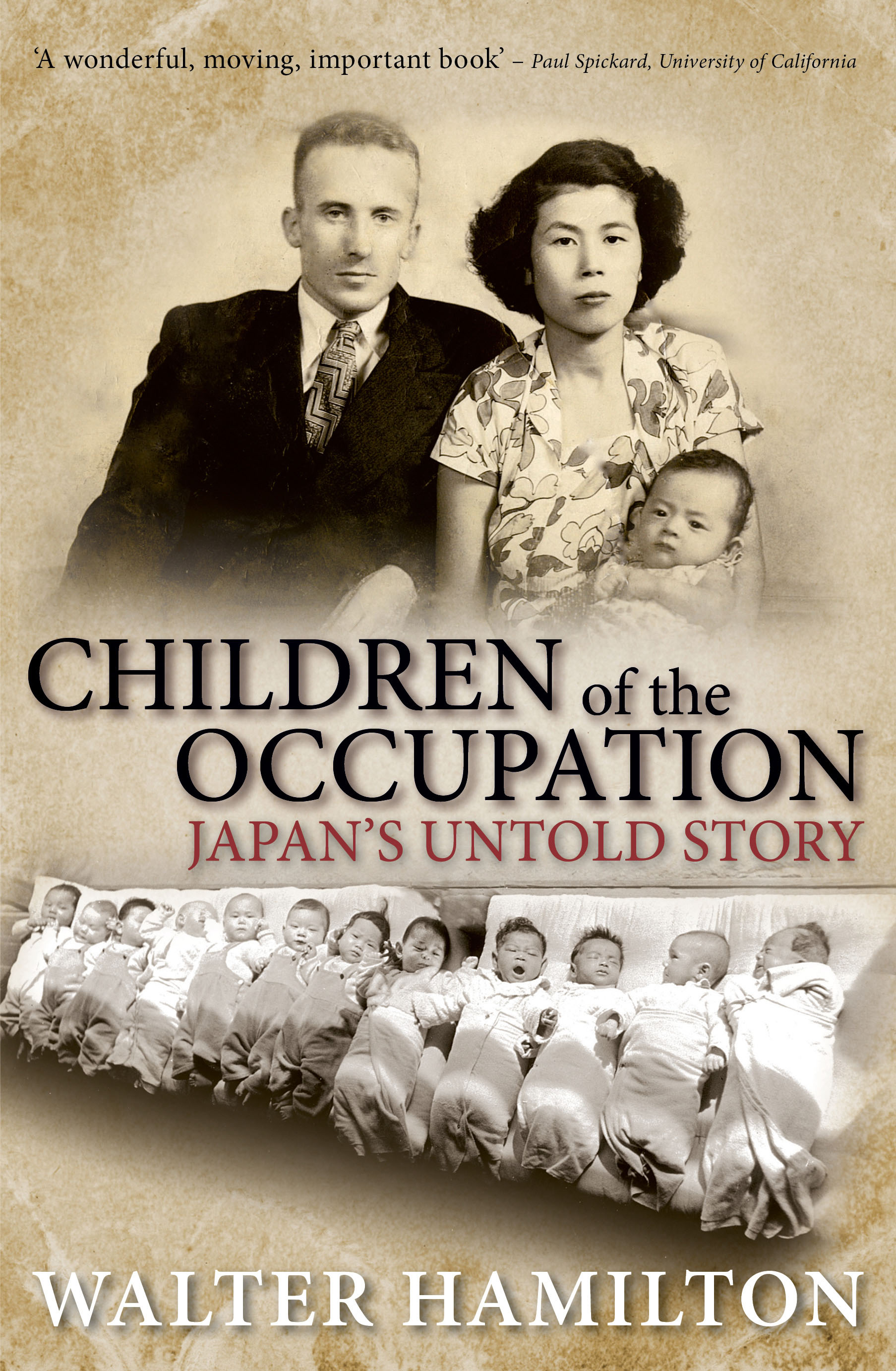
Children of the Occupation: Japan’s Untold Story

Posted in Asian Diaspora, Books, Canada, History, Media Archive, Monographs, Oceania, United States on 2012-10-06 01:51Z by Steven

Children of the Occupation: Japan’s Untold Story

NewSouth Books (American Edition coming soon from Rutgers University Press)
July 2012
352 pages
234 x 153mm
Paperback ISBN: 9781742233314

Walter Hamilton, Journalist and Author

This is a beautifully written, deeply moving and well-researched account of the lives of mixed-race children of occupied Japan. The author artfully blends oral histories with an historical and political analysis of international race relations and immigration policy in North America and Australia, to highlight the little-known story of the thousands of children that resulted from the unions of Japanese women and Allied servicemen posted to Japan following WWII. It is a powerful narrative of loss, longing and reconnection, written by the ABC’s long-time Tokyo correspondent, Walter Hamilton.

Visit the website here.

Tags: , , , ,

The Biopolitics of Mixing: Thai Multiracialities and Haunted Ascendancies

Posted in Anthropology, Asian Diaspora, Books, Europe, Media Archive, Monographs, Social Science, United Kingdom on 2012-10-05 00:45Z by Steven

The Biopolitics of Mixing: Thai Multiracialities and Haunted Ascendancies

Ashgate Publishing
October 2012
198 pages
234 x 156 mm
Hardback ISBN: 978-0-7546-7680-5
ebook ISBN 978-1-4094-2502-1

Jinthana Haritaworn, Assistant Professor in Gender, Race and Environment at the Faculty of Environmental Studies
York University, Canada

Debates over who belongs in Europe and who doesn’t increasingly speak the language of mixing, but how are the figures commonly described as ‘mixed’ actually embodied? The Biopolitics of Mixing invites us to reckon with the spectres of pathologization past and present, placing the celebration of mixing beside moral panics over terrorism and trafficking and a post-race multiculturalism that elevates some as privileged members of the neoliberal community, whilst ghosting others from it. Drawing on a broad archive including rich qualitative interviews conducted in Britain and Germany, media and policy debates, popular culture, race-based research and queer-of-colour theories, this book imagines into being communities in which people and places normally kept separate can coexist in the same reality.

As such, it will appeal to scholars across a range of sociological and cultural studies, including critical race, ethnic and migration studies, transnational gender and queer studies, German and European studies, Thai and Southeast Asian studies, and studies of affect, performativity, biopolitics and necropolitics. It should be read by all those interested in thinking critically on the intersections of race, class, gender, sexuality and disability.

Contents

  • Introduction: haunted origins
  • Where are you from?
  • From monster to fashion model: regenerating racialized bodies
  • Is it better to be mixed race?
  • Hybrid nations, mixed feelings: from marginal man to Obama
  • Exceptional cities, exceptional citizens: metronormativity and mimeticism
  • Reckoning with prostitutes: performing Thai femininity
  • Conclusion: where do we want to go?
  • Bibliography
  • Index
Tags: , , , ,