From Slavery to Wealth: The Life of Scott Bond

Posted in Biography, Books, Media Archive, Monographs, Slavery, United States on 2013-01-01 01:56Z by Steven

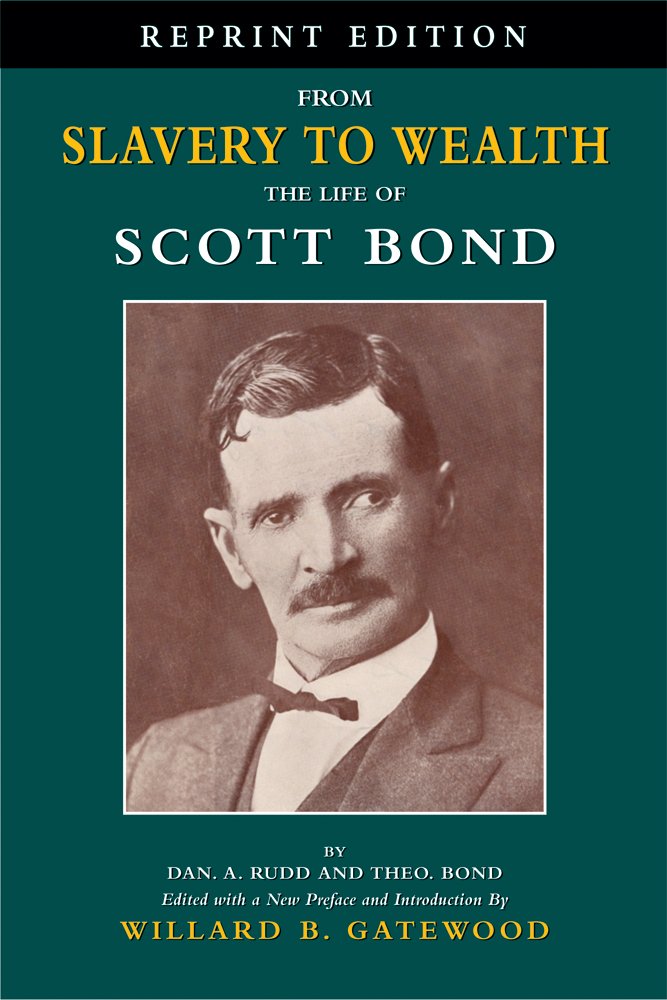
From Slavery to Wealth: The Life of Scott Bond

University of Arkansas Press
February 2008 (Originally Published: 1917)
336 pages
6 x 9; 72 photographs and index
ISBN 13: 978-0-9768007-6-7 ISBN 10: 0-9768007-6-4

Dan. A. (Daniel Arthur) Rudd (1854-1933)

Theo. (Theophilus) Bond

Edited with a new Preface and Introduction by

Willard B. Gatewood, Alumni Distinguished Professor of History Emeritus
University of Arkansas, Fayetteville

In an era in which African Americans were oppressed and deprived of many of the rights and privileges of citizenship, Scott Bond rose from being born a slave in Madison County, Mississippi, in the early 1850s to wealth and status as a farmer, merchant, and business entrepreneur in Madison, Arkansas, by the early 1900s. From Slavery to Wealth is the story of an extraordinary individual widely known and respected at the time of its first publication in 1917, for his integrity, prodigious energy, and strong work ethic. Throughout his career he never wearied of imploring African Americans to seize the opportunities offered them in the South in general and in the Arkansas Delta in particular. Scott Bond enjoyed an enviable reputation among blacks as well as whites. This reputation ultimately extended far beyond his local community to prominent blacks throughout the South and elsewhere, especially after he gained wider exposure as a conspicuous figure in the National Negro Business League in the early years of the twentieth century.

With this 2008 reprint edition, the current generation can be inspired by the man who has been referred to as the black John D. Rockefeller of Arkansas.

Read the entire book (From Slavery to Wealth. The Life of Scott Bond. The Rewards of Honesty, Industry, Economy and Perseverance) via “Documenting the American South” here.

Scott Bond was born in the early 1850s to an enslaved mother named Ann who worked in the Maben-Bond household near Canton, Mississippi. His father was the nephew of a white slave-owner to whom Bond’s mother had temporarily been hired out as a domestic servant. Just prior to the outbreak of the Civil War, Bond and his mother were moved to Arkansas, along with his step-father, William Bond, and the rest of the Maben-Bond family’s slaves. After Emancipation, Bond lived with his step-father until age twenty-two, when he “undertook to vouch for himself” and began work on his lifelong goal of becoming a successful businessman (p. 37). Bond accomplished this goal. At the time of his death he owned and farmed 12,000 acres, while also raising livestock and operating a large mercantile store, at least five cotton gins, a gravel pit, a lumber yard, and a saw mill. A member of the National Negro Business League, Bond supported the efforts of Booker T. Washington, whose philosophies regarding the social advancement of African Americans through economic and agricultural success mirrored Bond’s own. In 1877, he married Magnolia Nash, with whom he had eleven sons. Bond was killed in March 1933 by one of his registered bulls. According to his son, Ulysses, he “went down swinging and died among the things he loved” (p. 152)…

Read the entire summary here.

Tags: , , , , , , , ,

Silencing Race: Disentangling Blackness, Colonialism, and National Identities in Puerto Rico

Posted in Anthropology, Books, Caribbean/Latin America, History, Latino Studies, Media Archive, Monographs, United States on 2012-12-31 02:03Z by Steven

Silencing Race: Disentangling Blackness, Colonialism, and National Identities in Puerto Rico

Palgrave Macmillan
October 2012
330 pages
DOI: 10.1057/9781137263223
ebook ISBN: 9781137263223
Paperback ISBN: 9781137263216
Hardback ISBN: 9781137263230

Ileana M. Rodríguez-Silva, Associate Professor of Latin American and Caribbean History
University of Washington
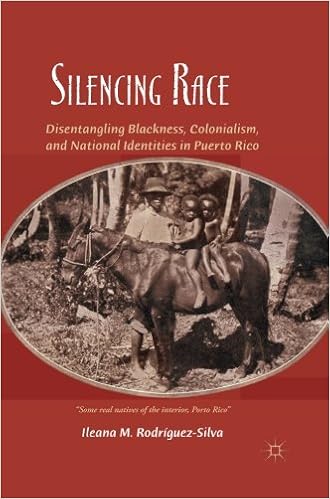
In their quest for greater political participation within shifting imperial fields—from Spanish (1850s–1898) to US rule (1898-)—Puerto Ricans struggled to shape and contain conversations about race. In so doing, they crafted, negotiated, and imposed on others multiple forms of silences while reproducing the idea of a unified, racially mixed, harmonious nation. Hence, both upper and working classes participated, although with different agendas, in the construction of a wide array of silences that together have prevented serious debate about racialized domination. This book explores the ongoing, constant racialization of Puerto Rican workers to explore the ‘class-making’ of race.

Contents

  • Acknowledgments
  • Introduction: Racial (Dis)Harmony in Puerto Rico
  • I. Slavery and the Multiracial, Racially Mixed Laboring Classes
    • 1. Becoming a Free Worker in Post-Emancipation Puerto Rico
    • 2. Liberal Elites’ Writings: The Racial Dissection of the Puerto Rican Specimen
    • 3. Race and the Modernization of Ponce after Slavery
  • II. Changing Empires
    • 4. US Rule and the Volatile Topic of Race in the Public Political Sphere
    • 5. Racial Silencing and the Organizing of Puerto Rican Labor
    • 6. Deflecting Puerto Rico’s Blackness
  • Conlusion: The Heavy Weight of Silence
  • Notes
  • Bibliography
  • Index

INTRODUCTION: Racial (Dis)Harmony in Puerto Rico

It is a theory with no foundation. She does not know what bomba is. Our bomba is a fusion of many races and cultures: Indigenous, Spanish or European, and African. This is the only authentic one. Everything else is just an invention.
—Puerto Rican performer Modesto Cepeda, April 13, 2005

After my first semester in the United States, I was desperate to leave the mainland and return to my home at the urban core of the northern city of Bayamón, Puerto Rico. My family and friends welcomed me with many gatherings, some in the San Juan area and others in my family’s hometown of Yaucoin the southern part of the island. Everyone peppered me with questions about life away from home. On one of these occasions, a relative asked me if I had become friends with other Puerto Ricans. I answered that I had become very close to a Puerto Rican black woman. I did not realize that I had spoken openly about blackness, instead of the customary muffled modalities that many islanders often employ, until my relative responded, “Then she is not Puerto Rican! Only the americanos would make reference to a person’s skin color.” My relative’s response was surprising to me because in our extended family, antiblack racism had been at the heart of many conflicts, despite (or because of) our racially mixed heritage.

After years of archival research on racial struggles in Puerto Rico, I find myself repeatedly recalling this one exchange, one of many others that have a similar pattern. Perhaps I recall it because of the array of important questions my relative’s response elicits about Puerto Rican immigration, US colonialism, national identities, constructions of whiteness/blackness/racial mixture, and gender (all of which I will explore in the pages of this book). But, most probably, this moment is fixed in my mind because I was struck by the quick and effective way in which my cousin silenced me when I acknowledged my friend’s cherished sense of self as a black Puerto Rican woman. There was no better strategy to shut down a possible conversation about the historical and contemporary realities of racialized marginalization than (a) to deem race, racialization, and racism as foreign matters, specifically as US phenomena, and (b) to question one’s commitment and love to the Puerto Rican nation. My own commitment was already in question; I too was quickly becoming an outsider. Given this oft deployed silencing device, this book is particularly attentive not to reify a Latin American paradigm of race relations or a US model. Instead, Puerto Rico’s move from Spanish to US rule provides a unique opportunity to flesh out some of the sociocultural and political processes that made necessary the organization of knowledge about racialized marginalization along the lines of opposite racial paradigms. To do so, it is imperative to look at silencing and racialization practices historically, as well as investigate the many struggles that elicited these practices. In the following pages, I explore a few key historical moments between the 1870s and 1910s when silencing became especially urgent in politics. It is worth noting that the reasons for and the modes of containing race talk have continued to shift and change after the period under scrutiny in this study…

…I aim to uncover the ways in which the history of slavery, the processes of emancipation, and the nature of colonialisms in Puerto Rico contributed to the contradictory construction of national and racial discourses at different historical moments since the late nineteenth century. For more than a century after emancipation in 1873– 76, government institutions, academic studies, and cultural organizations have reproduced the idea that Puerto Rico is a unified nation—despite its colonial relation to Spain and later the United States—whose people originated from a mélange of three cultural roots: the indigenous Taínos, Africans, and Spaniards. This national discourse holds that because these races mixed harmoniously to create the Puerto Rican race/nation, racial conflict has never existed on the island. In fact, the lack of racial conflict defines Puerto Ricanness. Therefore, to address issues of racialized exclusion or to express/embrace a racialized sense of self is understood by most Puerto Ricans as antinational. Paradoxically, the Puerto Rican dominant classes have persistently underscored the white, Hispanic experience as the main thread that provides coherence to the history of the Puerto Rican people. In this discourse of the nation, the presumptively racially mixed, harmonious society ensures the unity of all social classes. Yet that discourse also preserves the rights of white Creole men as political and social superiors, and consequently, the struggles and aspirations of those deemed or self identified as black continue to be systematically marginalized.

The attempts to silence discussions about racialized domination (especially the persistent denial of racism) and the corollary suppressions regarding individual and communal racialized histories coexist with Puerto Ricans’ everyday antiblack racist practices and racialized talk. Most Puerto Ricans, however, do not recognize their everyday references to racialized markers of difference— mostly derogatory remarks about blackness— as a product of and form sustaining racialized domination. To explore this tension I have chosen the analytics of silence, where silence means something other than total absence. I am here interested in both the attempts to shape or prevent talk and the partial and fragile silences produced through such endeavors. Hence, as I explain later in this introduction, silence is communicative in nature, comprising a wide array of practices that were, in fact, generative of more talk.12 The many disruptions of silences and the other idioms elaborated to advance mobilization for social justice also fostered talk on race. As such, the practices of censorship shaped (creating gaps, voids, misrecognition, and euphemisms, among others) but did not impede the talk of race. Conversely, efforts at repressing the talk of race have indeed prevented sustained conversations about racialized domination because these could crystallize into projects for sociopolitical transformation. This book seeks to track both the fraught processes through which silences are constantly reconstituted and the overall effect of a plurality of silences, intended and unintended, which have prevented open discussions about racialized domination…

Read the entire Introduction here.
Tags: , ,

The Election of Barack Obama: How He Won

Posted in Barack Obama, Books, Media Archive, Monographs, Politics/Public Policy, United States on 2012-12-30 04:01Z by Steven

The Election of Barack Obama: How He Won

Palgrave Macmillan
August 2010
178 pages
DOI: 10.1057/9780230111790
ebook ISBN: 9780230111790
Paperback ISBN: 9780230103511
Hardback ISBN: 9780230314603

Baodong Liu, Associate Professor of Political Science
University of Utah

This book examines the historical election of Barack Obama as the first African-American president from the perspective of racial relations. To trace the effect of time, Liu links Obama’s multiracial winning coalition to the two-party system and the profound impact of racial changes since 1965. Contrary to the popular momentum theory which emphasizes the early victories in mainly two states, Iowa and New Hampshire, this book demonstrates that state context matters. Obama’s electoral performance in a state is better explained by its level of racial tension, rather than the emotional need of Americans to elect a black president.

List of Contents

  • Emotion and Rationality: An Introduction
  • Minimum Winning Coalition: the 2008 Presidential Election from a Historical Perspective
  • Racial Change and the Politics of Hope
  • The 2008 Democratic Primaries and the Presidential Selection Process
  • Building the Winning Coalition in Time
  • Building the Winning Coalition in Space
  • Winning the General Election
  • The Obama Racial Coalition: Conclusion
Tags: ,

The Black Middle: Africans, Mayas, and Spaniards in Colonial Yucatán

Posted in Books, Caribbean/Latin America, History, Media Archive, Mexico, Monographs on 2012-12-24 03:39Z by Steven

The Black Middle: Africans, Mayas, and Spaniards in Colonial Yucatán

Stanford University Press
2009
456 pages
39 tables, 4 figures, 13 illustrations, 11 maps.
Cloth ISBN: 9780804749831

Matthew Restall, Professor of Latin American History and Director of Latin American Studies
Pennsylvania State University

The Black Middle is the first full-length study of black African slaves and other people of African descent in the Spanish colonial province of Yucatán, which is today part of southern Mexico. The study is based on Spanish and Maya-language documents from the sixteenth through nineteenth centuries, found in a dozen different archives (mostly in Spain and Mexico). Restall’s goal is to discover what life was like for a people hitherto ignored by historians. He explores such topics as slavery and freedom, militia service and family life, bigamy and witchcraft, and the ways in which Afro-Yucatecáns (as he dubs them) interacted with Mayas and Spaniards. He concludes that in numerous ways, Afro-Yucatecans lived and worked in a middle space between—but closely connected to—Mayas and Spaniards. The book’s “black middle” thesis has profound implications for the study of Africans throughout the Americas.

Tags: , , , ,

Medicating Race: Heart Disease and Durable Preoccupations with Difference

Posted in Books, Health/Medicine/Genetics, Media Archive, Monographs, Politics/Public Policy, United States on 2012-12-22 19:05Z by Steven

Medicating Race: Heart Disease and Durable Preoccupations with Difference

Duke University Press
October 2012
280 pages
5 illustrations
Paperback ISBN: 978-0-8223-5344-7
Cloth ISBN: 978-0-8223-5329-4

Anne Pollock, Assistant Professor of Science, Technology and Culture
Georgia Institute of Technology, Atlanta, Georgia

In Medicating Race, Anne Pollock traces the intersecting discourses of race, pharmaceuticals, and heart disease in the United States over the past century, from the founding of cardiology through the FDA’s approval of BiDil, the first drug sanctioned for use in a specific race. She examines wide-ranging aspects of the dynamic interplay of race and heart disease: articulations, among the founders of American cardiology, of heart disease as a modern, and therefore white, illness; constructions of “normal” populations in epidemiological research, including the influential Framingham Heart Study; debates about the distinctiveness African American hypertension, which turn on disparate yet intersecting arguments about genetic legacies of slavery and the comparative efficacy of generic drugs; and physician advocacy for the urgent needs of black patients on professional, scientific, and social justice grounds. Ultimately, Pollock insists that those grappling with the meaning of racialized medical technologies must consider not only the troubled history of race and biomedicine but also its fraught yet vital present. Medical treatment should be seen as a site of, rather than an alternative to, political and social contestation. The aim of scholarly analysis should not be to settle matters of race and genetics, but to hold medicine more broadly accountable to truth and justice.

Table of Contents

  • Acknowledgments
  • Introduction
  • 1. Racial Preoccupations and Early Cardiology
  • 2. Making Normal Populations and Making Difference in the Framingham and Jackson Heart Studies
  • 3. The Durability of African American Hypertension as a Disease Category
  • 4. The Slavery Hypothesis beyond Genetic Determinism
  • 5. Thiazide Diuretics as a Nexus of Associations: Racialized, Proven, Old, Cheap
  • 6. BiDil: Medicating the Intersection of Race and Heart Failure
  • Conclusion
  • Notes
  • Works Cited
  • Index
Tags: , ,

Family Trees: A History of Genealogy in America

Posted in Books, History, Media Archive, Monographs, United States on 2012-12-13 22:16Z by Steven

Family Trees: A History of Genealogy in America

Harvard University Press
April 2013
250 pages
5-1/2 x 8-1/4 inches
Hardcover ISBN: 9780674045835

François Weil, Chancellor and Professor of History; former president of the École des Hautes Études en Sciences Sociales
Universities of Paris

The quest for roots has been an enduring American preoccupation. Over the centuries, generations have sketched coats of arms, embroidered family trees, established local genealogical societies, and carefully filled in the blanks in their bibles, all in pursuit of self-knowledge and status through kinship ties. This long and varied history of Americans’ search for identity illuminates the story of America itself, according to François Weil, as fixations with social standing, racial purity, and national belonging gave way in the twentieth century to an embrace of diverse ethnicity and heritage.

Seeking out one’s ancestors was a genteel pursuit in the colonial era, when an aristocratic pedigree secured a place in the British Atlantic empire. Genealogy developed into a middle-class diversion in the young republic. But over the next century, knowledge of one’s family background came to represent a quasi-scientific defense of elite “Anglo-Saxons” in a nation transformed by immigration and the emancipation of slaves. By the mid-twentieth century, when a new enthusiasm for cultural diversity took hold, the practice of tracing one’s family tree had become thoroughly democratized and commercialized.

Today, Ancestry.com attracts over two million members with census records and ship manifests, while popular television shows depict celebrities exploring archives and submitting to DNA testing to learn the stories of their forebears. Further advances in genetics promise new insights as Americans continue their restless pursuit of past and place in an ever-changing world.

Tags: ,

Under the Skin

Posted in Africa, Autobiography, Books, Media Archive, Monographs, South Africa on 2012-12-09 22:07Z by Steven

Under the Skin

Finch Publishing
August 2012
210 pages
Paperback ISBN: 9781921462801

Marion van Dyk

This beautifully written and evocative memoir is a fascinating insight into the lives of her family, living under apartheid, who struggled to create a sense of identity and personal worth. It’s a book of historical relevance in its revelations about resistance to Apartheid by South Africans of mixed race; and it is also a book of social relevance to the debate on racism today, in Australia, South Africa, and elsewhere in the world.
 
Marion van Dyk’s absorbing memoir submerges the reader in the world of South Africa in the 1950s through to the 1980s. Classified as a ‘coloured’ (being neither black nor white) by an apartheid government, she and her family are forced to live as second-class citizens, caught between two worlds. Marion and her family struggle to make ends meet after they are forced to leave their family home when their area is redesignated for whites only.
 
After relocating to a small ‘coloured’ township, Marion attends a school where, despite severe restrictions, her teachers fight tooth and nail to give her an education. She becomes head of a computer programming department, breaking through racial and gender barriers in the process, before emigrating to Australia with her husband and son.
 
Marion van Dyk was a finalist in the 2012 Finch Memoir Prize for this, her first book, the memoir Under the Skin.

Tags: ,

Race in a Bottle: The Story of BiDil and Racialized Medicine in a Post-Genomic Age

Posted in Books, Health/Medicine/Genetics, Media Archive, Monographs, Politics/Public Policy, United States on 2012-12-07 05:18Z by Steven

Race in a Bottle: The Story of BiDil and Racialized Medicine in a Post-Genomic Age

Columbia University Press
December, 2012
336 pages
Charts: 4, B&W Illus.: 1
Cloth ISBN: 978-0-231-16298-2

Jonathan Kahn, Professor of Law
Hamline University, Saint Paul, Minnesota

At a ceremony announcing the completion of the first draft of the human genome in 2000, President Bill Clinton declared, “I believe one of the great truths to emerge from this triumphant expedition inside the human genome is that in genetic terms, all human beings, regardless of race, are more than 99.9 percent the same.” Yet despite this declaration of unity, biomedical research has focused increasingly on mapping that .1 percent of difference, particularly as it relates to race.

This trend is exemplified by the drug BiDil. Approved by the FDA in 2005 as the first drug with a race-specific indication on its label, BiDil was originally touted as a pathbreaking therapy to treat heart failure in black patients and help underserved populations. Upon closer examination, however, Jonathan Kahn reveals a far more complex story. At the most basic level, BiDil became racial through legal maneuvering and commercial pressure as much as through medical understandings of how the drug worked. Using BiDil as a central case study, Kahn broadly examines the legal and commercial imperatives driving the expanding role of race in biomedicine, even as scientific advances in genomics could render the issue irrelevant. He surveys the distinct politics informing the use of race in medicine and the very real health disparities caused by racism and social injustice that are now being cast as a mere function of genetic difference. Calling for a more reasoned approach to using race in biomedical research and practice, Kahn asks readers to recognize that, just as genetics is a complex field requiring sensitivity and expertise, so too is race, particularly in the field of biomedicine.

Contents

  • Acknowledgments
  • INTRODUCTION: Race and Medicine: Framing [Is] the Problem
  • 1. ORGANIZING RACE: Paths Toward the Re-Biologization of Race in Modern Biomedical Research, Practice, and Product Development
  • 2. THE BIRTH OF BIDIL: How a Drug Becomes “Ethnic”
  • 3. STATISTICAL MISCHIEF AND RACIAL FRAMES FOR DRUG DEVELOPMENT AND MARKETING
  • 4. CAPITALIZING [ON] RACE IN DRUG DEVELOPMENT
  • 5. RACE-ING PATENTS/PATENTING RACE: An Emerging Political Geography of Intellectual Property in Biotechnology
  • 6. NOT FADE AWAY: The Persistence of Race and the Politics of the “Meantime” in Pharmacogenomics
  • 7. FROM DISPARITY TO DIFFERENCE: The Politics of Racial Medicine
  • CONCLUSIONS AND RECOMMENDATIONS
  • Notes
  • Index
Tags: , ,

Rose Hill: An Intermarriage before Its Time

Posted in Autobiography, Biography, Books, Identity Development/Psychology, Judaism, Latino Studies, Media Archive, Monographs, Religion, United States on 2012-11-27 04:24Z by Steven

Rose Hill: An Intermarriage before Its Time

Heyday Books
March 2012
192 pages
5.5 x 8.5
Paperback ISBN: 978-1-59714-188-8

Carlos Cortés, Professor Emeritus of History
University of California, Riverside

A riveting memoir of cultural crossfire

“Dad was a Mexican Catholic. Mom was a Kansas City–born Jew with Eastern European immigrant parents. They fell in love in Berkeley, California, and got married in Kansas City, Missouri.

That alone would not have been a big deal. But it happened in 1933, when such marriages were rare. And my parents spent most of their lives in Kansas City, a place both racially segregated and religiously divided.

Mom and Dad chose to be way ahead of their time; I didn’t. But because of them, I had to be. My mixed background meant that, however unwillingly, I had to learn to live as an outsider.”

The son of a Mexican Catholic father with aristocratic roots and a mother of Eastern European Jewish descent, Carlos Cortés grew up wedged between cultures, living a childhood in “constant crossfire-straddling borders, balancing loves and loyalties, and trying to fit into a world that wasn’t quite ready.” In some ways, even his family wasn’t quite ready (for him). His request for a bar mitzvah sent his proud father into a cursing rage. He was terrified to bring home the Catholic girl he was dating, for fear of wounding his mother and grandparents. When he tried to join a high school fraternity, Christians wouldn’t take him because he was Jewish, and Jews looked sideways at him because his father was Mexican.

In his new memoir, Rose Hill: An Intermarriage before Its Time, Cortés lovingly chronicles his family’s tumultuous, decades-long spars over religion, class, and culture, from his early years in legally segregated Kansas City during the 1940s to his return to Berkeley (where his parents met) in the 1950s, and to his parents’ separation, reconciliation, deaths, and eventual burials at the Rose Hill Cemetery. Cortés elevates the theme of intermarriage to a new level of complexity in this closely observed and emotionally fraught memoir adapted from his nationally successful one-man play, A Conversation with Alana: One Boy’s Multicultural Rite of Passage.

Tags: , , ,

Edith and Winnifred Eaton: Chinatown Missions and Japanese Romances

Posted in Asian Diaspora, Biography, Books, Canada, Monographs, Women on 2012-11-27 04:01Z by Steven

Edith and Winnifred Eaton: Chinatown Missions and Japanese Romances

University of Illinois Press
2002
240 pages
6 x 9 in.
14 black & white photographs, 7 line drawings
Cloth ISBN: 978-0-252-02721-5

Dominika Ferens, Professor of American Literature and Writing
University of Wrocław, Wrocław, Poland

Daughters of a British father and a Chinese mother, Edith and Winnifred Eaton pursued wildly different paths. While Edith wrote stories of downtrodden Chinese immigrants under the pen name Sui Sin Far, Winnifred presented herself as Japanese American and published Japanese romance novels in English under the name Onoto Watanna. In this invigorating reappraisal of the vision and accomplishments of the Eaton sisters, Dominika Ferens departs boldly from the dichotomy that has informed most commentary on them: Edith’s “authentic” representations of Chinese North Americans versus Winnifred’s “phony” portrayals of Japanese characters and settings.

Arguing that Edith as much as Winnifred constructed her persona along with her pen name, Ferens considers the fiction of both Eaton sisters as ethnography. Edith and Winnifred Eaton suggests that both authors wrote through the filter of contemporary ethnographic discourse on the Far East and also wrote for readers hungry for “authentic” insight into the morals, manners, and mentality of an exotic other.

Ferens traces two distinct discursive traditions–-missionary and travel writing–-that shaped the meanings of “China” and “Japan” in the nineteenth century. She shows how these traditions intersected with the unconventional literary careers of the Eaton sisters, informing the sober, moralistic tone of Edith’s stories as well as Winnifred’s exotic narrative style, plots, settings, and characterizations.

Bringing to the Eatons’ writings a contemporary understanding of the racial and textual politics of ethnographic writing, this important account shows how these two very different writers claimed ethnographic authority, how they used that authority to explore ideas of difference, race, class and gender, and how their depictions of nonwhites worked to disrupt the process of whites’ self-definition.

Tags: , , , , , ,