Hybrid: Bisexuals, Multiracials, and Other Misfits Under American Law

Posted in Books, Gay & Lesbian, Law, Media Archive, Monographs, Social Science, United States on 2009-11-04 02:51Z by Steven

Hybrid: Bisexuals, Multiracials, and Other Misfits Under American Law

New York University Press
1996-05-01
176 pages
16 illustrations
ISBN: 9780814715383

Ruth Colker, Distinguished University Professor and Heck Faust Memorial Chair in Constitutional Law
Michael E. Moritz College of Law, Ohio State University

The United States, and the West in general, has always organized society along bipolar lines. We are either gay or straight, male or female, white or not, disabled or not.

In recent years, however, America seems increasingly aware of those who defy such easy categorization. Yet, rather than being welcomed for the challenges that they offer, people living the gap are often ostracized by all the communities to which they might belong. Bisexuals, for instance, are often blamed for spreading AIDS to the heterosexual community and are regarded with suspicion by gays and lesbians. Interracial couples are rendered invisible through monoracial recordkeeping that confronts them at school, at work, and on official documents. In Hybrid, Ruth Colker argues that our bipolar classification system obscures a genuine understanding of the very nature of subordination. Acknowledging that categorization is crucial and unavoidable in a world of practical problems and day-to-day conflicts, Ruth Colker shows how categories can and must be improved for the good of all.
Tags: ,

Choosing Ethnic Identity

Posted in Books, Census/Demographics, Identity Development/Psychology, Media Archive, Monographs, Social Science, United Kingdom, United States on 2009-11-04 02:16Z by Steven

Choosing Ethnic Identity

Polity Books
February 2003
192 pages
229 x 152 mm, 6 x 9 in
Hardback ISBN: 9780745622767; ISBN10: 0745622763
Paperback ISBN: 9780745622774; ISBN10: 0745622771

Miri Song, Professor of Sociology
University of Kent

Choosing Ethnic Identity explores the ways in which people are able to choose their ethnic identities in contemporary multiethnic societies such as the USA and Britain. Notions such as adopting an identity, or self-designated terms, such as Black British and Asian American, suggest the importance of agency and choice for individuals. However, the actual range of ethnic identities available to individuals and the groups to which they belong are not wholly under their control. These identities must be negotiated in relation to both the wider society and coethnics. The ability of minority individuals and groups to assert or recreate their own self-images and ethnic identities, against the backdrop of ethnic and racial labelling by the wider society, is important for their self-esteem and social status.

This book examines the ways in which ethnic minority groups and individuals are able to assert and negotiate ethnic identities of their choosing, and the constraints structuring such choices. By drawing on studies from both the USA and Britain, Miri Song concludes that while significant constraints surround the exercising of ethnic options, there are numerous ways in which ethnic minority individuals and groups contest and assert particular meanings and representations associated with their ethnic identities.

Table of Contents

Preface.
Chapter 1 Ethnic identities: choices and constraints.
Chapter 2 Comparing minorities’ ethnic options.
Chapter 3 Negotiating individual and group identities.
Chapter 4 The growth of `mixed race’ people.
Chapter 5 The diversification of ethnic groups.
Chapter 6 The second generation in a global context.
Chapter 7 Debates about racial hierarchy.
Chapter 8 The future of `race’ and ethnic identity.
Notes.
References.
Index

Tags: ,

Tripping on the Color Line: Black-White Multiracial Families in a Racially Divided World

Posted in Books, Census/Demographics, Family/Parenting, Media Archive, Monographs, Social Science, United States on 2009-11-03 22:10Z by Steven

Tripping on the Color Line: Black-White Multiracial Families in a Racially Divided World

Rutgers University Press
October 2000
192 pages
Cloth ISBN: 0-8135-2843-7
Paper ISBN: 0-8135-2844-5

Heather M. Dalmage, Professor of Sociology and Director
Mansfield Institute for Social Justice
Roosevelt University

A sociological analysis of the experiences and challenges faced by black-white multiracial families

At the beginning of the twentieth century, W. E. B. Du Bois predicted that the central problem facing the United States in the new century would be that of the “color line.” Now, with another century upon us, many people are found straddling the color line. They come from the growing number of multiracial families in America, families seeking their places in a racially polarized society.

In interviews with individuals from black/white multiracial families, Heather M. Dalmage examines the challenges they face and explores how their experiences demonstrate the need for rethinking race in America. She examines the lived reality of race in the ways multiracial families construct their identities and sense of community and politics. The lack of language to describe multiracial experiences, along with the methods of negotiating racial ambiguity in a racially divided, racist society are central themes of Tripping on the Color Line. By connecting her interviewees stories to specific issues, such as census categories, transracial adoption, and intermarriage, Dalmage raises the debate to a broad discussion of the idea of race and its impact on social justice.

Tags: , , ,

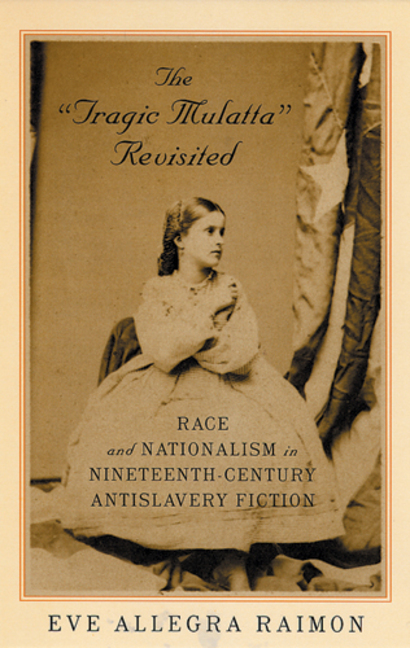
The “Tragic Mulatta” Revisited: Race and Nationalism in Nineteenth-Century Antislavery Fiction

Posted in Books, History, Literary/Artistic Criticism, Media Archive, Monographs, Slavery, Social Science, United States, Women on 2009-11-03 19:27Z by Steven

The “Tragic Mulatta” Revisited: Race and Nationalism in Nineteenth-Century Antislavery Fiction

Rutgers University Press
2004-09-29
202 pages
Cloth ISBN: 978-0-8135-3481-7
Paper ISBN: 978-0-8135-3482-4

Eve Allegra Raimon, Professor, Arts & Humanities
University of Southern Maine

Since its inception, the United States has been intensely preoccupied with interracialism. The concept is embedded everywhere in our social and political fabric, including our sense of national identity. And yet, in both its quantitative and symbolic forms, interracialism remains an extremely elusive phenomenon, causing policy makers and census boards to wrangle over how to delineate it and, on an emblematic level, stirring intense emotions from fear to fascination. In The “Tragic Mulatta” Revisited, Eve Allegra Raimon focuses on the mixed-race female slave in literature, arguing that this figure became a symbolic vehicle for explorations of race and nation-both of which were in crisis in the mid-nineteenth century. At this time, judicial, statutory, social, and scientific debates about the meaning of racial difference (and intermixture) coincided with disputes over frontier expansion, which were never merely about land acquisition but also literally about the “complexion” of that frontier. Embodying both northern and southern ideologies, the “amalgamated” mulatta, the author argues, can be viewed as quintessentially American, a precursor to contemporary motifs of “hybrid” and “mestizo” identities. Where others have focused on the gendered and racially abject position of the “tragic mulatta,” Raimon reconsiders texts by such central antislavery writers as Lydia Maria Child, William Wells Brown, Harriet Beecher Stowe, and Harriet Wilson to suggest that the figure is more usefully examined as a way of understanding the volatile and shifting interface of race and national identity in the antebellum period.

Read an excerpt here.

Tags: , , , , ,

“Miscegenation” Making Race in America

Posted in Books, History, Media Archive, Monographs, Politics/Public Policy, Slavery, Social Science, United States on 2009-11-02 16:59Z by Steven

“Miscegenation” Making Race in America

University of Pennsylvania Press
2002
216 pages
6 x 9, 19 illus.
Cloth: ISBN 978-0-8122-3664-4
Paper ISBN: 978-0-8122-2064-3

Elise Lemire, Professor of Literature
Purchase College, State University of New York

In the years between the Revolution and the Civil War, as the question of black political rights was debated more and more vociferously, descriptions and pictorial representations of whites coupling with blacks proliferated in the North. Novelists, short-story writers, poets, journalists, and political cartoonists imagined that political equality would be followed by widespread inter-racial sex and marriage. Legally possible yet socially unthinkable, this “amalgamation” of the races would manifest itself in the perverse union of “whites” with “blacks,” the latter figured as ugly, animal-like, and foul-smelling. In Miscegenation, Elise Lemire reads these literary and visual depictions for what they can tell us about the connection between the racialization of desire and the social construction of race.

Previous studies of the prohibition of interracial sex and marriage in the U.S. have focused on either the slave South or the post-Reconstruction period. Looking instead to the North, and to such texts as the Federalist poetry about Thomas Jefferson and Sally Hemings, James Fenimore Cooper‘s Last of the Mohicans, Edgar Allan Poe‘s “Murders in the Rue Morgue,” and the 1863 pamphlet in which the word “miscegenation” was first used, Lemire examines the steps by which whiteness became a sexual category and same-race desire came to seem a biological imperative.

Table of Contents

  • List of Illustrations
  • Introduction: The Rhetorical Wedge Between Preference and Prejudice
  • 1. Race and the Idea of “Preference” in the New Republic: The Port Folio Poems About Thomas Jefferson and Sally Hemings
  • 2. The Rhetoric of Blood and Mixture: Cooper’s “Man Without a Cross”
  • 3. The Barrier of Good Taste: Avoiding A Sojourn in the City of Amalgamation in the Wake of Abolitionism
  • 4. Combating Abolitionism with the Species Argument: Race and Economic Anxieties in Poe’s Philadelphia
  • 5. Making “Miscegenation”: Alcott‘s Paul Frere and the Limits of Brotherhood After Emancipation
  • Epilogue: “Miscegenation” Today
  • Notes
  • Bibliography
  • Index
  • Acknowledgments
Tags: , , , , , , , , ,

Mestizo Democracy: The Politics of Crossing Borders

Posted in Books, Caribbean/Latin America, Media Archive, Monographs, Politics/Public Policy, Social Science, United States on 2009-11-02 16:45Z by Steven

Mestizo Democracy: The Politics of Crossing Borders

Texas A&M University Press
2003
320 pages
6.125 x 9.25
Paper ISBN: 978-1-58544-346-8

John Francis Burke, Professor of Political Science and Chair
University of St. Thomas, Houston

Foreword by Virgilio Elizondo

It can come as no surprise that the ethnic makeup of the American population is rapidly changing. That there are political repercussions from these changes is also self-evident. How the changes can, must, and should alter our very understanding of democracy, though, may not be obvious. Political theorist John Burke addresses these issues by offering a “mestizo” theory of democracy and tracing its implications for public policy.

The challenge before the United States in the coming century, Burke posits, will be to articulate a politics that neither renders cultures utterly autonomous from each other nor culminates in their homogeneous assimilation. Fortuitously or ironically, the way to do this comes from the very culture that is now necessitating the change.

Mestizo is a term from the Mexican socio-political experience. It means “mixture” and implies a particular kind of mixture that has resulted in a blend of indigenous, African, and Spanish genes and cultures in Latin America. This mixture is not a “melting pot” experience, where all eventually become assimilated; rather, it is a mixture in which the influences of the different cultures remain identifiable but not static. They all evolve through interaction with the others, and the resulting larger culture also evolves as the parts do. Mestizaje (the collective noun form) is thus process more than condition.

John Burke analyzes both American democratic theory and multiculturalism within political theology to develop a model for cultivating a democratic political community that can deal constructively with its cultural diversity. He applies this new model to a number of important policy issues: official language(s), voting and participation, equal employment opportunity, housing, and free trade. He then presents an intensive case study, based on a parish “multicultural committee” and choir in which he has been a participant, to show how the “engaged dialogue” of mestizaje might work and what pitfalls await it.

Burke concludes that in the United States we are becoming mestizo whether we know it or not and whether we like it or not. By embracing the communitarian but non-assimilationist stance of intentional mestizaje, we can forge a future together that will be not only greater than the sum of its parts but also freer and more just than its past.

John Francis Burke is a professor of political science and chair of the department at the University of St. Thomas in Houston. He is an active lay minister in a Houston Catholic parish characterized by diversity. With a Ph.D. from the University of Notre Dame, he brings strong training in western political philosophy and religious studies to his study of mestizo culture in the United States.

Tags: , ,

Mulattas and Mestizas: Representing Mixed Identities in the Americas, 1850–2000

Posted in Books, Caribbean/Latin America, History, Latino Studies, Media Archive, Mexico, Monographs, Politics/Public Policy, Social Science, United States on 2009-11-02 16:30Z by Steven

Mulattas and Mestizas: Representing Mixed Identities in the Americas, 1850–2000

University of Georgia Press
2003-01-27
284 pages
Trim size: 6 x 9
Cloth ISBN: 978-0-8203-2325-1
Paper ISBN: 978-0-8203-2781-5

Suzanne Bost, Associate Professor of English
Loyola University

In this broadly conceived exploration of how people represent identity in the Americas, Suzanne Bost argues that mixture has been central to the definition of race in the United States, Mexico, and the Caribbean since the nineteenth century. Her study is particularly relevant in an era that promotes mixed-race musicians, actors, sports heroes, and supermodels as icons of a “new” America. Bost challenges the popular media’s notion that a new millennium has ushered in a radical transformation of American ethnicity; in fact, this paradigm of the “changing” face of America extends throughout American history.

Working from literary and historical accounts of mulattas, mestizas, and creoles, Bost analyzes a tradition, dating from the nineteenth century, of theorizing identity in terms of racial and sexual mixture. By examining racial politics in Mexico and the United States; racially mixed female characters in Anglo-American, African American, and Latina narratives; and ideas of mixture in the Caribbean, she ultimately reveals how the fascination with mixture often corresponds to racial segregation, sciences of purity, and white supremacy. The racism at the foundation of many nineteenth-century writings encourages Bost to examine more closely the subtexts of contemporary writings on the “browning” of America.

Original and ambitious in scope, Mulattas and Mestizas measures contemporary representations of mixed-race identity in the United States against the history of mixed-race identity in the Americas. It warns us to be cautious of the current, millennial celebration of mixture in popular culture and identity studies, which may, contrary to all appearances, mask persistent racism and nostalgia for purity.

Tags: , , , ,

Bleeding Borders: Race, Gender, and Violence in Pre-Civil War Kansas

Posted in Books, History, Media Archive, Monographs, Native Americans/First Nation, Slavery, United States on 2009-11-02 02:40Z by Steven

Bleeding Borders: Race, Gender, and Violence in Pre-Civil War Kansas

Louisiana State University Press
April 2009
224 pages
Series: Conflicting Worlds: New Dimensions of the American Civil War
Illustrations: 5 halftones, 1 map
Cloth ISBN-13: 978-0-8071-3390-3

Kristen Tegtmeier Oertel, Associate Professor of History
Millsaps College

In Bleeding Borders, Kristen Tegtmeier Oertel offers a fresh, multifaceted interpretation of the quintessential sectional conflict in pre-Civil War Kansas. Instead of focusing on the white, male politicians and settlers who vied for control of the Kansas territorial legislature, Oertel explores the crucial roles Native Americans, African Americans, and white women played in the literal and rhetorical battle between proslavery and antislavery settlers in the region. She brings attention to the local debates and the diverse peoples who participated in them during that contentious period.

Oertel begins by detailing the settlement of eastern Kansas by emigrant Indian tribes and explores their interaction with the growing number of white settlers in the region. She analyzes the attempts by southerners to plant slavery in Kansas and the ultimately successful resistance of slaves and abolitionists. Oertel then considers how crude frontier living conditions, Indian conflict, political upheaval, and sectional violence reshaped traditional Victorian gender roles in Kansas and explores women’s participation in the political and physical conflicts between proslavery and antislavery settlers.

Oertel goes on to examine northern and southern definitions of “true manhood” and how competing ideas of masculinity infused political and sectional tensions. She concludes with an analysis of miscegenation–not only how racial mixing between Indians, slaves, and whites influenced events in territorial Kansas, but more importantly, how the fear of miscegenation fueled both proslavery and antislavery arguments about the need for civil war.

As Oertel demonstrates, the players in Bleeding Kansas used weapons other than their Sharpes rifles and Bowie knives to wage war over the extension of slavery: they attacked each other’s cultural values and struggled to assert their political wills. They jealously guarded ideals of manhood, womanhood, and whiteness even as the presence of Indians and blacks and the debate over slavery raised serious questions about the efficacy of these principles. Oertel argues that ultimately, many Native Americans, blacks, and women shaped the political and cultural terrain in ways that ensured the destruction of slavery, but they, along with their white male counterparts, failed to defeat the resilient power of white supremacy.

Moving beyond a conventional political history of Kansas, Bleeding Borders breaks new ground by revealing how the struggles of this highly-diverse region contributed to the national move toward disunion and how the ideologies that governed race and gender relations were challenged as North, South, and West converged on the border between slavery and freedom.

Tags: , , , , ,

The Literary Career of Charles W. Chesnutt

Posted in Books, History, Monographs, Passing, Slavery, United States on 2009-11-02 02:17Z by Steven

The Literary Career of Charles W. Chesnutt

Louisiana State University Press
1980
312 pages
Trim: 6 x 9
Paper ISBN-13: 978-0-8071-2452-9

William L. Andrews, E. Maynard Adams Professor of English
University of North Carolina, Chapel Hill

The career of any black writer in nineteenth-century American was fraught with difficulties, and William Andrews undertakes to explain how and why Charles Waddell Chesnutt (1858-1932) became the first Negro novelist of importance: “Steering a difficult course between becoming co-opted by his white literary supporters and becoming alienated from then and their access to the publishing medium, Chesnutt became the first Afro-American writer to use the white-controlled mass media in the service of serious fiction on behalf of the black community.”

Awarded the Spingarn Medal in 1928 by the National Association for the Advancement of Colored People [NAACP], Chesnutt admitted without apologies that because of his own experiences, most of his writings concentrated on issue about racial identity. Only one-eighth Negro and able to pass for Caucasian, Chesnutt dramatized the dilemma of others like him. The House Behind the Cedars (1900), Chesnutt’s most autobiographical novel, evokes the world of “bright mulatto” caste in post-Civil War North Carolina and pictures the punitive consequences of being of mixed heritage.

Chesnutt not only made a crucial break with many literary conventions regarding Afro-American life, crafting his authentic material with artistic distinction, he also broached the moral issue of the racial caste system and dared to suggest that a gradual blending of the races would alleviate a pernicious blight on the nation’s moral progress. Andrews argues that “along with [George Washington] Cable in The Grandissimes and Mark Twain in Pudd’nhead Wilson, Chesnutt anticipated [William] Faulkner in focusing on miscegenation, even more than slavery, as the repressed myth of the American past and a powerful metaphor of southern post-Civil War history.” Although Chesnutt’s career suffered setback and though he was faced with compromises he consistently saw America’s race problem as intrinsically moral rather than social or political. In his fiction he pictures the strengths of Afro-Americans and affirms their human dignity and heroic will.

William L. Andrews provides an account of essentially all that Chesnutt wrote, covering the unpublished manuscripts as well as the more successful efforts and viewing these materials in he context of the author’s times and of his total career. Though the scope of this book extends beyond textual criticism, the thoughtful discussions of Chesnutt’s works afford us a vivid and gratifying acquaintance with the fiction and also account for an important episode in American letters and history.

Tags: , , , , , , , , , ,

New People: Miscegenation and Mulattoes in the United States

Posted in Books, History, Media Archive, Monographs, Social Science, United States on 2009-11-02 01:51Z by Steven

New People: Miscegenation and Mulattoes in the United States

Louisiana State University Press
1980
240 pages
6 x 9
Paper ISBN-13: 978-0-8071-2035-4

Joel Williamson, Lineberger Professor in the Humanities
University of North Carolina, Chapel Hill

New People is an insightful historical analysis of the miscegenation of American whites and blacks from colonial times to the present, of the “new people” produced by these interracial relationships, and of the myriad ways in which miscegenation has affected our national culture. Because the majority of American blacks are in fact of mixed ancestry, and because mulattoes and pure blacks ultimately combined their cultural heritages, what begins in the colonial period as mulatto history and culture ends in the twentieth century as black history and culture. Thus, understanding the history of the mulatto becomes one way of understanding something of the experience of the African American.

Williamson traces the fragile lines of color and caste that have separated mulattoes, blacks, and whites throughout history and speculates on the effect that the increasing ambiguity of those lines will have on the future of American society.

Tags: , , , ,