Reading the Dougla Body: Mixed-race, Post-race, and Other Narratives of What it Means to be Mixed in Trinidad

Posted in Anthropology, Articles, Caribbean/Latin America, Family/Parenting, Identity Development/Psychology, Literary/Artistic Criticism, Social Science on 2009-11-07 03:10Z by Steven

Reading the Dougla Body: Mixed-race, Post-race, and Other Narratives of What it Means to be Mixed in Trinidad

Latin American and Caribbean Ethnic Studies
Volume 3, Issue 1 (March 2008)
pages 1-31
DOI: 10.1080/17442220701865820

Sarah England, Associate Professor of Anthropology
Soka University of America, Aliso Viejo, California

In recent years there has been a great deal of scholarship addressing the ‘mixed-race’ question in the Americas. Much of this literature is concerned with documenting the experiences of mixed-race peoples and exploring how their existence alters racial ideologies and racial formations in their respective societies. This essay contributes to that literature through an analysis of the experience of mixed-race peoples in Trinidad and Tobago. Through interviews with people of Indo-Trinidadian and Afro-Trinidadian parentage (douglas) I show how the dougla experience both challenges traditional ways that race is understood ontologically, and is shaped by those same ideologies. I further examine the place that douglas see themselves as occupying in a society where racial mixing is both heralded as the essence of the national character and seen as threatening to the traditional division between Indo-Trinidadians and Afro-Trinidadians.

Read or purchase the article here.

Tags: , , ,

Mixed and Multiracial in Trinidad and Honduras: Rethinking Mixed-race Identities in Latin America and the Caribbean

Posted in Anthropology, Articles, Caribbean/Latin America, Media Archive, Social Science on 2009-11-07 02:51Z by Steven

Mixed and Multiracial in Trinidad and Honduras: Rethinking Mixed-race Identities in Latin America and the Caribbean

Ethnic and Racial Studies
Volume 33, Issue 2 (2010)
pages 195-213
DOI: 10.1080/01419870903040169

Sarah England, Associate Professor of Anthropology
Department of Social and Behavioral Sciences
Soka University of America, Aliso Viejo, California

The purpose of this paper is to explore what it means to be mixed in Latin America and the Caribbean and to ask if mixing in the ‘South’ can always be understood within the so-called racial continuum as opposed to the racial binary of the ‘North’. I do this through a comparison of two potentially mixed-race identities, the afro-indigenous Garifuna of Honduras and peoples of East Indian and African mixture (douglas) in Trinidad. Through this comparison I show that in both Honduras and Trinidad classification of mixed-race peoples can follow the logic of the racial binary or of the racial continuum depending on the historical context and the particular mix. I also discuss the way that mixed-race identities can sometimes be radical critiques of state racial projects of pluralism and at other times they can be the basis of state racial projects meant to obfuscate racial pluralism.

In his 1967 book, The Two Variants in Caribbean Race Relations, Harry Hoetnik argued thai the main gauge of racism within a society is not so much the degree to which different racial groups are integrated on the level of work and social interaction, but rather the degree to which inter-racial mixing (sexual, reproductive) is accepted and gradations between racial categories are recognized. Based on this premise he set out to characterize the racial systems of the Caribbean, within which he included the United Stales South and Brazil. He argued thai (here are basically three different systems: 1) the North American variant, characterized by a high degree of segmentation between black and white based on strict definitions of whiteness and rules of hypodescent that relegate any mixed people into the non-white…

Read or purchase the article here.

Tags: , , ,

An Examination of Social Science Literature Pertaining to Multiracial Identity: A Historical Perspective

Posted in Anthropology, Articles, Identity Development/Psychology, Media Archive, Social Science on 2009-11-07 02:41Z by Steven

An Examination of Social Science Literature Pertaining to Multiracial Identity: A Historical Perspective

Journal of Multicultural Social Work
Volume 6, Issue 1 & 2
August 1997
pages 117 – 138
DOI: 10.1300/J285v06n01_08

Jack S. Kahn, Professor of Psychology
Curry College

Jacqueline Denmon
Department of Anthropology
College of William and Mary

This article traces the history of the construct, multiracial identity, within social science literature. This research evolves from an emphasis on demonstrating the inferiority of multiracial individuals to understanding their phenomenological experiences. Over time, the emphasis seems to shift from categorizing by race to a focus on ethnicity. The method of inquiring about racial identity appears to have shifted from behavioral observation to self-report. Empirical research examining this phenomenon also seems to become more methodologically rigorous over time. Historically, the struggle to understand multiracial individuals as either marginal or healthy may have been more the result of ethnocentric beliefs on the part of the researchers rather than the identification process of multiracial individuals. It is additionally urged that further research continue to explore this often overlooked and misrepresented subgroup.

Tags: , ,

Philosophical aspects of the ‘AAA Statement on “Race”’

Posted in Anthropology, Articles, Media Archive, Philosophy, Social Science, United States on 2009-11-06 01:37Z by Steven

Philosophical aspects of the ‘AAA Statement on “Race”’

Anthropological Theory
Volume 1, Number 4 (December 2001)
pages 445-465
DOI: 10.1177/14634990122228836

Naomi Zack, Professor of Philosophy
University of Oregon

I apply philosophical analysis to the ‘AAA Statement on “Race”’ (American Anthropological Association, 1998) and the commentary on its earlier draft published in the Anthropology Newsletter (1997). Racial essentialism is the theory that there are distinct and general human biological traits that determine racial membership and cause the presence of specific racial traits. This theory is false, as is the belief that a taxonomy of human races, or race, exists. But the 1998 ‘AAA Statement on “Race”’ fails to repudiate racial essentialism explicitly. Instead, the Statement denies that race determines culture or psychology and thereby misses the broad logical point that race cannot determine anything, because it does not exist. In the Anthropology Newsletter discussion of Kennewick Man, which appeared to be a debate about racial essentialism, contributors spoke past one another in confusing population-based measures of human diversity with race. The same confusion clouds contemporary concerns about the relevance of common-sense racial categories to medical diagnosis and treatment. Education is the solution to the public’s ignorance about the scientific foundation for its ideas about race. It is an empirical question whether such education will remedy racism or unjust treatment based on the false racial taxonomy. Although mixed-race categories are no more real than ‘pure’ ones, their acceptance may help unsettle the prevailing false taxonomy of race.

Read the entire article here.

Tags: , , ,

Louisiana Creoles: Cultural Recovery and Mixed-Race Native American Identity (review)

Posted in Anthropology, Articles, Book/Video Reviews, Louisiana, Media Archive, Native Americans/First Nation, United States on 2009-11-02 18:46Z by Steven

Louisiana Creoles: Cultural Recovery and Mixed-Race Native American Identity (review)

The American Indian Quarterly
Volume 33, Number 4
Fall 2009
E-ISSN: 1534-1828
Print ISSN: 0095-182X
DOI: 10.1353/aiq.0.0078

Gary C. Cheek Jr.

Jolivétte, Andrew J., Louisiana Creoles: Cultural Recovery and Mixed-Race Native American Identity, Lexington Books, 2006.

“Who is white?” Jolivétte asks in the first chapter of his recent Louisiana Creoles, posing a controversial question that concerns both racial and ethnic identity. Part of the issue, he states, is a matter of family history, and the other is based on choice. Here he explores ideas about racial and ethnic identity, mixing and definition. At its core the book discusses the internal struggle of Louisiana Creoles with mixed heritage to define themselves among family and friends, within local communities, and among Americans at large. The author then explores how members of Creole communities have fought to acknowledge their unique blend of cultural traditions and heritage, particularly by including Native American lineage, to forge a multiracial ethnic identity and why they choose to define themselves as such.

The study approaches questions about race, ethnicity, and choice both sociologically and anthropologically. Jolivétte includes portions of his research tools in the appendices. These include a survey, interview questions, and a list of Creole organizations, periodicals…

Purchase or read the entire review here.

Tags: , , , , , ,

Impurity of Blood: Defining Race in Spain, 1870-1930

Posted in Anthropology, Books, Europe, History, Media Archive, Monographs, Social Science on 2009-11-02 01:28Z by Steven

Impurity of Blood: Defining Race in Spain, 1870-1930

Louisiana State University Press
Published: December 2009
288 pages
Trim: 6 x 9
Illustrations: 1 map
Cloth ISBN: 13: 978-0-8071-3516-7

Joshua Goode, Professor of History and Cultural Studies
Claremont Graduate University, California

Although Francisco Franco courted the Nazis as allies during the Spanish Civil War in the late 1930s, the Spanish dictator’s racial ideals had little to do with the kind of pure lineage that obsessed the Nazis. Indeed, Franco’s idea of race—that of a National Catholic state as the happy meeting grounds of many different peoples willingly blended together—differed from most European conceptions of race in this period and had its roots in earlier views of Spanish racial identity from the late nineteenth and early twentieth centuries. In Impurity of Blood, Joshua Goode traces the development of racial theories in Spain from 1870 to 1930 in the burgeoning human science of anthropology and in political and social debates, exploring the counterintuitive Spanish proposition that racial mixture rather than racial purity was the bulwark of national strength.

Goode begins with a history of ethnic thought in Spain in the medieval and early modern era, and then details the formation of racial thought in Spain’s nascent human sciences. He goes on to explore the political, social, and cultural manifestations of racial thought at the dawn of the Franco regime and, finally, discusses its ramifications in Francoist Spain and post–World War II Europe. In the process, he brings together normally segregated historiographies of race in Europe.

Goode analyzes the findings of Spanish racial theorists working to forge a Spanish racial identity in the late nineteenth and early twentieth centuries, when race and racial sciences were most in vogue across Europe. Spaniards devised their own racial identities using scientifically substantiated racial ideas and confronted head-on the apparent limitations of Spain’s history by considering them as the defining characteristics of la raza española. The task of the Spanish social sciences was to trace the history of racial fusion: to study both the separate elements of the Spanish composition and the factors that had nurtured them. Ultimately, by exploring the development of Spanish racial thought between 1875 and 1930, Goode demonstrates that national identity based on mixture—the inclusion rather than the exclusion of different peoples—did not preclude the establishment of finely wrought and politically charged racial hierarchies.

Providing a new comprehensive view of racial thought in Spain and its connections to the larger twentieth-century formation of racial thought in the West, Impurity of Blood will enlighten and inform scholars of Spanish and European history, racial theory, historical anthropology, and the history of science.

Tags: , , , , ,

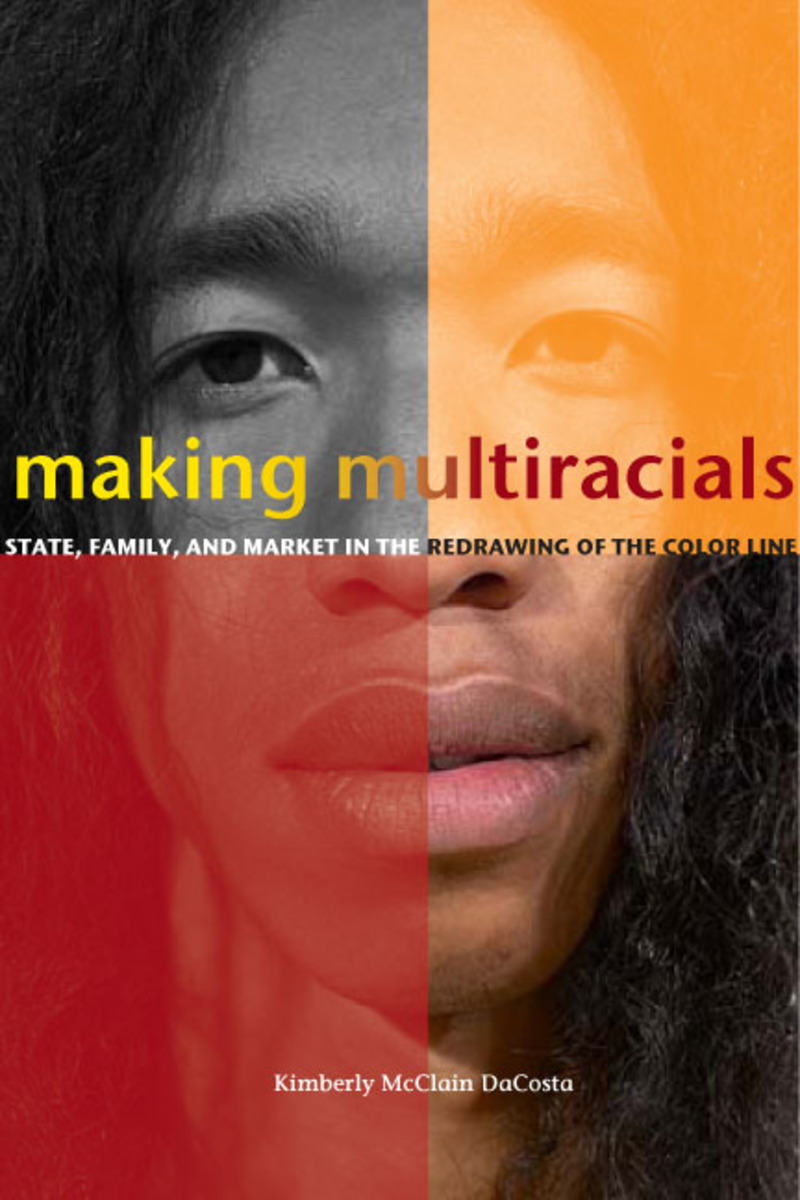
Making Multiracials: State, Family, and Market in the Redrawing of the Color Line

Posted in Anthropology, Books, Economics, Family/Parenting, Identity Development/Psychology, Media Archive, Monographs, Politics/Public Policy, Social Science, United States on 2009-10-29 03:28Z by Steven

Making Multiracials: State, Family, and Market in the Redrawing of the Color Line

Stanford University Press
2007
280 pages
3 tables, 2 figures, 4 illustrations.
Cloth ISBN-10: 0804755450; ISBN-13: 9780804755450
Paper ISBN-10: 0804755469; ISBN-13: 9780804755467

Kimberly McClain DaCosta, Associate Professor
Gallatin School of Individualized Study, New York University

When in 1997 golfer Tiger Woods described his racial identity on Oprah as “cablinasian,” it struck many as idiosyncratic. But by 2003, a New York Times article declared the arrival of “Generation E.A.”—the ethnically ambiguous. Multiracial had become a recognizable social category for a large group of Americans.

Making Multiracials tells the story of the social movement that emerged around mixed race identity in the 1990s. Organizations for interracial families and mixed race people—groups once loosely organized and only partially aware of each other—proliferated. What was once ignored, treated as taboo, or just thought not to exist quickly became part of the cultural mainstream.

How did this category of people come together? Why did the movement develop when it did? What is it about “being mixed” that constitutes a compelling basis for activism? Drawing on extensive interviews and fieldwork, the author answers these questions to show how multiracials have been “made” through state policy, family organizations, and market forces.

Table of Contents

  • Tables, Figures and Photos
  • Acknowledgements
  • The Making of a Category
  • Becoming a Multiracial Entrepreneur: Four Stories
  • Making Multiracial Families
  • Creating Multiracial Identity and Community
  • Consuming Multiracials
  • Redrawing the Color Line?: The Problems and Possibilities of Multiracial Families and Group Making
  • Appendix A: List of Respondents
  • Appendix B: Methodology
  • Appendix C: Situating Multiracial Group Making in the Literature on Social Movements, Race, and the Work of Pierre Bourdieu
  • Notes
  • Bibliography
  • Index

For the press release, click here.
For an excerpt of chapter 2, click here.

Tags: , , , ,

Injun Joe’s Ghost: The Indian Mixed-Blood in American Writing

Posted in Anthropology, Books, History, Literary/Artistic Criticism, Media Archive, Monographs, Native Americans/First Nation, United States on 2009-10-26 20:55Z by Steven

Injun Joe’s Ghost: The Indian Mixed-Blood in American Writing

University of Missouri Press
2004
ISBN 978-0-8262-1530-7
288 pages
6 x 9

Harry J. Brown, Assistant Professor of English
DePauw University

What does it mean to be a “mixed-blood,” and how has our understanding of this term changed over the last two centuries? What processes have shaped American thinking on racial blending?  Why has the figure of the mixed-blood, thought too offensive for polite conversation in the nineteenth century, become a major representative of twentieth-century native consciousness?

In Injun Joe’s Ghost, Harry J. Brown addresses these questions within the interrelated contexts of anthropology, U.S. Indian policy, and popular fiction by white and mixed-blood writers, mapping the evolution of “hybridity” from a biological to a cultural category. Brown traces the processes that once mandated the mixed-blood’s exile as a grotesque or criminal outcast and that have recently brought about his ascendance as a cultural hero in contemporary Native American writing.

Because the myth of the demise of the Indian and the ascendance of the Anglo-Saxon is traditionally tied to America’s national idea, nationalist literature depicts Indian-white hybrids in images of degeneracy, atavism, madness, and even criminality. A competing tradition of popular writing, however, often created by mixed-blood writers themselves, contests these images of the outcast half-breed by envisioning “hybrid vigor,” both biologically and linguistically, as a model for a culturally heterogeneous nation.

Injun Joe’s Ghost focuses on a significant figure in American history and culture that has, until now, remained on the periphery of academic discourse. Brown offers an in-depth discussion of many texts, including dime novels and Depression- era magazine fiction, that have been almost entirely neglected by scholars. This volume also covers texts such as the historical romances of the 1820s and the novels of the twentieth-century “Native American Renaissance” from a fresh perspective. Investigating a broad range of genres and subject over two hundred year of American writing, Injun Joe’s Ghost will be useful to students and professionals in the fields of American literature, popular culture, and native studies.

Tags: , , ,

The Social Construction of Race and Ethnicity in the United States (2nd Edition)

Posted in Anthologies, Anthropology, Books, Census/Demographics, Law, Media Archive, Politics/Public Policy, Social Science, United States on 2009-10-17 19:19Z by Steven

The Social Construction of Race and Ethnicity in the United States (2nd Edition)

Prentice Hall
2001
525 pages
Paperback ISBN-10: 0130283231; ISBN-13:  9780130283238

Edited By:

Joan Ferrante
Northern Kentucky University

Prince Brown, Jr.
Northern Kentucky University

For undergraduate courses in race and ethnic relations.

This groundbreaking collection of classic and cutting edge sociological research gives special attention to the social construction of race and ethnicity in the United States. It offers an in-depth and eye-opening analysis of (a) the power of racial classification to shape our understanding of race and race relations, (b) the way in which the system came into being and remains, and (c) the real consequences this system has on life chances.

I. THE PERSONAL EXPERIENCE OF CLASSIFICATION SCHEMES.
Patricia Riley, Adventures of an Indian Princess. Timothy Egan, Expelled in 1877, Indian Tribe is Now Wanted as a Resource. Lawrence Otis Graham, Black Man with a Nose Job. Garrett Hongo, Culture Wars in Asian America. Andrea Kim, Born and Raised in Hawaii, But Not Hawaiian. Yolanda Adams, Don’t Want to Be Black Anymore. Mitzi Uehara-Carter, On Being Blackanese. Joan Ferrante, Six Case Studies. Dympna Ugwu-Oju, What Will My Mother Say. Paul Andrew Dawkins, Apologizing for Being a Black Male. Judy Scales-Trent, Choosing Up Sides. Marilyn Halter, Identity Matters: The Immigrant Children. Sarah Van’t Hul, How It Was for Me. Joseph Tovares, Mojado Like Me. Yuri Kochiyama, Then Came the War.

II. CLASSIFYING PEOPLE BY RACE.
Paul Knepper, Historical Origins of the Prohibition of Multiracial Legal Identity in the State and the Nation. Federal Statistical Directive No. 15 THE U.S. OFFICE OF MANAGEMENT AND BUDGET, OMB’s Decisions: Revisions to Federal Statistical Directive. Prince Brown, Jr., Biology and the Social Construction of the “Race” Concept. Ian F. Haney Lopez, The Mean Streets of Social Race. Jack D. Forbes, “Indian” and “Black” as Radically Different Categories. Michael Granberry, A Tribe’s Battle for Its Identity. Madison Hemings, The Memoirs of Madison Hemings. Ariela J. Gross, Litigating Whiteness. Laura L. Lovett, Invoking Ancestors. Angelo N. Ancheta, Race Relations in Black and White . Time Magazine, How to Tell Your Friends From the Japs.

III. ETHNIC CLASSIFICATION.
The U.S. Bureau of the Census, Questions Related to Ethnicity. Luis Angel Toro, Directive No. 15 and Self-Identification. Himilce Novas, What’s in a Name? Julie E. Sprott, The Mingling of Alaska Natives with “Foreigners”: A Brief Historical Overview. Mary C. Waters, Choosing an Ancestry. David Steven Cohen, Reflections on American Ethnicity. Yen Le Espiritu, Theories of Ethnicity. Rudolph J. Vecoli, Are Italian-Americans Just White Folk? Peter D. Salins, Americans United by Myths.

IV. THE PERSISTENCE, FUNCTIONS, AND CONSEQUENCES OF SOCIAL CLASSIFICATION.
Judy Scales-Trent, On Being Like a Mule. Article XIX, Chinese, Constitution of the State of California, 1872; Repealed, November 4, 1952, State of California. Howard Zinn, Persons of Mean and Vile Condition. Stephen Jay Gould, Science and Jewish Immigration. J. A. Rogers, Remarks on the First Two Volumes of Sex and Race. Prince Brown, Jr., Why “Race” Makes No Scientific Sense: The Case of Africans and Native Americans. Albert Jacquard, Science, Pseudo-science and Racism. Charles A Gallagher, White Reconstruction in the University. Trina Grillo and Stephanie M. Wildman, Taking Back the Center. The U.S. Supreme Court, Plessy v. Ferguson. Cheryl I. Harris, Plessy. Albert Jacquard, Declaration of Athens: Scientists Speak Out Against Racism.

V. TOWARD A NEW PARADIGM: TRANSCENDING CATEGORIES.
Vivian J. Rohrl, The Anthropology of Race: A Study of Ways of Looking at Race. Letter from Thomas Jefferson: Virginia’s Definition of a Mulatto. Cruz Reynoso, Ethnic Diversity: Its Historical and Constitutional Roots. Erich Loewy, Making Good Again. Stephen H. Caldwell and Rebecca Popenoe, Perceptions and Misperceptions of Skin Color. Selected Discrimination Cases Handled by the U.S. Department of Justice in 1999. Nicholas Peroff, Indianess. K.C. Cole, Brain’s Use of Shortcuts Can Be A Route to Bias. Richard T. Schaefer, Talking Past One Another. Ward Churchill, Let’s Spread the “Fun” Around: The Issue of Sports Team Names and Mascots. Lawrence Otis Graham, The Rules of Passing. Anthony S. Parent and Susan Brown Wallace, Childhood and Sexual Identity Under Slavery. Patricia Hill Collins, Toward a New Vision: Race, Class, and Gender as Categories of Analysis and Connection. Bruce N. Simon, White-Blindness. Robert Jensen, White Privilege Shapes the U.S. Robert Jensen, More Thoughts on Why the System of White Privilege is Wrong.

Tags: , , , , , , , , , , , , , , , , , , , , , , , , , , , , , , , , , , , , , , , , ,

Lecture by Professor Jennifer DeVere Brody

Posted in Anthropology, Live Events, Media Archive, United States on 2009-10-13 18:57Z by Steven

Lecture by Professor Jennifer DeVere Brody

Theater Dance & Performance Studies
University of California at Berkeley
Durham Studio Theater (Dwinelle Hall)
Thursday, 2010-02-18 16:00 PST (Local Time)

Sponsor: Department of Theater, Dance & Performance Studies

Jennifer DeVere Brody is a Professor of African and African American Studies at Duke University where she teaches cultural and performance studies, gender and sexuality as well as film and literary studies. She is the author of Impossible Purities: Blackness, Femininity and Victorian Culture (Duke University Press, 1998) and Punctuation: Art, Politics and Play (Duke University Press, 2008). Her work has been supported by a Postdoctoral Fellowship from the Ford Foundation, a grant from the British Society for Theatre Research and was recognized by the Monette/Horwitz Trust for Independent Research to combat homophobia. Her research on race, visual culture and African American Literature has appeared in journals such as Genders, Signs, Callaloo, Theatre Journal, Text and Performance Quarterly and numerous edited volumes. Before joining the faculty at Duke, Professor Brody was the Weinberg College Board of Visitors Research and Teaching Professor at Northwestern University. She was also the President of the Women and Theatre Program, a division of the Association for Theatre in Higher Education. She serves on several boards and works with MLA, ASA, and ATHE.

Attendance restrictions: Free admission. Seating is limited. No advance reservations available.
Event Contact: tdps@berkeley.edu, 510-642-8268

Tags: , ,