Being Anglo-Indian: Practices and Stories from Calcutta

Posted in Anthropology, Asian Diaspora, Dissertations, Media Archive, Oceania, Religion on 2012-10-14 00:58Z by Steven

Being Anglo-Indian: Practices and Stories from Calcutta

Massey University, Palmerston North, New Zealand
2005
263 pages

Robyn Andrews, Lecturer, Social Anthropology Programme
Massey University

A thesis in partial fulfilment of the requirements for the degree of Doctor of Philosophy in Social Anthropology at Massey University

This thesis is an ethnography of Anglo-Indians in Calcutta. All ethnographies are accounts arising out of the experience of a particular kind of encounter between the people being written about and the person doing the writing. This thesis, amongst other things, reflects my changing views of how that experience should be recounted. I begin by outlining briefly who Anglo-Indians are, a topic which in itself alerts one to complexities of trying to get an ethnographic grip on a shifting subject. I then look at some crucial elements that are necessary for an “understanding” of Anglo-Indians in Calcutta: the work that has already been done in relation to Anglo-Indians, the urban context of the lives of my research participants and I discuss the methodological issues that I had to deal with in constructing this account.

In the second part of my thesis I explore some crucial elements of the lives of Anglo-Indians in Calcutta: the place of Christianity in their lives, education not just as an aspect of socialisation but as part of their very being and, finally, the public rituals that now give them another way of giving expression to new forms of Anglo-Indian becoming.

In all of my work I was driven by a desire to keep close to the experience of the people themselves and I have tried to write a “peopled” ethnography. This ambition is most fully realised in the final part of my thesis where I recount the lives of three key participants.

Read the entire dissertation here.

Tags: , , ,

Representations of colonial intimacy in Anglo-Indian narratives

Posted in Asian Diaspora, Dissertations, Media Archive, United States on 2012-10-13 19:31Z by Steven

Representations of colonial intimacy in Anglo-Indian narratives

Syracuse University, Syracuse, New York
2009
272 pages

Nandini Sengupta

This dissertation examines nineteenth-century manifestations of colonial intimacy in a range of texts produced by Anglo-Indians, capturing their colonial experience from the 1830s to the 1880s. Through these texts, I examine the ideological implications of interracial intimacy in a range of relationships that were established between the Indians and British in the ‘contact zone.’ The first two chapters examine the letters of Emily Eden and Fanny Parks to probe British women’s experience of India. I argue that the women forge an alternative space of intimacy that defies the notion that Anglo-Indian women remained on the periphery of Indian space as female ethnographers using their pen and pencil to engage in the act of colonial appropriation. Instead, such intimacies and attachments produce an alternative knowledge about India that expand our understanding of colonial interactions. In the third chapter, I read Philip Taylor’s novel Seeta (1872), which recuperates the events of the Sepoy Uprising of 1857. Taylor composes a story of interracial love and marriage between an English administrator and a Hindu widow. Probing the manifestations and ideological import of the sexual and emotional affinities for colonial relations in the moment of the Uprising, I argue that the interracial intimacy in the novel ultimately translates itself into an exercise of punishing the recalcitrant Indian man by embracing the compliant, loyal Indian woman. The final chapter continues the examination of interracial heterosexual intimacy through a reading of Rudyard Kipling’s short stories contained in the volume Plain Tales from the Hills. In particular, I probe his delineations of interracial heterosexual intimacy between various officers of empire and socially marginalized Indian women belonging to different ethnic communities of India to construct an argument about the operations of class in colonial India.

TABLE OF CONTENTS

  • List of Illustrative Material
  • Acknowledgments
  • Introduction
  • Chapter One: The British Woman Traveler in India: Diplomatic Intimacy and Hetero-Social Bonding in Emily Eden’s Up the Country
  • Chapter Two: The British Woman Traveler in India: Cultural Intimacy and Interracial Kinship in Fanny Parks’s Wanderings of a Pilgrim In Search of the Picturesque
  • Chapter Three: Interracial Love, Marriage and Female Friendship in Philip Meadows Taylor’s Seeta
  • Chapter Four: “Behind the Wooden Gate”: Rudyard’s Kipling’s Stories of Love and Betrayal
  • Conclusion
  • Works Cited
  • Curriculum Vita
  • List of Illustrative Material
    • Page 50: Map of India in 1836
    • Page 89: Frontispiece from Fanny Parks’s Wanderings of a Pilgrim in Search of the Picturesque
  • Acknowledgements
Tags: , , , , , , , , ,

Ai, a Steadfast Poetic Channel of Hard Lives, Dies at 62

Posted in Articles, Asian Diaspora, Biography, Media Archive, Native Americans/First Nation, United States, Women on 2012-10-13 15:10Z by Steven

Ai, a Steadfast Poetic Channel of Hard Lives, Dies at 62

The New York Times
2010-03-27

Margalit Fox

The prominent American poet Ai, whose work — known for its raw power, jagged edges and unflinching examination of violence and despair — stood as a damning indictment of American society, died on March 20 in Stillwater, Okla. She was 62 and lived in Stillwater.

The cause was pneumonia, a complication of previously undiagnosed cancer, said Carol Moder, head of the English department at Oklahoma State University, where Ai had taught since 1999.

Born Florence Anthony, the poet legally changed her name to Ai, which means love in Japanese, as a young woman. She received a National Book Award in 1999 for “Vice: New and Selected Poems,” published that year by W. W. Norton & Company.

Her other books include “Sin” (1986), “Fate” (1991), “Greed” (1993) and “Dread” (2003). A posthumous volume, “No Surrender,” is to be published by Norton in September…

…Though Ai’s work was determinedly not autobiographical, its concern with disenfranchised people was informed, she often said, by her own fractional heritage. Many poems could be read as biting dissertations “On Being 1/2 Japanese, 1/8 Choctaw, 1/4 Black, and 1/16 Irish,” as the title of a 1978 essay she wrote in Ms. magazine put it. (The proportions are telling, too, for not quite adding up to a complete person.)…

…Florence Anthony was born in 1947 in Albany, Tex., and reared mostly in Arizona by her mother and stepfather. For years her biological father’s identity was kept from her. She later learned, as she wrote in an autobiographical essay in the reference work Contemporary Poets, that “I am the child of a scandalous affair my mother had with a Japanese man she met at a streetcar stop.”…

Read the entire obituary here.

Tags: , , , ,

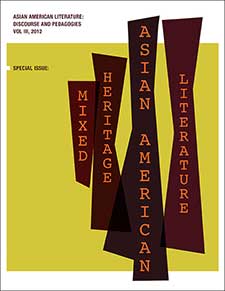
Special Issue: Mixed Heritage Asian American Literature

Posted in Articles, Asian Diaspora, Literary/Artistic Criticism, Media Archive on 2012-10-12 02:38Z by Steven

Special Issue: Mixed Heritage Asian American Literature

Asian American Literature: Discourses & Pedagogies
Volume 3 (2012): Special Issue: Mixed Heritage Asian American Literature

Table of Contents

Read the entire issue here.

Tags: , , , , , , , , , , , , , , , , , , , , , , , , , , , , ,

A diverged family converges at Harvard Law

Posted in Articles, Asian Diaspora, History, Identity Development/Psychology, United States on 2012-10-11 02:16Z by Steven

A diverged family converges at Harvard Law

Havard Law School News
2012-10-10

Audrey Kunycky

A chance encounter, a discovery of kin on opposite sides of the world

It wasn’t inevitable that Harvard Law School graduate students Erum Khalid Sattar and Rebecca Zaman would meet so soon, or even at all. Sattar has been at the law school for three years, pursuing a doctorate in juridical science (S.J.D.); Zaman arrived in August to begin a year of study for a master’s in law (LL.M.). Sattar is from Pakistan, and studied law in London; Zaman grew up, earned her law degree and completed a judicial clerkship in Australia. Then again, they’re about the same height, with the same dark brown hair, and that might not be just a coincidence.

In August, a few days into LL.M. Orientation, the two women shook hands and said hello at a Graduate Program reception. “If we hadn’t been wearing nametags, what happened next might never have happened,” says Zaman. Sattar’s large, expressive eyes are glittering, but she wants Zaman to tell the story, because she tells it better.

My surname is Zaman, and it’s a very unusual surname for a white-appearing Australian to have,” explains Zaman. “So when they saw my nametag, a lot of the Indians, Pakistanis and Middle Easterners asked how I could have this name. When I met Erum, it was very similar.  So I said, ‘Oh! My father’s father is a Muslim Indian from Hyderabad.’ And Erum said, ‘Oh, what a coincidence. My family was from Hyderabad, before they moved to Karachi after the partition.’ And she laughed, and said, ‘Maybe we’re related.’ We both laughed, and I said, ‘Maybe. It’s a strange story.’”…

Read the entire article here.

Tags: , , , , , , ,

Portuguese and Luso-Asian Legacies in Southeast Asia, 1511-2011, Volume 2: The Making of the Luso-Asian World: Culture and Identity in the Luso-Asian World: Tenacities & Plasticities

Posted in Anthologies, Anthropology, Arts, Asian Diaspora, Books, History, Media Archive on 2012-10-10 05:19Z by Steven

Portuguese and Luso-Asian Legacies in Southeast Asia, 1511-2011, Volume 2: Culture and Identity in the Luso-Asian World: Tenacities & Plasticities

Institute of Southeast Asian Studies
2012
368 pages
Soft cover ISBN: 978-981-4345-50-7
See Volume 1 here.

Edited by:

Laura Jarnagin, Visiting Professorial Fellow
Institute of Southeast Asian Studies in Singapore
also Associate Professor Emerita in the Division of Liberal Arts and International Studies at Colorado School of Mines (Golden, Colorado)

“In 1511, a Portuguese expedition under the command of Afonso de Albuquerque arrived on the shores of Malacca, taking control of the prosperous Malayan port-city after a swift military campaign. Portugal, a peripheral but then technologically advanced country in southwestern Europe since the latter fifteenth century, had been in the process of establishing solid outposts all along Asia’s litoral in order to participate in the most active and profitable maritime trading routes of the day. As it turned out, the Portuguese presence and influence in the Malayan Peninsula and elsewhere in continental and insular Asia expanded far beyond the sphere of commerce and extended over time well into the twenty-first century.

Five hundred years later, a conference held in Singapore brought together a large group of scholars from widely different national, academic and disciplinary contexts, to analyse and discuss the intricate consequences of Portuguese interactions in Asia over the longue dure. The result of these discussions is a stimulating set of case studies that, as a rule, combine original archival and/or field research with innovative historiographical perspectives. Luso-Asian communities, real and imagined, and Luso-Asian heritage, material and symbolic, are studied with depth and insight. The range of thematic, chronological and geographic areas covered in these proceedings is truly remarkable, showing not only the extraordinary relevance of revisiting Luso-Asian interactions in the longer term, but also the surprising dynamism within an area of studies which seemed on the verge of exhaustion. After all, archives from all over the world, from Rio de Janeiro to London, from Lisbon to Rome, and from Goa to Macao, might still hold some secrets on the subject of Luso-Asian relations, when duly explored by resourceful scholars.”

—Rui M. Loureiro
Centro de Historia de Alem-Mar, Lisbon

“This two-volume set pulls together several interdisciplinary studies historicizing Portuguese ‘legacies’ across Asia over a period of approximately five centuries (ca. 1511-2011). It is especially recommended to readers interested in the broader aspects of the early European presence in Asia, and specifically on questions of politics, colonial administration, commerce, societal interaction, integration, identity, hybridity, religion and language.”

—Associate Professor Peter Borschberg
Department of History, National University of Singapore

Table of Contents

  • Preliminary pages with Introduction
  • PART I: CRAFTING IDENTITY IN THE LUSO-ASIAN WORLD
    • 1. Catholic Communities and their Festivities under the Portuguese Padroado in Early Modern Southeast Asia, by Tara Alberts
    • 2. A “Snapshot” of a Portuguese Community in Southeast Asia: The Bandel of Siam, 1684-86, by Rita Bernardes de Carvalho
    • 3. The Colonial Command of Ceremonial Language: Etiquette and Custom-Imitation in Nineteenth-Century East Timor, by Ricardo Roque
    • 4. Remembering the Portuguese Presence in Timor and Its Contribution to the Making of Timor’s National and Cultural Identity, by Vicente Paulino
  • PART II: CULTURAL COMPONENTS: LANGUAGE, ARCHITECTURE AND MUSIC, by Alan Baxter
    • 5. The Creole-Portuguese Language of Malacca: A Delicate Ecology
    • 6. Oral Traditions of the Luso-Asian Communities: Local, Regional and Continental, by Hugo C. Cardoso
    • 7. Verb Markings in Makista: Continuity/Discontinuity and Accommodation, by Mario Pinharanda-Nunes
    • 8. From European-Asian Conflict to Cultural Hertiage: Identification of Portuguese and Spanish Forts on Ternate and Tidore Islands, by Manuel Lobato
    • 9. The Influence of Portuguese Musical Culture in Southeast Asia in the Sixteenth and Seventeenth Centuries, by Christian Storch
  • PART III: ADVERSITY AND ACCOMMODATION, by Roderich Ptak
    • 10. Portugal and China: An Anatomy of Harmonious Coexistence (Sixteenth and Seventeenth Centuries)
    • 11. “Aocheng” or “Cidade do Nome de Deus”: The Nomenclature of Portuguese and Castilian Buildings of Old Macao from the “Reversed Gaze” of the Chinese, by Vincent Ho
    • 12. Enemies, Friends, and Relations: Portuguese Eurasians during Malacca’s Dutch Era and Beyond, by Dennis De Witt
  • Appendix: Maps
  • Bibliography
  • Index
See Volume 1 here.
Tags: , , , , , , , , , , , , , , , , ,

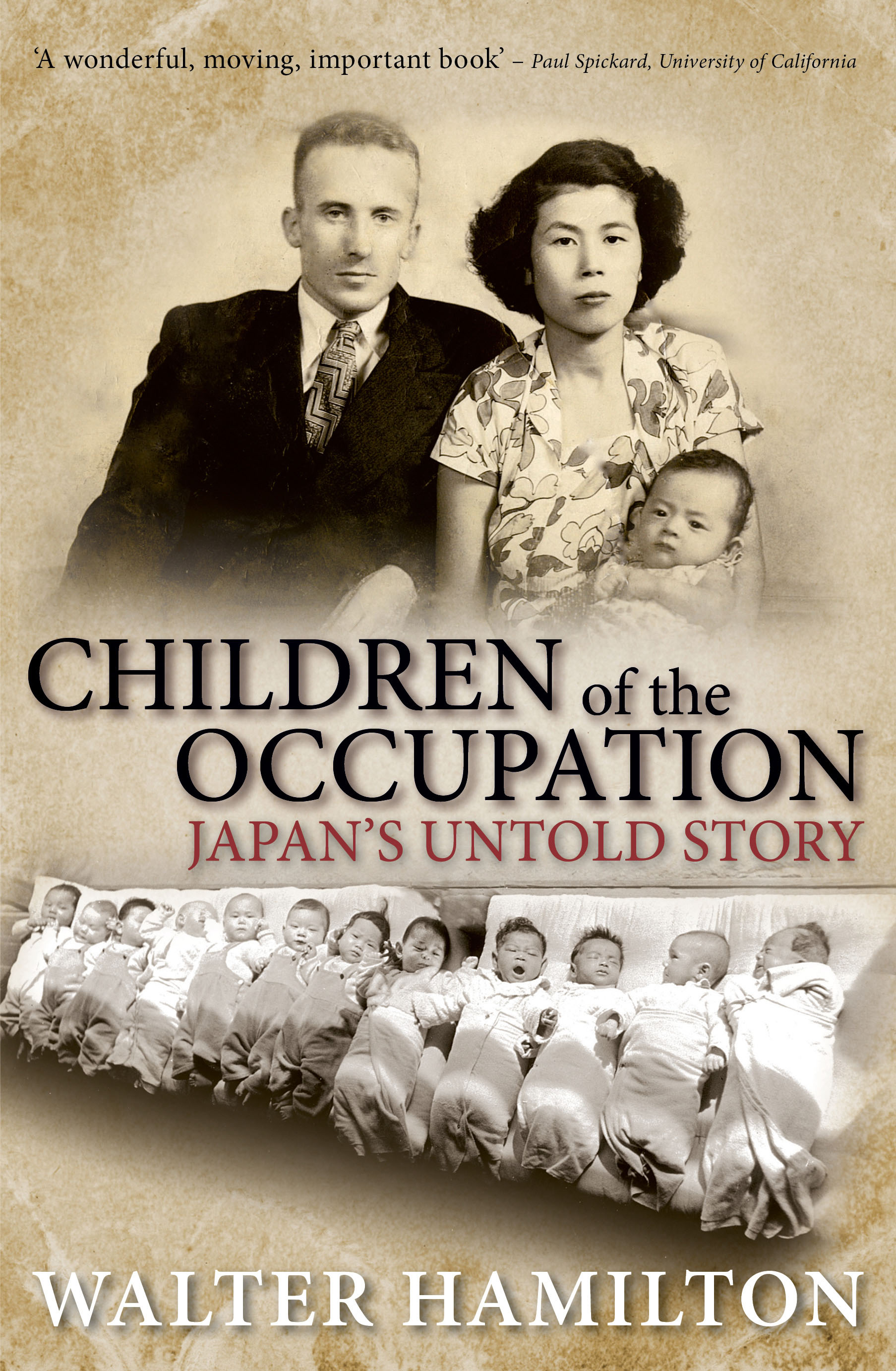
Children of the Occupation

Posted in Articles, Asian Diaspora, History, Media Archive, Oceania on 2012-10-10 01:19Z by Steven

Children of the Occupation

NewSouth Publishing
2012-07-01

Walter Hamilton, Journalist and Author

Towards the end of an eventful life, George Budworth, who served with the Australian Army in Japan after the war, wrote an account describing the first time he saw his son, Peter. It was not in a hospital maternity ward but on the streets of Kure one chilly night in 1954:

In broken English, the woman said, ‘Please, you look my baby, he sick’. She turned her back to Quietly [George’s fictional alter ego]. The baby was tied on her back in a kind of carryall. Quietly reached down and flipped back the lid. Looking up at him was the pinched, undernourished white face of a very young baby. Quietly could see at a glance that the child was half Japanese ­– certainly not a full blood. ‘He now six weeks; he Goshu (Australian) baby-san,’ was all she said through her sobs.

George gave the woman all the money he was carrying. She later sought him out to return the change; they started a relationship; and George formed a close bond with the child, Hideki, whom he renamed Peter and formally adopted.

In 1956, as the British Commonwealth Forces Korea prepared to pull out of Japan, George was among a handful of soldiers and civilians seeking permission to take adopted children back to Australia. In the decade since the first Australian troops arrived in Occupied Japan, such a thing had never been allowed (though war brides were admitted after 1952). In George’s fictionalised memoir, Peter’s mother, Fusako, surrenders custody of her child because she fears for his future in Japan: ‘They could never go to school, never marry, or hold any job but as labourers, in other words a life worse than death was the best these children could expect’…

…Walter Hamilton’s book Children of the Occupation: Japan’s Untold Story will be published by NewSouth in June.

Read the entire article here.

Tags: , , ,

Children of the Occupation: Japan’s Untold Story

Posted in Asian Diaspora, Books, Canada, History, Media Archive, Monographs, Oceania, United States on 2012-10-06 01:51Z by Steven

Children of the Occupation: Japan’s Untold Story

NewSouth Books (American Edition coming soon from Rutgers University Press)
July 2012
352 pages
234 x 153mm
Paperback ISBN: 9781742233314

Walter Hamilton, Journalist and Author

This is a beautifully written, deeply moving and well-researched account of the lives of mixed-race children of occupied Japan. The author artfully blends oral histories with an historical and political analysis of international race relations and immigration policy in North America and Australia, to highlight the little-known story of the thousands of children that resulted from the unions of Japanese women and Allied servicemen posted to Japan following WWII. It is a powerful narrative of loss, longing and reconnection, written by the ABC’s long-time Tokyo correspondent, Walter Hamilton.

Visit the website here.

Tags: , , , ,

The Biopolitics of Mixing: Thai Multiracialities and Haunted Ascendancies

Posted in Anthropology, Asian Diaspora, Books, Europe, Media Archive, Monographs, Social Science, United Kingdom on 2012-10-05 00:45Z by Steven

The Biopolitics of Mixing: Thai Multiracialities and Haunted Ascendancies

Ashgate Publishing
October 2012
198 pages
234 x 156 mm
Hardback ISBN: 978-0-7546-7680-5
ebook ISBN 978-1-4094-2502-1

Jinthana Haritaworn, Assistant Professor in Gender, Race and Environment at the Faculty of Environmental Studies
York University, Canada

Debates over who belongs in Europe and who doesn’t increasingly speak the language of mixing, but how are the figures commonly described as ‘mixed’ actually embodied? The Biopolitics of Mixing invites us to reckon with the spectres of pathologization past and present, placing the celebration of mixing beside moral panics over terrorism and trafficking and a post-race multiculturalism that elevates some as privileged members of the neoliberal community, whilst ghosting others from it. Drawing on a broad archive including rich qualitative interviews conducted in Britain and Germany, media and policy debates, popular culture, race-based research and queer-of-colour theories, this book imagines into being communities in which people and places normally kept separate can coexist in the same reality.

As such, it will appeal to scholars across a range of sociological and cultural studies, including critical race, ethnic and migration studies, transnational gender and queer studies, German and European studies, Thai and Southeast Asian studies, and studies of affect, performativity, biopolitics and necropolitics. It should be read by all those interested in thinking critically on the intersections of race, class, gender, sexuality and disability.

Contents

  • Introduction: haunted origins
  • Where are you from?
  • From monster to fashion model: regenerating racialized bodies
  • Is it better to be mixed race?
  • Hybrid nations, mixed feelings: from marginal man to Obama
  • Exceptional cities, exceptional citizens: metronormativity and mimeticism
  • Reckoning with prostitutes: performing Thai femininity
  • Conclusion: where do we want to go?
  • Bibliography
  • Index
Tags: , , , ,

Portuguese and Luso-Asian Legacies in Southeast Asia, 1511-2011, Volume 1: The Making of the Luso-Asian World: Intricacies of Engagement

Posted in Anthologies, Anthropology, Asian Diaspora, Books, History, Media Archive on 2012-10-04 05:05Z by Steven

Portuguese and Luso-Asian Legacies in Southeast Asia, 1511-2011, Volume 1: The Making of the Luso-Asian World: Intricacies of Engagement

Institute of Southeast Asian Studies
2011
323 pages
Soft cover ISBN: 978-981-4345-25-5
See Volume 1 here.

Edited by:

Laura Jarnagin, Visiting Professorial Fellow
Institute of Southeast Asian Studies in Singapore
also Associate Professor Emerita in the Division of Liberal Arts and International Studies at Colorado School of Mines (Golden, Colorado)

“In 1511, a Portuguese expedition under the command of Afonso de Albuquerque arrived on the shores of Malacca, taking control of the prosperous Malayan port-city after a swift military campaign. Portugal, a peripheral but then technologically advanced country in southwestern Europe since the latter fifteenth century, had been in the process of establishing solid outposts all along Asia’s litoral in order to participate in the most active and profitable maritime trading routes of the day. As it turned out, the Portuguese presence and influence in the Malayan Peninsula and elsewhere in continental and insular Asia expanded far beyond the sphere of commerce and extended over time well into the twenty-first century.

Five hundred years later, a conference held in Singapore brought together a large group of scholars from widely different national, academic and disciplinary contexts, to analyse and discuss the intricate consequences of Portuguese interactions in Asia over the longue dure. The result of these discussions is a stimulating set of case studies that, as a rule, combine original archival and/or field research with innovative historiographical perspectives. Luso-Asian communities, real and imagined, and Luso-Asian heritage, material and symbolic, are studied with depth and insight. The range of thematic, chronological and geographic areas covered in these proceedings is truly remarkable, showing not only the extraordinary relevance of revisiting Luso-Asian interactions in the longer term, but also the surprising dynamism within an area of studies which seemed on the verge of exhaustion. After all, archives from all over the world, from Rio de Janeiro to London, from Lisbon to Rome, and from Goa to Macao, might still hold some secrets on the subject of Luso-Asian relations, when duly explored by resourceful scholars.”

—Rui M. Loureiro
Centro de Historia de Alem-Mar, Lisbon

“This two-volume set pulls together several interdisciplinary studies historicizing Portuguese ‘legacies’ across Asia over a period of approximately five centuries (ca. 1511-2011). It is especially recommended to readers interested in the broader aspects of the early European presence in Asia, and specifically on questions of politics, colonial administration, commerce, societal interaction, integration, identity, hybridity, religion and language.”

—Associate Professor Peter Borschberg
Department of History, National University of Singapore

Table of Contents

  • Preliminary pages
  • PART I: ADAPTATIONS AND TRANSITIONS IN THE SOUTH AND SOUTHEAST ASIAN THEATRES, SIXTEENTH THROUGH EIGHTEENTH CENTURIES
    • 1. Supplying Simples for the Royal Hospital: An Indo-Portuguese Medicinal Garden in Goa (1520-1830), by Timothy D. Walker 
    • 2. Malacca in the Era of Viceroy Linhares (1629-35), by Anthony Disney
    • 3. From Meliapor to Mylapore, 1662-1749: The Portuguese Presence in Sao Tome between the Qut.b Shahi Conquest and Its Incorporation into British Madras, by Paolo Aranha
    • 4. Eighteenth-Century Diplomatic Relations between Portuguese Macao and Ayutthaya: The 1721 Debt Repayment Embassy from Macao, by Stefan Halikowski Smith
    • 5. Continuities in Bengal’s Contact with the Portuguese and Its Legacy: A Community’s Future Entangled with the Past, by Ujjayan Bhattacharya
  • PART II: DISPERSION, MOBILITY AND DEMOGRAPHY FROM THE SIXTEENTH INTO THE TWENTY-FIRST CENTURIES
    • 6. The Luso-Asians and Other Eurasians: Their Domestic and Diasporic Identities, by John Byrne
    • 7. The Population of the Portuguese Estado da India, 1750-1820: Sources and Demographic Trends, by Paulo Teodoro de Matos
    • 8. Flying with the Papagaio Verde (Green Parrot): An Indo-Portuguese Folkloric Motif in South and Southeast Asia, by K. David Jackson
  • PART III: MIXED LEGACIES: THE PORTUGUESE AND LUSO-ASIANS IN THE TWENTIETH AND TWENTY-FIRST CENTURIES
    • 9. Portuguese Communities in East and Southeast Asia during the Japanese Occupation, by Felicia Yap
    • 10. Indo-Portuguese Literature and the Goa of Its Writers, by Everton V. Machado
    • 11. Binding Ties of Miscegenation and Identity: The Narratives of Henrique Senna Fernandes (Macao) and Rex Shelley (Singapore), by Isabel Maria da Costa Morais
    • 12. Portuguese Past, Still Imperfect: Revisiting Asia in Luso-Diasporic Writing, by Christopher Larkosh
  • Bibliography
  • Index

See Volume 1 here.

Tags: , , , , , , , , , , , , , ,