From exclusion and alienation to a ‘multi-racial community’: The image of the métis in New Caledonian literature

Posted in Articles, Asian Diaspora, Literary/Artistic Criticism, Media Archive, Social Science on 2009-10-31 21:36Z by Steven

From exclusion and alienation to a ‘multi-racial community’: The image of the métis in New Caledonian literature

International Journal of Francophone Studies
ISSN: 13682679
Volume 8 Issue 3
December 2005
DOI: 10.1386/ijfs.8.3.305/1

Peter Brown 

In her 2005 New Year’s greetings, Marie-Noëlle Thémereau, the President of the New Caledonian government, expressed her confidence in the future of her multiracial country, echoing the recognition of New Caledonia’s demographic make-up in official discourse since the Noumea Accord (1998). This view of New Caledonian society has not, however, always been so optimistic or encompassing. The island’s mixed population of some 230,000 has given rise over the years to social and political tensions. In this context, representations of Self and Other found in the island’s literature, particularly as they concern the historically highly contentious issue of biological and cultural interaction, provide valuable perspectives on this subject, enabling us to trace the evolution of local attitudes to the question of métissage and acquire a broader vision of the lived experience of the island’s population.

Tags: , ,

Mixed-Race Identity Politics in Nella Larsen and Winnifred Eaton (Onoto Watanna)

Posted in Asian Diaspora, Dissertations, Literary/Artistic Criticism, Media Archive, Passing, Social Science, Women on 2009-10-29 16:30Z by Steven

Mixed-Race Identity Politics in Nella Larsen and Winnifred Eaton (Onoto Watanna)

Ohio University
English (Arts and Sciences) Department
November 2001
217 pages
Advisor: David Dean McWilliams

Sachi Nakachi

A dissertation presented to the faculty of the College of Arts and Sciences of Ohio University In partial fulfillment of the requirements for the degree Doctor of Philosophy.

The dissertation examines how two women authors of mixed-race, Nella Larsen and Winnifred Eaton (Onoto Watanna), resisted American identity politics in their works.  The ideological complexities of mixed-race identity, which is “in-between” races, are the focus of my argument. To discuss what Judith Butler calls “the performativity of identity” in the interracial context, “passing,” “masquerading” and “mimicking” are used as key strategies. I examine whether the space of hybridity, in which the incompatible notions of difference and sameness exist together, opens up the horizon of transformation of significations . In Chapter One, I discuss how Larsen used her “mulatto” heroines to criticize the essentialist notion of identity. I probe how crossing boundaries (passing, geographical crossing and transgressing sexual norms) functions in her novels. In Chapter Two, I examine the works of Winnifred Eaton, who passed as Japanese in her authorship. By crossing the “authentic” ethnic boundaries and placing herself in a fictional identity, Eaton challenged racism and sexism. The dynamics of Orientalism, race and gender in Eaton’s works are examined in this chapter. Postmodern feminist theories and postcolonial theories are used in tandem to support my argument, which tries to discuss how the system of racial oppression operates in multi-racial/multi-ethnic women’s literature.

Read the entire dissertation here.

Tags: , , , ,

Mixed Race Literature

Posted in Anthologies, Asian Diaspora, Books, History, Identity Development/Psychology, Literary/Artistic Criticism, Media Archive on 2009-10-24 01:37Z by Steven

Mixed Race Literature

Stanford University Press
2002
256 pages
8 illustrations
Cloth Edition: ISBN-10: 0804736391; ISBN-13: 9780804736398
Paperback Edition ISBN-10: 0804736405; ISBN-13: 9780804736404

Edited by

Jonathan Brennan, Professor of English
Mission College, Santa Clara, California

This collection presents the first scholarly attempt to map the rapidly emerging field of mixed-race literature, defined as texts written by authors who represent multiple cultural and literary traditions—African-European, Native-European, Eurasian, African-Asian, and Native-African American. It not only allows scholars to engage a wide variety of mixed race literatures and critical approaches, but also to situate these literatures in relation to contemporary fields of literary inquiry.

The editor’s introduction provides a historical context for the development of mixed-race identity and literature, summarizing existing scholarship on the subject, interrogating the social construction of race and mixed race, and arguing for a literary (rather than literal) inquiry into mixed-race texts.

The essays examine such subjects as mythmaking and interpreting; the illustration of mixed-race texts; the mixed-race drama of Velina Hasu Houston; race, gender, and transnational spaces; the meaning and negotiation of identity; the theory of kin-aesthetic in Asian-Native American literatures; and Maori-Pakeha mixed-race writing in New Zealand.

The editor’s conclusion argues that rather than following the tragic employment assigned to mulattos, octoroons, and half-bloods, the evolution of mixed-race texts has been from tragedy to trickster. The role of the tragic trickster facilitates a shift in which new and distinct literary strategies and forms emerge. These models represent critical sites from which to theorize the overall formation of American literature and to complicate its formation in ways that unfold our usual notions of race, gender, and culture.

Tags: ,

What Are You? The Changing Face of America with Kip Fulbeck

Posted in Arts, Asian Diaspora, Live Events, New Media, United States on 2009-10-22 14:44Z by Steven

What Are You? The Changing Face of America with Kip Fulbeck

National Association of Independent Schools (NAIS)
2010 Annual Conference
Dates: 2010-02-24 through 2010-02-26
Moscone Convention Center West
San Francisco, California, USA
Adapt, Survive, Thrive: Unleashing the Superpowers Within

Kip Fulbeck, Professor of Performative Studies, Video
University of California, Santa Barbara

Friday, 2010-02-26
13:30 – 14:30 PDT (Local Time)

A seminal artist exploring multiracial identity, Kip Fulbeck captivates audiences with his videos, performances, and writings. His words and artwork have received a landslide of attention from media as diverse as MTV and CNN. On stage his uniquely personal monologues and multimedia shows combine stand-up comedy with a powerful and politically charged edge, leading audiences to honestly consider Who Am I? Using his own Cantonese, English, Irish, and Welsh background as a springboard, Fulbeck confronts media imagery of Asian men, interracial dating patterns, and icons of race and sex in the U.S., constantly questioning where Hapas “fit in” in a country that ignores multiracial identity. His work invites and inspires viewers to explore how ethnic stereotypes and opinions on interracial dating, gender roles, and personal identity are formed. A professor at the University of California, Santa Barbara, Fulbeck has performed and exhibited across the U.S. and in more than 20 countries. He has twice keynoted the National Conference on Race in Higher Education to standing ovations; directed 13 independent videos; and authored the critically acclaimed books Paper Bullets: A Fictional Autobiography and Part Asian, 100% Hapa, featuring portraits of multiracials of Asian/Pacific Islander descent, with an introduction by Sean Lennon.

Tags: , , , ,

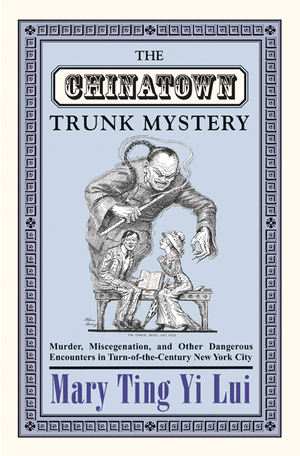
The Chinatown Trunk Mystery: Murder, Miscegenation, and Other Dangerous Encounters in Turn-of-the-Century New York City

Posted in Asian Diaspora, Books, History, Media Archive, Monographs, United States on 2009-10-18 20:44Z by Steven

The Chinatown Trunk Mystery: Murder, Miscegenation, and Other Dangerous Encounters in Turn-of-the-Century New York City

Princeton University Press
November 2004
320 pages
6 x 9; 23 halftones. 4 maps.
Paperback ISBN: 9780691130484

Mary Ting Yi Lui, Assistant Professor of American Studies and History
Yale University

2005 AAAS Book Award, History category

In the summer of 1909, the gruesome murder of nineteen-year-old Elsie Sigel sent shock waves through New York City and the nation at large. The young woman’s strangled corpse was discovered inside a trunk in the midtown Manhattan apartment of her reputed former Sunday school student and lover, a Chinese man named Leon Ling.

Through the lens of this unsolved murder, Mary Ting Yi Lui offers a fascinating snapshot of social and sexual relations between Chinese and non-Chinese populations in turn-of-the-century New York City. Sigel’s murder was more than a notorious crime, Lui contends. It was a clear signal that attempts to maintain geographical and social boundaries between the city’s Chinese male and white female populations had failed.

When police discovered Sigel and Leon Ling’s love letters, giving rise to the theory that Leon Ling killed his lover in a fit of jealous rage, this idea became even more embedded in the public consciousness. New Yorkers condemned the work of Chinese missions and eagerly participated in the massive national and international manhunt to locate the vanished Leon Ling.

Lui explores how the narratives of racial and sexual danger that arose from the Sigel murder revealed widespread concerns about interracial social and sexual mixing during the era. She also examines how they provoked far-reaching skepticism about regulatory efforts to limit the social and physical mobility of Chinese immigrants and white working-class and middle-class women.

Through her thorough re-examination of this notorious murder, Lui reveals in unprecedented detail how contemporary politics of race, gender, and sexuality shaped public responses to the presence of Chinese immigrants during the Chinese exclusion era.

Tags: , , , , , ,

The Sum of Our Parts: Mixed-Heritage Asian Americans

Posted in Anthologies, Asian Diaspora, Books, Census/Demographics, Media Archive, Politics/Public Policy, United States on 2009-10-15 20:55Z by Steven

The Sum of Our Parts: Mixed-Heritage Asian Americans

Temple University Press
June 2001
296 pages
7×10
2 tables 4 figures 3 halftones
paper: EAN: 978-1-56639-847-3 (ISBN: 1-56639-847-9)

edited by Teresa Williams-León and Cynthia L. Nakashima, foreword by Michael Omi

Largely as a result of multiracial activism, the US Census for 2000 offers people the unprecedented opportunity to officially identify themselves with more than one racial group. Among Asian-heritage people in this country and elsewhere, racial and ethnic mixing has a long but unacknowledged history. According to the last US Census, nearly one-third of all interracial marriages included an Asian-descent spouse, and intermarriage rates are accelerating. This unique collection of essays focuses on the construction of identity among people of Asian descent who claim multiple heritages.

In the U.S., discussions of race generally center on matters of black and white; mixed heritage Asian Americans usually figure in conversations about race as an undifferentiated ethnic group or as exotic Eurasians. The contributors to this book disrupt the standard discussions by considering people of mixed Asian ethnicities. They also pay particular attention to non-white multiracial identities to decenter whiteness and reflect the experience of individuals or communities who are considered a minority within a minority. With an entire section devoted to the Asian diaspora, The Sum of Our Parts suggests that questions of multiracial and multiethnic identity are surfacing around the globe. This timely and provocative collection articulates them for social scientists and students.

Table of Contents

  • ForewordMichael Omi
  • Acknowledgments
  • Introduction: Reconfiguring Race, Rearticulating Ethnicity – Teresa Williams-León and Cynthia L. Nakashima
  • Part I: Multiraciality and Asian America: Bridging the Hybrid Past to the Multiracial Present
    • 1. Who Is an Asian? Who Is a Pacific Islander? Monoracialism, Multiracial People, and Asian American Communities – Paul Spickard
    • 2. Possibilities of a Multiracial Asian America – Yen Le Espiritu
    • 3. Servants of Culture: The Symbolic Role of Mixed-Race Asians in American Discourse – Cynthia L. Nakashima
    • 4. “The Coming of the Neo-Hawaiian American Race”: Nationalism and Metaphors of the Melting Pot in Popular Accounts of Mixed-Race Individuals – John Chock Rosa
  • Part II: Navigating Sociocultural Terrains of Family and Identity
    • 5. Factors Influencing the Variation in Racial and Ethnic Identity of Mixed-Heritage Persons of Asian Ancestry – Maria P. P. Root
    • 6. Alaska’s Multiracial Asian American Families: Not Just at the Margins – Curtiss Takada Rooks
    • 7. The Diversity of Biracial Individuals: Asian-White and Asian-Minority Biracial Identity – Christine C. Iikima Hall and Trude I. Cooke Turner
    • 8. Black, Japanese, and American: An Asian American Identity Yesterday and Today – Michael C. Thornton and Harold Gates
  • Part III: Remapping Political Landscapes and Communities
    • 9. A Rose by Any Other Name: Names, Multiracial/Multiethnic People, and the Politics of Identity – Daniel A. Nakashima
    • 10. Multiracial Comedy as a Commodity in Hawaii – Darby Li Po Price
    • 11. Doing the Mixed-Race Dance: Negotiating Social Spaces Within the Multiracial Vietnamese American Class Typology – Kieu Linh Caroline Valverde
    • 12. The Convergence of Passing Zones: Multiracial Gays, Lesbians, and Bisexuals of Asian Descent – Teresa Williams-León
    • 13. Mirror, Mirror, on the Wall: Mapping Discussions of Feminism, Race, and Beauty in Japanese American Beauty Pageants – Rebecca Chiyoko King
    • 14. Mixed but Not Matched: Multiracial People and the Organization of Health Knowledge – Cathy J. Tashiro
  • Part IV: Asian-Descent Multiraciality in Global Perspective
    • 15. “We Paved the Way”: Exemplary Spaces and Mixed Race in Britain – David Parker
    • 16. A Dutch Eurasian Revival? – Mark Taylor Brinsfield
    • 17. Multiethnic Lives and Monoethnic Myths: American-Japanese Amerasians in Japan – Stephen Murphy-Shigematsu
    • 18. The Racial Politics of Being Dogla and of “Asian” Descent in Suriname – Loraine Y. Van Tuyl
    • 19. The Tiger and His Stripes: Thai and American Reactions to Tiger Woods’s (Multi-) “Racial Self” – Loraine Y. Van Tuyl
  • Bibliography
  • About the Contributors
Tags: , , , , , , , , , , , , , , , , , , , , , , , , ,

Raising Eurasia: Race, Class, and Age in French and British Colonies

Posted in Articles, Asian Diaspora, Caribbean/Latin America, Europe, History, Media Archive, Social Science, United Kingdom, United States on 2009-10-15 19:47Z by Steven

Raising Eurasia: Race, Class, and Age in French and British Colonies

Comparative Studies in Society and History
Volume 51, Issue 2 (April 2009)
pages 314-343
DOI: 10.1017/S0010417509000140

David M. Pomfret, Associate Professor
The University of Hong Kong

Sexual relationships between European men and indigenous women produced racially mixed offspring in all of Europe’s empires. Recent interdisciplinary scholarship has shown how these persons of mixed race, seen as transgressing the interior frontiers of supposedly fixed categories of racial and juridical difference upon which colonizers’ prestige and authority rested, posed a challenge to the elaborate but fragile sets of subjective criteria by which “whiteness” was defined.  Scholars critiquing the traditional historiography of empire for its tendency to present colonial elites as homogeneous communities pursuing common interests have emphasized the repertoire of exclusionary tactics, constructed along lines of race, class, and gender, devised within European colonial communities in response to the presence of “mixed bloods.” This article aims to show that the presence of people of biracial heritage inspired collaborative as well as exclusionary responses in outposts of European empire during the late imperial era. It also illustrates how, with white prestige and authority at stake, age, age-related subcategories, and in particular childhood and adolescence, powerfully underpinned responses to the threat this group posed to the cultural reproduction of racialized identity.

Footnotes
Acknowledgments: Research for this article was generously supported by the Hong Kong Government Research Grants Council Competitive Earmarked Research Grant (HKU7455/05H).

Tags: , , , ,

Callaloo Nation: Metaphors of Race and Religious Identity among South Asians in Trinidad

Posted in Asian Diaspora, Books, Caribbean/Latin America, Identity Development/Psychology, Media Archive, Monographs, Religion on 2009-10-12 22:38Z by Steven

Callaloo Nation: Metaphors of Race and Religious Identity among South Asians in Trinidad

Duke University Press
October 2004
280 pages
9 b&w photos, 2 maps
Cloth ISBN: 0-8223-3376-7, ISBN13: 978-0-8223-3376-0
Paperback ISBN: 0-8223-3388-0, ISBN13: 978-0-8223-3388-3

Aisha Khan, Associate Professor of Anthropology
New York University

Mixing—whether referred to as mestizaje, callaloo, hybridity, creolization, or multiculturalism—is a foundational cultural trope in Caribbean and Latin American societies. Historically entwined with colonial, anticolonial, and democratic ideologies, ideas about mixing are powerful forces in the ways identities are interpreted and evaluated. As Aisha Khan shows in this ethnography, they reveal the tension that exists between identity as a source of equality and identity as an instrument through which social and cultural hierarchies are reinforced. Focusing on the Indian diaspora in the Caribbean, Khan examines this paradox as it is expressed in key dimensions of Hindu and Muslim cultural history and social relationships in southern Trinidad. In vivid detail, she describes how disempowered communities create livable conditions for themselves while participating in a broader culture that both celebrates and denies difference.

Khan combines ethnographic research she conducted in Trinidad over the course of a decade with extensive archival research to explore how Hindu and Muslim Indo-Trinidadians interpret authority, generational tensions, and the transformations of Indian culture in the Caribbean through metaphors of mixing. She demonstrates how ambivalence about the desirability of a callaloo nation—a multicultural society—is manifest around practices and issues, including rituals, labor, intermarriage, and class mobility. Khan maintains that metaphors of mixing are pervasive and worth paying attention to: the assumptions and concerns they communicate are key to unraveling who Indo-Trinidadians imagine themselves to be and how identities such as race and religion shape and are shaped by the politics of multiculturalism.

Tags: , ,

America Beyond Black and White: How Immigrants and Fusions Are Helping Us Overcome the Racial Divide

Posted in Asian Diaspora, Books, Media Archive, Monographs, Social Science, United States on 2009-10-12 22:03Z by Steven

America Beyond Black and White: How Immigrants and Fusions Are Helping Us Overcome the Racial Divide

University of Michigan Press
2007
296 oages
6 x 9. 296 pgs. 1 table
Cloth: 978-0-472-11609-6
Paper: 978-0-472-03320-1
Ebook Formats: 978-0-472-02175-8

Ronald Fernandez, Professor of Sociology
Criminal Justice Department
Central Connecticut State University

For the first time in U.S. history, the black-white dichotomy that historically has defined race and ethnicity is being challenged, not by a small minority, but by the fastest-growing and arguably most vocal segment of the increasingly diverse American population—Mexicans, Chinese, Japanese, Koreans, Indians, Arabs, and many more—who are breaking down and recreating the very definitions of race.

Drawing on interviews with hundreds of Americans who don’t fit conventional black or white categories, the author invites us to empathize with these “doubles” and to understand why they represent our best chance to throw off the strictures of the black-white division.

The revolution is already under way, as newcomers and mixed-race fusions reject the prevailing Anglo-Protestant culture. Americans face two choices: understand why these individuals think as they do or face a future that continues to define us by what divides us rather than by what unites us.

Tags: , ,

Multiracial Faces: How Categorization Affects Memory at the Boundaries of Race

Posted in Articles, Asian Diaspora, Media Archive, Social Science, United States on 2009-10-10 16:26Z by Steven

Multiracial Faces: How Categorization Affects Memory at the Boundaries of Race

Journal of Social Issues
Volume 65, Number 1 (March 2009)
pages 69-86
DOI: 10.1111/j.1540-4560.2008.01588.x

Kristin Pauker
Tufts University

Nalini Ambady
Tufts University

Monoracial and multiracial individuals are likely to have different conceptualizations of race and subsequently different approaches toward racial ambiguity.  In particular, monoracial individuals may be more likely to rely on categories when processing ambiguous faces, whereas multiracial individuals may tend to ignore such categorizations due to a reduced tendency to essentialize race.  We compared monoracial (White and Asian) and biracial (Asian/White) individuals’ memory patterns.  Specifically, we examined participants’ memory for White, Asian, and biracial faces labelled as either White or Asian.  Both White and Asian participants relied on the labels, remembering faces labeled as the in-group better than faces labeled as the out-group. Biracial participants relied less on the labels, exhibiting better recognition memory overall. Biracial participants’ memory performance was also highly correlated with a less essentialist view of human traits.  This cognitive flexibility may serve an adaptive function for biracial individuals and contribute to enhanced facial recognition.

Read or purchase the article here.

Tags: , ,