Half-Caste Woman

Posted in Arts, Asian Diaspora, Media Archive, Women on 2011-08-07 03:27Z by Steven

Half-Caste Woman

Noël Coward
1932

Laugh a bit, drink a bit, love a bit more.
You can supply our needs.
Think a bit, sink a bit, what’s it all for.
That’s your Eurasian creed.

Sailors with sentimental hearts, who love and sail away.
When the dawn is gray, look at you… and say.

Half-caste woman, living a life apart.
Where did your story begin?
Half-caste-woman, have you a secret heart
Waiting for someone to win?

Were you born of some queer magic
In your shimmering gown?
Is there something strange and tragic
Deep, deep down?

Half-caste woman, what are your slanting eyes
Waiting and hoping to see?
Scanning the far horizon
Wondering what the end will be.

Down along the river
The sky is a quiver
And dawn is beginning to break.

Hear the sirens wailing
Some big ship is sailing.
I’m loosing my dreams in it’s wake.

Why should I remember the things that are past
Moments so softly gone.
Why worry for the Lord knows
Live goes on.

Go to bed in daylight.
Try to sleep in vain.
Get up in the evening.
Work begins again.

Tinker, tailor, soldier, sailor, rich man, poor man, beggar-man, thief
Questioning the same refrain.

Half-caste woman, living a life apart.
Where did your story begin?
Half-caste woman, have you a secret heart
Waiting for someone to win?

Were you born of some queer magic
In your shimmering gown?
Is there something strange and tragic
Deep, deep down?

Half-caste woman, what are your slanting eyes
Waiting and hoping to see?
Scanning the far horizon
Wondering what the end will be.

Tags: ,

Love with a Proper Stranger: What Anti-Miscegenation Laws Can Tell Us About the Meaning of Race, Sex, and Marriage

Posted in Articles, Asian Diaspora, Law, Media Archive, Native Americans/First Nation, United States on 2011-08-06 22:03Z by Steven

Love with a Proper Stranger: What Anti-Miscegenation Laws Can Tell Us About the Meaning of Race, Sex, and Marriage

Hofstra Law Review
Volume 32, Issue 4 (2004)
pages 1663-1679

Rachel F. Moran, Michael J. Connell Distinguished Professor of Law
University of California, Los Angeles

True love. Is it really necessary?
Tact and common sense tell us to pass over it in silence,
like a scandal in Life’s highest circles.
Perfectly good children are born without its help.
It couldn’t populate the planet in a million years,
it comes along so rarely.

Wislawa Szymborska

If true love is for the lucky few, then for the rest of us there is the far more mundane institution of marriage. Traditionally, love has sat in an uneasy relationship to marriage, and only in the last century has romantic love emerged as the primary, if not exclusive, justification for a wedding in the United States. In part, the triumph of love reflects a society increasingly committed to an ethic of individualism, including individualism of the romantic variety, so that marriage is no longer presumptively a tool for the State to advance the general welfare. In the quest for individual liberation, women have gained access to education and employment that increasingly emancipates them from dependency on a husband to achieve economic security.

Because marriage has grown to be a matter of personal choice, the number of restrictions on permissible partners has steadily declined. Even so, some official regulation persists, and we can learn as much about the meaning of matrimony by looking at who is excluded as by looking at who is eligible. To that end, I want to explore the lessons of anti-miscegenation laws, state statutes that once prohibited interracial marriage. At one time, these statutes were widespread, but they were not identical in their coverage. The laws universally targeted relationships between Blacks and Whites, and a number of the provisions, particularly those in Western states, banned unions between Asians and Whites. A few restricted intermarriage with Native Americans, but none mentioned Latinos. The laws had a remarkable longevity. Even though individuals enjoyed increasing freedom to choose a mate free of state and community interference, these statutes remained valid until 1967 when the United States Supreme Court struck them down as unconstitutional in Loving v. Virginia.

Although anti-miscegenation laws generally have been analyzed as racial legislation, they also can tell us a great deal about intimacy. These provisions have certainly been used to define and entrench racial difference, but they are also a means to set the boundaries of sexual decency and marital propriety. Here, I will use the comparative experience of Blacks, Asians, Native Americans, and Latinos to illustrate some of the laws’ implications for race and identity. I will then place the statutes in the context of larger developments regarding the regulation of sex and marriage to show how they reflected anxieties about wayward lust and forbidden desire.

I. THE ROLE OF ANTI-MISCEGENATION LAWS IN RACIAL SEPARATION AND STRATIFICATION

In the American mythology of racial segregation, there is an assumption that racial groups have always lived separately and that there is an almost natural inevitability about this arrangement. In fact, in the earliest years of settling the American colonies, Black slaves often worked side by side with White indentured servants. In these close, cooperative arrangements, interracial attraction was by no means a rarity. Relationships across the color line complicated social boundaries between Black and White, slave and free. Whites who, at least as a formal matter, had freely chosen a temporary contract of hard labor did not seem so very different from Blacks who had been sold into prevented race-mixing that undermined both the sanctity of free White labor and the legitimacy of Blacks’ status as property.

As the institution of slavery was consolidated, anti-miscegenation laws assumed another valuable purpose. They defined a racial hierarchy in which Whites were free and Blacks were not. Although many statutes banned both interracial marriage and fornication, White male slaveholders regularly flouted the laws. They could demand sex from their Black female slaves and inflict terrible punishment, including rape and sale on the auction block, if the women resisted. A former Virginia slave remembers the fate of another slave woman named Sukie:

“Ole Marsa was always tryin’ to make Sukie his gal.” One day when she was making lye soap and he approached her, “she gave him a shove an’ push his hindparts down in de hot pot o’ Soap. Soap was near to bilin’, an’ it burn him near to death. . . Marsa never did bother slave gals no mo’.” But a few days later Sukie was sent to the auction block.

In fact, interracial sex was so common that a new dilemma arose: How should the mixed-race offspring be identified? Traditionally, a child’s status was based on the father’s heritage, but a patrilineal rule would mean that most children of Black and White origin would be White and free. Such a result would once again complicate the line between Black and White, slave and free, as masters who enjoyed their license with female slaves produced emancipated mulattoes, not subject to the control of White owners and potentially loyal to Black mothers still in bondage. The solution was to change the rule of descendible privilege. Instead of determining a child’s status based on the father’s identity, a matrilineal principle of identity would be applied. Moreover, a one-drop rule evolved to ensure that even remote African ancestry identified a child as Black, not White. The children of sex across the color line would be Black and nearly always slaves. They could be emancipated only if their White father and master chose to do so, and they could never escape their Blackness…

…While anti-miscegenation laws were used to define racial difference and create racial hierarchy between Blacks and Whites in colonial America and later the antebellum South, the statutes served a distinct function when applied to Asian immigrants who arrived on the West Coast, particularly California, in the mid- to late 1800s. The Chinese were the first to arrive in substantial numbers in the middle of the nineteenth century when gold was discovered. Under the immigration laws, the Chinese were treated as sojourners, laborers who came temporarily to work and then returned to their home country. This migrant labor force was overwhelmingly male. In 1852, only seven of 11,794 Chinese were female. By 1870, Chinese men outnumbered Chinese women by a margin of 14 to 1.8 Because the men were here to sweat but not to stay, the United States government made clear that as unassimilable, non-White foreigners, they were ineligible for citizenship. Federal officials discouraged immigration of Chinese women because they did not want the sojourners to put down roots, form families, and produce children who would be Americans by birth….

…In contrast to Blacks and Asians, anti-miscegenation laws were seldom applied to Native Americans and never mentioned Latinos. The reasons for the lenient treatment of Latinos and Native Americans are quite similar. In both cases, these groups first came into contact with Whites when frontiers were being settled. At the outset, Whites had much to gain by forming friendly alliances with Indian tribes or Mexican natives. On occasion, these alliances could be cemented through intermarriage. Consider, for example, the Anglo settlers who arrived in northern Mexico to make their fortunes in the early to mid-1800s. Mexico, newly freed from Spanish rule, hoped to capitalize on the sparsely populated furthermost reaches of its territory by attracting foreign investors. However, Mexican officials did not want Anglos simply to come to their country, exploit the land, and leave with their fortunes. Instead, the government wanted to encourage permanent settlement, and an excellent way to do this was to reward those who put down roots there. As a result, Mexico offered naturalization opportunities and corresponding trade advantages to Anglos who married Mexican women. Indeed, the expectation was that Anglo settlers would be loyal to Mexican wives, not manipulate or abandon them after using them to personal advantage. In a diary of his Western travels, Matt Field, a journalist for the New Orleans Picayune, made these expectations clear to his readers when he described the sad tale of Maria Romero, who fell in love with a charming but dissolute Anglo adventurer who deserted her and her child by him. As Field wrote, “when subsequently she heard that [her lover] had designedly abandoned her, and had gone forever back to the United States, her reason failed, and poor Maria, the beauty of Taos, became a lunatic.” Maria had clearly expected marriage, not betrayal. In keeping with the commitment to permanent settlement in Mexico, the children of mixed marriages often spoke Spanish, observed Mexican cultural traditions, and Hispanicized their non-Spanish surnames…

Read the entire article here.

Tags: , , ,

Miscegenation’s ‘dusky human consequences’

Posted in Articles, Asian Diaspora, Media Archive, Philosophy on 2011-08-03 01:56Z by Steven

Miscegenation’s ‘dusky human consequences’

Postcolonial Studies
Volume 5, Issue 3, 2002
pages 297-307
DOI: 10.1080/1368879022000032801

Jacqueline Lo, Professor and Director of the ANU Centre for European Studies
Austrailian National University

Race is defined not by its purity but rather by the impurity conferred upon it by a system of domination. Bastard and mixed-blood are the true names of race.
Gilles Deleuze and Félix Guattari, A Thousand Plateaus, 1980

In recent years there has been a surge in academic endeavours to claim hybridity as a site of transgression, subversion and liberation. In particular, hybridity has been deployed as a strategy for the negotiating of difference which, according to Homi Bhabha, is ‘neither One nor the Other but something else besides, in-between‘. Within this transformative ‘third space’, boundaries are remade and fixities destabilised. In the hands of less careful scholars, however, hybridity runs the risk of being idealised and dehistoricised as the only ‘enlightened’ response to oppression. Despite the evidence for reading the colonial process as one of mutual transculturation. affecting both coloniser and colonised cultures, the celebratory discourses of hybridity tend to foreground the destabilising of the latter. The danger of this notion of  ‘enlightened hybridity’ as Anne McClintock points out, is that it rehearses the myth of colonialism as the progress and liberation of humanity from a state of deprivation to enlightened reason. Other critics including Jean Fisher have argued that hybridity as a concept is too deeply embedded within a discourse of biology, and as such cannot extricate us from an original dualism of self and other.’ While this does not preclude the potential for the concept to be liberated from its origins and strategically transformed,  there is a need to be more attentive to the ways in which this transformation is mobilised.

Hybridity has its origins in nineteenth-century racial science; whether used to describe physiological 0r cultural difference, hybridity has served as the primary metaphor for the dangerous consequences of cross-racial contact. This essay focuses on the ambivalent figure of the Eurasian within the Australian national imaginary in order to elaborate on the thorny issue of hybridity as a source of both desire and anxiety. The term ‘race’ is commonly associated with hereditary qualities that manifest in visible, phenotypical markers. The emphasis on somatic signifiers is important since the living product of cross-racial heterosexuality is primarily identified with and through the body. As my discussion goes on to demonstrate, the body of the racial hybrid is both the physical manifestation of cross-racial desire and the source of repulsion and fear. While race as a scientific category has long been disproven, it remains one of the most insidious aspects of our colonial heritage. The idea of race survives because the most consistent arguments about it have always been framed within cultural and aesthetic terms. Hence, in looking at the discourse of cross-racial desire. I am less interested in…

Read or purchase the article here.

Tags: ,

Tune Your Engine – What is a New Zealander?

Posted in Asian Diaspora, Audio, Identity Development/Psychology, Media Archive, Oceania, Social Science on 2011-08-02 13:40Z by Steven

Tune Your Engine – What is a New Zealander?

Afternoons with Jim Mora
Radio New Zealand National
2011-08-02, 03:10Z (15:10 NZT)

Jim Mora, Presenter

Zarine L. Rocha, Research Scholar in the Department of Sociology
National University of Singapore

Zarine Rocha is a research Scholar in the Department of Sociology at the National University of Singapore. She’s exploring the issues of mixed race and mixed ethnic identity in New Zealand and Singapore. (00:19:25)

Listen to the interview here in (MP3 or Ogg Vorbis format).

Tags: , , , , , , ,

Escape from Saigon: How a Vietnam War Orphan Became an American Boy

Posted in Asian Diaspora, Biography, Books, Media Archive, Monographs, United States on 2011-07-27 23:02Z by Steven

Escape from Saigon: How a Vietnam War Orphan Became an American Boy

Farrar, Straus and Giroux BYR Paper (an imprint of Macmillan)
September 2008
128 pages
7 1/2 x 9 1/4 inches
Grade Range: 5 and up, Age Range: 10 and up
ISBN: 978-0-374-40023-1, ISBN10: 0-374-40023-7

Andrea Warren

An unforgettable true story of an orphan caught in the midst of war

Over a million South Vietnamese children were orphaned by the Vietnam War. This affecting true account tells the story of Long, who, like more than 40,000 other orphans, is Amerasian—a mixed-race child—with little future in Vietnam. Escape from Saigon allows readers to experience Long’s struggle to survive in war-torn Vietnam, his dramatic escape to America as part of “Operation Babylift” during the last chaotic days before the fall of Saigon, and his life in the United States as “Matt,” part of a loving Ohio family. Finally, as a young doctor, he journeys back to Vietnam, ready to reconcile his Vietnamese past with his American present.

As the thirtieth anniversary of the end of the Vietnam War approaches, this compelling account provides a fascinating introduction to the war and the plight of children caught in the middle of it.

Tags: , ,

Into the Arms of America: The Korean Roots of International Adoption

Posted in Asian Diaspora, Dissertations, History, Media Archive, Politics/Public Policy on 2011-07-25 22:03Z by Steven

Into the Arms of America: The Korean Roots of International Adoption

The University of Chicago
August 2008
248 pages
Publication Number: AAT 3322621
ISBN: 9780549742289

Arissa Hyun Jung Oh

A Dissertation submitted to the faculty of the division of Social Sciences in candidacy for the degree of Doctor of Philosophy, Department of History

This dissertation locates the origins of the phenomenon of international adoption in Korea in the 1950s, when Americans began adopting mixed-race ‘GI babies’ produced through liasions between Korean women and foreign military personnel during the Korean War. Seeing no other solution to the existence of these children than their mass emigration abroad, the Korean government cooperated with allies in Korea and in the United States to establish an intercountry adoption system.

Americans had adopted children from Europe and Japan prior to the Korean War, but there are a number of reasons why intercountry took off from Korea. First, the supply of unwanted mixed-race GI babies in South Korea converged with a demand for them in the United States. The newly established Republic of South Korea sought to to redefine itself through a nationalism centered in large part on its sense of itself as an racially homogeneous nation and was therefore eager to send its mixed-race children overseas. At the same time, Americans expressed interest in adopting Korean GI babies for a number of reasons: humanitarianism, a shortage of adoptable children in the U.S., or because they wished to avoid the doctrinal investigations of social workers required under state adoption laws.

Second, a ‘culture religion’ or ‘civic religion’ that I call Christian Americanism emerged in the 1950s to power the early movement to adopt Korean GI babies. Christian Americanism combined patriotism with vaguely Christian principles to form a powerful ideology that promoted U.S. responsibility in the new world of the Cold War. The adoption of Korean GI babies became a Christian Americanist missionary project, and although not all adoptive parents of children from Korea were Christian Americanists, the language of Christian Americanism became the language of the Korean adoption movement. Christian Americanist adopters saw adopting a Korean GI baby as a way to participate in their country’s new Cold War project of proving its racial liberalism and winning the hearts and minds of newly independent countries around the world. Third, Harry Holt, a farmer from Oregon, emerged as a leader of the Christian Americanist Korean adoption movement. Holt founded the Holt Adoption Program in 1956, made Korean adoption available to the masses, and was a crucial catalyst in the establishment and development of international adoption.

In the early 1960s, the composition of the Korean homeless-child population changed such that mixed-race children no longer represented the majority of the Korean children being adopted internationally. The institutions, procedures and laws that had been erected to facilitate the removal of mixed-race children became a convenient system through which to send full-blooded children abroad.

Korean adoption has been a dynamic and ever-changing phenomenon reflecting some of the major trends in Cold War politics as well as shifting ideas about race, family and nation in both Korea and the United States. What began as a race-based evacuation evolved into a Cold War missionary project, and has now become an increasingly common way for Americans to build their families.

TABLE OF CONTENTS

  • VOLUME ONE
    • LIST OF TABLES
    • ACKNOWLEDGMENTS
    • ABSTRACT
    • INTRODUCTION
    • CHAPTER 1. Soldiers, Missionaries and the Kids of Korea
    • CHAPTER 2. Creating Intercountry Adoption
    • CHAPTER 3. A New Kind of Missionary Work: Christian Americanism and the Adoption of Korean GI Babies
  • VOLUME TWO
    • CHAPTER 4. Making Orphans, Making Families
    • CHAPTER 5. Harry Holt Versus ‘The Welfare’: The Fight Over Proxy Adoption
    • CHAPTER 6. The Turn In the Road
    • APPENDIX U. S. Immigration Laws Pertaining to Korean Adoption
    • BIBLIOGRAPHY

LIST OF TABLES

  • VOLUME ONE
    • TABLE 0.1 Immigrant Orphans Admitted to the United States Under the Displaced Persons Act of 1948
    • TABLE 2.1 Number of Korean Children Admitted to the U.S. Under Temporary Orphan Legislation
  • VOLUME TWO
    • TABLE 3.1 Number of Mixed-Race and Full-Blooded Korean Children Placed Abroad for Adoption (By Race), 1955-1961
    • TABLE 3.2 Number of Mixed-Race and Full-Blooded Korean Children Placed Abroad for Adoption (By Agency), 1955-1961
    • TABLE 6.1 Overseas Child Placement by Agency, 1953-1960
    • TABLE 6.2 Number of Korean Children Placed Abroad by HAP By Year
  • Purchase the dissertation here.

    Tags: , , , ,

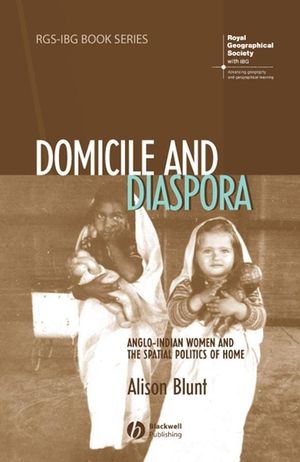
    Domicile and Diaspora: Anglo-Indian Women and the Spatial Politics of Home

    Posted in Asian Diaspora, Books, History, Identity Development/Psychology, Media Archive, Monographs, Oceania, Social Science, United Kingdom, Women on 2011-07-20 14:39Z by Steven

    Domicile and Diaspora: Anglo-Indian Women and the Spatial Politics of Home

    Wiley-Blackwell
    August 2005
    304 pages
    Hardcover ISBN: 978-1-4051-0054-0
    Papeback ISBN: 978-1-4051-0055-7
    E-book ISBN: 978-1-4051-4130-7

    Alison Blunt, Professor of Geography
    Queen Mary, University of London

    Domicile and Diaspora investigates geographies of home and identity for Anglo-Indian women in the 50 years before and after Indian independence in 1947.

    • The first book to study the Anglo-Indian community past and present, in India, Britain and Australia.
    • The first book by a geographer to focus on a community of mixed descent.
    • Investigates geographies of home and identity for Anglo-Indian women in the 50 years before and after Indian independence in 1947.
    • Draws on interviews and focus groups with over 150 Anglo-Indians, as well as archival research.
    • Makes a distinctive contribution to debates about home, identity, hybridity, migration and diaspora.

    Table of Contents

    • List of Figures.
    • Series Editors’ Preface.
    • Acknowledgements.
    • 1. Domicile and Diaspora: An Introduction.
    • 2. At Home in British India: Imperial Domesticity and National Identity.
    • 3. Home, Community and Nation: Domesticating Identity and Embodying Modernity.
    • 4. Colonization and Settlement: Anglo-Indian Homelands.
    • 5. Independence and Decolonization: Anglo-Indian Resettlement in Britain.
    • 6. Mixed Descent, Migration and Multiculturalism: Anglo-Indians in Australia since 1947.
    • 7. At Home in Independent India: Post-Imperial Domesticity and National Identity.
    • 8. Domicile and Diaspora: Conclusions.
    • Bibliography.
    • Appendix 1 Archival Sources.
    • Appendix 2 Interviews and Focus Groups.
    • Index

    Read chapter one here.

    Tags: , , ,

    Manufacturing citizenship: Metapragmatic framings of language competencies in media images of mixed race men in South Korea

    Posted in Anthropology, Articles, Asian Diaspora, Communications/Media Studies, Media Archive, Social Science on 2011-07-18 21:15Z by Steven

    Manufacturing citizenship: Metapragmatic framings of language competencies in media images of mixed race men in South Korea

    Discourse & Society
    Volume 22, Number 4 (July 2011)
    pagesw 440-457
    DOI: 10.1177/0957926510395834

    Adrienne Lo, Assistant Professor of Anthropology and Asian American Studies
    University of Illinois, Urbana-Champaign

    Jenna Kim
    Department of Educational Psychology
    University of Illinois, Urbana-Champaign

    This article examines how discourses of linguistic (in)competency regiment productions of citizenship in the South Korean popular media. Through an analysis of newspaper articles and television programs, we investigate how depictions of language competency become key resources for locating individuals within genealogies of kinship and chronotopic figures of personhood. In some cases, the speech of these celebrities associates them with imaginings of their backwards, low-class Korean kin, the Japanese colonial period, and American military presence, while in other cases, their language is associated with the 21st-century ideal of the modern, elite, globetrotting neoliberal subject. This analysis demonstrates how competence is read in relation to changing notions of citizenship in the new ‘multicultural’ Korea as these men are differentially positioned between multiple raced, classed, and gendered imaginings of Whiteness and Koreanness. More generally, we argue that understandings of linguistic competence are social productions, rather than reflections of language ability.

    Read or purchase the article here.

    Tags: , , , ,

    Are We Content to Let Our DNA Define Us?

    Posted in Articles, Asian Diaspora, Identity Development/Psychology, New Media, United States on 2011-07-12 19:47Z by Steven

    Are We Content to Let Our DNA Define Us?

    Diaspora@chinaSMACK
    2011-07-12

    Ashton J. Liu

    A Chinese friend once responded harshly when asked, “Are you Japanese?” by a young child who had approached him on the street. His response struck me as strange. After all, my identity was always a topic of discussion. As a child of a Chinese-American father and Caucasian mother, I looked neither. I have thick dark hair, a long nose, large eyes, and slightly colored skin. In fact, I was more often mistaken for Hispanic or Native American rather than Asian or white. My identity was discussed among close friends, acquaintances, and even with strangers who I bumped into in a bar or with whom I had a brief encounter on the street.

    Plus, I got it all the time. Meeting someone for the first time usually meant that he or she might give me that slightly elongated, curious gaze, which was followed by an awkward “I’m sorry..I can’t tell, are you [insert misconceived identity here]?” Or, in contrast, when meeting someone Asian, my appearance wouldn’t merit a second glance, but my last name would always surprise them. “Wait…. why do you have a Chinese last name?” they might ask. In time, I got used to it, like a high school graduate who puts up with questions like “What are you going to major in? What do you want to do when you graduate from college?” You know people are good intentioned and genuinely curious, but when you answer the same question to all your relatives, family friends, teachers and random acquaintances, you still answer out of courtesy, but each time you draw a deeper sigh as you prepare your now well-practiced response…

    …This all changed once I set foot in college; there was a blossoming of expression and awareness. Suddenly, we were one. Organizations and clubs formed to challenge preexisting notions of race, and ran discussions, published magazines and held conferences on the multiracial experience. Being biracial went from being a footnote to being something one could flaunt, something fashionable.

    Yet strangely, I grew tired of this discussion. I went to one diversity awareness event, and visited the multicultural session, structured as a reenactment of what mixed blood students encountered in high school. I entered a mock cafeteria and students representing the black table, Asian table and white table, and turned you away, saying you weren’t black, Asian or white enough to sit with them. C’mon, I thought, of course some people think like that, but what an over-dramatization….

    Read the entire article here.

    Tags: , ,

    Mental Conflicts of Eurasian Adolescents

    Posted in Articles, Asian Diaspora, Identity Development/Psychology, Social Science on 2011-07-11 01:20Z by Steven

    Mental Conflicts of Eurasian Adolescents

    The Journal of Social Psychology
    Volume 5, Issue 3 (August 1934)
    pages 402-408
    ISSN: 0022-4545 (Print), 1940-1183 (Online)
    DOI: 10.1080/00224545.1934.9921608

    Linden B. Jenkins

    The article presents information on mental conflicts of Eurasian adolescents. In the early colonizing days when only young unmarried men were sent out there seemed to be no expressed attitude toward mixed marriages or concubinage. Eurasians were looked upon as a “natural result” of the conditions under which “empire builders” were forced to live. Mixed marriages then began to be looked upon as contrary to tradition and Eurasians became an “ever-present reminder that taboos have been violated and caste integrity threatened.” These Eurasians are generally so marked physically as to set them off from both parents, and, being excluded from either full-blood group, they constitute a third distinct class. One of the great tragedies to the Eurasion personality is the fact that the struggle to adjust himself to his environment results in the capitulation of his “ego.” The “inferior ego” is a most significant problem for the Eurasian adolescent. Hygienic mental adjustment begins at the point where the adolescent is learning the hard lesson that other individuals be- sides himself exist and have rights similar to his own.

    In Malaysia there have been European contacts with the native peoples since the early exploration days of the Portuguese and, as a consequence, there is today a hybrid population of about fifteen thousand “Eurasians” in British Malaya alone. They are of a variety of mixtures—the more common type being Portuguese-Malay. Other mixtures are those of the Dutch, British, and Americans with the Malays, Indians, Javanese, and Chinese.

    In the early colonizing days when only young unmarried men were sent out there seemed to be no expressed attitude toward mixed marriages or concubinage. Eurasians were looked upon as a “natural result” of the conditions under which “empire builders” were forced to live.  At a much…

    Read or purchase the article here.

    Tags: , ,