Navigating Multiple Identities: Race, Gender, Culture, Nationality, and Roles

Posted in Anthologies, Anthropology, Asian Diaspora, Barack Obama, Books, Gay & Lesbian, Identity Development/Psychology, Media Archive on 2012-02-13 21:36Z by Steven

Navigating Multiple Identities: Race, Gender, Culture, Nationality, and Roles

Oxford University Press
March 2012
288 pages
Paperback ISBN13: 9780199732074; ISBN10: 0199732078

Edited by

Ruthellen Josselson, Professor of Psychology
Fielding Graduate University, Santa Barbara, California

Michele Harway, Faculty Research Specialist
Fielding Graduate University, Santa Barbara, California

Although questionnaires routinely ask people to check boxes indicating if they are, for example, male or female, black or white, Hispanic or American, many people do not fit neatly into one category or another. Identity is increasingly organized multiply and may encompass additional categories beyond those that appear on demographic questionnaires. In addition, identities are often fluid and context-dependent, depending on the external social factors that invite their emergence. Identity is constantly evolving in light of changing environments, but people are often uncomfortably fixed with societal labels that they must include or resist in their individual identity definition.

In our increasingly complex, globalized world, many people carry conflicting psychosocial identities. They live at the edges of more than one communal affiliation, with the challenge of bridging different loyalties and identifications. Navigating Multiple Identities considers those who are navigating across racial minority or majority status, various cultural expectations and values, gender identities, and roles. The chapters collected here by Josselson and Harway explore the ways in which individuals attain or maintain personal integration in the face of often shifting personal or social locations, and how they navigate the complexity of their multiple identities.

Features

  • Discusses different forms of identity, beyond race and ethnicity
  • Incorporates international perspectives

Table of Contents

  • Chapter 1—The Challenges of Multiple Identity—Ruthellen Josselson and Michele Harway
  • Chapter 2—Multiple Identities and Their Organization—Gary S. Gregg
  • Chapter 3—The “We of Me”: Barack Obama’s Search for Identity—Ruthellen Josselson
  • Chapter 4—The Varieties of the Masculine Experience—Kate A. Richmond, Ronald F. Levant, and Shamin C. J. Ladhani
  • Chapter 5—Growing Up Bicultural in the United States: The Case of Japanese-Americans—James Fuji Collins
  • Chapter 6—The Multiple Identities of Feminist Women of Color: Creating a New Feminism?—Janis Sanchez-Hucles, Alex Dryden, and Barbara Winstead
  • Chapter 7—The Multiple Identities of Transgender Individuals: Incorporating a Framework of Intersectionality to Gender Crossing—Theodore R. Burnes and Mindy Chen
  • Chapter 8—A Garden for Many Identities—Suzanne Ouellette
  • Chapter 9—“I Am More (Than Just) Black”: Contesting Multiplicity Through Conferring and Asserting Singularity in Narratives of Blackness—Siyanda Ndlovu
  • Chapter 10—Identities in the First Person Plural: Muslim-Jewish Couples in France—Brian Schiff, Mathilde Toulemonde, and Carolina Porto
  • Chapter 11—Identity Wounds: Multiple Identities and Intersectional Theory in the Context of Multiculturalism—Michal Krumer-Nevo and Menny Malka
  • Chapter 12—Evaluation of Cultural and Linguistic Practices: Constructing Finnish-German Identities in Narrative Research Interviews—Sara Helsig
  • Chapter 13—“Because I’m Neither Gringa nor Latina”: Conceptualizing Multiple Identities Within Transnational Social Fields—Debora Upegui-Hernandez
Tags: , , , , , , , , , , , , , , , , , , , , , , , , , ,

City of Broken Promises

Posted in Asian Diaspora, Books, History, Media Archive, Novels on 2012-02-13 04:01Z by Steven

City of Broken Promises

Hong Kong University Press
1967
320 pages
Paperback ISBN: 978-962-209-076-7
ebook ISBN: 978-988-8053-59-9

Austin Coates (1922-1997)

The city is Macao, the Portuguese settlement on the China Coast, as it was more than 200 years ago. The promises are those made by Englishmen to marry their Macao mistresses, only to leave them abandoned and their children bastards.

Martha Merop and her English lover are unique in this period. He, son of the founder of Lloyd’s and cousin of the philosopher, Jeremy Bentham, was one of the first merchants to oppose the trade in opium. She, Chinese, abandoned at birth and sold into prostitution at the age of thirteen, became an international trader in her own right, the richest woman on the China Coast and Macao’s greatest public benefactress.

This moving novel that captures the time and place so convincingly is a historical reconstruction of the years 1780 to 1795 when the two were together. It is based on oral tradition handed down through generations in Macao, and on documents that survive about them in Macao, Lisbon and London. Austin Coates identified Martha Merop’s lover, about whom little was known. The documents about him confirmed the traditional Macao story, and the outcome was this book.

Tags: ,

Rice Outside the Paddy: The Form and Function of Hybridity in a Thai Novel

Posted in Articles, Arts, Asian Diaspora, Literary/Artistic Criticism, Media Archive on 2012-02-12 21:14Z by Steven

Rice Outside the Paddy: The Form and Function of Hybridity in a Thai Novel

Crossroads: An Interdisciplinary Journal of Southeast Asian Studies
Volume 11, Number 1 (1997)
pages 51-78

Jan R. Weisman

This paper examines some of the problematic issues of racial hybridity in contemporary Thailand through an analysis of the fictional portrayal of Thai hybrid individuals in the archetypical story, Khao Nok Na. I argue that the modern Thai treatment of hybridity—both fictional and real—privileges some forms over others as it 1) reflects Thai Buddhist concepts of the phenotypical expression of accumulated religious merit, 2) reflects and creates audience desire and anxiety as it reminds the nation of its actual, perceived, or feared loss of control over the course of its development and globalization, and 3) insists on Thai control of its various images as a means of  alleviating the anxieties so created.

Introduction

Thai popular conceptions of hybridity—in particular, the genetic hybridity expressed in individuals of mixed Thai-Western ancestry—have undergone significant changes in recent decades. Eurasians occupied a neutral social category for much of Thai history. Their numbers were small; their parents were of high socioeconomic status; and their Thai lineage was usually a paternal connection. This situation changed dramatically with the influx of American military personnel into Thailand during the Vietnam War. Though the Thai government does not maintain records on the subject, it is estimated that as many as 7,000 Amerasian children…

Tags: , , ,

“The Girl Isn’t White”: New Racial Dimensions in Octavia Butler’s Survivor

Posted in Articles, Asian Diaspora, Literary/Artistic Criticism, Media Archive on 2012-02-12 03:23Z by Steven

“The Girl Isn’t White”: New Racial Dimensions in Octavia Butler’s Survivor

Extrapolation
Volume 47, Number 1 (2006)
pages 35-50
DOI: 10.3828/extr.2006.47.1.6
ISSN: 0014-5483 (Print); 2047-7708 (Online)

Crystal S. Anderson, Associate Professor of English Department
Elon University, Elon, North Carolina

Since the publication of her first novel, Octavia Butler’s popularity has increased, making her now a staple for individuals attracted to the fiction of Afro-futurism. Sandra Govan argues that Butler “forge[s] a black presence in science fiction,” a presence that consistently challenges assumptions regarding inter-group and intra-group relations (87). Butler’s Patternist series of novels focuses on the tensions between groups with psychic abilities and those without, and her Xenogenesis trilogy explores the ramifications of blending humans with an alien race. Much of Butler’s success among African Americans surely rests on the connections readers make between the themes of these novels and their experiences in a race-conscious society. Changes in American society, particularly the dynamic between ethnic groups, prompt a reexamination of Butler’s early fiction. Survivor (1978) anticipates the challenges contemporary blacks face in an increasingly diverse society. Butler uses Alanna, an Afro-Asian protagonist, to illuminate strategies of negotiation for African Americans who engage a variety of ethnic groups.

During the late 1970s, African Americans became increasingly aware of other ethnic groups, particularly Asians. This time period witnesses a mode of civil rights that acknowledges the parallel struggle of American blacks and Asian groups, especially in radical political circles. Bill Mullen reminds us that “beginning with the 1955 meeting of decolonizing African and Asian nations in Bandung, Indonesia, until at least the early 1970s, African American and Asian radicals imagined themselves as antipodal partners in cultural revolution, pen pals for world liberation” (76) Asian cultures so interpenetrated African American cultural movements in the 1970s, Robin Kelley declares, “although the Black Arts Movement was the primary vehicle for black cultural revolution in the United States United States,  it is hard to imagine what that revolution would have looked like without China” (107). Butler’s early foray  into fiction demonstrates its awareness of similar Afro-Asian dynamics by meditating on racial dynamics contrary to the traditional black-white racial paradigm.

…Butler’s use of an Afro-Asian protagonist disrupts conventional tendencies that read all biracial identities according to a black-white paradigm. The reader learns of Alanna’s heritage during a flashback: “There was a man, as lean and tall as Alanna was now. His coloring was dark brown, almost black, contrasting strangely with the very fair skin of the woman. Alanna stood between them, her eyes only slightly narrowed, her skin a smooth medium brown” (27). Initially, Butler does not identify the race of each parent, but uses phrases such as “dark brown” and “fair skin” to imply they are both non-white. As Alanna stands between them, her appearance operates as a visual median, taking the “medium brown” coloring from her father and her narrow eyes possibly from her mother. Butler intentionally delays racial identification, explaining, “if I had given the characters’ race away earlier … possibly the reader wouldn’t react, but, instead, maybe discard that information” (Butler, “Radio,” 52). Such a strategy suggests that Alanna’s background is not an insignificant detail. Butler’s narrative soon confirms Alanna’s unique mixed-race identity when Neila reveals that Alanna’s “Afro-Asian from what she says of her parents. Black father, Asian mother” (31).

As the product of two minority groups, Alanna’s racial identity produces a different set of issues than the traditional black-white racial identity. Butler is aware of such differences, for when she was a child, she discovered that a neighbor had a black father and a Japanese mother. That discovery informs her adult thoughts on minority mixed-race identity: “It didn’t change anything about the way I thought about her except that I was intensely curious about her life. How is her life different because she’s from this unusual situation?” (Butler, “Radio,” 52). Butler recognizes that minority mixed-race individuals may have a different perspective because they culturally partake from two similarly marginalized groups within society. Christine C. Iijima Hall and Trude I. Cooke Turner assert, “the minority-minority individual does not have to choose between being a member of a minority or a majority group. Because these individuals already belong to two minority groups, their social standing in American culture is usually minority” (82). Alanna’s bifurcated identity signals to the reader that she is uniquely suited to see situations from a point of view not associated with the dominant group. She has a perspective attuned to difference. According to Lucille Fultz, diverging from traditional characterizations of the racial backgrounds of characters encourages readers to “rethink received notions of difference based on race and class and question their own investment in the cultural constructions of such categories” (26). Alanna’s mixed-race identity will underscore her engagement with multiple groups…

Read the entire article here.

Tags: , , ,

Black, yellow, (honorary) white or just plain South African?: Chinese South Africans, identity and affirmative action

Posted in Africa, Articles, Asian Diaspora, Law, Media Archive, Politics/Public Policy, Social Science, South Africa on 2012-02-06 22:52Z by Steven

Black, yellow, (honorary) white or just plain South African?: Chinese South Africans, identity and affirmative action

Transformation: Critical Perspectives on Southern Africa
Number 77 (2011)
pages 107-121
DOI: 10.1353/trn.2011.0043

Yoon Jung Park, Senior Researcher in the Centre for Sociological Research
Humanities Research Village
University of Johannesburg

On 18 June 2008, while the country was still reeling from outbreaks of xenophobic violence, the Pretoria High Court issued an order proclaiming that the Chinese South Africans fall within the broad definition of ‘black people’ as contained in the nation’s affirmative action policies. Reaction to the decision was swift, angry and overwhelmingly negative; across the board, South Africans were in disbelief that the Chinese South Africans could be viewed as ‘black’. In this essay the author, a Korean American long resident in South Africa, addresses concerns about affirmative action and argues that these race-based policies are re-racialising the country. Chinese South Africans have long held an ambiguous, confused, in-between position in South Africa. In light of continuing new Chinese migration to the country, the global rise of China and its growing influence on South Africa’s economy and polity, the place and position of Chinese South Africans is further confused. Seen through the lens of the Chinese South African case, affirmative action policies impede progress toward building an inclusive, racially diverse national identity. So long as rewards are doled out solely on the basis of blackness, and blackness increasingly becomes the principal defining characteristic of South Africanness, South Africa fails to construct a national identity that reflects its history and its diversity.

Read or purchase the article here.

Tags: , ,

A Matter Of Honour: Being Chinese in South Africa

Posted in Africa, Anthropology, Asian Diaspora, Books, Media Archive, Monographs, Social Science, South Africa on 2012-02-06 22:32Z by Steven

A Matter Of Honour: Being Chinese in South Africa

Jacana Media
2008
256 pages
235 x 155mm
Paperback ISBN: 978-1-77009-568-7

Yoon Jung Park, Senior Researcher in the Centre for Sociological Research
Humanities Research Village
University of Johannesburg

The South African-born Chinese community is a tiny one, consisting of 10,000 to 12,000 members in a population of approximately 45 million. Throughout much of the history of this most race-conscious country, the community has been ignored or neglected, and officially classed along with Coloureds (people of mixed race) or with Indians in that particularly South African category of ‘Asiatic’.

More recently, as China’s aid, trade and investment in Africa grow and large numbers of new Chinese immigrants stream into South Africa and other African states, Chinese South Africans are beginning to receive both media and scholarly attention. For this reason it is timely to focus on the only resident community of Chinese on the continent.

This book, based on a PhD thesis, focuses on Chinese South Africans by examining their shifting social, ethnic, racial and national identities over time. Using concepts of identity, ethnicity, race, nationalism, and transnationalism, and drawing on comparisons with other overseas Chinese communities, it explores the multi-layered identities of the South African group and analyses the way in which their identities have changed over time and with each generation.

As the book makes clear, Chinese identities in South Africa have been shaped by both external and internal forces. As regards external factors, the state—both that of China and of South Africa—played a key role in establishing the parameters of identity construction. Over time the weight of this influence changed, as a result of international political events, internal racial policies, and external trade and political relations. At the same time, individual and community agency, and the force of the ‘China myth’, played important parts in the construction of Chinese South African identity.

Tags: , ,

Woman traces her Tanzanian roots in film

Posted in Africa, Arts, Asian Diaspora, Identity Development/Psychology, Media Archive, United States, Women on 2012-02-05 07:00Z by Steven

Woman traces her Tanzanian roots in film

The Citizen
Dar es Salaam, Tanzania
2012-02-04

Tyrone Beason

Sometimes a journey begins with a song. In the case of Seattle documentary filmmaker Eli Kimaro, it was a transporting version of the classic lullaby Summertime from the African-American opera Porgy and Bess, this one sung by the Benin-born artist Angelique Kidjo as a West African spiritual, full of cooing background vocals and soul-tapping percussion.

Kimaro’s father is Tanzanian. Her mother is Korean. She’d always been comfortable with her mixed-race background, but something about hearing that song eight years ago sparked a longing to better understand the people she came from, particularly the relatives in Kilimanjaro region, where her father grew up and where she’d visited many times as a child.It dawned on her that she should make a film about her father’s side of the family, even though she’d never directed a movie in her life.

The result, A Lot Like You, debuted at the Seattle International Film Festival last year to positive reviews.

The film helps raise the profile of a population in the United States that many people who identify with just one racial or ethnic group scarcely understand…

…Elikimaro is part of a new wave of multiracial pride, discussion and activism rooted in a very real demographic shift.

America is, in fact, more multiracial. According to the 2010 U.S. census, more than 9 million Americans identified themselves as belonging to two or more racial groups, or about 2.9 per cent of the total population, up from 2.4 per cent a decade ago.

Since 2000, the census has made it easier than ever for people answering its surveys to pick more than one racial group; and Americans who have mixed-race backgrounds, long a cause for derision and marginalization, are ever more comfortable checking all the boxes that apply to them…

Read the entire article here.

Tags: , , ,

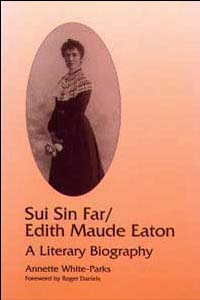
Sui Sin Far / Edith Maude Eaton: A Literary Biography

Posted in Asian Diaspora, Biography, Books, Canada, Caribbean/Latin America, Literary/Artistic Criticism, Media Archive, Monographs, United States, Women on 2012-01-30 03:10Z by Steven

Sui Sin Far / Edith Maude Eaton: A Literary Biography

University of Illinois Press
1995
288 pages
ISBN-10: 0252021134; ISBN-13: 978-0252021138

Annette White-Parks, Professor Emeritus of English
University of Wisconsin, LaCrosse

Foreword by Roger Daniels

Winner of the Association for Asian American Studies Outstanding Book Award in Cultural Studies.

This first full-length biography of the first published Asian North American fiction writer portrays both the woman and her times.

The eldest daughter of a Chinese mother and British father, Edith Maude Eaton was born in England in 1865. Her family moved to Quebec, where she was removed from school at age ten to help support her parents and twelve siblings. In the 1880s and 1890s she worked as a stenographer, journalist, and fiction writer in Montreal, often writing under the name Sui Sin Far (Water Lily). She lived briefly in Jamaica and then, from 1898 to 1912, in the United States. Her one book, Mrs. Spring Fragrance, has been out of print since 1914.

Today Sui Sin Far is being rediscovered as part of American literature and history. She presented portraits of turn-of-the-century Chinatowns, not in the mode of the “yellow peril” literature in vogue at the time but with an insider’s sympathy. She gave voice to Chinese American women and children, and she responded to the social divisions and discrimination that confronted her by experimenting with trickster characters and tools of irony, sharing the coping mechanisms used by other writers who struggled to overcome the marginalization to which their race, class, or gender consigned them in that era.

Table of Contents

  • Foreword by Roger Daniels
  • Preface
  • Introduction
  • 1. A Bird on the Wing
  • 2. Montreal: The Early Writings
  • 3. Pacific Coast Chinatown Stories
  • 4. Boston: The Mature Voice and Its Art
  • 5. Mrs. Spring Fragrance
  • Conclusion
  • Bibliography
  • Index
Tags: , , , , ,

Biracial/Bicultural Identity in the Writings of Sui Sin Far

Posted in Articles, Asian Diaspora, Literary/Artistic Criticism, Media Archive, Women on 2012-01-30 02:57Z by Steven

Biracial/Bicultural Identity in the Writings of Sui Sin Far

MELUS
Volume 26, Number 2 (Summer 2001)
pages 159-186

Vanessa Holford Diana, Professor of English
Westfield State Unviversity, Westfield, Massachusetts

At the turn into the twentieth century, American culture witnessed related literary and political shifts through which marginalized voices gained increased strength despite the severe racism that informed US laws and social interaction. Many authors and literary critics saw connections between literary content and social influence. For example, in Criticism and Fiction (1891), William Dean Howells, proponent of nineteenth-century American realism, warns readers to avoid sentimental or sensational novels, which he claims “hurt” by presenting “idle lies about human nature and the social fabric.” He reminds us that “it behooves us to know and to understand” our people and our social context “that we may deal justly with ourselves and with one another” (94-95). He argues that the writer of fiction is obligated to write that which is “tree to the motives, the impulses, the principles that shape the life of actual men and women” in the US (99). His is both a demand for aesthetic standards in fiction and an insistence that the failure to achieve “true” representations of American people will result in the disintegration of national humanity and, consequently, of national unity. The irony of Howells’ standards is that despite this impulse toward national unification, his own tenets of American realism have for years served to exclude from the canon those writers who were greatly interested in creating “tree” representations of American characters in order to promote a society in which Americans could finally “deal justly with ourselves and with one another.”

One artist who wrote with the goal of creating an America where we would “deal justly” with one another was turn-of-the-century Eurasian journalist and fiction writer Sui Sin Far. In an essay entitled “The Chinese in America,” Sui Sin Far laments western literary depictions of the Chinese that portray them as “unfeeling” and “custom-bound.” “[F]iction writers seem to be so imbued with [these] ideas that you scarcely ever read about a Chinese person who is not a wooden peg,” she protests (234). She argues that in general the Chinese “think and act just as the white man does, according to the impulses which control them. They love those who love them; they hate those who hate; are kind, affectionate, cruel or selfish, as the case may be” (234). Through this comparison Sui Sin Far decenters whiteness as the standard of what is “human,” a move that is in fact central to much of her work, as Annette White-Parks has argued in an essay entitled “A Reversal of American Concepts of `Otherness.'” Sui Sin Far’s characters are often people who resist assimilation, and through them she depicts Chinese communities in North America populated with characters rich and diverse in their complexity. This study builds on White-Parks’ conclusions by exploring the role of genre manipulation in Sui Sin Far’s literary and political innovations. In addition, I will argue that Sui Sin Far’s specific focus on the position of biracial and bicultural individuals (both in autobiographical and fictional representations) is a major strategy in her redefinition of “race” as a category in American thought.

Like Howells, Sui Sin Far demands in fiction a truthful depiction of Americans; her rewriting, however, represents an adaptation of mainstream realism because it focuses on Americans who had, before she wrote, little voice in American literature. Amy Ling characterizes Sui Sin Far’s writing as among one of “the earliest attempts by Asian subalterns to speak for themselves” (“Reading” 70). Offering alternative perspectives on American identity and culture, Sui Sin Far, along with many of her contemporary writers of color, actively challenged mainstream readers’ preconceptions and contributed to a social climate in which increasing numbers of writers of color made their voices heard in print. In doing this, she engaged a shift from margin to center that posited the “Other” as speaking voice, thereby dramatizing the injustices that plagued race relations in North America.

Current critical approaches to turn-of-the-century American realism locate within the project of national identity-building a trend of revolutionary revision, through which marginalized writers disclose the inequalities in US culture and show the establishment of a unified and “true” American identity to be impossible while racism continues to enforce social exclusion and hierarchy. At the same time, literary critics are rethinking the genre of sentimental romance to better understand the ways in which women writers employed and subverted this genre and the rhetorical devices it employs in order to dramatize (and put an end to) social injustice. Drawing from elements of both realism and sentimental romance, Sui Sin Far uses short stories, articles, and essays to pioneer the act of self-representation for a people who existed in late nineteenth-century mainstream American imagination and literature as uncivilized, heathen foreigners. In her short stories, articles, and autobiographical essays Sui Sin Far achieves far more than her modestly stated goal “of planting a Eurasian thoughts into Western literature” (288). Her fiction challenges and shifts socially constructed definitions of Chineseness, constructions that enact what Judith Butler would term the “regulatory norms” that inflict exclusion upon marginalized peoples.

A focus on Sui Sin Far’s depiction of Eurasian characters and on the subject of interracial marriage illustrates her multifaceted understanding of the crisis in US race relations. Through the treatment of these subjects, she enacts a revolutionary revisioning of race differences. The stories found in Mrs. Spring Fragrance and Other Writings, including “Pat and Pan,” “Its Wavering Image,” along with excerpts from “The Story of One White Woman who Married a Chinese,” “Her Loving Husband,” and Sui Sin Far’s autobiographical essay, “Leaves from the Mental Portfolio of an Eurasian,” exemplify the artistic and psychological complexity of Sui Sin Far’s treatment of the biracial character and of interracial marriage. In particular, by addressing these themes, Sui Sin Far deconstructs Orientalism by dramatizing the destructive ways in which North American culture defines the Chinese as inhuman “Other” in order to prevent interracial understanding and maintain profitable power structures. Sui Sin Far’s fiction and essays illustrate the lengths to which members of the dominant culture will go to preserve a notion of racial purity based on hatred and ignorance, and she explores the terrible effects that racism has on its victims…

Purchase the article here.

Tags: , , , , ,

Stand Back Ladies and Gentlemen! The Wonders of the World! Conformity and Confrontation in Winnifred Eaton’s Freak Show Setting in “The Loves of Sakura Jiro and the Three-Headed Maid”

Posted in Asian Diaspora, Canada, Literary/Artistic Criticism, Media Archive, Papers/Presentations, Women on 2012-01-30 01:37Z by Steven

Stand Back Ladies and Gentlemen! The Wonders of the World! Conformity and Confrontation in Winnifred Eaton’s Freak Show Setting in “The Loves of Sakura Jiro and the Three-Headed Maid”

Winnifred Eaton Project Symposium
2007-03-15 through 2007-03-16
Owens Art Gallery
Mount Allison University, Sackville, New Brunswick, Canada

2007-03-16

Christine Mayor
Mount Allison University

The freak show claims true wonders but encourages fraud, offers multicultural exhibits only to reinforce white supremacy, and asserts authenticity while promoting an exotic and aggrandized racial performance. While many have critiqued Winnifred Eaton’s false persona, questioned her authenticity as an “armchair ethnographer,” and accused her of reinforcing Orientalist stereotypes, this essay will concentrate on her deployment of the freak show in the short story “The Loves of Sakura Jiro and the Three-Headed Maid” to challenge widely held American values at the turn of the century. As Pat Shea argues, Eaton’s fiction skilfully balances “concession and resistance,” ensuring commercial success and readership while parodying and subverting white supremacy (19). Eaton capitalises on the potential of the freak show to entice and entertain readers, thus giving her freer reign to critique aspects of the nation, the ideology of whiteness, and the entertainment industry, while playfully exploring her own sideshow hoax as Onoto Watanna.

Historically, the freak show is not simply a form of entertainment, but is also a powerful tool for defining the self through negation, and “allow[s] ordinary people to confront, and master, the most extreme and terrifying forms of Otherness they could imagine” (Adams 2). In the public setting of a sideshow, each audience member is encouraged to identify with the uniform, “normal”, mass, and is distanced from the exotic, disabled, and/or freakishly skilled “Other”. As Robert Bogdan argues,

Americans viewing such displays of non-Western people did not confront their own ethnocentrism…[but]merely [had] confirmed old prejudices and beliefs regarding the separateness of the “enlightened” and “primitive” worlds; they left the freak show reassured of their own superiority by such proofs of others’ inferiority. (197)

…In this manner, Eaton’s image of the freak show may serve as a metaphor for the entertainment industry and a defence of her own passing as Japanese. Eaton, as a mixed-race subject, stands in as a “racial freak” that aggrandizes and exoticises her own identity to gain wider marketability and popularity. Ferens explores in detail Eaton’s conceit of the freak show, stating, “The dime museum may be usefully interpreted as a trope for the popular publishing industry of which Winnifred was, by 1903, a seasoned worker. The two businesses have a similar social function and structure: a metropolitan location, a publisher/manager, a press agent, a stable of expendable writers/performers, and a broad, unsophisticated customer base” (147). The ease with which these two industries can be paralleled further highlights the various ways in which difference is produced and staged to be profitable. Eaton describes in her fiction, the tactics used by the sideshow manager to increase the interest in the acts, which are strikingly similar to the way Eaton packaged herself as an artist. Eaton created for herself a Japanese persona presented through a pen-name, pictures in exotic dress, and authority through racial and familial authenticity. Eaton’s Japanese persona was her commodity and allowed her work to be judged apart from Western literary standards, as, “The naïveté and lack of literary technique that would have disadvantaged her as a white writer suddenly became part of what reviewers recognized as the “peculiar charm” of her untutored style” (Ferens 118). Eaton’s passing thereby allowed her to simultaneously critique and exploit the dominant system, as well as forcing readers to question how we understand and construct the identities of others. Eaton’s playful and cynical arguments that appearances are all that matter in either industry, and that each person must compete as best they can, serve as a critique of the discriminatory American capitalist system and defend her own elaborate hoax…

Read the entire paper here.

Tags: , , ,