Racial Constructions: The Legal Regulation of Miscegenation in Alabama, 1890–1934

Posted in Articles, History, Law, Media Archive, Politics/Public Policy, Social Science, United States on 2009-12-08 03:52Z by Steven

Racial Constructions: The Legal Regulation of Miscegenation in Alabama, 1890–1934

Law and History Review
Volume 20, Number 2 (Summer 2002)
DOI: 10.2307/744035

Julie Novkov, Associate Professor of Political Science and Women’s Studies
State University of New York, Albany

For over one hundred years–from the post–Civil War era to the post–Civil Rights era–the state of Alabama maintained a legal and social commitment to keeping blacks and whites from engaging in long-term sexual relationships with each other. Recent studies addressing the laws that barred miscegenation have shown that investigating governmental reactions to intimate interracial connections reveals much about the interplay between legal and social definitions of race as well as about the development of whiteness as a proxy for superior social, political, and legal status. As scholarly interest in whiteness as an ideological category has grown, historians have sought the roots of modern conceptions of whiteness as an oppositional category to blackness in legal, social, and economic relations in the southern United States during the era of Jim Crow.

Prosecutions for miscegenation were an important component in the process of defining race and entrenching white supremacy.  Interracial sexual relationships challenged the boundaries between white and non-white in the most fundamental way by subverting the model of the white family and often by threatening to produce or producing mixed-race children. In most southern states, even before the rise of the so-called “Redeemer” governments and the establishment of Jim Crow, lawmakers in the new postbellum legislatures moved quickly to bar specifically marriages between blacks and whites. By doing so, they sent a signal that even if the national government were intent upon imposing civil and political equality, so-called social equality would not result from emancipation or constitutional reform. The struggle against miscegenation was at bottom a struggle to establish and maintain whiteness as a separate and impermeable racial category that all observers could easily identify. While individuals whose race could not easily be determined threatened this system, the greater threat was the establishment of the miscegenic family. A black man with a white wife, as well as a white man with a black wife, not only had the potential to produce racially ambiguous children but also undermined white supremacy, and thus whiteness itself, by openly melding black and white into the most fundamental unit of society, the family.

Thus, keeping black and white separate required preventing individuals from being able to challenge the boundary between them. In order to do so, however, understandings of what constituted blackness and whiteness had to be in place. Prior to the Civil War, these had rested largely in social context and interaction; whiteness was intimately connected to performance and its constitution depended upon an individual’s ability to do the things that whites characteristically did. While free blacks posed a problem for this schema, their existence did not challenge the fundamental nature of the system in place, which became increasingly stringent and rigid as sectional conflict increased. In the wake of the Civil War, both whiteness and blackness had to be renegotiated and reconstructed, since slavery was no longer a yardstick. Some legislators and legal actors turned to science both to define blackness and whiteness and to understand their significance for public policy. Defining “race” was always in the background of the prohibition against miscegenation, but during the period when genetic understandings of race were most popular, the question of defining blackness was central in Alabama.

Because of the wealth of data, studying Alabama’s regulation of miscegenation is particularly helpful in understanding the generation and shifting of ideological conceptions of race. Other Southern and Western states were also grappling with these questions, as evinced by appellate decisions regarding convictions for miscegenation, but Alabama’s appellate courts were particularly engaged with these questions. They produced thirty-eight opinions concerning miscegenation–more reported decisions on the appellate level than any other state–between the end of the Civil War and the U.S. Supreme Court’s invalidation of such statutes in 1967. The number of individuals charged with violating a statute and convicted of violations is a significant measure of the law’s importance. But reviewing appellate litigation reveals more about the questions that were settled and in flux at particular historical moments.  Charles Robinson speculates that Alabama had significantly more cases than any other state both because of its large black population from the postbellum era to the present and because Alabama’s prohibitionary law was more broadly framed than comparable laws in neighboring states; a legal climate in which appeals were sometimes successful probably also contributed to the frequency of litigation.  Because of the large number of appellate cases, more information is available about the development of legal and social questions regarding miscegenation in Alabama than anywhere else.

This article focuses on a subset of these cases, analyzing the development of racial definitions in the law through the interplay between changing scientific understandings of race and legal actors’ manipulations of these understandings. In the 1890s and early 1900s, appeals of convictions for miscegenation raised evidentiary questions that set the stage for a struggle over proving race in the courts that began in 1918 and continued into the 1930s. In the appellate cases, the focused contention over racial definitions partially resulted from and coincided with the growing presence of eugenic theories about race in public and legal discourse. The science of eugenics captured the popular imagination shortly after the turn of the century and provided a new framework for arguing in terms of scientific expertise that non-whites were inherently and irremediably inferior to whites. This shift toward eugenic explanations of race and racial definition paralleled and partially initiated a shift from evidentiary concerns in the courts to a direct confrontation with questions about racial definition. The new focus on genetic framings of race, however, had an ironic result: criminal defendants convicted of miscegenation were able, often successfully, to challenge their convictions on the ground that the state had not adequately proven that they were black. This temporarily undermined the state’s efforts to maintain whiteness as a separate and impenetrable category.

As background to this argument, the article first addresses the evolution of the prohibition of miscegenation and the scope of appellate litigation that it generated. It then explains the evidentiary battles of the turn of the century and outlines the rise of eugenic theories and their impact on the law. With this legal, social, and scientific context established, the article turns to the question of how defense attorneys were able to exploit genetic framings of racial definitions for their clients convicted of miscegenation…

Read the entire article here.

Tags: , , ,

One Nation, One Blood: Interracial Marriage in American Fiction, Scandal, and Law, 1820–1870

Posted in Books, History, Law, Literary/Artistic Criticism, Media Archive, Monographs, Native Americans/First Nation, Politics/Public Policy, Slavery, Social Science, United States on 2009-12-05 23:05Z by Steven

One Nation, One Blood: Interracial Marriage in American Fiction, Scandal, and Law, 1820–1870

University of Massachusetts Press
June 2005
288 pages
Cloth ISBN: 978-1-55849-483-1

Karen Woods Weierman, Associate Professor of English
Worcester State University

Examines the roots of a pernicious and persistent American taboo

The proscription against interracial marriage was for many years a flashpoint in American culture. In One Nation, One Blood, Karen Woods Weierman explores this taboo by investigating the traditional link between marriage and property. Her research reveals that the opposition to intermarriage originated in large measure in the nineteenth-century desire for Indian land and African labor. Yet despite the white majority’s overwhelming rejection of nonwhite peoples as marriage partners, citizens, and social equals, nineteenth-century reformers challenged the rule against intermarriage. Dismissing the new “race science” that purported to prove white superiority, reformers held fast to the religious notion of a common humanity and the republican rhetoric of freedom and equality, arguing that God made all people “of one blood.”

The years from 1820 to 1870 marked a crucial period in the history of this prejudice. Tales of interracial marriage recounted in fiction, real-life scandals, and legal statutes figured prominently in public discussion of both slavery and the fate of Native Americans. In Part One of this book, Weierman focuses on Indian-white marriages during the 1820s, when Indian removal became a rallying cry for New England intellectuals.

In Part Two she shifts her attention to black-white marriages from the antebellum period through the early years of Reconstruction. In both cases she finds that the combination of a highly publicized intermarriage scandal, new legislation prohibiting interracial marriage, and fictional portrayals of the ills associated with such unions served to reinforce popular prejudice, justifying the displacement of Indians from their lands and upholding the system of slavery. Even after the demise of slavery, restrictions against intermarriage remained in place in many parts of the country long into the twentieth century. Not until the 1967 Loving v. Virginia decision did the Supreme Court finally rule that such laws were unconstitutional.

Finishing on a contemporary note, Weierman suggests that the stories Americans tell about intermarriage today—stories defining family, racial identity, and citizenship—still reflect a struggle for resources and power.

Tags: , , , ,

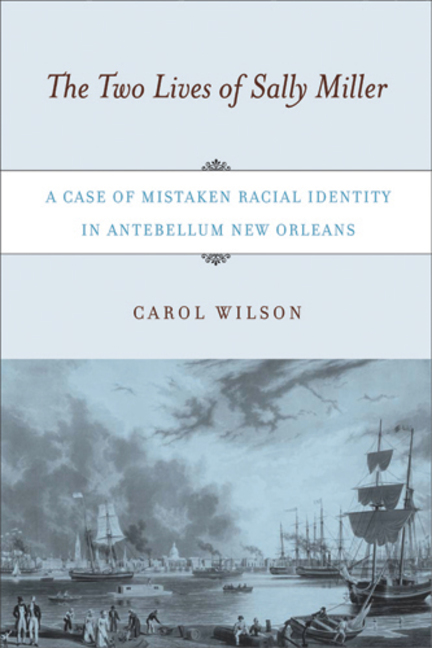
The Two Lives of Sally Miller: A Case of Mistaken Racial Identity in Antebellum New Orleans

Posted in Biography, Books, History, Law, Louisiana, Media Archive, Monographs, Slavery, United States, Women on 2009-12-05 17:28Z by Steven

The Two Lives of Sally Miller: A Case of Mistaken Racial Identity in Antebellum New Orleans

Rutgers University Press
2007-03-28
168 pages
9 b&w illustrations
Paper ISBN: 978-0-8135-4058-0
Cloth ISBN: 978-0-8135-4057-3

Carol Wilson, Arthur A. and Elizabeth R. Knapp Professor of American History
Washington College, Chestertown, Maryland

In 1843, the Louisiana Supreme Court heard the case of a slave named Sally Miller, who claimed to have been born a free white person in Germany. Sally, a very light-skinned slave girl working in a New Orleans cafe, might not have known she had a case were it not for a woman who recognized her as Salom Muller, with whom she had emigrated from Germany over twenty years earlier. Sally decided to sue for her freedom, and was ultimately freed, despite strong evidence contrary to her claim.

In The Two Lives of Sally Miller, Carol Wilson explores this fascinating legal case and its reflection on broader questions about race, society, and law in the antebellum South. Why did a court system known for its extreme bias against African Americans help to free a woman who was believed by many to be a black slave? Wilson explains that while the notion of white enslavement was shocking, it was easier for society to acknowledge that possibility than the alternative-an African slave who deceived whites and triumphed over the system.

Comments by Carol Wilson from her website:

…My book on the case of Sally Miller looks at a similar issue of status. As a society we have recently begun openly acknowledging that many people in the United States are of mixed racial background. The restrictive categorization of people as either white or black has begun to collapse. Many people assume, however, that this is the result of relaxing of racial barriers over the last few decades. Scholars of pre-Civil War American history, however, are well aware of the extensiveness of racial mixing in our nation’s past, albeit a practice usually illegal and denied. Because of the not uncommon existence of enslaved mulattoes, antebellum Americans were not unused to seeing slaves who looked “white.” With racial identity a feature imposed by those in power in society, it was only a matter of time before “whites” (people of European ancestry) found themselves illegally enslaved. Because white status was impossible to prove, some whites did find themselves in slavery…

Tags: , , ,

Love and Race Caught in the Public Eye

Posted in Articles, History, Law, Media Archive, Social Science, United States on 2009-12-05 05:23Z by Steven

Love and Race Caught in the Public Eye

ND Newswire
University of Notre Dame
2001-05-31

Heidi Ardizzone, Assistant Professor of American Studies
University of Notre Dame

Earl Lewis, Provost
Emory University

Lovers seek to create a place that they can inhabit together against the obstacles of the world. Marriage promises that they will live in that place forever. What happens, though, when love cannot keep out the world’s strictures? What happens when the bond severs, and the nation serves as a witness to marital separation? And what happens when a culture’s notions about love and romance come into conflict with the lines dividing races and classes?

In 1925 Alice Beatrice Jones and Leonard “Kip” Rhinelander found themselves painfully trapped in this conflict between love and family, desire and social standing. Their marriage had the trappings of a fairy tale — wealthy New York scion marries humble girl from New Rochelle — yet the events that led to their estrangement provide an unusual window into the nation’s attitudes about race, class, and sexuality. Their sensational annulment trial scandalized 1920’s America and opened their private life to public scrutiny, amid cultural conflicts over racial definitions, class propriety, proper courtship and sexual behavior, and racial mixing.

As a Rhinelander, Leonard was descended from several of New York’s oldest and wealthiest families. Had he followed in the family tradition, Leonard might have attended Columbia University, joined the Rhinelander Real Estate Company, and made his mark on New York society through philanthropy and support of the arts.

By contrast, Alice’s parents immigrated in 1891 to the United States from England, where they had both worked as servants. George Jones had had some success in his adopted country; he eventually owned a fleet of taxicabs and several small properties. Alice, her sisters, and their husbands worked primarily as domestics and servants — solid members of the working class.

Despite this pronounced class difference, Alice and Leonard met and began dating in 1921. Their love deepened over the next three years, tested by months and years of separation as Leonard’s father tried to keep them apart. Philip Rhinelander’s efforts were in vain, however.  From 1921 to 1924 the lovers exchanged hundreds of letters and visited when possible. As soon as Leonard turned 21 and received money from a trust fund, he left school and returned to Alice. In the fall of 1924, they quietly married in a civil ceremony at the New Rochelle City Hall.

Had reporters from the New Rochelle Standard Star ignored the entry in the City Hall records, the couple might have lived their lives away from the public spotlight. They did not. Someone eventually realized that a Rhinelander had married a local woman, and it was news. And once they discovered who Alice Jones was, it was big news. The first story appeared one month after their wedding, announcing to the world that the son of a Rhinelander had married the daughter of a colored man.

Or had he? Well, at least he had married the daughter of a working-class man, and that was enough to start a tremor of gossip throughout New York. Reporters rushed to sift through the legal documents and contradictory accounts of and by the Joneses and the newlyweds. Despite the confidence of the first announcement, there was confusion for quite some time as to George Jones’s — and therefore Alice’s — precise racial identity…

Read the entire article here.

Tags: , , , , , , , , , ,

Sex, Love, Race: Crossing Boundaries in North American History

Posted in Anthologies, Asian Diaspora, Books, History, Law, Media Archive, Slavery, Social Science, United States, Women on 2009-12-05 02:53Z by Steven

Sex, Love, Race: Crossing Boundaries in North American History

New York University Press
1999
416 pages
Cloth ISBN: 9780814735565
Paperback ISBN: 9780814735572

Edited by

Martha Hodes, Professor of History
New York University

Since pre-colonial days, America has been both torn apart and united by love, sex, and marriage across racial boundaries. Whether motivated by violent conquest, economics, lust, or love, such unions have disturbed some of America’s most sacred beliefs and prejudices.

Sex, Love, Race provides a historical foundation for contemporary discussions of sex across racial lines, which, despite the numbers of interracial marriages and multiracial children, remains a controversial issue today. The first historical anthology to focus solely and widely on the subject, Sex, Love, Race gathers new essays by both younger and well-known scholars which probe why and how the specter of sex across racial boundaries has so threatened Americans of all colors and classes.

Traversing the whole of American history, from liaisons among Indians, Europeans, and Africans to twentieth-century social scientists’ fascination with sex between “Orientals” and whites, the essays cover a range of regions, races, ethnicities, and sexual orientations. In so doing, Sex, Love, Race, sketches a larger portrait of the overlapping construction of racial, ethnic, and sexual identities in America.

Tags: ,

White Women, Black Men: Illicit Sex in the Nineteenth-Century South

Posted in Books, History, Law, Media Archive, Monographs, Slavery, Social Science on 2009-12-05 01:50Z by Steven

White Women, Black Men: Illicit Sex in the Nineteenth-Century South

Yale University Press
January 1997
352 pages
6 1/8 x 9 1/4
ISBN: 9780300077506
ISBN-10: 0300077505

Martha Hodes, Professor of History
New York University

White Women, Black Men: Illicit Sex in the Nineteenth-century South by [Hodes, Martha]

  • Winner of the Allan Nevins Prize given by the Society of American Historians.
  • Honorable mention in the Gustavus Myers Outstanding Book Awards, sponsored by the Gustavus Myers Center for the Study of Bigotry and Human Rights in North America.

This book is the first to explore the history of a powerful category of illicit sex in America’s past: liaisons between Southern white women and black men. Martha Hodes tells a series of stories about such liaisons in the years before the Civil War, explores the complex ways in which white Southerners tolerated them in the slave South, and shows how and why these responses changed with emancipation.

Hodes provides details of the wedding of a white servant-woman and a slave man in 1681, an antebellum rape accusation that uncovered a relationship between an unmarried white woman and a slave, and a divorce plea from a white farmer based on an adulterous affair between his wife and a neighborhood slave. Drawing on sources that include courtroom testimony, legislative petitions, pardon pleas, and congressional testimony, she presents the voices of the authorities, eyewitnesses, and the transgressors themselves—and these voices seem to say that in the slave South, whites were not overwhelmingly concerned about such liaisons, beyond the racial and legal status of the children that were produced. Only with the advent of black freedom did the issue move beyond neighborhood dramas and into the arena of politics, becoming a much more serious taboo than it had ever been before. Hodes gives vivid examples of the violence that followed the upheaval of war, when black men and white women were targeted by the Ku Klux Klan and unprecedented white rage and terrorism against such liaisons began to erupt. An era of terror and lynchings was inaugurated, and the legacy of these sexual politics lingered well into the twentieth century.

Tags: , , ,

Almighty God Created the Races: Christianity, Interracial Marriage, and American Law

Posted in Books, History, Law, Media Archive, Monographs, Politics/Public Policy, Religion, Social Science, United States on 2009-12-04 17:14Z by Steven

Almighty God Created the Races: Christianity, Interracial Marriage, and American Law

University of North Carolina Press
December 2009
288 pages
6.125 x 9.25, notes, bibl., index
Cloth ISBN: 978-0-8078-3318-6
Paper ISBN: 978-1-4696-0727-6

Fay Botham, Adjunct Professor of Religious Studies
University of Iowa

In this fascinating cultural history of interracial marriage and its legal regulation in the United States, Fay Botham argues that religion–specifically, Protestant and Catholic beliefs about marriage and race–had a significant effect on legal decisions concerning miscegenation and marriage in the century following the Civil War.

Botham argues that divergent Catholic and Protestant theologies of marriage and race, reinforced by regional differences between the West and the South, shaped the two pivotal cases that frame this volume, the 1948 California Supreme Court case of Perez v. Lippold (which successfully challenged California’s antimiscegenation statutes on the grounds of religious freedom) and the 1967 U.S. Supreme Court case Loving v. Virginia (which declared legal bans on interracial marriage unconstitutional). Botham contends that the white southern Protestant notion that God “dispersed” the races, as opposed to the American Catholic emphasis on human unity and common origins, points to ways that religion influenced the course of litigation and illuminates the religious bases for Christian racist and antiracist movements.

Tags: , , , , , ,

Racial Passing

Posted in Articles, History, Identity Development/Psychology, Law, Media Archive, Passing, Politics/Public Policy, Social Science, United States on 2009-11-28 01:31Z by Steven

Racial Passing

Ohio State Law Journal
Ohio State University Michael E. Moritz College of Law
Vol. 62: 1145 (2001)
Frank R. Strong Law Forum Lecture

Randall Kennedy, Michael R. Klein Professor of Law
Harvard Law School

I. Passing: A Definition

Passing is a deception that enables a person to adopt certain roles or identities from which he would be barred by prevailing social standards in the absence of his misleading conduct. The classic racial passer in the United States has been the “white Negro”: the individual whose physical appearance allows him to present himself as “white” but whose “black” lineage (typically only a very partial black lineage) makes him a Negro according to dominant racial rules. A passer is distinguishable from the person who is merely mistaken—the person who, having been told that he is white, thinks of himself as white, and holds himself out to be white (though he and everyone else in the locale would deem him to be “black” were the facts of his ancestry known). Gregory Howard Williams was, for a period, such a person. The child of a white mother and a light-skinned Negro man who pretended to be white, Williams assumed that he, too, was white. Not until he was ten years old, when his parents divorced, did Williams and his brother learn that they were “black” according to the custom by which any known Negro ancestry makes a person a Negro. Williams recalls vividly the moment at which he was told of his “new” racial identity:

I never had heard anything crazier in my life! How could Dad tell us such a mean lie? I glanced across the aisle to where he sat grim-faced and erect, staring straight ahead. I saw my father as I had never seen him before. The veil dropped from his face and features. Before my eyes he was transformed from a swarthy Italian to his true self—a high-yellow mulatto. My father was a Negro! We were colored! After ten years in Virginia on the white side of the color line, I knew what that meant. When he held himself out as white before learning of his father’s secret, Williams was simply mistaken. When he occasionally held himself out as white after learning the “true” racial identity of his father, Williams was passing. In other words, as I define the term, passing requires that a person be self-consciously engaged in concealment. Such a person knows about his African American lineage—his black “blood”—and either stays quiet about it, hoping that silence along with his appearance will lead observers to perceive him as white, or expressly asserts that he is white (knowing all the while that he is “black” according to ascendant social understandings).

Estimates regarding the incidence of passing have varied greatly. Walter White claimed that annually “approximately 12,000 white-skinned Negroes disappear” into white society. Roi Ottley asserted that there were five million “white Negroes” in the United States and that forty to fifty thousand passed annually. Professor John H. Burma’s estimates were considerably lower. He posited that some 110,000 blacks lived on the white side of the color line and that between 2,500 and 2,750 passed annually. Given its secretive nature, no one knows for sure the incidence of passing. It is clear, however, that at the middle of the twentieth century, large numbers of African Americans claimed to know people engaged in passing…

Read the entire article/lecture here.

Tags: , , ,

The Blurring of the Lines: Children and Bans on Interrracial Unions and Same-Sex Marriages

Posted in Articles, Family/Parenting, Gay & Lesbian, Law, Media Archive, Politics/Public Policy, Social Science, United States on 2009-11-25 18:56Z by Steven

The Blurring of the Lines: Children and Bans on Interrracial Unions and Same-Sex Marriages

Fordham Law Review
May 2008
Volume 76, Number 6
pages 2733-2770

Carlos A. Ball, Professor of Law and Judge Frederick Lacey Scholar
Rutgers University School of Law, Newark

When Richard Loving and Mildred Jeter drove from their hometown of Central Point, Virginia, to Washington, D.C., on June 2, 1958, in order to get married, Mildred was several months pregnant Later that year—a few weeks before the couple pled guilty to having violated Virginia’s antimiscegenation law—Mildred gave birth to a baby girl. Richard and Mildred had two more children, a son born in 1959 and a second daughter born a year after that.

The legal commentary on Loving v. Virginia usually does not discuss the fact that the couple had children. In some ways, this is not surprising given that their status as parents was not directly relevant to either their violation of the Virginia statute, or to their subsequent constitutional challenge to that law. Concerns about the creation of interracial children, however, were one of the primary reasons why antimiscegenation laws were first enacted in colonial America and why they were later adopted and retained by many states. It is not possible, in other words, to understand fully the historical roots and purposes of antimiscegenation laws without an assessment of the role that concerns related to interracial children played in their enactment and enforcement.

The offspring of interracial unions were threatening to whites primarily because they blurred the lines between what many of them understood to be a naturally superior white race and a naturally inferior black race. As long as there was a clear distinction between the two racial categories—in other words, as long as the two categories could be thought to be mutually exclusive—then the hierarchical racial regimes represented first by slavery, and later by legal segregation, could be more effectively defended. The existence of interracial children destabilized and threatened the understanding of racial groups as essentialized categories that existed prior to, and independent of, human norms and understandings. To put it differently, interracial children showed that racial categories, seemingly distinct and immutable, were instead highly malleable. Therefore, from a white supremacy perspective, it was important to try to deter the creation of interracial children as much as possible, and the ban on interracial marriage was a crucial means to attaining that goal.

Although it is possible to disagree on how much progress we have made as a society in de-essentializing race, it is (or it should be) clear that an essentialized and static understanding of race is both descriptively and normatively inconsistent with the multicultural American society in which we live. In fact, it would seem that we have made more progress in deessentializing race than we have in de-essentializing sex/gender. One of the best examples of this difference in progress is that while we no longer, as a legal matter, think of the intersection of race and marriage in essentialized ways, legal arguments against same-sex marriage are still very much grounded in an essentialized (and binary) understanding of sex/gender.

The conservative critique of same-sex marriage is premised on the idea that men and women are different in essential and complementary ways and that these differences justify the denial of marriage to same-sex couples.  One of the most important of these differences relate to the raising of children. The reasoning—which is found in the arguments of conservative commentators, in the briefs of states defending same-sex marriage bans, and in some of the judicial opinions upholding those bans—is that there is something unique to women as mothers and something (separately) unique to men as fathers that makes different-sex couples able to parent in certain valuable ways that same-sex couples cannot.

These arguments continue to resonate legally and politically because our laws and culture continue to think about sex/gender in essentialized and binary ways. In fact, one of the reasons why same-sex marriage is so threatening to so many is that the raising of children by same-sex couples blurs the boundaries of seemingly preexisting and static sex/gender categories in the same way that the progeny of interracial unions blur seemingly preexisting and static racial categories…

Read the entire article here.

Tags: , , , , , ,

Sex, Segregation, and the Sacred after Brown

Posted in Articles, History, Law, Media Archive, Religion, Social Science, United States on 2009-11-24 18:05Z by Steven

Sex, Segregation, and the Sacred after Brown

The Journal of American History
Volume 91, No. 1
June 2004
pp. 119–144

Jane Dailey, Associate Professor of American History
University of Chicago

The religious history of the civil rights movement is strangely one-sided. “God was on our side,” the activists have said, and scholars have tended to agree. But the opponents of civil rights also used religion in their cause. Jane Dailey argues that historians have underestimated the role of religion in supporting segregation as well as in dismantling it. Viewing the civil rights movement as a contest over Christian orthodoxy helps explain the arguments made by both sides and the strategic actions they took. Dailey examines the connections among antimiscegenation anxiety, politics, and religion to reveal how deeply interwoven Christian theology was in the segregation ideology that supported the discriminatory world of Jim Crow.

This article explores how religion served as a vessel for one particular language crucial to racial segregation in the South: the language of miscegenation. It was through sex that racial segregation in the South moved from being a local social practice to a part of the divine plan for the world. It was thus through sex that segregation assumed, for the believing Christian, cosmological significance. Focusing on the theological arguments wielded by segregation’s champions reveals how deeply interwoven Christian theology was in the segregationist ideology that supported the discriminatory world of Jim Crow. It also demonstrates that religion played a central role in articulating not only the challenge that the civil rights movement offered Jim Crow but the resistance to that challenge…

…Although rebutted at the time and later, Ariel’s argument remained current through the middle of the twentieth century, buttressed along the way by such widely read books as Charles Carroll’s The Negro a Beast (1900) and The Tempter of Eve (1902), both of which considered miscegenation the greatest of sins. Denounced for its acceptance of separate creations, The Negro a Beast was nonetheless enormously influential. Recalling the door-to-door sales campaign that brought the book to the notice of whites across the South, a historian of religion lamented in 1909 that “during the opening years of the twentieth century it has become the Scripture of tens of thousands of poor whites, and its doctrine is maintained with an appalling stubbornness and persistence.” In this tradition, miscegenation—or, more commonly, amalgamation or mongrelization—was the original sin, the root of all corruption in humankind.

The expulsion from Paradise did not solve the problem of miscegenation. By the time of Noah race mixing was so prevalent that, in the words of one civil rights–era pamphleteer, “God destroyed ‘all flesh’ in that part of the world for that one sin. Only Noah was ‘perfect in his generation’ … so God saved him and his family to rebuild the Adamic Race.” That perfection did not last long, however; according to some traditions, the cursed son of Ham, already doomed to a life of servitude, mixed his blood with “pre-Adamite negroes” in the Land of Nod. Again and again God’s wrath is aroused by the sin of miscegenation, and the people feel the awful weight of his punishment: Sodom and Gomorrah were destroyed for this sin, as was the Tower of Babel, where, in a failed effort to protect racial purity, God dispersed the peoples across the globe. King Solomon, “reputed to be the wisest of men, with a kingdom of matchless splendor and wealth was ruined as a direct result of his marrying women of many different races,” and the “physical mixing of races” that occurred between the Israelites and the Egyptians who accompanied Moses into the wilderness “resulted in social and spiritual weakness,” leading God to sentence the Exodus generation to die before reaching the Promised Land. For evidence that the God of Noah remained as adamantly opposed to racial mixing as ever, white southern believers could look back a mere fifteen years to the Holocaust. The liquidation of six million people was caused, D. B. Red explained in his pamphlet Race Mixing a Religious Fraud (c. 1959), by the sexual “mingling” of the Jews, who suffered what Red represents as God’s final solution to the miscegenation problem: “Totally destroy the people involved.” Here, surely, was proof that segregation was “divine law, enacted for the defense of society and civilization…

Read the entire article here.

Tags: , , ,