Showing Her Colors: An Afro-German Writes the Blues in Black and White

Posted in Articles, Book/Video Reviews, Europe, Literary/Artistic Criticism, Women on 2011-11-22 04:29Z by Steven

Showing Her Colors: An Afro-German Writes the Blues in Black and White

Callaloo
Volume 26, Number 2, Spring 2003
pages 306-319
DOI: 10.1353/cal.2003.0045

Karein Kirsten Goertz, Lecturer of Germanic Language and Literature
University of Michigan

This essay undertakes a detailed analysis of May Ayim’s Blues in Schwarz Weiss and examines her development of what she terms Ayim’s “hybrid language”—an expressive poetic style in which African and German elements are not mutually exclusive but rather two interwoven strands that Ayim brings together to articulate the texture of her identity as a Black German. Goertz contends that Ayim’s use of complex forms of irony and displacement constitutes a sophisticated practice of “defamiliarization” that represents an important new signifying practice in German literary expression.

I am who I am, doing what I came to do, acting upon you like a drug or a chisel to remind you of your me-ness as I discover you in myself.
Audre Lorde

That bird is wise, look. Its beak, back turned, picks for the present what is best from ancient eyes, then steps forward, on ahead to meet the future, undeterred.
—Kayper-Mensah

Through her poetry, essays and political activism. May Ayim sought to dissolve the socially and politically constructed borders that continued to exist after the fall of the Berlin Wall in 1989. To her, the post-unification “new German solidarity” with its nationalistic rhetoric of Heimat (homeland), Volk (the people) and Vaterland (fatherland) signaled a redrawing of the line between those who were considered part of the German collective and those who were not; the previous ideological and geopolitical faultline between Fast and West was being replaced by a division along ethnic lines. Afro-Germans and other ethnic minorities living in Germany recognized that “the new ‘We’ in ‘this our country’ did and does not make room for everyone.” Rather than feeling summoned by this newly constructed collective identity, they understood it to be a place of confinement or delimitation and exclusion: “ein eingrenzender und ausgrenzender Ort” (Ayim, “Das Jahr” 214). Ayim’s spatial description of the pronoun signals that the repercussions of its limited parameters are real and practical, as well as psychological. Unable to identify with the new definition of the first-person possessive pronoun, she invariably finds herself cast into its second-person negative.

The title poem of Ayim’s first poetry volume, Blues in Schwarz Weiß (Blues in Black and White), published in 1995, traces the process of marginalization along color lines, with German unification as one of its more recent manifestations. To explain the age-old dynamic between black and white, she references the African-American tradition of the blues: during the celebration of German unity, some rejoiced in white, while others mourned on its fringes in black—together they danced to the rhythm of the blues. The blues were born out of the experience of oppression, but, as Angela Davis points out, blues also offers the key to transcending the racial and gender imbalance…

Read or purchase the article here.
Tags: , , , , , ,

Racial Ambiguity and Whiteness in Brian Castro’s Drift

Posted in Articles, Literary/Artistic Criticism, Media Archive, Oceania on 2011-11-22 01:56Z by Steven

Racial Ambiguity and Whiteness in Brian Castro’s Drift

Journal of the European Association of Studies on Australia
Volume 2, Number 2, 2009
pages 113-126
ISSN 2013-6897

Marilyne Brun, Lecturer in Postcolonia Studies
Université Nancy 2

This article focuses on Drift, the fifth novel of contemporary Australian writer, Brian Castro, and concentrates on the ambiguous racial inscriptions of some of its characters. While white experimental British writer B.S. Johnson progressively becomes darker in the novel, his desire to escape his whiteness is complicated by another extreme, the albinism of Tasmanian Aboriginal Thomas McGann. This article discusses one essential aspect of these surprising fictional representations: the critique of whiteness that they articulate. The racial ambiguity of the two main characters offers a subtle reflection on Tasmania’s colonial legacy. Yet beyond Castro’s exploration of the contingencies of the Tasmanian context, the characters‟ racial ambivalence destabilises conventional representations of whiteness. The novel both exposes the metonymic nature of whiteness and critiques the specific modes of reading the body that are involved in preoccupations with whiteness.

Read the entire article here.

Tags: , , , ,

Cultural encounters and hyphenated people

Posted in Articles, Media Archive, Oceania, Social Science on 2011-11-22 00:18Z by Steven

Cultural encounters and hyphenated people

The Journal of the European Association of Studies on Australia
Volume 1, 2009
pages 97-107
ISSN 1988-5946

Anne Holden Rønning, Professor Emerita
University of Bergen, Norway

Cultural encounters are a dominant feature of contemporary society. Identities are ever-changing ‘routes’ as Hall and others have stated, so we become insiders and outsiders to our own lives. The manifaceted expression of cultural belonging and its formation is illustrated by examples from Australasian writers who express not only the conflict of belonging to more than one culture, but also its inherent value. Such writers provide the reader with alternative ways of reading culture and illustrate the increasing trend to see ourselves as hyphenated people belonging nowhere specific in a globalised world.

In the move from a colonial to a post-colonial, multicultural, and transnational society critics have spoken of identity, identities, pluralism and hyphenated peoples. Globalization and extensive migration in the late twentieth and early twenty-first centuries have increased encounters between cultures and raised further questions of integration and assimilation. Matthews has defined culture as “the information and identities available from the global supermarket” (27). He sees culture as hyphenating in our materialistic society since the cultural supermarket, dominated by the mass media, leaves the ability to appropriate culture in an adequate manner socially to the individual rather than the group.

If we consider the manifaceted expression of cultural belonging and its formation, two of the most common encounters are linguistic and cultural, expressed in texts of different kinds in art, music, literature, or drama. The themes of many recent EASA conferences have underlined this aspect of Australian studies, from pluralism at the first conference, to maintaining the national, re-visioning, remembering, re-invention of itself, and translating cultures, to mention just some. In art, for example, this has been demonstrated by papers on the use of palimpsest in Japanese-Australian pottery, a fascinating picture of sculptures and vases with half Chinese and half Australian motifs. On another occasion it was shown how older colonial Australian landscape paintings were painted over, or had new features imposed on them by indigenous painters—for example, barbed wire, different indigenous signs—thus subverting and reclaiming the land. And, of course, literature has provided a plethora of examples of cultural encounters at all conferences. Brydon and Tiffin think of this kind of “cross-cultural interaction” in terms of flora, comparing it to a rhizome which spreads its roots out and shoots up in other places, yet retains its contact with the centre (1993, 12), symptomatic of the diversification of cultures and identities…

…Hyphenated people

Though the word ‘hyphenated’ has often been thought of in negative terms, in today’s society it is increasingly thought of as positive, indicating multiculturality—since the days of homogeneity of race are long gone. However, recently when speaking of this I have been met with a sense of derision—another attempt to make oneself different, another labelling. But are we not all hyphenated in some way, the two parts intertwined? An understanding of this could lead to a world less full of conflicts. Bhahba has discussed what happens when cultures meet, historically from the point of view of colonization, and today with immigration as the site for such exchange. He describes “[h]ybridity [as] a fraught, anxious and ambivalent condition. It is about how you survive, how you try to produce a sense of agency or identity in situations in which you are continually having to deal with the symbols of power or authority” (THES 1999). But he also acknowledges the mix of cultures he himself represents in this ironic description of himself as Mr. Hybrid: “The very process of colonization shifts certainties and sureties. It exposes the fictionality of certain ideas that are seen to be universal. (…) Hybridity is like the way I’m dressed – Indian jacket, silk scarf, corduroys and a collarless shirt from Italy. There you are, Mr. Hybrid” (THES 1999)

The hyphenated person retains parallel cultures, both influencing the other but yet remaining separate. This is most clearly seen in migrant and settler communities, but is equally relevant for all who no longer live in their so-called ‘country of origin’. Trinh-Minh-Ha, the American Vietnamese film critic, has written much on these issues as she sees film as a particular example of cross-cultural encounters both in viewer and maker as well as in text and performance. She envisages such encounters as often resulting in a bricolage, a pastiche, quoting Scott Momaday: “We are what we imagine. Our very existence consists in our imagination of ourselves (…) The greater tragedy that can befall us is to go unimagined” (‘Out There’ cited in Minh-Ha 8). For those migrating or of mixed racial and ethnic parentage literature has always had a vital role to play in disseminating and problematizing issues of hyphenation, from the time of Shakespeare’s Caliban onwards. In When the Moon Waxes Red Trinh Minh-Ha uses the moon as a symbol of the constant and yet the changing, and therefore I would suggest symbolic of how cultural encounters function. The title of the book refers to a belief in Chinese mythology that a red moon is a portent of coming calamity—the eclipse as dangerous. Just as the moon waxes and wanes, yet retains its form, so do our identities vary according to time and place, and the cultural encounters we meet…

Read the entire article here.

Tags: , , ,

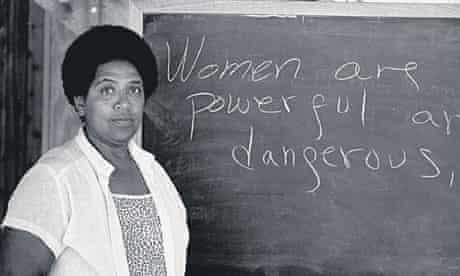
My hero: Audre Lorde by Jackie Kay

Posted in Articles, Gay & Lesbian, Identity Development/Psychology, Literary/Artistic Criticism, Media Archive, Women on 2011-11-21 02:04Z by Steven

My hero: Audre Lorde by Jackie Kay

The Guardian
Series: My Hero
2011-11-18

Jackie Kay, Professor of Creative Writing
Newcastle University


Refusal to be defined by single categories: Lorde in 1983. Photograph: Robert Alexander/Getty Images

‘Lorde was openly lesbian before the gay movement existed. Her wise words often seem eerily prescient’

Audre Lorde dropped the y from Audrey when she was still a child so she could be Audre Lorde. She liked the symmetry of the es at the end. She was born in New York City in 1934 to immigrants from Grenada. She didn’t talk till she was four and was so short-sighted she was legally blind. She wrote her first poem in eighth grade. The Black Unicorn, her most unified collection of poems, partly describes a tricky relationship with her mother. “My mother had two faces and a frying pot / where she cooked up her daughters / into girls … My mother had two faces / and a broken pot /where she hid out a perfect daughter /who was not me.”…

…I first met Audre in 1984, when I was 22. She told me her grandfather had been Scottish, and that I didn’t need to choose between being Scottish and being black. “You can be both. You can call yourself an Afro Scot,” she said in her New York drawl. Lorde was Whitman-like in her refusal to be confined to single categories. She was large. She contained multitudes…

Read the entire article here.

Tags: , ,

Pacific children of US servicemen for study

Posted in Articles, History, Media Archive, Oceania on 2011-11-21 01:10Z by Steven

Pacific children of US servicemen for study

Otago Daily Times
University of Otago, New Zealand
2010-01-05

Allison Rudd

World War 2 brought two million United States servicemen to New Zealand and many Pacific Islands. Inevitably, many formed liaisons with local women and fathered possibly several thousand children. What happened to those babies, and, more than 60 years later, where are they now? Allison Rudd talks to University of Otago historian Prof Judith Bennett, who has won funding to try and trace the all-but forgotten offspring.

Judith Bennett was doing some research when she got sidetracked.

She was compiling information for a book on the environmental effect of the war on Pacific Island countries when she came across references to the mixed-race children of local women and United States servicemen.

Her interest was piqued.

“I was very curious because I could find very little on this topic.

“So it seemed to me there were questions that needed to be answered: How were these children accepted?

“Did their parentage affect their land rights?

“Did it affect their marriage prospects?

“How were their mothers characterised in their own societies?

“How did the US Government view marriage?

“How did the indigenous people view these relationships?

“Were they profitable, were they shameful, or were they a mixture?

“What have been the long-term effects of mixed parentage?

“These children would have looked different – their fathers were white or African American.

“What impact did that have on them as they were growing up and when they were adults?”

Now Prof Bennett hopes to satisfy her curiosity, having secured a $917,000 Marsden grant to embark on a three-year research project…

Read the entire article here.

Tags: , , , ,

Families on the color-line: patrolling borders and crossing boundaries

Posted in Articles, Family/Parenting, Media Archive, Social Science, United States on 2011-11-21 00:46Z by Steven

Families on the color-line: patrolling borders and crossing boundaries

Race and Society
Volume 5, Issue 2, 2002
Pages 139-161
DOI: 10.1016/j.racsoc.2004.01.001

Erica Chito-Childs, Associate Professor of Sociology
Hunter College, City University of New York

Multiracial couples and families are becoming increasingly more common, yet opposition to these relationships still exists even if it is often hidden in color-blind language. In this lingering societal opposition to black-white unions, the strongest opposition often comes from the couples’ families. The social institution of the family plays an integral role in reproducing the dominant ideologies of race that exist in society, and more specifically a racialized discourse that actively discourages interracial unions. Families reproduce racial boundaries, by patrolling who their members can and cannot become involved with. In our society where group membership is all-important and identity is based primarily on one’s racial group, families object to individuals from different “racial” groups redefining themselves apart from their racial identities. Drawing from in-depth interviews with black-white couples, the responses of their white and black families will be explored to illustrate how families express opposition to black-white interracial relationships. In both white and black families, certain discourses are used when discussing black-white relationships that reproduce the image of these unions as different, deviant, even dangerous. Interracial relationships and marriage often bring forth certain racialized attitudes and beliefs about family and identity which otherwise are not expressed.

Article Outline

  • 1. The role of family in societal opposition
  • 2. Theorizing black–white couples and their families
  • 3. Racialized discourses and color-blindness
  • 4. Methods
  • 5. Findings
  • 6. Color-blind or blinded by color?
  • 7. Family responses: from ambivalence to opposition
  • 8. “But what about the children?”
  • 9. Black–white differences in familial opposition
  • 10. Black, white, and shades of grey
  • References

Read or purchase the article here.

Tags: ,

Racial identity and the spatial assimilation of Mexicans in the United States

Posted in Articles, Caribbean/Latin America, Census/Demographics, Media Archive, Mexico, Social Science, United States on 2011-11-20 21:37Z by Steven

Racial identity and the spatial assimilation of Mexicans in the United States

Social Science Research
Volume 21, Issue 3 (September 1992)
pages 235-260
DOI: 10.1016/0049-089X(92)90007-4

Douglas S. Massey, Henry G. Bryant Professor of Sociology and Public Affairs
Princeton University

Nancy A. Denton, Professor of Sociology
Center for Social and Demographic Analysis
State University of New York, Albany

Mexico’s national ideology holds that Mexicans are mestizos, a racially mixed group created by the union of Europeans and Indians. When Mexicans migrate to the United States, this mixed racial identity comes into conflict with Anglo-American norms that view race dichotomously, as Indian or white but not both. In this paper we examine the process of ideological assimilation by which Mexicans in the United States shift their identities from mestizo to white, and then measure the effect that race has on the level of residential segregation from non-Hispanic whites. Although residential barriers are not as severe for mestizos as for Hispanics of African heritage, we find that mestizos are significantly less likely than white Mexicans to achieve suburban residence and that this fact, in turn, lowers their probability of contact with non-Hispanic whites.

Read or purchase the article here.

Tags: , , , , ,

I wouldn’t, But You Can: Attitudes toward Interracial Relationships

Posted in Articles, Media Archive, Social Science, United States on 2011-11-19 17:33Z by Steven

I wouldn’t, But You Can: Attitudes toward Interracial Relationships

Social Science Research
Published online: 2011-11-18
DOI: 10.1016/j.ssresearch.2011.11.007

Melissa R. Herman, Visiting Researcher of the Research Unit
Wissenschaftszentrum Berlin für Sozialforschung
also Assistant Professor, Sociology, Dartmouth College, Hanover, New Hampshire

Mary E. Campbell, Associate Professor of Sociology
University of Iowa

Using the 2008 Cooperative Congressional Election Study (CCES), we study Whites’ attitudes towards dating, cohabiting with, marrying, and having children with African Americans and Asian Americans. We find that 29% of White respondents reject all types of relationships with both groups whereas 31% endorse all types. Second, Whites are somewhat less willing to marry and bear children interracially than to date interracially. These attitudes and behaviors are related to warmth toward racial outgroups, political conservatism, age, gender, education, and region. Third, White women are likely to approve of interracial relationships for others but not themselves, while White men express more willingness to engage in such relationships personally, particularly with Asians. However, neither White men nor White women are very likely to actually engage in interracial relationships. Thus, positive global attitudes toward interracial relationships do not translate into high rates of actual interracial cohabitation or marriage.

Highlights

  • Whites are more willing date interracially than to intermarry or bear multiracial children.
  • These attitudes are related to outgroup warmth, conservatism, age, gender, education & region.
  • White women generally approve of interracial relationships for others but not themselves.
  • White men generally approve of interracial relationships both personally and globally.
  • Neither White men nor White women are very likely to actually engage in one.
Tags: , , , , , ,

Exploring Gloria Anzaldúa’s Methodology in Borderlands/La Frontera—The New Mestiza

Posted in Articles, Literary/Artistic Criticism, Media Archive, Women on 2011-11-19 03:19Z by Steven

Exploring Gloria Anzaldúa’s Methodology in Borderlands/La Frontera—The New Mestiza

Human Architecture: Journal of the Sociology of Self-Knowledge
Volume IV, Special Issue, Summer 2006
pages 87-94
ISSN: 1540-5699

Jorge Capetillo-Ponce, Associate Professor of Sociology
University of Massachusetts, Boston

Gloria Anzaldúa’s Borderlands/La Frontera—The New Mestiza does not fit into the usual critical categories simply because she follows inclination of interest, as opposed to working at achieving systematization. Not only does she shift continually from analysis to meditation, and refuse to recognize disciplinary barriers, but she speaks poetically even when dealing with cultural, political, and social issues. Indeed her method, like Simmel’s, is more akin to “style” in art than it is to “analysis” or “inquiry” in the social sciences. A critic proclaims her/his own incompetence, however, if the mere fact that a text has a certain interdisciplinary quality scares him/her away from her/his rightful task of elucidating its various historical, philosophical, sociological, psychological, and literary elements. In this article, I herewith take up that pleasant task, via this brief sketch pointing us toward a deeper comprehension of Anzaldúa’s Borderlands.

Read the entire article here.

Tags: , ,

Only Skin Deep? The Harm of Being Born a Different Colour to One’s Parents: A (a minor) and B (a minor) by C (their mother and next friend) v A Health and Social Services Trust [2010] NIQB 108; [2011] NICA 28

Posted in Articles, Health/Medicine/Genetics, Law, Media Archive, United Kingdom on 2011-11-18 06:27Z by Steven

Only Skin Deep? The Harm of Being Born a Different Colour to One’s Parents: A (a minor) and B (a minor) by C (their mother and next friend) v A Health and Social Services Trust [2010] NIQB 108; [2011] NICA 28

Medical Law Review
Volume 19, Issue 4 (Autumn 2011)
pages 657-668
DOI: 10.1093/medlaw/fwr029

Sally Sheldon, Professor of Medical Law and Ethics
University of Kent

The complainants, A and B, were twins born as a result of IVF treatment involving donated sperm provided by the Defendant Trust to their mother. While the children’s parents were white, the twins had darker skin than either of them and different skin colour to each other, a difference that had become more marked as they had grown older. It transpired that while the Trust’s normal practice would be to request only sperm from ‘Caucasian’ or ‘white’ donors for a white couple, in this instance sperm from a ‘Caucasian (Cape Coloured)’ donor had mistakenly been used. The implication of this error was that while the sperm donor was white, there was no guarantee that his genetic children would also be so. By the time the action reached the courts, the twins were eleven years old.

The Trust admitted liability to the parents. However, it opposed the action brought on behalf of the twins, in which they alleged three broad kinds of harm. First, because of their colour, the twins had become ‘the subject of derogatory comment and hurtful name calling from other children, causing emotional upset’. Secondly, they had been the subject of adverse and hurtful comment about the colour of their skin and their physical dissimilarity from each other, on the one hand, and between themselves and their parents on the other. This had led them to question their parents about whether they were adopted. Thirdly, should either twin go on to have a child with a partner of mixed race, any child born to them was likely to have a different skin colour from either parent.

The court proceedings raised, by common agreement of the parties, a number of legal issues: first, the existence and nature of a duty of care owed to A …

Read or purchase the article here.

Tags: ,