The Sexualization of Difference: A Comparison of Mixed-Race and Same-Gender Marriage

Posted in Articles, Gay & Lesbian, Law, Media Archive, United States on 2012-10-12 03:22Z by Steven

The Sexualization of Difference: A Comparison of Mixed-Race and Same-Gender Marriage

Harvard Civil Rights-Civil Liberties Law Review
Volume 37, Number 2, Summer 2002
pages 255-288

Josephine Ross, Associate Professor of Law; Supervisor, Criminal Justice Clinic
Howard University, Washington, D.C.

I. Introduction: Mixed-Race Love as a Sexual Orientation

The past prohibition of mixed-race marriages in many U.S. states is often cited by those who support civil recognition of same-sex marriages. Advocates and scholars reason that just as it is no longer legal to deny marriage licenses on the basis of race, it should be illegal to deny marriage licenses on the basis of sex. Unfortunately, the comparison usually stops there. No effort has been made by the legal community to examine the actual lives of these two groups of outsider couples to see if the comparison holds together descriptively as well as formalistically. Nor have contemporary attitudes towards same-sex couples been compared to historical data detailing attitudes towards mixed-race sexuality during the time that mixed-race relationships were illicit. This Article will compare heterosexual mixed-race and same-sex unions (both mixed-race and monorace) in the context of history, both legal and cultural. The historical treatment of mixed-race marriages in this country supplies important information regarding the way society marginalizes certain relationships, and the connection between deprivation of marriage rights and the sexualization of relationships.

To say that a relationship is “sexualized,” means it is viewed as essentially sexual, and is not seen to be about commitment, communication or love. To understand what I mean by the word “sexualized,” consider certain reactions to an elementary school teacher who came out to his class in Newton, Massachusetts. When asked if he was married, the teacher responded that he was not, but that if he were to live with someone, he would live with a man that he would “love the way your mom and dad love each other.” This response gave rise to a parent’s complaint that the teacher had talked inappropriately about “sex;’ That story nicely encapsulates what I mean by the sexualization of same-sex love. If the teacher had answered that he would like to marry a woman whom he would “love the way your mom and dad love each other,” no one would have sexualized his response.

My argument is that the sexualization of gay relationships is similar to the way interracial relationships were sexualized in the past. For both, sexualization is a cause as well as a symptom of disempowerment. In the 1970s, social scientists began to describe the continued sexualization of black-white relationships in the United States from the time of slavery through the decade following the Supreme Court’s 1967 decision in Loving v. Virginia. They noted that narrative discourse around mixed-race couples was sexualized, and that mixed-race love was viewed as something pornographic and essentially different from mono-race love. Social scientists uncovered attitudes towards mixed-race couples by family members and society at large that I believe mirror attitudes towards same-sex couples.

Part II of this Article provides clues to the link between the sexualization of relationships that trespass on societal norms, and the deprivation of power and rights. Section A explores how mixed-race relationships were sexualized in the past, while Section B examines how the law has been used to restrict both mixed-race and gay couples. Section B also explores the cases that predate Loving and the reasons for denying recognition to mixed-race marriages. Those reasons are compared to arguments made by marriage opponents in same-sex marriage cases today.

Part III considers similarities in the lives of gay couples and mixed-race couples in order to demonstrate that analogizing the issue of marriage as it relates to each group is not merely a trick of logic. Section A examines the analogy between Loving v. Virginia and same-sex marriage cases. Section B reviews recent social science data that illustrates many parallel experiences of outsider couples, including the reactions of family members and society, the ways non-traditional couples cope with those negative reactions, and the reasons couples commit to one another despite adversity. By comparing mixed-race and same-sex couples, one can learn a good deal about the way society grants status and safety to certain relationships while marginalizing others.

Part IV asks whether the term “sexual orientation” should be expanded to include those in mixed-race, heterosexual relationships. How one answers this question will shed light on whether the phrase “sexual orientation” is a useful or accurate term when applied to those in gay relationships.

In the Conclusion to this Article, I urge scholars to desist from sexualizing gay relationships. Like mixed-race couples, same-sex partners are not necessarily any more sexual than their heterosexual counterparts. Gay couples, like mixed-race couples, are different not because of what they do or do not do in the bedroom, but because of the meaning ascribed to these couples in supermarkets, in dance halls, and in PTA meetings. Advocates and scholars should learn from past sexualization of mixed-race love and consider more accurate and less sexualized means to characterize same-sex love and relationships…

…The ban on mixed-race marriage did not eliminate sexual activity, but affected the nature of the sexuality, making it secret, closeted and sinful. In the case of white men and black women, the taboo distorted their relationships, suppressing affection or the appearance of affection, rendering them sexual liaisons only. As sociologist [Calvin C.] Hernton wrote, a white man “can sleep with [a black lover] discreetly, give her mulatto babies, but in all of this he must never act as if he loves her.”

Although the apartheid system in this country was intended to prevent access to white women by black men, the system was not completely successful. Hernton documented in his personal life and in his work a great deal of sexual activity between white women and black men in this era. In his opinion, women were often the aggressors because they were the ones with power during segregation. Jim Crow laws could even be said to aid the women’s conquest because although there were dreadful consequences for black men who consented and were discovered, men were sometimes more afraid to resist for fear they would be framed as rapists and face mob violence. As with white men’s liaisons with black women, the interracial sex taboo served to make liaisons between white women and black men purely sexual and clandestine…

Read the entire article here.
Tags: ,

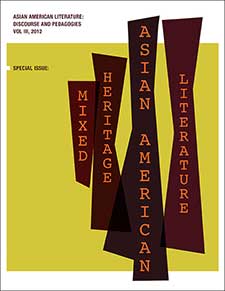
Special Issue: Mixed Heritage Asian American Literature

Posted in Articles, Asian Diaspora, Literary/Artistic Criticism, Media Archive on 2012-10-12 02:38Z by Steven

Special Issue: Mixed Heritage Asian American Literature

Asian American Literature: Discourses & Pedagogies
Volume 3 (2012): Special Issue: Mixed Heritage Asian American Literature

Table of Contents

Read the entire issue here.

Tags: , , , , , , , , , , , , , , , , , , , , , , , , , , , , ,

A diverged family converges at Harvard Law

Posted in Articles, Asian Diaspora, History, Identity Development/Psychology, United States on 2012-10-11 02:16Z by Steven

A diverged family converges at Harvard Law

Havard Law School News
2012-10-10

Audrey Kunycky

A chance encounter, a discovery of kin on opposite sides of the world

It wasn’t inevitable that Harvard Law School graduate students Erum Khalid Sattar and Rebecca Zaman would meet so soon, or even at all. Sattar has been at the law school for three years, pursuing a doctorate in juridical science (S.J.D.); Zaman arrived in August to begin a year of study for a master’s in law (LL.M.). Sattar is from Pakistan, and studied law in London; Zaman grew up, earned her law degree and completed a judicial clerkship in Australia. Then again, they’re about the same height, with the same dark brown hair, and that might not be just a coincidence.

In August, a few days into LL.M. Orientation, the two women shook hands and said hello at a Graduate Program reception. “If we hadn’t been wearing nametags, what happened next might never have happened,” says Zaman. Sattar’s large, expressive eyes are glittering, but she wants Zaman to tell the story, because she tells it better.

My surname is Zaman, and it’s a very unusual surname for a white-appearing Australian to have,” explains Zaman. “So when they saw my nametag, a lot of the Indians, Pakistanis and Middle Easterners asked how I could have this name. When I met Erum, it was very similar.  So I said, ‘Oh! My father’s father is a Muslim Indian from Hyderabad.’ And Erum said, ‘Oh, what a coincidence. My family was from Hyderabad, before they moved to Karachi after the partition.’ And she laughed, and said, ‘Maybe we’re related.’ We both laughed, and I said, ‘Maybe. It’s a strange story.’”…

Read the entire article here.

Tags: , , , , , , ,

Don’t Be Too Black, Mr. President: The Racial Effect of President Obama’s Performance in the 2012 Presidential Debates

Posted in Articles, Barack Obama, Media Archive, Politics/Public Policy, United States on 2012-10-11 01:34Z by Steven

Don’t Be Too Black, Mr. President: The Racial Effect of President Obama’s Performance in the 2012 Presidential Debates

Darron Smith
2012-10-05

Darron T. Smith, Assistant Professor, Physician Assistant
Wichita State University, Wichita, Kansas

What does it mean to be Black in America? Many Americans caught a glimpse of it on national television during the first of three presidential debates. The President looked disinterested, annoyed, preoccupied, not on his “A” game as some analyst remarked. Other pundits suggested that POTUS appeared tired looking and too nice. Obama supporters and those tough independent voters wanted more.

Remember, it’s been four years since the man has had a debate-he’s rusty. But amidst the fight of his political career, few have considered the enormous psychological cost of being black that the President must feel each and every time he’s on the stage. President Obama is not just another president in the long history of white presidents we’ve had in this country. He’s the first black president, and with that comes additionally burdens that only blacks and other stigmatized minority groups can truly appreciate. His overall likeability ratings are indicative of his daily performance of hyper-politeness, which is what black folk must do when working in predominately white settings. It’s in black Americans’ best interest to keep white folks happy and content as to not upset the racial applecart…

Read the entire article here.

Tags: , ,

The Elizabeth Warren Situation Is More Complicated Than Many Think

Posted in Anthropology, Articles, Canada, Identity Development/Psychology, Native Americans/First Nation, New Media, Politics/Public Policy, United States on 2012-10-10 21:02Z by Steven

The Elizabeth Warren Situation Is More Complicated Than Many Think

Indian Country Today Media Network
2012-10-10

Laura Waterman Wittstock
Seneca Nation

A ton of ink has been spilled on the subject of the Elizabeth Warren run for the U.S. Senate in Massachusetts. Most of the writing on the Indian side of opinion is whether or not Warren has a legitimate claim to her Delaware and Cherokee ancestry. Strong language has emerged on the subject, rightly due to the fact that so many Americans claim Indian heritage without any idea of what being an Indian is all about.

But between the Indian and non-Indian sides of the coin are a million slices of what-ifs and others. Example one: I met a woman whose husband was enrolled in Coweta Creek and got support for his considerable higher education costs. Beyond that, he knew next to nothing about his tribe. He was born into an African American family, married an African American and had a couple of wonderful children. His wife’s question to me was how she could get the children enrolled after they had been informed the children lacked sufficient blood quantum. This mother was interested in her children’s education and wanted them to have all the benefits they might be due as a result of their father’s heritage. I did not have good news for them…

Read the entire article here.

Tags: , , ,

Local Filmmaker to Give Voice to Biracial Issues

Posted in Articles, Identity Development/Psychology, New Media, United States, Videos on 2012-10-10 04:59Z by Steven

Local Filmmaker to Give Voice to Biracial Issues

News Release
Nashville, Tennessee
2012-10-10

Jefferey Martin
615-918-8688


James Southard, Director/Producer

Native Nashville, [Tennessee]  filmmaker, James Southard aims to tackle the subject of what it means to be biracial in his forth-coming documentary, “Half-Caste.” The documentary comes from a mixture of personal experience with being biracial, a desire to help other people tell their story, and a need to increase awareness on the subject.
 
Half-Caste will explore the poignant issues of people who come from multi-racial backgrounds throughout society. This documentary will tackle issues such as personal identity, social identity, basic desire to belong to one group, race identification, government classification, racism, stereotypes, family, dating, difficulties of interaction within races and many other issues specific to the loose multi-racial community.
 
Southard is currently filling new interviews and gathering footage even while in the midst of trying to raise money, using Kickerstarter.com. Southard is aiming to raise awareness on the subject and has set his sights on making an incredible film that will bring this subject into the Public’s focus.

Southard is available for interviews, and can be contacted at: 615-918-8688

For more infomation, click here.

Tags: ,

Jazz, Race Collide With War In 1930s Europe

Posted in Articles, Audio, Canada, Europe, History, Media Archive, United States on 2012-10-10 03:55Z by Steven

Jazz, Race Collide With War In 1930s Europe

Tell Me More
National Public Radio
2012-03-26

Jacki Lyden, Host

The novel Half Blood Blues explores an often overlooked slice of history: black jazz musicians in Germany on the eve of World War II. The book moves from 1992 to 1939, from Baltimore to Berlin to Paris. It’s told by an elderly black jazz musician and his friend who survived the war. Guest host Jacki Lyden speaks with author Esi Edugyan.

Transcript:

This is TELL ME MORE from NPR News. I’m Jacki Lyden. Michel Martin is away this week. Now we’re going to take a trip back in time with the help of a prize-winning novelist.

The novel, “Half Blood Blues,” considers a slice of history that often gets overlooked: black jazz musicians and their fate in Germany just before World War II. The novel moves back and forth from 1992 to 1939, from Baltimore to Berlin, Berlin to Paris and it’s told through the eyes of an elderly Baltimore black jazz musician, Sid Griffiths, and his lifelong friend, Chippewa Jones, all in invented period slang.

The novel was short-listed for the Booker Prize this year and won the Giller Prize in Canada and its author, Esi Edugyan, joins us now from member station KUOW in Seattle. Welcome.

ESI EDUGYAN: Thank you.

LYDEN: Esi, just to establish, you are a Canadian author.

EDUGYAN: I am.

LYDEN: And you live in…

EDUGYAN: I was born and raised in Calgary.

LYDEN: Born and raised in Calgary, of Ghanaian parents and you live in Victoria?

EDUGYAN: Yes.

LYDEN: Well, please tell us about this novel, which has had so much success. Tell us about the men at the center of your story. They’re jazz musicians from a group called the Hot Time Swingers. We meet them in Paris. They already have escaped from Berlin. They’ve met Duke Ellington and at the center of the group is this really intriguing character you’ve invented called Hieronymus Falk. And he is eventually picked up by the Gestapo in June of 1940. Tell us about these fellows and Hieronymus.

EDUGYAN: Well, essentially, the novel is told in two parts and the first part centers around the Hot Time Swingers who, you know, are a jazz band who’s had quite a bit of success playing in Berlin. And, you know, now the Third Reich has been ushered in and they’re trying to decide exactly how to proceed now that they’ve been prohibited from playing in public.

And so the band consists of two African-American players, Sid and Chip from Baltimore, as well as the German players, Paul, who’s a pianist who has a Jewish background, and Ernst. And then Hieronymus Falk, who is an Afro-German, the child of a French colonial soldier and a German mother, and he’s the trumpet prodigy.

LYDEN: Hieronymus Falk really intrigued me, Esi Edugyan. He is, you say in the novel, the German word was mischling. He is of mixed race and there really were such Afro-Germans prior to the Nazis taking power…

Read the entire transcript here. Listen to the interview here. Download the interview here.

Tags: , , , , , , , ,

Children of the Occupation

Posted in Articles, Asian Diaspora, History, Media Archive, Oceania on 2012-10-10 01:19Z by Steven

Children of the Occupation

NewSouth Publishing
2012-07-01

Walter Hamilton, Journalist and Author

Towards the end of an eventful life, George Budworth, who served with the Australian Army in Japan after the war, wrote an account describing the first time he saw his son, Peter. It was not in a hospital maternity ward but on the streets of Kure one chilly night in 1954:

In broken English, the woman said, ‘Please, you look my baby, he sick’. She turned her back to Quietly [George’s fictional alter ego]. The baby was tied on her back in a kind of carryall. Quietly reached down and flipped back the lid. Looking up at him was the pinched, undernourished white face of a very young baby. Quietly could see at a glance that the child was half Japanese ­– certainly not a full blood. ‘He now six weeks; he Goshu (Australian) baby-san,’ was all she said through her sobs.

George gave the woman all the money he was carrying. She later sought him out to return the change; they started a relationship; and George formed a close bond with the child, Hideki, whom he renamed Peter and formally adopted.

In 1956, as the British Commonwealth Forces Korea prepared to pull out of Japan, George was among a handful of soldiers and civilians seeking permission to take adopted children back to Australia. In the decade since the first Australian troops arrived in Occupied Japan, such a thing had never been allowed (though war brides were admitted after 1952). In George’s fictionalised memoir, Peter’s mother, Fusako, surrenders custody of her child because she fears for his future in Japan: ‘They could never go to school, never marry, or hold any job but as labourers, in other words a life worse than death was the best these children could expect’…

…Walter Hamilton’s book Children of the Occupation: Japan’s Untold Story will be published by NewSouth in June.

Read the entire article here.

Tags: , , ,

“The Ineffaceable Curse of Cain”: Race, Miscegenation, and the Victorian Staging of Irishness

Posted in Articles, Europe, Literary/Artistic Criticism, Media Archive, United Kingdom, United States on 2012-10-09 21:38Z by Steven

“The Ineffaceable Curse of Cain”: Race, Miscegenation, and the Victorian Staging of Irishness

Victorian Literature and Culture
Volume 29, Number 2 (September 2001)
pages 383–396

Scott Boltwood, Associate Professor of English
Emory & Henry College, Emory, Virginia

THROUGHOUT THE NINETEENTH CENTURY both the English popular and scientific communities increasingly argued for a distinct racial difference between the Irish Celt and the English Saxon, which conceptually undermined the Victorian attempt to form a single kingdom from the two peoples. The ethnological discourse concerning Irish identity was dominated by English theorists who reflect their empire’s ideological necessity; thus, the Celt and Saxon were often described as racial siblings early in the nineteenth century when union seemed possible, while later descriptions of the Irish as members of a distant or degenerate race reflect the erosion of public sympathy caused by the era of violence following the failed revolt of 1848. Amid this deluge of scientific discourse, the Irish were treated as mute objects of analysis, lacking any opportunity for formal rejoinder; nonetheless, these essentially English discussions of racial identity and Irishness also entered into the Irish popular culture.

This paper will examine the dynamic resonance of English ethnography within Irish culture by using Victorian theories of Celtic racial character to inform a reading of a seminal dramatic portrayal of the Irish. The focus of my analysis will be the romantic melodrama The Colleen Bawn, written by the Irish dramatist Dion Boucicault in 1860. This work is the first of Boucicault’s several “Irish” melodramas: plays that celebrated Irish identity, enjoyed the fanatical devotion of Irish audiences well into the next century, and inspired a school of Boucicauldian nationalists at Belfast’s Queen’s Theatre at the turn of the century. Ultimately, though, the artistic impetus for The Colleen Bawn underscores Boucicault’s deep ambivalence over his homeland. Early in 1860, he began working on The Colleen Bawn following his completion of The Octoroon, a play in which he performed each night throughout the period of the Irish play’s composition and rehearsal. Both plays focus on a young landowner who is torn between his love for a poor, local beauty and his financial necessity to marry his wealthy neighbor. Moreover, in both plays the heroes inherit estates teetering on the brink of financial ruin, both intended brides are faithful and wealthy cousins, and both heroines are celebrated for their innocence and purity. Tellingly though, the first heroine is the mulatto freed-slave Zoe, while the second is the Irish peasant Eily O’Connor.

Although avowedly not intended to be an “Irish Octoroon,” The Colleen Bawn anticipates the racial conflation of Irish and African that the English ethnological imagination scientifically argued for beginning in the 1880s. Indeed, the creative genesis of this Irish romance in a melodrama of slavery and miscegenation aptly reveals the status of the Irish within the United Kingdom in spite of the promised equality supposedly conferred on the Irish by the Act of Union in 1800. Whereas the modern reader may argue that the play’s tension arises from the social, religious, and economic disparities between Hardress Cregan and Eily O’Connor, the widespread popularity of Victorian theories of racial identity would have predisposed the play’s audience to recognize the racial difference between Hardress and Eily as the fundamental impediment to their happiness…

Read the entire article here.

Tags: , , , ,

The Miscegenation of Richard Mentor Johnson as an Issue in the National Election Campaign of 1835-1836

Posted in Articles, History, Media Archive, Politics/Public Policy, United States on 2012-10-09 20:52Z by Steven

The Miscegenation of Richard Mentor Johnson as an Issue in the National Election Campaign of 1835-1836

Civil War History
Volume 39, Number 1, March 1993
pages 5-30
DOI: 10.1353/cwh.1993.0043

Thomas Brown

White American men of the antebellum era abhorred few, if any, things more than the danger of an “amalgamation” of their race with African Americans through interracial sexual relations. But their concerns about miscegenation between whites and blacks were usually not a major factor in national politics. However, in the election of 1836, the Democratic candidate for vice president was Representative Richard Mentor Johnson of Kentucky, who was revealed to be a “practical amalgamator.” The opposition to the Democrats—an assortment of Antimasons, Whigs, and disaffected Democrats supporting three presidential candidates in different parts of the country—exploited Johnson’s candidacy to make the menace of amalgamation into a national political issue. Its attacks compelled the Democrats, in turn, to deal with the issue of Johnson’s private life in a manner designed to minimize the damage to their party, and perhaps even make an asset of a liability. The positions taken in the controversy over Johnson’s miscegenation are of great value and interest, for the spokesmen of the opposing sides had to grapple with…

Tags: , ,