Wrightsville Beach alderman pressured to resign after insult against bartender

Posted in Articles, Media Archive, Politics/Public Policy, United States on 2015-04-22 19:51Z by Steven

Wrightsville Beach alderman pressured to resign after insult against bartender

StarNews
Wilmington, North Carolina
2015-04-17

Julian March

WRIGHTSVILLE BEACH | Alderman Darryl Mills is facing pressure to resign after he used derogatory language to a bartender last month.

Mills made the comment to Mia Banks while she was working at King Neptune Restaurant on North Lumina Avenue.

In an interview, Mills confirmed he called Banks a “mixed breed” and used an expletive. He said he and Banks have had a bantering and teasing relationship for years.

“That night, as soon as it happened, I saw that it bothered her, hurt her, and I apologized immediately and left,” Mills said. He later apologized a second time in an email.

He has no plans to resign. “I think this is a personal matter,” he said. “It has nothing to do with Wrightsville Beach.”

Banks agreed she had a bantering relationship with Mills, but said that would be true with all of her customers, especially regulars.

She said she had not discussed her race with Mills before his comment. Her mother is Polish and Italian and her father is African-American.

“I was humiliated,” Banks said. “I was degraded.”…

Read the entire article here.

Tags: , , , ,

Having Mixed-Race Kids Doesn’t Make You Non-White

Posted in Anthropology, Articles, Asian Diaspora, Family/Parenting, Media Archive, United States on 2015-04-22 19:40Z by Steven

Having Mixed-Race Kids Doesn’t Make You Non-White

Mom.Me
2015-04-20

Grace Hwang Lynch, Blogger
Hapa Mama


Adel Vardell photography

Do white parents become “less white” when they have non-white kids? That question is burning up my Facebook feed right now, thanks to an essay in the New York Times last week.

In the piece published in Motherlode, Jack Cheng (a Chinese American man married to a white woman) writes of his wife:

“She became less white when our son, and then our daughter, were born. I think the first bit of doubt surfaced the day we were on the subway with our newborn and a woman came up to my wife and said: ‘Oh, he’s so cute! When did you adopt him?’ I was livid: Did it not occur to this woman that the father was sitting right next to his wife and child?”

But that is not becoming less white…

…While I might be able to code switch and move in different circles and enjoy a variety of cultures, that doesn’t change the fact that my skin is golden, my nose is wide and sometimes people assume I’m a Tiger Mother. Or the manicurist. Or that I should be taking their General’s Chicken order…

Read the entire article here.

Tags: ,

In Puerto Rico, a push to revive indigenous culture

Posted in Anthropology, Articles, Caribbean/Latin America, Census/Demographics, History, Media Archive, United States on 2015-04-22 19:18Z by Steven

In Puerto Rico, a push to revive indigenous culture

The Associated Press
2015-04-20

Anica Coto

SAN LORENZO, Puerto Rico (AP) — In Puerto Rico’s misty, bamboo-studded mountains, elementary school students are studying a nearly extinct language, beating on drums and growing native crops like cassava and sweet potato as they learn about the indigenous people who lived on the island before Christopher Columbus.

The children in four towns in the island’s southeast corner play a ceremonial ball game that was called batey by the native Tainos, who were all but wiped out during colonial times. The boys and girls also learn words from the local Arawak language, which was in part rebuilt with help from linguists, and still exists in varying forms among other native groups in the hemisphere.

Now, a group of academics and educators hope to expand the Taino education program to other public schools around the U.S. territory in an effort to teach children this little known part of the territory’s history.

“If you don’t know your roots, you don’t know yourself,” said anthropologist Carlalynne Yarey Melendez, director of the Taino cultural organization that runs the educational program. “There are so many communities and schools that want the classes, but I can’t keep up with the demand.”

Puerto Ricans’ interest in the territory’s indigenous past has grown in recent years, with 42,000 of the 3.7 million people then living on the island identifying themselves as at least partially Taino in the 2010 Census.

But even though that’s just a little more than 1 percent, Puerto Rico’s legislature is considering a proposal to declare Melendez’s Naguake organization to be the island’s first indigenous-based community. The designation would allow it to receive federal funds under a program that aids native groups, and expand the program to other towns…

Read the entire article here.

Tags: , , , ,

See First Photos of Matthew McConaughey in The Free State of Jones

Posted in Articles, Arts, History, Media Archive, Mississippi, United States on 2015-04-21 20:40Z by Steven

See First Photos of Matthew McConaughey in The Free State of Jones

Time
2015-04-21

Sarah Begley, Culture Reporter


Matthew McConaughey stars in The Free State of Jones (Murray Close)

He’s basically your Civil War boyfriend

For an actor, there’s no better awards bait than an appearance-transforming role in a biographical war movie. World, meet The Free State of Jones.

Matthew McConaughey will star in the action-drama as Newt Knight, a Mississippi farmer who led a southern rebellion against the Confederates during the Civil War. He and his followers “seceded” from the Confederacy, calling Jones County “The Free State of Jones.” After the war, he distinguished himself from fellow southerners once again by marrying a former slave named Rachel…

Read the entire article here.

Tags: , , , , , , , ,

Panel discusses mixed race scholarship

Posted in Articles, Media Archive, United States on 2015-04-21 18:25Z by Steven

Panel discusses mixed race scholarship

Washington Square News: NYU’s Independent Student Newspaper
2015-04-21

Amanda Morris, Contributing Writer


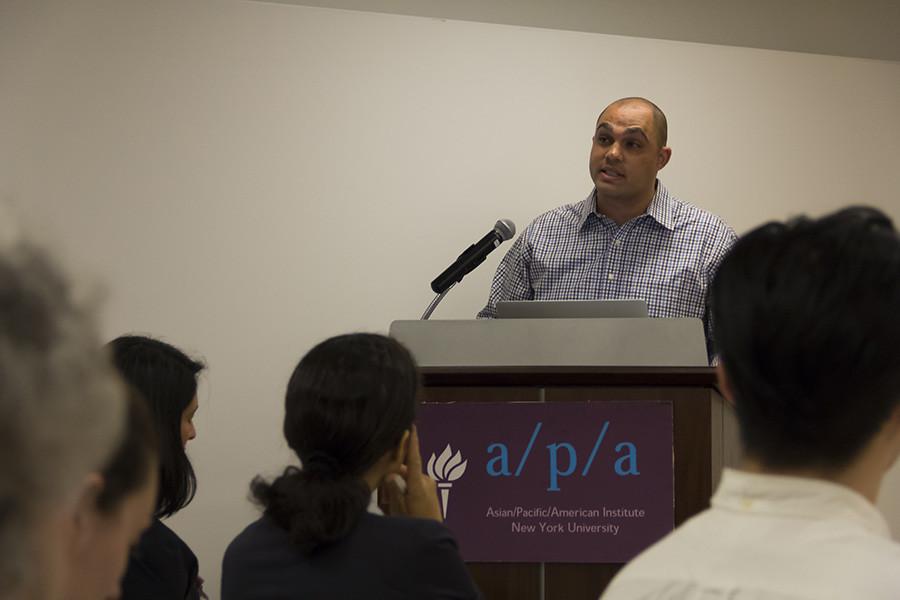
Jared Sexton speaks on the topic of mixed race individuals. Sexton is the director of the African American Studies program in UC Irvine. (Shawn Paik)

In studying mixed race identities, the historical focus has been on the individual, but speakers at Monday’s roundtable conversation “What’s Radical About Mixed Race?” aimed to reframe discussion in a way that allows for more nuanced understanding of racial identity.

Speakers at the event, which was hosted by the Asian/Pacific/American Institute, included Minelle Mahtani, an associate professor at the University of Toronto, and Jared Sexton, an associate professor and director of African American studies at the University of California, Irvine.

Sexton said hypodescent, a condition in which people with multiple race identities are automatically classified according to their non-white race, is one of the concerns researchers of mixed race have had in the past. Sexton said he wants researchers to re-examine this issue in a larger framework of racial stereotypes.

“Some of the preoccupations are the issue of hypodescent and challenging its reflexive use, but in challenging hypodescent, multiracial studies also runs the risk of re-stigmatizing the very identities that it claims to combine,” Sexton said.

Mahtani said some mixed raced individuals try to fuse their various identities, but often reinforce white supremacy by ignoring their non-white ancestry. Mahtani added that the media often takes advantage of people of mixed race, using their perceived racial ambiguity to appeal to several demographics at once…

…“We need to ask new questions,” Mahtani said. “Not ‘What is mixed race?’ but ‘How does the meaning of mixed race change over time?’”

University of Washington student Na’quel Walker, who attended the event, said she often had trouble with her identity as a child.

“When I was younger, for me to say ‘I’m mixed,’ was to denounce blackness,” Walker said. “I was trying to elevate myself because I wanted to feel special or different, but I was running away from my blackness.”

Nicole Holliday, a doctoral student at NYU in linguistics who is studying the speech patterns of people of mixed race, agreed that research into mixed race culture needs to take a new approach…

Read the entire article here.

Tags: , , , , , , , , , ,

Color Blindness and Racial Politics in the Era of Obama

Posted in Articles, Barack Obama, Book/Video Reviews, Media Archive, Politics/Public Policy, United States on 2015-04-21 01:46Z by Steven

Color Blindness and Racial Politics in the Era of Obama

Books & Ideas
2010-12-08

Andrew J. Diamond, Professor of American History and Civilization
Université Paris-Sorbonne, France

At a time when a supposedly “post-racial” America is becoming increasingly polarized over its first black president, historian Thomas Sugrue proposes a badly needed perspective on Obama’s attempts to negotiate between color blindness and race consciousness. Despite the depth of his historical perspective, he understates how destructive Obama’s religious moralism is for the cause of racial progress.

Reviewed: Thomas J. Sugrue, Not Even Past. Barack Obama and the Burden of Race, Princeton University Press, 2010, 178p., $24.95

Thomas J. Sugrue’s Not Even Past is one of the latest contributions to the exploding field of Obama studies. Sugrue discloses in the opening pages that he voted for Barack Obama, made a small financial contribution to his campaign, and even worked on the candidate’s urban advisory committee, but his objective in his own rendering of Obama’s breathtaking rise to the White House is “balance”. In a moment when the United States is becoming increasingly polarized over its first black president, with a rising crescendo of criticism on both the right and left of the American political spectrum, this is an ambitious project to say the least. But Sugrue, an eminent Professor of History and Sociology at the University of Pennsylvania and a pioneer in the new urban historiography of race and power in the postwar American metropolis, is just the guy for the job, even if, in the final analysis, Obama’s detractors will no doubt have more complaints with the book than his supporters. And yet, if one gets the sense that Sugrue is at times pulling punches, he ultimately manages to produce an even-handed and illuminating analysis of the Obama story.

Not Even Past, which consists of three essays adapted from a series of lectures the author presented at Princeton University in 2009, stands out among the recent works on what Barack Obama means to the United States, in part, because Sugrue remains true to his métier. Joining a field crowded with works of a somewhat polemical and journalistic bent, Sugrue delivers a rich, lucid, and badly needed account of the historical events, political movements, and ideological currents that shaped the ground upon which Obama negotiated his racial identity, developed his political views, and positioned himself for an improbable run for the presidency. Yet, this is as much a story about the world that made the man than it is about the man himself. “It is the story”, Sugrue writes, “of a journey through one of the most contentious periods of America’s racial history, through America’s post-1960s multicultural turn, into the syncretic black urban politics of the late twentieth century, onto the contested intellectual and cultural terrain of race and ‘identity politics’ in the late 1980s and 1990s, and finally to a moment in the early twenty-first century when America still lived in the shadow of the unfinished civil rights struggles of the previous century while influential journalists, politicians, and scholars hailed the emergence of a post-racial order” (p. 16). These were treacherous waters indeed for black politicians and white liberals alike, both of whom had to navigate a course through the ideological cross-currents of color blindness and race consciousness. These conditions had the Democratic Party lost at sea for the good part of three decades. Obama’s journey to political and racial self-discovery is also the story of how the Democrats rediscovered their bearings in a country drifting ineluctably rightward…

Read the entire article in HTML or PDF format.

Tags: , , , ,

Obama on Racism circa 1995

Posted in Articles, Autobiography, Barack Obama, Media Archive, United States, Videos on 2015-04-21 01:17Z by Steven

Obama on Racism circa 1995

Horizons: Nancy LeTourneau’s big picture look at politics and life
2015-04-16

Nancy LeTourneau

It is always fascinating to find articles and video about Barack Obama from the past. Recently a group called 22-CityView in Cambridge released the video of a reading and book discussion on Dreams From My Father by Obama back in 1995. At the time he had graduated from Harvard Law School, moved back to Chicago, was working as a civil rights lawyer and had recently married Michelle.

The reading is from what I remember as the most racially poignant part of the book. It takes place when he was 16 and includes the incident when his maternal grandmother was frightened by a black man at her bus stop as well as an interchange Barack had about that with Frank Marshall Davis

Read the entire article here.

Tags: ,

Obama’s Mother

Posted in Articles, Barack Obama, Biography, Media Archive, Politics/Public Policy, United States, Women on 2015-04-21 00:50Z by Steven

Obama’s Mother

Books & Ideas
2009-05-20

Gloria Origgi

The American presidential election was won by a woman: Stanley Ann Dunham. Born in 1942, she died of cancer in 1995, shortly after turning 52, and thus without having seen her visionary dream realized: the election of her son, Barack Hussein Obama, as 44th President of the United States.

The male name was imposed on her by Stanley Dunham, her father, who would have preferred a boy. As the only child of Stanley and his wife Madelyn Payne, Stanley Ann was nonconformist young girl and a solitary mother, convinced that she could raise her children in a way that would prepare them for a new world, globalized and multicultural, a world that certainly didn’t exist in her daily life as a middle-class girl in an anonymous little town in Kansas. Barack – or Barry, as she called him – is her creation, the fruit of a patient, attentive and loving education that was the commitment of her life, as she saw in her two racially mixed children the reflection of a better future, one in which the warm commingling of blood pacifies the false oppositions and odious attachments, the “unreal loyalties”, as Virginia Woolf called them, that reassure us in the desperate need for social identity to which our species falls prey.

When Barack Obama was born on August 4, 1961, he was still considered in half the American states the criminal product of miscegenation, or the interbreeding of races, a heinous biological hybrid whose existence simply wasn’t taken into consideration while those who committed it were punished with incarceration. Today it is a hard-to-pronounce word that was coined in the United States in 1863, with a specious Latin etymology, from miscere (mix) and genus (race), to indicate the supposed genetic difference between whites and blacks. The question of miscegenation became crucial during the Civil War and subsequent emancipation of the slaves. It was fine to grant civil rights to non-whites, but to allow intimate relations between whites and blacks was another story. The term appeared for the first time in the title of a pamphlet published in New York, Miscegenation: The Theory of Blending of the Races, Applied to the American White Man and Negro, in which the anonymous author promoted the idea of racial mixing as the project of the Republican Party, which supported the abolition of slavery. By encouraging the interbreeding of whites and blacks, racial differences would be progressively attenuated until they disappeared altogether. It was soon discovered that the pamphlet had been created by the Democrats in order to frighten American citizens faced with the intolerable Republican project of encouraging racial mixing. The crime of miscegenation was definitively abolished in 1967, when the U.S. Supreme Court ruled the anti-miscegenation laws to be unconstitutional in response to Loving v. Virginia, a case in which a racially mixed married couple was sentenced to a year in prison – with the sentence suspended for 25 years on condition that the couple leave the state of Virginia – for having been found in bed together under the same roof. The marriage certificate hanging above the nuptial bed wasn’t considered valid by the police – who, armed with rifles, broke down the entry door and beat the humiliated couple – because it was obtained in another county, one in which miscegenation wasn’t illegal. This occurred in 1959, and the couple had to wait eight years for the moral indecency of their ordeal and their own innocence to be recognized.

One must try to imagine that America in order to understand the courage of Stanley Ann, who was 18 years old and 4 months pregnant when she married the brilliant young Kenyan student Barack Obama Sr., the first African to be admitted to the University of Hawaii. He was 25. He’d arrived in Hawaii in 1959 thanks to a scholarship from the Kenyan government, which was also sponsored by the United States to help some of the more gifted African students get an education at an American University so they could return to their native country and become part of a new, competent, modern elite…

Read the entire article in HTML or PDF.

Tags: , , ,

Race and Republicanism

Posted in Articles, Book/Video Reviews, Media Archive, Philosophy, Social Science on 2015-04-20 18:34Z by Steven

Race and Republicanism

Books & Ideas
2015-02-23 (Originally published in laviedesidees.fr on February 17, 2014.)

Dominique Schnapper, Director of Studies
École des hautes études en sciences sociales, Paris, France

Translated by (with the support of the Florence Gould Foundation):

Michael C. Behrent

Though race is socially constructed, it nonetheless really exists: consequently, Magali Bessone argues, the concept of race must be taken into consideration when fighting racism. But what positive content can be given to the “critical republicanism” she advocates?

Reviewed: Magali Bessone, Sans distinction de race ? Une analyse critique du concept de race et de ses effets pratiques, [Without Race Distinctions? A Critical Analysis of the Concept of Race and its Practical Effects] Paris, Vrin, “Philosophie concrète”, 2013. 240 p., 24 €.

On a topic that might seem rather overdone, Magali Bessone has written a remarkable book, one that sparkles with intelligence and culture. She seeks to deconstruct a concept that has become taboo in France, though it is commonly used by English-speaking scholars and statisticians. With great flair, she proposes an analysis that can be summed up in several propositions encompassing the very core of her arguments.

  1. Biologists have now established that racial categories (not to be confused with racism, despite complex affinities with it), which became systematic following the encounter with the Other during the Age of Discovery and the eighteenth-century attempt to classify species, do not exist. There are no homogeneous populations groups that can be defined once and for all, and which are different from and unequal to others. Skin color, which for a long time was used to distinguish human races (depending on the author, there were four, five, or seven races, thus proving that race is not self-evident), is but one marker of geographic and historical affiliation among others. Essentialist ways of thinking, which attribute specific and final characteristics to particular population groups, have no biological basis. Differences between individuals are greater than differences between groups, and the boundaries between human groups are porous. “There is no racial essence that can be defined coherently from a biological point of view” (p. 71).
  2. As a result of the atrocities that have been committed in the name of certain races’ claims to superiority, the French have generally replaced the term “race” with “ethnicity” or “culture.” Scholars are afraid that they will be accused of believing race exists if they use a term that, as biologists have shown, lacks any scientific basis and, as historians have demonstrated, was used to justify colonialism and genocide. Yet, as Pierre-André Taguieff has already argued, these terms are not immune to the criticisms directed against race, since ethnicity and culture are characterized by permanent and inherited traits. Consequently, this strategy does not lead to the abandonment of essentialist ways of thinking, which are constitutive of racial thinking. This is the reason I proposed getting beyond the American sociological debate over the validity of the concepts of “racial” or “ethnic group” by proposing that of “historical collectivity.”…

Read the entire review in HTML or PDF.

Tags: , , , ,

Meeting Miss Universe Japan, the ‘half’ who has it all

Posted in Articles, Arts, Asian Diaspora, Interviews, Media Archive on 2015-04-20 13:52Z by Steven

Meeting Miss Universe Japan, the ‘half’ who has it all

The Japan Times
2015-04-19

Bay McNeil


Star-struck: Baye McNeil meets Miss Universe Japan, Ariana Miyamoto, at The Japan Times offices in Tokyo. | OLGA GARNOVA

I felt an almost star-struck excitement at the chance to interview the newly crowned Miss Universe Japan, Ariana Miyamoto. I mean, she’s all the rage, right?

Her name has lit up social media like the constellations since her coronation. Black media can’t stop talking about her. To many, she is yet another global validation of black beauty in the flesh, a young woman who overcame prejudice and race-based adversity to achieve the previously unachievable. How do you not talk about her? Even some of the big dogs, like CNN and Reuters, have given her the time of day, spreading her name and compelling story to media markets everywhere.

Well, almost everywhere…

Read the entire article here.

Tags: , , , , ,