Scholarly perspectives on the mixed race experience.
For similar reasons,The Boondocks also critiques one of the mainstays of mixed race representation: the obligatory rehearsal of one’s multiracial family tree. Replacing calls for social justice or racial equity, the most often repeated goal of “mixed race rights” is merely to “name all the parts of myself.” The rhetorical or graphic display of the family tree (almost de rigueur in the growing genre of mixed race narratives) participates in a racial gaze that can interrupt political reflection. For Jazmine and her family, description has come to stand in for politics, genealogy substituting for political discussions of the body politic. The family tree is paraded as revelatory and socially transforming fact. It has come to serve as proxy for social change, in which representing one’s family tree has become a political end in itself. The exercise of those rights often amounts to making identity a category of genealogical documentation, documentation which, to the extent that it is complacently represented as an end in itself whose social good is somehow self-evident, obscures identity as social index and mode of analysis. When Huey asks Jazmine, “OK… if you’re not black, then what are you, hmmm?” she responds dutifully with a list documenting down to the fraction her ethnic racial portfolio: “My mother is one-quarter Irish, one-quarter Swedish, and one-half German, and on my father’s side is part Cherokee, and my grandfather is mostly French, I think, because he’s originally from Louisiana, and his father was from Haiti I believe, which makes me…” Huey intervenes: “Which makes you as black as Richard Roundtree in ‘Shaft in Africa’” (A Right to Be Hostile 15). Huey disparages not so much her mixed genealogy as the idea that a recapitulation of ethnic and national descent really says anything meaningful about racial identity. At the very least, he suggests, her genealogy is neither progressive nor has sufficient explanatory force. Rather, her accounting retroactively ratifies the idea of racially homogeneous categories and national identities by suggesting that each parent’s race or ethnicity is unitary.
Her laundry list also collapses blood and nation and then fractionalizes both—how else can the notion of “one-quarter Swedish” make sense—and looks less like the new millennial model of post-race and more like an uncritical revival of classic nineteenth-century positivist racialism. Huey interrupts her—and the discourse itself—by insisting instead on the political nature of racial identity: he teases her by saying, “I understand, Jazmine. I’m mixed too.” We see an up-close shot of her face, which lights up as she says hopefully, “You are?” only to have him sarcastically claim, much to her disappointment, to be “part Black, part African, part Negro, and part colored.” Significantly, his designations do not pretend to be descriptive; they all carry heavy historical and political implication. He then walks off wailing, “Poor me. I just don’t know where I fit in,” as she cries after him (again): “You’re making fun of me!” (16). Of course, Huey is making fun of Jazmine in this exchange. However, his send-up is social critique to the degree that it does not concede the reduction of racial identity to the sum of one’s parts; he thinks of race not in terms of blood but in relation to representation. Shaft in Africa, after all, is late in the series of 1970s campy sex-and-adventure Blaxploitation films. Huey’s invocation of the hyper-blackness represented in the Blaxploitation genre of film is a spoof of them—he is concerned not with black authenticity but with cultural figurations of blackness. Race, for McGruder, is always cast as a matter of historical consciousness, social play, and political engagement. This perspective is reinforced in his comments on the racial status of Barack Obama, when he notes, “We all share the common experiences of being Black in America today—we do not all share a common history.” In such scenes, The Boondocks replaces mere optic confirmation of race with black cultural performance and historical citation as more useful markers of racial identity. His coherent sense of “Black” is historically informed, historically evolving, and historically heterogeneous in both community composition and cultural practice.
Tanya Golash-Boza, Associate Professor of Sociology University of California, Merced
This article contests the contention that sociology lacks a sound theoretical approach to the study of race and racism, instead arguing that a comprehensive and critical sociological theory of race and racism exists. This article outlines this theory of race and racism, drawing from the work of key scholars in and around the field. This consideration of the state of race theory in sociology leads to four contentions regarding what a critical and comprehensive theory of race and racism should do: (1) bring race and racism together into the same analytical framework; (2) articulate the connections between racist ideologies and racist structures; (3) lead us towards the elimination of racial oppression; and (4) include an intersectional analysis.
In an article for the National Review late last year, senior editor Jonah Goldberg discussed the (now former) popularity of Ben Carson amongst the GOP. He said “ … most analysis of Carson’s popularity from pundits focuses on his likable personality and his sincere Christian faith. But it’s intriguingly rare to hear people talk about the fact that he’s black. One could argue that he’s even more authentically African-American than Barack Obama … ”
Goldberg makes this statement and then goes on to make a number of claims as to why President Obama is not “authentically African-American” enough, at least when compared to Carson.
“ … Obama’s mother was white and he was raised in part by his white grandparents. In his autobiography, Obama writes at length about how he grew up outside the traditional African-American experience — in Hawaii and Indonesia — and how he consciously chose to adopt a black identity when he was in college.”…
This isn’t a new sentiment. Many people of many different races have often brought up Obama’s racial heritage as a way to discredit his Blackness. In fact, a 2014 article by the Washington Post shows most of America doesn’t consider the president as Black, but as “mixed race.” The problem with this line of thinking stems from how we conceptualize multi-racial identities in this country — one with a history of hypodescent ideologies, like the infamous one-drop rule. The problem with this line of thinking is that all Obama needs to be “authentically” Black is to be Black, and that he most definitely is…
I have a Black father and a white mother. I’m mixed. I’m not a unicorn.
I think there are some misconceptions about who mixed race people are and what function we serve in society. Let’s unpack those.
We’re not the default mediators between cultures.
I feel like this misconception is tied to the fact that our society thinks of mixed race people as “half white, half something else.” Mixed race people who don’t have a “white parent” are largely erased when mixed race people are discussed or represented in media. Being mixed race isn’t limited to being “white and…,” but our society perceives mixed identity that way. My experience is shaped by the fact that I am “white and….,” but I need to stress that my experience, though over-represented, isn’t the experience…
A new Hollywood movie looks at the tale of the Mississippi farmer who led a revolt against the Confederacy
With two rat terriers trotting at his heels, and a long wooden staff in his hand, J.R. Gavin leads me through the woods to one of the old swamp hide-outs. A tall white man with a deep Southern drawl, Gavin has a stern presence, gracious manners and intense brooding eyes. At first I mistook him for a preacher, but he’s a retired electronic engineer who writes self-published novels about the rapture and apocalypse. One of them is titled Sal Batree, after the place he wants to show me.
On his property, Jones County’s J. R. Gavin points out a site that was a hide-out for Newt Knight. “The Confederates kept sending in troops to wipe out old Newt and his boys,” says Gavin, “but they’d just melt into the swamps.” (William Widmer)
I’m here in Jones County, Mississippi, to breathe in the historical vapors left by Newton Knight, a poor white farmer who led an extraordinary rebellion during the Civil War. With a company of like-minded white men in southeast Mississippi, he did what many Southerners now regard as unthinkable. He waged guerrilla war against the Confederacy and declared loyalty to the Union.
In the spring of 1864, the Knight Company overthrew the Confederate authorities in Jones County and raised the United States flag over the county courthouse in Ellisville. The county was known as the Free State of Jones, and some say it actually seceded from the Confederacy. This little-known, counterintuitive episode in American history has now been brought to the screen in Free State of Jones, directed by Gary Ross (Seabiscuit, TheHunger Games) and starring a grimy, scruffed-up Matthew McConaughey as Newton Knight.
As great-granddaughters of Newt and Rachel, Dorothy Knight Marsh, left, and Florence Knight Blaylock revere their past: “It’s a very unusual, complex family,” says Blaylock. (William Widmer)
…After the Civil War, Knight took up with his grandfather’s former slave Rachel; they had five children together. Knight also fathered nine children with his white wife, Serena, and the two families lived in different houses on the same 160-acre farm. After he and Serena separated—they never divorced—Newt Knight caused a scandal that still reverberates by entering a common-law marriage with Rachel and proudly claiming their mixed-race children.
The Knight Negroes, as these children were known, were shunned by whites and blacks alike. Unable to find marriage partners in the community, they started marrying their white cousins instead, with Newt’s encouragement. (Newt’s son Mat, for instance, married one of Rachel’s daughters by another man, and Newt’s daughter Molly married one of Rachel’s sons by another man.) An interracial community began to form near the small town of Soso, and continued to marry within itself…
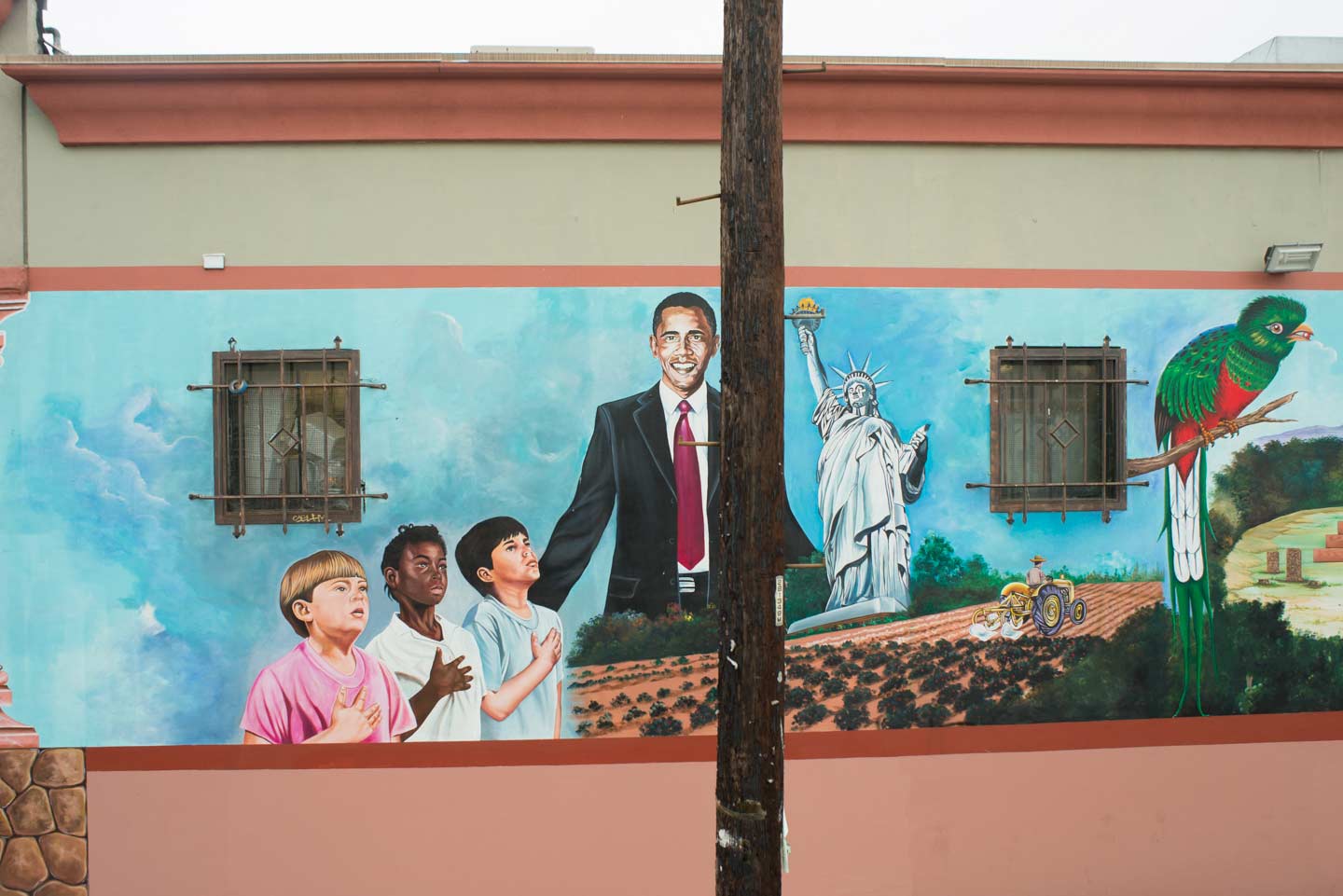
Documenting the murals that decorate the walls of barbershops, restaurants, butcher shops, storefront churches and liquor stores in poor, minority communities has been a decades-long interest of mine. These examples of popular art employ a relatively small range of symbols, motifs, and iconic figures to remind people of their roots and aspirations. When Barack Obama was elected in 2008, I knew that his likeness would soon be featured in ghettos across the nation, and so I searched inner-city neighborhoods for his portraits and interviewed artists and neighborhood residents…
In African-American neighborhoods, President Obama is frequently depicted as a powerful man of action. Folk portraits of him express pride that a black person was able to achieve the presidency, something few believed possible. He is often accompanied by such symbols of American power as the eagle and the American flag…
He called me negra. Not mami or guapa, but what translates to “black woman.” I wasn’t offended. More confused. The thing is, I’m really just a white Jewish girl from Brooklyn. There, I said it.
Junot Diaz came to give a book talk and I was awestruck by the man who stood in front of me, waxing poetically in a black hoodie sweatshirt. Would that have been the time to correct a genius? Oh, I am sorry, Junot, I’m actually just another Jewish girl from Brooklyn. I balked.
My last name is Rabinowitz, and with a name like that, and a life like mine, I’ve had my share of jokes and stereotypes, but never anything I couldn’t handle. The more interesting paradox is that the hue of my skin and the positioning of my features has often made me appear more Hispanic than anything else. After a while you get used to it, and eventually, I even started to believe it. I lived and studied in Ecuador, Argentina, and Mexico. Each trip I returned home with more mannerisms and vocabulary inadvertently adding to my new identity…
I cannot tell you how many times I have been asked this question and the same response I like to give is “I’m human.” I know it strikes people’s curiosity that I am mixed with black and white, having a white father and black mother. I have struggled with my racial identity since I was a child, feeling like there was no in-between besides it being black and white…
Exploring the challenges of mingling identities with photos & stories of cool people I meet around the streets of the cities that I visit during my year-long travel…
The need to belong is a fundamental aspect of life. For bi-racial individuals, ethnic belongingness can be more complicated compared to a monoracial individual. Belongingness contributes to self-esteem and for bi-racial individuals their perceived lack of belonging can cause a problematic question; what am I?
Due to the one-drop rule that categorized any individual with a black ancestor as black, many bi racial individuals adapt a black ethnic identity. This one-drop rule continues to be implemented because of the justification that multi-racial children will be defined by society as black. With a growing population and increased awareness of multi-racial individuals some adapt an ambiguous identity. The purpose of this study is to find out if bi-racial (black and white) individuals who self-identify as bi-racial will have a different sense of belongingness compared to bi-racial individuals who self-identify as black or self-identify as white.
Customers are being charged up to £300 to learn whether they have links to famous people or societies despite the fact many of the tests are not backed up by scientific evidence, experts said.
The amount of DNA any individual inherits from relatives just a few steps up their family tree is negligible compared with the vast amount we all share from common ancestors.
It means any ancestral “history” identified by a simple genetic test is just one of dozens of possible interpretations, and to try to trace our lineage directly through our genes is “absurd”, they claimed…
… The warning was backed by a number of leading genetics experts. Steve Jones, Emeritus Professor of Human Genetics at UCL said: “On a long trudge through history – two parents, four great-grandparents, and so on – very soon everyone runs out of ancestors and has to share them.
“As a result, almost every Briton is a descendant of Viking hordes, Roman legions, African migrants, Indian Brahmins, or anyone else they fancy.”…