The Origins and Authors of the Code Noir

Posted in Articles, Caribbean/Latin America, Europe, History, Law, Media Archive, Slavery, United States on 2013-02-28 01:39Z by Steven

The Origins and Authors of the Code Noir

Louisiana Law Review
Volume 56, Number 2 (Winter 1996)
pages 363-407

Vernon Valentine Palmer, Thomas Pickles Professor of Law
Tulane University, New Orleans

I. Introduction

The Code Noir marked France’s historic rendezvous with slavery in the Americas. It was one of the most important codes in the history of French codes. First promulgated by Louis XIV in 1685 for his possessions in the Antilles, then introduced in Louisiana in 1724, this code was, unlike the Custom of Paris, the only comprehensive legislation which applied to the whole population, both black and white. In these colonies where slaves vastly outnumbered Europeans and slave labor was the engine of the economy as well as its greatest capital investment, the Code was a law affecting social, religious and property relationships between all classes.

The Code was also an important sociological portrait, for no legislation better revealed the belief system of European society including its fears, values and moral blind spots. No legislation was more frequently amended and regularly adapted to adjust to France’s evolving experience with slavery. Furthermore, perhaps no aspect of the Code—whether one refers to its motives and aims, compares it to other slave systems, or questions its enforcement—is free of contemporary controversy.

However, no set of issues is more important than the Code’s antecedents and origins. Who were its authors and what sources did they use in drafting the Code? And what difference does it make? Some have claimed that the Code Noir derives from Roman law and that once again we have an example of legislation from the civil law which contrasts with slave legislation in the English colonies. But to what extent is this conclusion justified? Indeed, the claims about Roman sources usually include the argument that slave laws like those of France and Spain were susceptible of being codified because the Roman reservoir of rules was available, whereas English law developed ad hoc experientially, and could not be codified at the outset2 Some even argue that Rome’s legal influence improved the quality of life of slaves in the New World. France and Spain’s laws, they argue, were relatively more “humane” or less dehumanizing than slavery rules developed by English colonies, and Spanish slavery regulation was milder than that of France because of the greater degree to which Spain absorbed Roman law into its law of slavery…

…II. THE INSTRUCTIONS

The first document is the King’s Mémoire to his Intendant, dated April 30, 1681. This Mémoire is a statement of reasons or motifs why a slavery code is desired, and it contains a set of instructions for the preparation of an “ordonnance” in the Antilles. The King entrusted the task to Jean-Baptiste Patoulet and the Comte de Blénac, his two top officials in the Antilles…

…III. The Drafters’ Rough Notes

On December 3, 1681, de Blénac and Patoulet compiled what is essentially a set of notes comparing their views and seeking consensus on specific problems and topics relating to slavery. Two vertical columns divide each page. The right-hand column reads, “Advice of M. de Blénac on several issues in the Isles of America” and the left-hand column carries the heading “Response of Sieur Patoulet.” De Blénac took the initiative in the drafting, organizing his thoughts into nine articles. Article one deals with convening sessions of the Sovereign Councils, article two with matters of taxation, article three with the problem of the diminishing number of Europeans in the islands, article four with criminal and civil trials, procedures and punishments of slaves, article five with questions arising out of racial mixing (status of offspring, marriage, customs in Martinique and Guadeloupe, etc.), article six with the desirability of introducing feudal fiefs in the islands, article seven with establishing an inspectorate to monitor the treatment of slaves on each island, and article eight with police control (passes, runaways, etc.). Article nine contains a miscellany. De Blénac wrote these sections of the memorandum and then sent the papers on to Patoulet for his response or comments. Patoulet completed his “Response” three days later, and returned the entire document to de Blénac who then added a postscript stating that he would appear the following Monday at Patoulet’s office to work further on the drafting.

De Blénac’s procedure in this memorandum was to pose a general problem at the beginning of each paragraph within an article and then to list possible solutions by shorthand annotation. Patoulet’s responses either approved, disapproved, or supplemented these solutions. These agreements and disagreements formed the basis of their subsequent working session.

These notes allow glimpses into the formative stage of the redaction. They also illuminate aspects of the personalities of the authors and the sources at their disposition. The notes first reveal that the authors took quite seriously the obligation to collaborate with the three Sovereign Councils. De Blénac outlined a procedure in article one, whereby the Councils of all the islands were to meet every two months and to remain in continuous session where matters required it. The authors apparently interpreted their instructions as permitting some parts of the slave code to arise out of the deliberations of these assemblies. This was a sensible interpretation. Since the Intendant served as first president of these Councils with responsibility to take the votes, draw up and sign and promulgate the regulations, and since the Governor-General had full rights of audience and was expected to attend, these sessions would have been the most convenient means by which the authors might comply with their duty to seek consensus and collaboration. Yet this shows that they built the Code not merely out of previously established laws and customs, but from on-going legislative activity during the redaction period itself. Thus, to Patoulet and de Blénac “collaboration” did not exclude the passage of new legislation by the local representative institutions which they led. This was the antithesis of an “artificial” process of discovering rules by the light of Roman sources in faraway Paris.

Second, the notes give hints as to the personalities and motives of the codifiers. De Blénac appears the more humanitarian and racially tolerant of the two. He called for inspectors to be placed on each island to monitor the treatment of slaves, and he wanted to outlaw the use of cruel punishments like “la brimballe” and “le hamac.” Patoulet, however, did not find these practices “too rude” to be employed. Patoulet believed in strict separation of the races. He was scandalized by concubinage between Europeans and Africans, whereas de Blénac considered miscegenation a normal, even inevitable, phenomenon in the colonial context.

Though the drafters may have had somewhat differing outlooks, we should guard against the tendency to contuse their motives with our own views. Judging by these notes, some allegedly “protective” rules may have had a completely different motive than to protect slaves. For example, de Blénac and Patoulet reached the conclusion that the law should require owners to provide their slaves with minimum food and clothing allotments, and this rule passed into the Code Noir. They did not originally discuss this measure as a matter of decency or humanity toward slaves (as might be supposed), but as a means of halting the diminishing white population in the islands. The drafters’ notes argued that when slaves were not properly fed, they had a tendency to run away in search of food and steal from the petit blancs, causing these whites to sell their lands and leave the islands. Readers of the Code may search for higher motives behind the rations provision, but the Mémoire provides evidence that cold-eyed efficiency primed every other consideration.

Finally, the drafters’ notes contain important references to the existence of customs and usages about slavery which had already taken root in the Caribbean islands. These practices were a vital part of the dynamic by which indigenous slave law developed. De Blénac tells us, for example, that there was a usage on the isle of Martinique regarding the manumission of mulattoes: the men are freed automatically when they become twenty years old, the women when they reach fifteen years. The father of a mulatto child was obliged to pay a fine to the Church as a penalty, and if he claimed the child for himself from the owner of the mother he had to pay the owner a similar sum. On Guadeloupe and St. Christophe, however, de Blénac outlines the development of other laws and customs. De Blénac takes all of these rules and practices into account in stating his position to Patoulet. As mentioned earlier, the presence of these diverse legal elements and sources shows that the picture of French slave law drawn by Professor Watson is quite misleading. Professor Watson assumed that France would have turned inevitably to Roman sources because there was a legal vacuum existing with respect to local law and custom. This took no account, however, of the speed and diversity with which law and custom incubated on small isolated islands separated by great distances. None of this development could have been visible from Paris, nor would it have depended upon Rome…

Read the entire article here.

Tags: , , , , , ,

Enlightenment

Posted in Articles, Media Archive on 2013-02-27 15:52Z by Steven

Enlightenment

Poetry Daily
2012-10-09

From Thrall by Natasha Trethewey, Poet Laureate of the United States

In the portrait of Jefferson that hangs
     at Monticello, he is rendered two-toned:
his forehead white with illumination—

a lit bulb—the rest of his face in shadow,
     darkened as if the artist meant to contrast
his bright knowledge, its dark subtext.

By 1805, when Jefferson sat for the portrait,
     he was already linked to an affair
with his slave. Against a backdrop, blue…

Read the entire poem here.

Tags: , ,

Of One Blood: Or, The Hidden Self

Posted in Books, Media Archive, Novels, Passing on 2013-02-26 04:16Z by Steven

Of One Blood: Or, The Hidden Self

Washington Square Press (an imprint of Simon & Schuster)
February 2004 (Originally Published in 1903)
224 pages
Paperback ISBN-10: 0743467698; ISBN-13: 9780743467698
eBook ISBN-10: 1451604351; ISBN-13: 9781451604351

Pauline Hopkins (1859-1930)

Introduction by:

Deborah E. McDowell, Alice Griffin Professor of English
University of Virginia

Of One Blood is the last of four novels written by Pauline Hopkins. She is considered by some to be “the most prolific African-American woman writer and the most influential literary editor of the first decade of the twentieth century, though she is one of the lesser known literary figures of the much lauded Harlem Renaissance. Of One Blood first appeared in serial form in Colored American Magazine in the November and December 1902 and the January 1903 issues of the publication, during the four-year period that Hopkins served as its editor.

Hopkins tells the story of Reuel Briggs, a medical student who couldn’t care less about being black and appreciating African history, but finds himself in Ethiopia on an archeological trip. His motive is to raid the country of lost treasures—which he does find in the ancient land. However, he discovers much more than he bargained for: the painful truth about blood, race, and the half of his history that was never told. Hopkins wrote the novel intending, in her own words, to “raise the stigma of degradation from [the Black] race.” The title, Of One Blood, refers to the biological kinship of all human beings.

Tags: , , ,

UWI lecturer on 2011 census: Mixed-race figures can change voting pattern in T&T

Posted in Articles, Caribbean/Latin America, Census/Demographics, Media Archive, Politics/Public Policy on 2013-02-26 04:02Z by Steven

UWI lecturer on 2011 census: Mixed-race figures can change voting pattern in T&T

Guardian Media
Trinidad & Tobago Guardian Online
2013-02-22

Raphael John-Lall

The view that there is race-based voting in T&T is a mere “illusion,” says Dr Fuad Khan, Minister of Health and UNC MP for the Barataria/San Juan constituency. “We do not have race-based voting in T&T. We have political party voting. The illusion of race voting comes from the fact that the large ethnic groups historically support either political party. But race is not a huge factor, it is less that five per cent,” Khan told the T&T Guardian on Wednesday.
 
In the 2011 Population and Housing Census Demographic Report results released on Tuesday, the latest statistics show almost a quarter of T&T is racially mixed, giving rise to the phenomenon of T&T as a country of “minority races.” According to the census, 22.8 per cent or approximately 302,788 people in T&T are racially mixed. East Indians comprise 35.4 per cent of the population while people of African descent form 34.2 per cent.
 
Of the “mixed” category, 7.7 per cent refer to themselves as Douglas and 15.1 per cent are mixed but not Indian/African. All other ethnic groups totalled 1.4 per cent while 6.2 per cent of the population did not declare an ethnicity. University of the West Indies (UWI) lecturer and economist Hayden Blades said the census results should now be used as a platform to determine voting patterns in the future…

Read the entire article here.

Tags: , , , , , ,

Japanese Officer Slain

Posted in Articles, Asian Diaspora, Law, Media Archive, United States on 2013-02-25 04:10Z by Steven

Japanese Officer Slain

San Francisco Call
Volume 113, Number 107
1913-03-17
page 3, column 4
Source: California Digital Newspaper Collection

Los Angeles Half-caste Policeman Is Murdered in “Little Tokyo”

LOS ANGELES, March 16.—Tom Fushiyama White, a half-caste Japanese, who had been connected with the Los Angeles police force for half a dozen years, was found murdered early today in an alley in “Little Tokyo.” the Japanese quarter of the city. He had been struck on the head with a blackjack and there was a “bullet hole through his head.

Tags: , , ,

The Bone People: A Novel (Hardcover Reissue)

Posted in Books, Media Archive, Novels, Oceania on 2013-02-25 03:40Z by Steven

The Bone People: A Novel (Hardcover Reissue)

LSU Press
April 2005
464 pages
6.00 x 9.00 inches
Hardcover ISBN: 9780807130728

Keri Hulme

  • Winner of The Booker Prize
  • The Pegasus Prize for Literature
  • The New Zealand Book Award for Fiction

Integrating both Māori myth and New Zealand reality, The Bone People became the most successful novel in New Zealand publishing history when it appeared in 1984. Set on the South Island beaches of New Zealand, a harsh environment, the novel chronicles the complicated relationships between three emotional outcasts of mixed European and Māori heritage. Kerewin Holmes is a painter and a loner, convinced that “to care for anything is to invite disaster.” Her isolation is disrupted one day when a six-year-old mute boy, Simon, breaks into her house. The sole survivor of a mysterious shipwreck, Simon has been adopted by a widower Māori factory worker, Joe Gillayley, who is both tender and horribly brutal toward the boy. Through shifting points of view, the novel reveals each character’s thoughts and feelings as they struggle with the desire to connect and the fear of attachment.

Compared to the works of James Joyce in its use of indigenous language and portrayal of consciousness,The Bone People captures the soul of New Zealand. After twenty years, it continues to astonish and enrich readers around the world.

Tags: , , ,

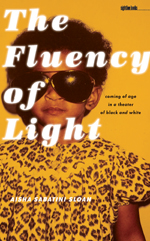
The Fluency of Light: Coming of Age in a Theater of Black and White

Posted in Arts, Autobiography, Books, Identity Development/Psychology, Media Archive, Monographs on 2013-02-24 23:15Z by Steven

The Fluency of Light: Coming of Age in a Theater of Black and White

University of Iowa Press
April 2013
144 pages
5 ¾ x 9 ¼
Paper ISBN: 1-60938-160-2; 978-1-60938-160-8

Aisha Sabatini Sloan

In these intertwined essays on art, music, and identity, Aisha Sabatini Sloan, the daughter of African American and Italian American parents, examines the experience of her mixed-race identity. Embracing the far-ranging stimuli of her media-obsessed upbringing, she grasps at news clippings, visual fragments, and lyrics from past and present in order to weave together a world of sense.

Art in all forms guides the author toward understanding concepts like blackness, jazz, mortality, riots, space, time, self, and other without falling prey to the myth that all things must exist within a system of binaries. Recalling her awkward attempts at coolness during her childhood, Sabatini Sloan evokes Thelonious Monk’s stage persona as a metaphor for blackness. Through the conceptual art of Adrian Piper, the author is able to understand what is so quietly menacing about the sharp, clean lines of an art gallery where she works as an assistant. The result is a compelling meditation on identity and representation.

Tags: , , ,

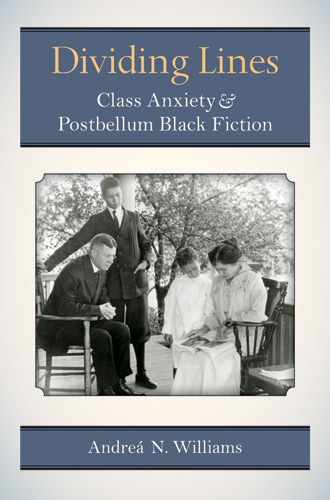
Dividing Lines: Class Anxiety and Postbellum Black Fiction

Posted in Books, Literary/Artistic Criticism, Media Archive, Monographs, United States on 2013-02-24 22:48Z by Steven

Dividing Lines: Class Anxiety and Postbellum Black Fiction

University of Michigan Press
2013
232 pages
6 x 9
Hardcover ISBN: 978-0-472-11861-8
Ebook ISBN: 978-0-472-02890-0

Andreá N. Williams, Associate Professor of English
Ohio State University

Photograph of John and Lugenia Burns Hope and family, undated, Atlanta University Photographs—Individuals, Atlanta University Center Robert W. Woodruff Library
(Pictured from left to right: Dr. John Hope, Edward Hope, John Hope, II, and and Lugenia Burns Hope)

New insights on the intersection of race and class in black fiction from the 1880s to 1900s

Dividing Lines is one of the most extensive studies of class in nineteenth-century African American literature. Clear and engaging, this book unveils how black fiction writers represented the uneasy relationship between class differences, racial solidarity, and the quest for civil rights in black communities.

By portraying complex, highly stratified communities with a growing black middle class, these authors dispelled popular notions that black Americans were uniformly poor or uncivilized. But even as the writers highlighted middle-class achievement, they worried over whether class distinctions would help or sabotage collective black protest against racial prejudice. Andreá N. Williams argues that the signs of class anxiety are embedded in postbellum fiction: from the verbal stammer or prim speech of class-conscious characters to fissures in the fiction’s form. In these telling moments, authors innovatively dared to address the sensitive topic of class differences—a topic inextricably related to American civil rights and social opportunity.

Williams delves into the familiar and lesser-known works of Frances E. W. Harper, Pauline Hopkins, Charles W. Chesnutt, Sutton Griggs, and Paul Laurence Dunbar, showing how these texts mediate class through discussions of labor, moral respectability, ancestry, spatial boundaries, and skin complexion. Dividing Lines also draws on reader responses—from book reviews, editorials, and letters—to show how the class anxiety expressed in African American fiction directly sparked reader concerns over the status of black Americans in the U.S. social order. Weaving literary history with compelling textual analyses, this study yields new insights about the intersection of race and class in black novels and short stories from the 1880s to 1900s.

Contents

  • Introduction: Contending Classes, Dividing Lines
  • 1. The Language of Class: Taxonomy and Respectability in Frances E. W. Harper’s Trial and Triumph and Iola Leroy
  • 2. Working through Class: The Black Body, Labor, and Leisure in Sutton Griggs’s Overshadowed
  • 3. Mapping Class Difference: Space and Social Mobility in Paul L. Dunbar’s Short Fiction
  • 4. Blood and the Mark of Class: Pauline Hopkins’s Genealogies of Status
  • 5. Classing the Color Line: Class-Passing, Antiracism, and Charles W. Chesnutt
  • Epilogue: Beyond the Talented Tenth
  • Notes
  • Bibliography
  • Index
Tags: , , , , , , , , , , , ,

Spectacular Wickedness: Sex, Race, and Memory in Storyville, New Orleans

Posted in Books, History, Louisiana, Media Archive, Monographs, United States on 2013-02-24 16:25Z by Steven

Spectacular Wickedness: Sex, Race, and Memory in Storyville, New Orleans

LSU Press
January 2013
336 pages
6.00 x 9.00 inches
13 halftones, 2 maps
Hardcover ISBN: 9780807150146

Emily Epstein Landau
Department of History
University of Maryland, College Park

From 1897 to 1917 the red-light district of Storyville commercialized and even thrived on New Orleans’s longstanding reputation for sin and sexual excess. This notorious neighborhood, located just outside of the French Quarter, hosted a diverse cast of characters who reflected the cultural milieu and complex social structure of turn-of-the-century New Orleans, a city infamous for both prostitution and interracial intimacy. In particular, Lulu White—a mixed-race prostitute and madam—created an image of herself and marketed it profitably to sell sex with light-skinned women to white men of means. In Spectacular Wickedness, Emily Epstein Landau examines the social history of this famed district within the cultural context of developing racial, sexual, and gender ideologies and practices.

Storyville’s founding was envisioned as a reform measure, an effort by the city’s business elite to curb and contain prostitution—namely, to segregate it. In 1890, the Louisiana legislature passed the Separate Car Act, which, when challenged by New Orleans’s Creoles of color, led to the landmark Plessy v. Ferguson decision in 1896, constitutionally sanctioning the enactment of “separate but equal” laws. The concurrent partitioning of both prostitutes and blacks worked only to reinforce Storyville’s libidinous license and turned sex across the color line into a more lucrative commodity.

By looking at prostitution through the lens of patriarchy and demonstrating how gendered racial ideologies proved crucial to the remaking of southern society in the aftermath of the Civil War, Landau reveals how Storyville’s salacious and eccentric subculture played a significant role in the way New Orleans constructed itself during the New South era.

Tags: , , , , , ,

Mingling of Races Becoming Too Common

Posted in Articles, Law, Media Archive, United States on 2013-02-24 04:53Z by Steven

Mingling of Races Becoming Too Common

Stark County Democrat
1902-02-18 (Weekly Edition)
page 3, columns 4-5
Source: Library of Congress: Chronicling America

Staff Correspondent

Ohio Legislator Will Introduce a New Law Against Miscegenation–More Canal Legislation Is Proposed

Columbus. Feb. 17.—A bill which will prevent miscegenation will shortly be introduced in the legislature by Representative Denune, of Franklin county. It is claimed that marriages of this kind are entirely too prevalent in Ohio and as the present law does not restrict the practice, according to the view of the author, the propagation of a race of moral degenerates is threatened.

One per cent of the marriages in Ohio during the past year were between whites and blacks, most of the white persons being women.

In no other city in Ohio is the marriage of whites and blacks more common that in Columbus.

Tags: , ,