Germany and the Black Diaspora: Points of Contact, 1250-1914

Posted in Anthologies, Books, Europe, History, Media Archive on 2013-07-15 15:37Z by Steven

Germany and the Black Diaspora: Points of Contact, 1250-1914

Berghahn Books
July 2013
262 pages
25 ills, 2 maps, bibliog., index
Hardback ISBN: 978-0-85745-953-4
eBook ISBN: 978-0-85745-954-1

Edited by:

Mischa Honeck, Research Fellow
German Historical Institute, Washington, D.C.

Martin Klimke, Associate Professor of History
New York University, Abu Dhabi

Anne Kuhlmann, Research Fellow in Russian History
Cultural Foundation of the German Federal States, Berlin
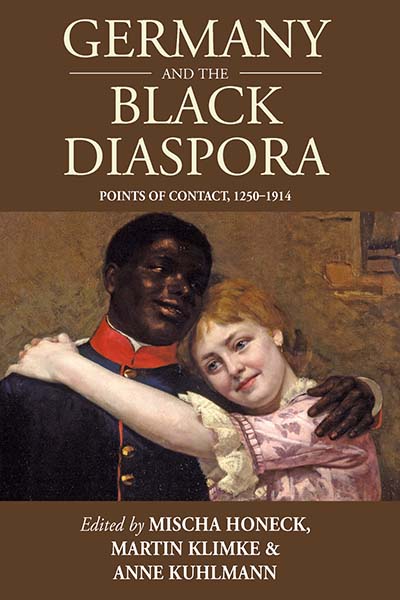
The rich history of encounters prior to World War I between people from German-speaking parts of Europe and people of African descent has gone largely unnoticed in the historical literature—not least because Germany became a nation and engaged in colonization much later than other European nations. This volume presents intersections of Black and German history over eight centuries while mapping continuities and ruptures in Germans’ perceptions of Blacks. Juxtaposing these intersections demonstrates that negative German perceptions of Blackness proceeded from nineteenth-century racial theories, and that earlier constructions of “race” were far more differentiated. The contributors present a wide range of Black–German encounters, from representations of Black saints in religious medieval art to Black Hessians fighting in the American Revolutionary War, from Cameroonian children being educated in Germany to African American agriculturalists in Germany’s protectorate, Togoland. Each chapter probes individual and collective responses to these intercultural points of contact.

Contents

  • List of Figures
  • Acknowledgments
  • Introduction / Mischa Honeck, Martin Klimke, and Anne Kuhlmann
  • PART I: SAINTS AND SLAVES, MOORS AND HESSIANS
    • Chapter 1. The Calenberg Altarpiece: Black African Christians in Renaissance Germany / Paul Kaplan
    • Chapter 2. Black Masques: Notions of Blackness in the Fifteenth and Sixteenth Centuries / Kate Lowe
    • Chapter 3. Ambiguous Duty: Black Servants at German Ancien Régime Courts / Anne Kuhlmann
    • Chapter 4. Real and Imagined Africans in German Court divertissements / Rashid-S. Pegah
    • Chapter 5. From American Slaves to Hessian Subjects: Silenced Black Narratives of the American Revolution / Maria Diedrich
  • PART II: FROM ENLIGHTENMENT TO EMPIRE
    • Chapter 6. The German Reception of African American Writers in the Long Nineteenth Century / Heike Paul
    • Chapter 7. “On the Brain of the Negro”: Race, Abolitionism, and Friedrich Tiedemann’s Scientific Discourse on the African Diaspora / Jeannette Eileen Jones
    • Chapter 8. Liberating Sojourns? African American Travelers in Mid-Nineteenth-Century Germany / Mischa Honeck
    • Chapter 9. Global Proletarians, Uncle Toms and Native Savages: The Antinomies of Black Identity in Nineteenth-Century Germany / Bradley Naranch
    • Chapter 10. We Shall Make Farmers of Them Yet: Tuskegee’s Uplift Ideology in German Togoland / Kendahl Radcliffe
    • Chapter 11. Education and Migration: Cameroonian School Children and Apprentices in the German Metropole, 1884-1914 / Robbie Aitken
  • Afterword: Africans in Europe: New Perspectives / Dirk Hoerder
  • Select Bibliography
  • Notes on Contributors
  • Index
Tags: , , , , , , , , , , , , , , , , ,

In Florida, a Death Foretold

Posted in Articles, Latino Studies, Media Archive, Social Science, United States on 2013-07-15 02:52Z by Steven

In Florida, a Death Foretold

The New York Times
2012-03-31

Isabel Wilkerson

In the mid-1930s, a Yale anthropologist ventured to an unnamed town in the South to explore the feudal divisions of what we commonly call race but what he preferred to describe with the more layered language of caste. When he arrived — white, earnest and fresh from the North — white Southerners told him that a Northerner would soon enough “feel about Negroes as Southerners do.” In making that prediction, the anthropologist John Dollard wrote in his seminal study “Caste and Class in a Southern Town,” they are saying “that he joins the white caste. The solicitation is extremely active, though informal, and one must stand by one’s caste to survive.”

Americans tend to think of the rigid stratification of caste as a distant notion from feudal Europe or Victorian India. But caste is alive and well in this country, where a still unsettled multiracial society is emerging from the starkly drawn social order that Dollard described. Assumptions about one’s place in this new social order have become a muddying subtext in the case of Trayvon Martin, the unarmed black teenager slain at the hands of an overzealous neighborhood watch captain, who is the son of a white father and a Peruvian mother.

We do not know what George Zimmerman was thinking as he watched Mr. Martin from afar, told a 911 dispatcher that he looked suspicious and ultimately shot him. But we do know that it happened in central Florida, a region whose demographic landscape is rapidly changing, where unprecedented numbers of Latino immigrants have arrived at a place still scarred by the history of a vigilante-enforced caste system and the stereotypes that linger from it. In this context, newcomers — like previous waves of immigrants in the past — may feel pressed to identify with the dominant caste and distance themselves from blacks, in order to survive…

…On the other hand, almost three-quarters of blacks felt that Latinos were hard-working or could be trusted. Black Americans appear to view Latinos as more like themselves. “Blacks are not as negative toward Latinos as Latinos are toward blacks because blacks see them as another nonwhite group that will be treated as they have been,” said Paula D. McClain, the lead author on the study. Even as blacks worry about losing jobs to new immigrants, they are less supportive of harsh anti-immigration laws, she said, “because they know what laws have done to them.”

But shared hardships don’t necessarily make allies. “As linked fate rises, so does competition,” said Michael Jones-Correa, a professor of government at Cornell who specializes in immigration and interethnic relations. “It’s like a sibling rivalry,” he said. “This is not a painless relationship.” And, of course, Latino immigrants don’t just enter a pre-existing racial hierarchy; they bring with them their own assumptions based on the hierarchies in their home countries. “When we come to the U.S.,” Eduardo Bonilla-Silva, a professor of sociology at Duke, who is Puerto Rican, said, “we immediately recognize whites on top and blacks on the bottom and say, ‘My job is to be anything but black.’ ”…

Read the entire opinion piece here.

Tags: , , , , , , , ,

The first black president has made it harder to talk about race in America

Posted in Articles, Barack Obama, Media Archive, Politics/Public Policy, Social Science, United States on 2013-07-15 02:30Z by Steven

The first black president has made it harder to talk about race in America

The Washington Post
2012-03-23

Reniqua Allen, Freelance Journalist and Bernard L. Schwartz Fellow
New America Foundation

A few weeks ago, I was standing outside a posh bar on the Lower East Side of Manhattan with my friends of almost two decades. I made an offhanded comment about the ratio of blonde-haired-blue-eyed chicks to brown girls like me. It seemed like a zillion to one.

My pals, who are white, didn’t get why I was bringing this up. “No one cares about race except you,” one said.

I tried to explain my frustration with having to always choose between an all-black experience or being the “only one,” whether at work, in grad school or even out for a night in New York. I waited for a nod of sympathy; instead, my best friend threw her hands up and said: “How can we all be racist? Look at who is president!”

I didn’t have a response.

Right now the nation has embarked on a massive conversation about race surrounding the tragic death of 17-year-old Trayvon Martin in Florida. On Friday, President Obama weighed in. “I think all of us have to do some soul searching to figure out: How does something like this happen?” he said.

It’s an important conversation to have — but I fear it won’t lead anywhere…

Read the entire article here.

Tags: , ,

He Checked That Box, But How Black is Obama?

Posted in Articles, Barack Obama, Census/Demographics, Media Archive, Politics/Public Policy, United States on 2013-07-15 02:21Z by Steven

He Checked That Box, But How Black is Obama?

Politic365: From Your Point of View
2013-07-12

William Reed, Head
The Business Exchange Network

If you had a choice of color, which one would you choose, my brother?

Curtis Mayfield, 1969

In the official U.S. 2010 head count, President Barack Obama provided one answer to the question about his ethnic background: African American. Since the option was introduced in 2000, the census figures indicate that the country has 5.2 million multiracial individuals. Americans who check more than one box for race now make up 5 percent of the minority population. It’s of note that Obama didn’t check multiple boxes that were available on the form, or choose the option that allowed him to elaborate on his racial heritage. He simply ticked the box that said “Black, African American, or Negro.”

Though he checked the census “Black” box, is Obama “Black” like you and me? To date, he has paid no attention to Blacks and their economic challenges. African-American voters are rooted in the belief that Obama’s platform and persona represent “real Black Americans.” They both may have run the streets of Chicago; however, it’s doubtful Obama knows about the late Curtis Mayfield and what he represented. An American singer, songwriter and record producer best known for his anthem-like music, Mayfield recorded and produced “message music” during the 1960s and 1970s. “Choice of Colors” hit No. 1 on Billboard‘s R&B chart and reached No. 21 on the Billboard Hot 100. Neither did Obama grow up under the influence of a weekly Jet and or Ebony magazine adorning the family living room coffee table. As opaque as Obama is to Blacks, a fellow Chicago businessman, the late John H. Johnson, made his fortune catering to us.

Obama has yet to show up in the East Room in a dashiki, but his being “Black” and being “there” has spawned “Obamania” among African Americans. Black voters love the fact that Obama checked the “Black” box, even though his mother was a white woman from Kansas. His father was a Black Kenyan. Obama’s biracial identity helped him build a sizable middle-class American following; it’s also opened up questions as to his authenticity as a Black man. “Obama and the Biracial Factor,” edited by Andrew J. Jolivette, is a book that explores the role of Obama’s mixed-race identity in his path to the presidency. It offers a broad and penetrating view of the importance of race in the ongoing development of American politics. It demonstrates how mixed-race identity reinforces rather than challenges white supremacy within popular discourse…

Read the entire article here.

Tags: , , , ,

Racism, White Supremacy and Biracial/Multiraciality (2011)

Posted in Articles, Asian Diaspora, Audio, Media Archive, Social Justice, Social Science, United States on 2013-07-14 17:05Z by Steven

Racism, White Supremacy and Biracial/Multiraciality (2011)

Tim Wise, Antiracist Essayist, Author and Educator
September 2011

Tim Wise

From my September 2011 talk at Spalding University in Louisville, KY. In this snippet, I respond to a question about how we should understand or think about biracial and multiracial folks’ experiences in a system of racism/white supremacy.

[Transcribed by Steven F. Riley]

I think it would be wise for people who are biracial and multiracial to never forget that this is a system of formal historical and institutional white supremacy. And I’m afraid sometimes, there are a lot incentives that the culture puts out there to biracial and multiracial people to forget that. Right. Because they’re not quite as Black or they’re not quite as Brown. And so there is a tendency for people to think that they really escape that system. Right. That they’re not really in that system. And look, and I think that every person ought to be able to claim whatever parts of and all parts of their identity. So if… look, if you’re Tiger Woods and you want to call yourself “Cablinasian,” which is what he did back in the early part of his career. He called himself Cablinasian because he wanted to honor Caucasian part, the Asian part, the Black part, the Native American part. Okay, here’s the deal… He was Cablinasian. He instited on that. He was not Black!

Okay. And then… when Tiger Woods did what Tiger Woods did… repeatedly, apparently, I went on the chat boards—sports chat boards, not political chat boards–sports chat boards. [Be]cause you can tell a lot about the culture based on the annonymous comments that folks post on sports boards. Forget politics, just read any post after a NBA game, after a NFL game, hell, read the comments after a storm goes through your community. Any story at all, folks will bring up race… with an “Anonymous,” just “Anonymous.” They never put their name and they have no avatar, it’s just that shadow-head and “Anonymous” and they put some nonsense. And so, I went on the chatboard after this Tiger Woods thing broke. And it was funny, everyone who had stuff to say about him, none of them said, “You know, this is just what Cablinasian men do.” [laughter] “What do you expect from a Cablinasian.” [laughter].

That’s not what they said, he was Black… as midnight, as soon as he did something that reminded the dominate group of the stereotype they had come to believe. So, multiracial, biracial folks: claim all of, claim every piece of it. Do not forget where one still sits on the trajectory of white supremacy. Because when once you forget that, there is real danger, real danger.

Listen to the clip here (00:02:14). Download the clip here (395 KB).

Tags: ,

Trayvon Martin, my son, and the Black Male Code

Posted in Articles, Law, Media Archive, Social Science, United States on 2013-07-14 16:20Z by Steven

Trayvon Martin, my son, and the Black Male Code

The Associated Press
2012-03-24

Jesse Washington, National Writer/Race and Ethnicity

PHILADELPHIA (AP) — I thought my son would be much older before I had to tell him about the Black Male Code. He’s only 12, still sleeping with stuffed animals, still afraid of the dark. But after the Trayvon Martin tragedy, I needed to explain to my child that soon people might be afraid of him.

We were in the car on the way to school when a story about Martin came on the radio. “The guy who killed him should get arrested. The dead guy was unarmed!” my son said after hearing that neighborhood watch captain George Zimmerman had claimed self-defense in the shooting in Sanford, Fla.

We listened to the rest of the story, describing how Zimmerman had spotted Martin, who was 17, walking home from the store on a rainy night, the hood of his sweatshirt pulled over his head. When it was over, I turned off the radio and told my son about the rules he needs to follow to avoid becoming another Trayvon Martin – a black male who Zimmerman assumed was “suspicious” and “up to no good.”…

Read the entire article here.

Tags: , , , ,

Understanding Ethnic-Racial Socialization and Cognition among Multiracial Youth: A Mixed Methods Study

Posted in Dissertations, Identity Development/Psychology, Media Archive, United States on 2013-07-14 00:36Z by Steven

Understanding Ethnic-Racial Socialization and Cognition among Multiracial Youth: A Mixed Methods Study

University of Massachusetts, Boston
June 2013

Susan A. Lambe Sarinana

According to the 2010 census report, 9 million people (2.9% of the total population in the United States) identified as multiracial. Of the individuals who identified (or whose parents/guardians identified them) as multiracial, 4.2 million were younger than 18 years of age (www.uscensus.gov). Given that social scientists predict that the multiracial population is increasing so that up to one in five people might identify as multiracial by 2050 (Lee & Bean, 2004), it is critical that researchers examine various aspects of multiracial experiences, including the ways that multiracial youth understand complex concepts such as race, ethnicity, and culture.

This two-part study addresses the gap in literature on intergenerational ethnic-racial socialization processes within interracial families and ethnic cognition among multiracial adolescents. In Study 1, monoracial parents of multiracial children (ages 2-22) completed a survey about ethnic-racial socialization practices, colorblind attitudes, ethnic identity, parent psychological distress, and child psychosocial functioning, and demographic characteristics. Parental ethnic racial socialization beliefs and practices were related to ethnic identity, colorblind attitudes, and parents’ received socialization. In Study 2, multiracial 7th through 12th grade students completed a survey about their perceptions of parental ethnic-racial socialization, ethnic identity, psychosocial functioning, and demographic characteristics. In addition, multiracial adolescents participated in a semi-structured interview to assess Ethnic Perspective Taking Abilities (EPTA; Quintana, 1994). Results support the use of the EPTA model with multiracial youth to assess their understandings of race, ethnicity, and inter-group relations.

Download the entire dissertation here on 2015-06-01.

Tags: ,

An African American’s Perspective on the Korean Wave

Posted in Anthropology, Articles, Asian Diaspora, Media Archive, United States on 2013-07-13 23:53Z by Steven

An African American’s Perspective on the Korean Wave

The Chosunilbo
Seoul, Korea
2013-07-09

Emanuel Pastreich, Associate Professor
Humanitas College, Kyunghee University

I received an unexpected email in February 2013, from a young woman who was studying public health at Harvard University. Mariesa Lee Ricks explained that her mother was Korean and that she had a great interest in Korean culture. Mariesa said that she hoped to find out how K-Pop and Korean social media can play a role in bringing positive messages to youth around the world.

Mariesa added that she hopes to visit Korea to carry out research. I wrote back to her telling her that I would be in Boston soon for a business trip and we agreed to meet up while I was there.

I did not recognize her at first. I was taken aback for a split second when she introduced herself because she turned out to be African American, and I had imagined a half-Korean, half-Caucasian woman who looked like my daughter Rachel. I was impressed that Mariesa did not display the slightest sense of discomfort or uncertainty in the few seconds that it took me to get over my embarrassment. She was clearly an extremely mature and composed woman with a strong sense of herself…

…That vision is linked to the critical role Mariesa’s Korean and African heritage has played in her cultural and intellectual development. Her Korean heritage was essential when she grew up in Atlanta. Her grandmother and mother maintained close ties with Korean culture and the Korean community, which was made easier by the burgeoning Korean population in the part of the city where they lived.

“My father’s family had a limited understanding of Korean culture, but fortunately my mother and grandmother were eager to introduce their culture, whether through funny stories from their childhood in Korea or through cooking kimchi jjigae (spicy Korean stew), for everyone, or teaching some Korean phrases,” she said. “So I developed an appetite to try new things and to explore new combinations of culture. That is the appeal of the Korean Wave for me.”

“Thanks in large part to my Korean heritage, I have developed an intense desire to honor my parents and family — a trait that has spurred me to be extremely aware of how my decisions and actions impact others,” she said. “At the same time, American values of individuality have allowed me to feel comfortable takings risks and exploring my own interests.”…

Read the entire article here.

Tags: , , , ,

A Postracial Society or A Diversity Paradox? Race, Immigration, and Multiraciality in the Twenty-First Century

Posted in Articles, Census/Demographics, Media Archive, Social Science, United States on 2013-07-13 23:34Z by Steven

A Postracial Society or A Diversity Paradox? Race, Immigration, and Multiraciality in the Twenty-First Century

Du Bois Review: Social Science Research on Race
Volume 9, Issue 2, Fall 2012
pages 419-437
DOI: 10.1017/S1742058X12000161

Jennifer Lee, Professor of Sociology
University of California, Irvine

Frank D. Bean, Chancellor’s Professor of Sociology
University of California, Irvine

At the beginning of the twentieth century, Southern states decreed that one drop of African American blood made a multiracial individual Black, and even today, multiracial Blacks are typically perceived as being Black only, underscoring the enduring legacy and entrenchment of the one-drop rule of hypodescent. But how are Asians and Latinos with mixed ancestry perceived? Based on analyses of census data and in-depth interviews with interracial couples with children and multiracial adults, I find that the children of Asian-White and Latino-White couples are much less constrained by strict racial categories. Racial identification often shifts according to situation, and individuals can choose to identify along ethnic lines, as White, or as American. Like their Irish and Italian immigrant forerunners, the Asian and Latino ethnicities of these multiracial Americans are adopting the symbolic character of European, White ethnicity. We appear to be entering a new era of race relations in which the boundaries of Whiteness are beginning to expand to include new non-White groups such as Asians and Latinos, with multiracial Asians and Latinos at the head of the queue. However, even amidst the new racial and ethnic diversity, these processes continue to shut out African Americans, illustrating a pattern of “Black exceptionalism” and the emergence of a Black–non-Black divide in the twenty-first century.

Read or purchase the article here. (Read for free until 2016-03-04!)

Tags: , , ,

“The One and Only Cheerios”~ The “NEW” American Family?

Posted in Audio, Census/Demographics, Live Events, Media Archive, United States on 2013-07-13 23:18Z by Steven

“The One and Only Cheerios”~ The “NEW” American Family?

Mixed Race Radio
Blog Talk Radio
2013-07-10, 16:00Z (12:00 EDT)

Tiffany Rae Reid, Host

Join us on Wednesday July 10th, 2013 as we explore the newest General Mills Cheerios commercial that recently debuted. We will discuss the backlash and speak with an all-star guest line-up while exploring what many of us have known for years: The “NEW” American family is mixed, blended, and splendid!

Listen to the episode here.

Tags: , , , , ,