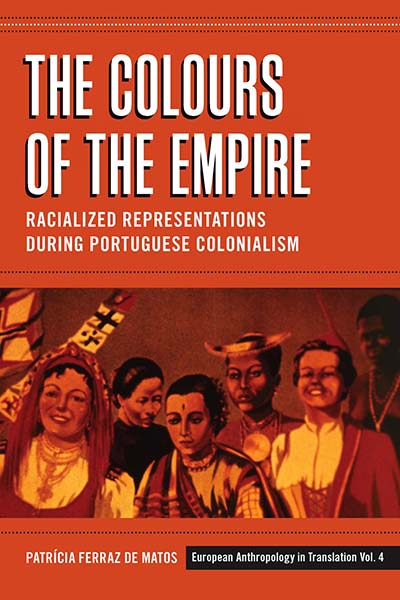
The Colours of the Empire: Racialized Representations during Portuguese Colonialism

Posted in Africa, Anthropology, Books, Caribbean/Latin America, Europe, History, Media Archive, Monographs on 2013-07-19 02:58Z by Steven

The Colours of the Empire: Racialized Representations during Portuguese Colonialism

Berghahn Books
February 2013
308 pages
26 ills & tables, bibliog., index
Hardback ISBN: 978-0-85745-762-2
eBook ISBN: 978-0-85745-763-9
Patrícia Ferraz de Matos, Professor of Anthropology
University of Coimbra, Coimbra, Portugal

Translated from the Portuguese by Mark Ayton

The Portuguese Colonial Empire established its base in Africa in the fifteenth century and would not be dissolved until 1975. This book investigates how the different populations under Portuguese rule were represented within the context of the Colonial Empire by examining the relationship between these representations and the meanings attached to the notion of ‘race’. Colour, for example, an apparently objective criterion of classification, became a synonym or near-synonym for ‘race’, a more abstract notion for which attempts were made to establish scientific credibility. Through her analysis of government documents, colonial propaganda materials and interviews, the author employs an anthropological perspective to examine how the existence of racist theories, originating in the eighteenth and nineteenth centuries, went on to inform the policy of the Estado Novo (Second Republic, 1933–1974) and the production of academic literature on ‘race’ in Portugal. This study provides insight into the relationship between the racist formulations disseminated in Portugal and the racist theories produced from the eighteenth century onward in Europe and beyond.

Contents

  • Tables and illustrations
  • Acknowledgements
  • Acronyms and abbreviations
  • Introduction
  • Chapter 1. Origins of a prejudice: the roots of racial discrimination
    • The discovery of human variety: early formulations
    • The emergence of ‘modern’ racism
    • Racialism under attack
  • Chapter 2. Discourse, images, knowledge: the place of the colonies and their populations in the Portuguese Colonial Empire
    • The formation of Portuguese colonialism and ‘colonial knowledge’
    • The Colonial Act and the ‘creation’ of the Indígena
    • Colonial propaganda: ‘marketing the empire’
    • Colonial representations in primary and secondary school readers
    • Cinema and colonialism in action: moving pictures on colonial themes (1928-53)
    • Recurrent images and prejudices
    • The production of ‘anthropological knowledge’ of the colonies
    • Racial purity, miscegenation and the appropriation of myths
  • Chapter 3. Exhibiting the empire, imagining the nation: representations of the colonies and the overseas Portuguese in the great exhibitions
    • The age of the great exhibitions
    • Representations of the Portuguese colonies, 1924-31
    • A ‘Guinean village’ at the Lisbon Industrial Exhibition (1932)
    • The Portuguese Colonial Exhibition of 1934: concept and objectives
    • Representations of the Portuguese colonies, 1934-39
    • The Exhibition of the Portuguese World (1940): concept and objectives
    • Colonial representations in Portugal dos Pequenitos
    • The status of the colonized populations at the exhibitions: the exotic vs. the familiar
  • Conclusions
  • Appendix I: Film
  • Appendix II: Texts from the padrões of Portugal dos Pequenitos
  • Bibliography
Tags: , , , ,

Obama Made in Kenya: Appropriating the American Dream in Kogelo

Posted in Africa, Anthropology, Articles, Barack Obama, Media Archive, Politics/Public Policy, Social Science on 2013-07-19 02:07Z by Steven

Obama Made in Kenya: Appropriating the American Dream in Kogelo

Africa Today
Volume 59, Number 4, Summer 2013
pages 68-90
DOI: 10.1353/at.2013.0027

Karin van Bemmel
Ghent University, Ghent, Belgium

In November 2008, millions of Kenyan citizens expressed their happiness about the election of Barack Obama as President of the United States. Four years later, people still cheered upon receiving the news of his reelection, but their enthusiasm was nowhere near the euphoria of those earlier days. This article focuses on the consequences of Obama’s presidency over four years in western Kenya—where Obama’s father was raised—and argues that the appropriation of Obama serves multiple purposes, including the negotiation of identity, enabling social and political change, facilitating processes of healing and harmony, and creating conditions for peace after the 2007 postelection violence. Looking at the appropriation of Obama in Kenya enables us to study the processes of change, the localization of global flows, and the ongoing dialogical process of identity negotiation within a sociopolitical context.

Tags: , ,

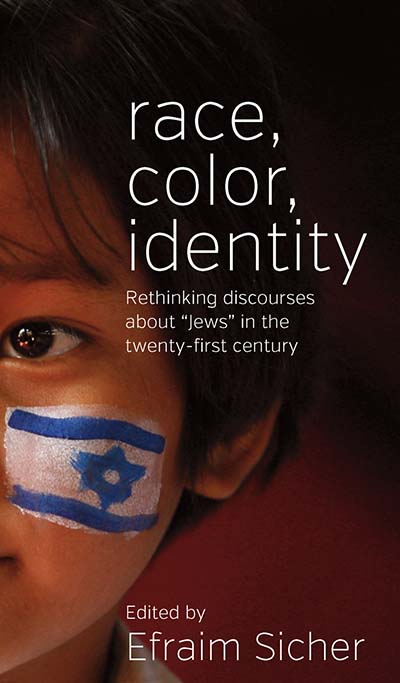
Race, Color, Identity: Rethinking Discourses about ‘Jews’ in the Twenty-First Century

Posted in Africa, Anthologies, Anthropology, Books, History, Judaism, Literary/Artistic Criticism, Media Archive, Religion, Social Science, United Kingdom, United States on 2013-07-19 00:38Z by Steven

Race, Color, Identity: Rethinking Discourses about ‘Jews’ in the Twenty-First Century

Berghahn Books
May 2013
398 pages
bibliog., index
Hardback ISBN: 978-0-85745-892-6
eBook ISBN: 978-0-85745-893-3

Edited by:

Efraim Sicher, Professor of Comparative and English Literature
Ben-Gurion University of the Negev

Advances in genetics are renewing controversies over inherited characteristics, and the discourse around science and technological innovations has taken on racial overtones, such as attributing inherited physiological traits to certain ethnic groups or using DNA testing to determine biological links with ethnic ancestry. This book contributes to the discussion by opening up previously locked concepts of the relation between the terms color, race, and “Jews”, and by engaging with globalism, multiculturalism, hybridity, and diaspora. The contributors—leading scholars in anthropology, sociology, history, literature, and cultural studies—discuss how it is not merely a question of whether Jews are acknowledged to be interracial, but how to address academic and social discourses that continue to place Jews and others in a race/color category.

Contents

  • Foreword / Sander Gilman
  • Introduction: Rethinking Discourses about “Jews” / Efraim Sicher
  • PART I: JEWS AND RACE IN AMERICA
    • Chapter 1. “I’m not White – I’m Jewish”: The Racial Politics of American Jews / Cheryl Greenberg
    • Chapter 2. Reflections on Black/Jewish Relations in the Age of Obama / Ibrahim Sundiata
    • Chapter 3. Stains, Plots, and the Neighbor Thing: Jews, Blacks and Philip Roth’s Utopias / Adam Zachary Newton
    • Chapter 4. Spaces of Ambivalence: Blacks and Jews in New York City / Catherine Rottenberg
    • Chapter 5. African-American Culture, Anthropological Practices and the Jewish “Race” in Zora Neale Hurston’s Mules and Men / Dalit Alperovich
    • Chapter 6. Jewish Characters in Weeds: Reinserting ‘Race’ into the Postmodern Discourse on American Jews / Hannah Adelman Komy Ofir and Shlomi Deloia
  • PART II: JEWS AS BLACKS / BLACK JEWS
    • Chapter 7. A Member of the Club? How Black Jews Negotiate Black Anti-Semitism and Jewish Racism / Bruce Haynes
    • Chapter 8. Ethiopian Immigrants in Israel: The Discourses of Intrinsic and Extrinsic Racism / Steven Kaplan
    • Chapter 9. Black-Jews in Academic and Institutional Discourse / Yonah Zianga
    • Chapter 10. The “Descendants of David” of Madagascar: Crypto-Judaic identities in 21st century Africa / Edith Bruder
  • PART III: DISCOURSES OF RACIAL AND ETHNIC IDENTITIES
    • Chapter 11. After the Fact: “Jews” in Post-1945 German Physical Anthropology / Amos Morris-Reich
    • Chapter 12. Genes as Jewish History?: Human Population Genetics in the Service of Historians / Noa Sophie Kohler and Dan Mishmar
    • Chapter 13. Sarrazin and the Myth of the “Jewish Gene” / Klaus Hödl
    • Chapter 14. Blood, Soul, Race, and Suffering: Full-Bodied Ethnography and Expressions of Jewish Belonging / Fran Markowitz
    • Chapter 15. Jews, Muslims, European Identities: Multiculturalism and Anti-Semitism in Britain / Efraim Sicher
    • Chapter 16. Brothers in Misery: Re-connecting Sociologies of Racism and Anti-Semitism / Glynis Cousin and Robert Fine
    • Chapter 17. Race by the Grace of God: Race, Religion, and the Construction of “Jew” and “Arab” / Ivan Davidson Kalmar
  • Select Bibliography
  • Notes on Contributors
  • Index
Tags: , , , , , , , , , , , , , , , , , , , , , , ,

Black And Jewish And Read All Over

Posted in Articles, Identity Development/Psychology, Judaism, Media Archive, Religion, United States, Women on 2013-07-19 00:12Z by Steven

Black And Jewish And Read All Over

The Jewish Week
2013-07-16

Julie Wiener

She may currently live on the Upper East Side, but Simone Weichselbaum, 31, remains a Brooklyn girl. Raised in Williamsburg and Crown Heights by her Ashkenazi Jewish dad (who freelances for The Jewish Week) and Jamaican mom, Weichselbaum, a Park East Day School grad (she formally converted to Judaism at age 7), covers Brooklyn for the Daily News.

Her coverage — “piercing, respectful, accurate and entertaining reporting of the multicultural borough, in particular its Orthodox Jews and Jews of color” — earned her the 2013 “Media Award” from Be’chol Lashon, a San Francisco-based nonprofit that celebrates and promotes cultural/racial diversity and inclusivity in American Jewish life.

Weichselbaum — who reports on everything from crime to the city’s bike-share program (she’s an avid cyclist who often commutes to interviews on her two-wheeler) — recently met with The Jewish Week at a café near her apartment. The following is a condensed and edited version of the conversation.

Q: So what was it like growing up in an interracial and Orthodox family?

A: My parents raised me Jewish — we never talked about race. They said, “You’re biracial.” I grew up with other kids who were like that too. Park East had other biracial Jews and Jews from around the world, so it wasn’t weird to be brown there.

So, do you identify as black?

I’m proudly biracial. I’m very adamant about this. I don’t understand why people pick one. I’m Jamaican and Jewish. I have friends who are biracial and say they’re black Jews or Latino Jews. I’m like, “You’re mom’s white, knock it off.” … I like [Shlomo] Carlebach and Biggie Smalls. I listen to both on a daily basis…

Read the entire article here.

Tags: , , , ,

Henry Samuel, Frankfort Barber and Free Man of Color

Posted in Articles, Census/Demographics, History, Media Archive, United States on 2013-07-18 03:13Z by Steven

Henry Samuel, Frankfort Barber and Free Man of Color

Random Thoughts on History: My musings on American, African American, Southern, Civil War, Reconstruction, and Public History topics and books
2013-03-19

Tim Talbott
Frankfort, Kentucky

Recently reading Knights of the Razor: Black Barbers in Slavery and Freedom got me to wondering if Frankfort had any black barbers in the antebellum era. Well, I didn’t have to look too hard to find one. No, I didn’t have to search through slides of microfilm searching the 1860 census records for Franklin County barbers—after all, in this particular case that would not have helped me.

Fortunately, I had remembered seeing an advertisement for a town barber while browsing through issues of the Frankfort Commonwealth newspaper some time back. And, it was not difficult to find these particular advertisements when I went back searching, because Henry Samuel had an ad in almost every edition of the newspaper for many years in the 1850s and 1860s. He must have been a firm believer in the old adage that “advertising pays.” However, there was no clue from the advertisements whether he was African American or white. That part took some searching…

Read the entire article here.

Tags: , , ,

Participatory diagramming in social work research: Utilizing visual timelines to interpret the complexities of the lived multiracial experience

Posted in Articles, Media Archive, Social Work, United States on 2013-07-18 02:31Z by Steven

Participatory diagramming in social work research: Utilizing visual timelines to interpret the complexities of the lived multiracial experience

Qualitative Social Work
Volume 12, Number 4 (July 2013)
pages 414-432
DOI: 10.1177/1473325011435258

Kelly F. Jackson, Assistant Professor of Social Work
Arizona State University

The purpose of this article is to present an illustrative example of the analytic potential of image-based research in social work. Insight gained from a qualitative research study that used a novel form of participatory diagramming to examine the racial identity development of ten multiracial individuals is referenced and critiqued. Utilizing a critical visual methodological framework to analyze visual timelines, this article offers insight into the contextually rich and dynamic processes comprising the multiracial experience. This article concludes with an informative discussion of how visual methods support key social work values, including commitment to clients and understanding the person-in-environment, and how participatory diagramming in particular can enhance culturally sensitive and responsible research and practice with multiracial individuals.

Read or purchase the article here.

Tags: , , ,

Missing faces

Posted in Articles, History, Media Archive, Slavery, United Kingdom on 2013-07-18 02:00Z by Steven

Missing faces

The Guardian
2007-03-23

Jackie Kay, Professor of Creative Writing
Newcastle University

As the United Kingdom marks the 200th anniversary of the abolition of the slave trade tomorrow, Jackie Kay challenges fellow Scots to acknowledge their forebears’ part in this shameful history and reflects on the ordeal suffered by her ancestors

We’re perhaps over-fond of dates, of going round in circles of a hundred years to mark the birth of, or the death of, trying to grasp, as we all get older, what time means. Anniversaries give us the perfect excuse to try and catch up on what we already should have caught up on. Anniversaries afford us a big noisy opportunity to try and remember what we should not have forgotten.

Slavery is one of those subjects we all think we know about. Men were shipped, packed like sardines, as in that famous drawing by Thomas Clarkson, the abolitionist. The Africans sold their own people – this gets mentioned so often, as if the reiteration of African complicity diminishes responsibility. But what spirit, eh, the African people? Mind you, there’s always been slavery, the ancient Romans were at it, etc etc. We are closed to any more detail; we don’t want to know. We don’t want to imagine how slavery would affect each of the five senses. Too much information fills ordinary people, black and white, with revulsion, distaste, or worse, induces boredom. We think we’ve heard it all before…

Read the entire article here.

Tags: , ,

6 News reporter learns Virginia town was named for her ancestor

Posted in Articles, History, Media Archive, United States, Virginia on 2013-07-17 22:39Z by Steven

6 News reporter learns Virginia town was named for her ancestor

WATE.com
Knoxville, Tennessee
2012-07-23

Erica Estep, 6 News Reporter

KNOXVILLE (WATE) – How much do you know about your family history? Where did your ancestors live? What were their daily lives like, and what do you have in common with them?

Whether it is physical features or an adventurous spirit you’ve inherited, have you ever wanted to know more? These were all questions I had about my own family history, so I went in search of answers and hoping to help others along the way.

My journey began with research online. Genealogy sites like ancestry.com and familysearch.org make it easy for anyone to begin filling in their family tree.

I quickly traced my father’s ancestors from the Carolinas back to England.

However, my mother’s line included the most stumbling blocks. I found that my third great grandmother married two brothers, and I still haven’t confirmed the father of my great, great grandfather.

Among unusual surnames like Lockhart, Honaker and Stump, I uncovered a few kissing cousins, illegitimate children, an abundance of preachers and even an outlaw or two. All of them originated from the same small mountain town in Virginia…

…Tracing your roots is easier than ever with online records available at the click of a mouse, but with traditional research, many people hit a brick wall. Sometimes there’s just one piece of a puzzle you can’t find, but DNA tests can help.

Science is offering a deeper understanding of where you come from. I traced my roots to a small town in Southwest Virginia, but still had a lot of un-answered questions.

I turned to DNA tests to help fill in the blanks…

…I’ve always been told that I have Native American ancestors, and found pictures of relatives with darker complexions, just like one Alma showed me of her great aunt.

When asked about what she knows of her heritage she said, “Spanish and German, I think. Yeah, and a possibility of Indian, there’s a little bit of Indian in there, somewhere.”

My fourth great grandfather was also listed as mulatto in the 1850 census. Researchers at the East Tennessee History Center told me that would not be surprising.

“It’s highly probable,” said Dr. George Sweitzer, a genealogist and professor at the University of Tennessee. “Mulatto meant that you had black blood.”…

Read the entire article here.

Tags: ,

Summer in the Global Village: Trevor Noah, South Africa’s Comic Phenomenon

Posted in Africa, Literary/Artistic Criticism, Media Archive, South Africa on 2013-07-17 22:24Z by Steven

Summer in the Global Village: Trevor Noah, South Africa’s Comic Phenomenon

The World
Public Radio International
2013-07-16

Mirissa Neff

In South Africa, comedian Trevor Noah is a phenomenon.

A friend who recently came back from Johannesburg and Cape Town, remarked that the 28-year-old’s every utterance, whether on TV or Twitter (where he has nearly a million followers), “creates a ripple throughout the entire country.”

For six weeks in the early summer, New Yorkers got a taste of why.

Noah’s solo show, “Born a Crime,” (which ran at Culture Project in NoHo) references his mixed-race heritage: He was born during the apartheid era to a black South African mother and a white Swiss father.

Much of his sidesplitting routine is devoted to skewering the politics of race, both within and outside of his native South Africa, where his father, who was barred from walking in public with his brown-skinned son, instead watched Noah from across the street, “like a creepy pedophile.”…

Read the entire article here.

Tags: , ,

“One Drop of Love” is Fanshen’s Story & She’s Sticking To It

Posted in Audio, Census/Demographics, Interviews, Live Events, Media Archive, Social Science, United States on 2013-07-17 16:03Z by Steven

“One Drop of Love” is Fanshen’s Story & She’s Sticking To It

Mixed Race Radio
Blog Talk Radio
2013-07-17, 16:00Z (12:00 EDT)

Tiffany Rae Reid, Host

Fanshen Cox DiGiovanni, Playwright, Producer, Actress, Educator

Join us on today’s episode of Mixed Race Radio as we meet award-winning actor, producer and educator, Fanshen Cox. Fanshen is currently touring the one-woman show she wrote and performs in: One Drop of Love, which is produced by Ben AffleckChay Carter and Matt Damon.

One Drop follows Fanshen’s journey to reconciliation with her father, taking audiences from the 1700s to the present and through various locations near and far—all in search of how our belief in ‘race’ affects our most precious intimate relationships.

Fanshen is also the co-creator of the Mixed Chicks Chat podcast (named a top podcast by Ebony magazine and the Black Weblog Awards) and co-founder of the Mixed Roots Film & Literary Festival®—a five-year festival celebrating its final event in 2012. She won a 2012 SAG award for Outstanding Performance by a Cast (for the film Argo).

Fanshen served as a Peace Corps Volunteer for two years in Cape Verde, West Africa as a teacher, and has taught in and designed curricula for over 15 years. She holds a BA in Spanish and Education, an MA in Teaching English to Speakers of Other Languages, and just earned her MFA in Acting and Performance in Film, TV and Theater. Fanshen is dedicated to constantly questioning the notion of ‘race’ and fighting racism through storytelling.

For more information, click here.

Tags: , , , ,