Mixed-Bloods and Tribal Dissolution: Charles Curtis and the Quest for Indian Identity

Posted in Biography, Books, History, Media Archive, Monographs, Native Americans/First Nation on 2013-08-21 23:46Z by Steven

Mixed-Bloods and Tribal Dissolution: Charles Curtis and the Quest for Indian Identity

University Press of Kansas
1989
244 pages
15 photographs, 3 maps, 6 x 9
Cloth ISBN 978-0-7006-0395-4

William E. Unrau, Emeritus Endowment Association Distinguished Research Professor of History
Wichita State University, Wichita, Kansas

This book shows that without the cooperation of the “mixed-bloods,” or part-Indians, dispossession of Indian lands by the U.S. government in the nineteenth and early twentieth centuries would have been much more difficult to accomplish. The relationship between the Métis and the loss of Indian lands, never before fully explored, is revealed in Unrau’s study of Charles Curtis, a mixed-blood member of the Kansa-Kaws.

Curtis is best remembered as Herbert Hoover’s vice-president, but he also served in Congress for more than 30 years.

A successful lawyer and Republican politician, Curtis had spent his early years on a reservation but grew up comfortably and fully integrated into the white world. By virtue of his celebrated status, he became the most important figure in the debate over federal Indian policy during the late nineteenth and early twentieth centuries.

As the Indian expert in Congress, Curtis had significant power in formulating and carrying out the assimilationist program that had been instituted, particularly by the Dawes Act, in the 1880s. The strategy was to encourage reservation Indians to reject communal life and reap the rewards of individual enterprise. Central to these developments were questions of ownership, land claims, allotments, tribal inheritance laws, and what constituted the public domain. The underlying issues, however, were Indian identification and assimilation. The government’s actions—affecting schools, the federal courts, Indian Office personnel, allotment and inheritance laws, mineral leases, and the absorption of the Indian Territory into the state of Oklahoma—all bore the mark of Curtis’s hand.

Tags: , , ,

Michelle Obama on the Move: What Will She Do Next?

Posted in Articles, Barack Obama, Interviews, Media Archive, United States, Women on 2013-08-21 01:27Z by Steven

Michelle Obama on the Move: What Will She Do Next?

Parade
2013-08-17

Maggie Murphy, Editor in Chief

Lynn Sherr, Contributor

America’s most famous mom takes her fight against childhood obesity to the next level, gears up for parenting teenagers, and admits to hitting her stride as first lady. Read the Parade cover story below and watch an exclusive video message from Mrs. Obama:

Nearly five years after moving into the White House, Michelle Obama could not look more at home. Posing in the formal Green Room, she appears both relaxed and invigorated, embracing the undefined (and undefinable) roles of Spouse in Chief, Role Model in Chief, and Mom in Chief. But it’s the last one that makes the first lady shine brightest of all. Put her in a room with kids—whether her own or the nation’s—and she glows. In fact, at the second annual Kids State Dinner on July 9, Mrs. Obama beamed at the success of 54 students who won a nationwide competition, sponsored by Epicurious.com, to develop creative, delicious, and healthful recipes. An outgrowth of her Let’s Move! program to curb childhood obesity within a generation, the State Dinner (which happened at lunch) featured dishes like Lucky Lettuce Cups and Bodacious Banana Muffins, as well as an appearance by her husband, whom she playfully tweaked for admitting he’d hated vegetables as a kid. As she sat with Parade the following day, Mrs. Obama was regal in a magenta sheath yet so down-to-earth that she quickly fluffed the cushion of an antique couch between photo takes. No longer sporting the bangs that caused such a sensation (“You know, it’s hard to make speeches with hair in your face!”), the first lady spoke to us about her second-term goals for her childhood obesity fight, her maturing family, and her dreams for America’s children…

…As we approach the 50th anniversary of Martin Luther King’s “I have a dream” speech, there have been a lot racial issues in the news, from Paula Deen to the Trayvon Martin case. What gives you hope about America today?

I have immense hope. We just finished our visit to Africa and spent time on Robben Island [where Nelson Mandela was imprisoned for 18 years] with one of President Mandela’s cell-block mates. Mandela took a lot of the lessons from Dr. King’s time to heart as he sat in a prison cell and thought about how to pull that country to where it is today. To come back to the United States, with an African-American president who has been influenced by both King and Mandela, that is a reason to be hopeful about all that Dr. King sacrificed.

Do you think having an African-American family in the White House has moved the needle?

Absolutely. Children born in the last eight years will only know an African-American man being president of the United States. That changes the bar for all of our children, regardless of their race, their sexual orientation, their gender. It expands the scope of opportunity in their minds. And that’s where change happens. You know, laws and policies are important. But in the end, it’s how we’re living our lives…

Read the interview here.

Tags: , , ,

Rethinking Race in Brazil

Posted in Autobiography, Brazil, Caribbean/Latin America, Media Archive, Social Science on 2013-08-21 00:45Z by Steven

Rethinking Race in Brazil

Journal of Latin American Studies
Volume 24, Number 1 (February, 1992)
pages 173-192

Howard Winant, Professor of Sociology
University of California, Santa Barbara

Introduction: the Repudiation of the Centenário

13 May 1988 was the 100th anniversary of the abolition of slavery in Brazil. In honour of that date, various official celebrations and commemorations of the centenário, organised by the Brazilian government, church groups and cultural organisations, took place throughout the country, even including a speech by President José Sarney.

This celebration of the emancipation was not, however, universal. Many Afro-Brazilian groups staged actions and marches, issued denunciations and organised cultural events repudiating the ‘farce of abolition’. These were unprecedented efforts to draw national and international attention to the extensive racial inequality and discrimination which Brazilian blacks – by far the largest concentration of people of African descent in any country in the western hemisphere – continue to confront. Particular interventions had such titles as ‘100 Years of Lies’, ‘One Hundred Years Without Abolition’, ‘March for the Real Liberation of the Race’, ‘Symbolic Burial of the 13th of May’, ‘March in Protest of the Farce of Abolition’, and ‘Discommemoration (Descomemoração) of the Centenary of Abolition’. The repudiation of the centenário suggests that Brazilian racial dynamics, traditionally quiescent, are emerging with the rest of society from the extended twilight of military dictatorship. Racial conflict and mobilisation, long almost entirely absent from the Brazilian scene, are reappearing. New racial patterns and processes – political, cultural, economic, social and psychological — are emerging, while racial inequalities of course continue as well. How much do we know about race in contemporary Brazil? How effectively does the extensive literature explain the present situation?

In this article the main theories of race in Brazil are critically reviewed in the light of contemporary racial politics. I focus largely on postwar Brazilian racial theory, beginning with the pioneering UNESCO studies. This body of theory has exhibited considerable strengths in the past: it has been particularly effective in dismantling the myth of a non-racist national culture, in which ‘racial democracy’ flourished, and in challenging the role of various elites in maintaining these myths. These achievements, appreciable in the context of the analytical horizon imposed on critical social science by an anti-democratic (and indeed often dictatorial and brutal) regime, now exhibit some serious inadequacies when employed to explain current developments.

This article accepts many of the insights of the existing literature but rejects its limitations. Such a reinterpretation, I argue, sets the stage for a new approach, based on racial formation theory. This theory is outlined below, and it is suggested that it offers a more accurate view of the changing racial order in contemporary Brazil. Racial formation theory can respond both to ongoing racial inequalities and to the persistence of racial difference, as well as the new possibilities opened up by the transition to democracy; it can do this in ways in which the established approaches, despite their considerable merits, cannot…

Read or purchase the article here.

Tags: ,

“Faithfully Drawn from Real Life”: Autobiographical Elements in Frank J. Webb’s The Garies and Their Friends

Posted in Articles, Literary/Artistic Criticism, Media Archive, Passing, United States on 2013-08-20 20:40Z by Steven

“Faithfully Drawn from Real Life”: Autobiographical Elements in Frank J. Webb’s The Garies and Their Friends

The Pennsylvania Magazine of History and Biography
Volume 137, Number 3 (July 2013)
pages 261-300
DOI: 10.5215/pennmaghistbio.137.3.0261

Mary Maillard

A resurgence of interest in Frank J. Webb’s The Garies and Their Friends—the second novel by an African American and the first to portray northern racism—underscores the need for consideration of recently discovered biographical information about this enigmatic author. Previously unknown details about the lives of Frank J. Webb (1828-94) and his family and friends parallel some of his literary portrayals, subtly inform other scenes and characters, and generally help to illuminate the unique combination of biography, social history, and creative imagination that constitute Webb’s complex literary achievement.

The Garies and Their Friends is constructed around two major narrative lines: the stories of the Garie family and the Ellis family. In Georgia, Clarence Garie, a white slave owner, is living openly with his mulatto slave mistress, Emily Winston; he treats her with as much affection and respect as if she were his wife and wishes to marry her, but interracial marriage is illegal in the state. They have two children, named after their parents, Clarence and Emily. The Garies entertain Emily’s cousin, George Winston, who, although born and raised in slavery, was educated and freed by a kind master. Now, with all the appearances of a refined gentleman, he is passing as white—much to the approbation and amusement of Mr. Garie.

In Philadelphia, the Ellises are a “highly respectable and industrious coloured family.” Mr. Ellis, a carpenter, and his wife, Ellen, have three…

Read or purchase the article here.

Tags: , , , , , , , , , , , , , , , , , , , , , , , , , , , , , , , , ,

Scholar Saw a Multicolored American Culture

Posted in Articles, Biography, Media Archive, Politics/Public Policy, Social Science, United States on 2013-08-20 03:11Z by Steven

Scholar Saw a Multicolored American Culture

The New York Times
2013-08-19

Mel Watkins

Albert Murray Dies at 97; Fought Black Separatism

Albert Murray, an essayist, critic and novelist who influenced the national discussion about race by challenging black separatism, insisting that the black experience was essential to American culture and inextricably tied to it, died on Sunday at his home in Harlem. He was 97.

Lewis P. Jones, a family spokesman and executor of Mr. Murray’s estate, confirmed the death.

Mr. Murray was one of the last surviving links to a period of flowering creativity and spreading ferment among the black intelligentsia in postwar America, when the growing force of the civil rights movement gave rise to new bodies of thought about black identity, black political power and the prospects for equality in a society with a history of racism.

 As blacks and whites clashed in the streets, black integrationists and black nationalists dueled in the academy and in books and essays. And Mr. Murray was in the middle of the debate, along with writers and artists including James Baldwin, Richard Wright, Romare Bearden and his good friend Ralph Ellison.

One of his boldest challenges was directed toward a new black nationalist movement that was gathering force in the late 1960s, drawing support from the Black Panthers and the Nation of Islam, and finding advocates on university faculties and among alienated young blacks who believed that they could never achieve true equality in the United States.

 Mr. Murray insisted that integration was necessary, inescapable and the only path forward for the country. And to those — blacks and whites alike — who would have isolated “black culture” from the American mainstream, he answered that it couldn’t be done. To him the currents of the black experience — expressed in language and music and rooted in slavery — run through American culture, blending with European and American Indian traditions and helping to give the nation’s culture its very shape and sound…

…Mr. Murray established himself as a formidable social and literary figure in 1970 with his first book, a collection of essays titled “The Omni-Americans: New Perspectives on Black Experience and American Culture.” The book constituted an attack on black separatism.

“The United States is not a nation of black and white people,” Mr. Murray wrote. “Any fool can see that white people are not really white, and that black people are not black.” America, he maintained, “even in its most rigidly segregated precincts,” was a “nation of multicolored people,” or Omni-Americans: “part Yankee, part backwoodsman and Indian — and part Negro.”…

Read the entire obituary here.

Tags: , , ,

Art at Wing Luke Museum explores mixed-race heritage

Posted in Articles, Arts, Asian Diaspora, Media Archive, United States on 2013-08-20 02:50Z by Steven

Art at Wing Luke Museum explores mixed-race heritage

The Seattle Times
2013-08-19

Robert Ayers, Special to The Seattle Times

The thought-provoking “War Baby/Love Child: Mixed Race Asian-American Art” exhibition is showing at the Wing Luke in Seattle through Jan. 19, 2014.

War Baby/Love Child: Mixed Race Asian-American Art,” currently at the Wing Luke Museum of the Asian Pacific American Experience, is a jewel of an exhibition that has been organized and curated by Laura Kina and Wei Ming Dariotis.

As their provocative title suggests, the curators — both scholars in the field of mixed-race studies — see their role not only to present a group of stimulating high-quality works (which they have done anyway,) but also to encourage a new understanding of what “mixed race” means. The last thing they intend is a celebration of multiculturalism, and instead, they stress that there is nothing new or exceptional about mixed-race heritage. These are issues that are more than political for them, and for the artists they have included in the show, because they are part of the fabric of their own experience…

Read the entire article here.

Tags: , , , , , , , ,

Sex and Race, Volume I: Negro-Caucasian Mixing in All Ages and All Lands: The Old World

Posted in Anthropology, Books, History, Media Archive, Monographs on 2013-08-20 02:33Z by Steven

Sex and Race, Volume I: Negro-Caucasian Mixing in All Ages and All Lands: The Old World

J. A. Rogers (1880-1966)

Helga Rogers
1941 (Ninth Edition, 1967)
302 pages
ISBN-13: 978-0960229406; ISBN 10: 096022940X
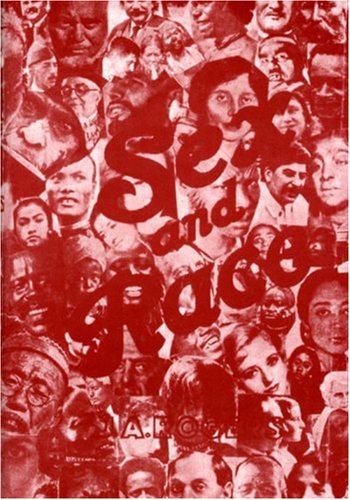
Table of Contents

  • I. RACE TODAY
  • II. WHICH IS THE OLDEST RACE?
  • III. THE MIXING OF BLACK AND WHITE IN THE ANCIENT EAST
  • IV. BLACK AND WHITE IN SYRIA, PALESTINE, ARABIA, PERSIA
  • V. WHO WERE THE FIRST INHABITANTS OF INDIA?
  • VI. WHO WERE THE FIRST CHINESE?
  • VII. THE NEGRO IN ANCIENT GREECE
  • VIII. NEGROES IN ANCIENT ROME AND CARTHAGE
  • IX. WERE THE JEWS ORIGINALLY NEGROES?
  • X. RACE-MIXING UNDER ISLAM
  • XI. RACE-MIXING UNDER ISLAM (Cont’d)
  • XII. MIXING OF WHITE AND BLACK IN AFRICA SOUTH OF THE SAHARA
  • XIII. MISCEGENATION IN SOUTH AFRICA
  • XIV. RACE-MIXING IN AFRICA AND ASIA TODAY
  • XV. MISCEGENATION IN SPAIN. PORTUGAL, AND ITALY
  • XVI. MISCEGENATION IN HOLLAND, BELGIUM, AUSTRIA, POLAND, RUSSIA
  • XVII. NEGRO-WHITE MIXING IN GERMANY, ANCIENT AND MODERN
  • XVIII. THE MIXING OF WHITES AND BLACKS IN THE BRITISH ISLES
  • XIX. MISCEGENATION IN FRANCE
  • XX. ISABEAU, BLACK VENUS OF THE REIGN OF LOUIS XV
  • XXI. THE BLACK NUN–MULATTO DAUGHTER OF MARIA THERESA, QUEEN OF FRANCE
  • XXII. BAUDELAIRE AND JEANNE DUVAL
  • APPENDICES
    • Race-mixing in European Literature
    • Did the Negro Originate in Africa or Asia?
    • Black Gods and Messiahs
    • History of the Black Madonnas
    • Notes and References to the Negro under Islam
    • List of the Illustrations and Notes on Them

Chapter One: RACE TODAY

“A Charm of Powerful Trouble”

The conception of races once so innocent,” said Jean Finot, “has cast a veil of tragedy over the earth. From without it shows us humanity divided into unequal fractions… From within this same falsely conceived science of races likewise encourages hatred and discord among the children of the same common country . . . People against people, race against race . . . persecution and extermination on every hand.”

One writer has called it a Frankenstein monster. But that comparison is far too feeble. However, it has this point of resemblance: Frankenstein’s monster was built of scraps—scraps of corpses, a hand from this one, an eye from that, a patch of skin from this other. The evil genie of race it also created from scraps—scraps of false philosophies of past centuries; a quotation from this or that prejudiced traveller; lines from this and that semi-ignorant divine of colonial days; excerpts from Gobineau, Thomas Jefferson, Abraham Lincoln, the Bible; passages from this or that badly mixed-up ethnologist, all jumbled together with catch-phrases from greedy plantation owners, slave-dealers, and other traffickers in human flesh.

The purpose was to create a “pure” race, a “superior” race, a race that like the philosopher’s stone of the ancients, excelled all excellence—a race so meritorious that it had the right to enslave and use the rest of humanity.

Every newly discovered bit of anthropology was twisted into building this doctrine of a “superior” race. A Putnam Weale worked most industriously on this part of it; a Tom Dixon, Madison Grant, and Lothrop Stoddard on that; a William McDougall and a Frederick Hoffman busied themselves with that other, while a host of Southern politicians and other lesser fry assisted…

…As for the mixed-blood, he ought never to have been. No amount of Christianity or religious training, we are informed, will give him good heredity, and this as late as 1935 by no less an authority than the learned Victoria Society of London, England. In short, the mixed-blood is a creation of Satan. “God made the white man and God made the black man” said Colonial America, “but the Devil made the mulatto.”

The white race flowed from “a pure source”: Europe. Miscegenation with blacks there was unknown throughout the ages, we are told. “It was not until the discovery of the New World that the races of men strikingly different in appearance came to intermix,” says Crawfurd. Before that, he says, inferior races did mix with superior races, but both were white.

Nothing, however, is further from the truth. We shall show in these pages that sex relations between so-called whites and blacks go back to prehistoric times and on all the continents. Furthermore, since it is held by many that it is only the mixing of the black man and the white woman that can affect the “purity of the race” that it is precisely this kind that happened most in Europe…

Read the entire book here.

Tags: ,

‘Mixed Kids Are Always So Beautiful’

Posted in Articles, Asian Diaspora, Family/Parenting, Media Archive, United States on 2013-08-19 23:41Z by Steven

‘Mixed Kids Are Always So Beautiful’

Motherlode: Adventures in Parenting
The New York Times
2013-08-19

Nicole Soojung Callahan

Like many other people of color, I am no stranger to awkward conversations about race. Strangers have complimented my English, remarked on how tall I am “for an Asian” and — more times than I can count — asked where I am really from. Since becoming a parent five years ago, I’ve had to learn to field a whole new set of questions and comments regarding my multiracial children.

“Korean, Irish and Lebanese is such a unique combination,” a friend exclaimed after my eldest daughter was born. “She’s like a poster baby for the U.N.!”

Several people in our diverse suburb of the District of Columbia have asked if I am my daughters’ baby sitter, presumably because they cannot spot the resemblance between us. At a party last year, a white woman asked if I was surprised when my children were born: “Did you expect them to look, you know, less white?” (No, I was pretty sure who their father was, so I wasn’t really shocked.)

Another person wanted to know if I thought the girls’ “coloring” would stay the same or “get darker” over time. Then there was the mother at the park who looked at my girls on the swing set and said bluntly: “What are they, exactly?”

The girls have even received compliments for not looking fully Korean. “Your daughter is so pretty,” a Chinese friend said to me last month. “Have you thought about having her model?”

“No,” I replied (possibly the truest thing I have ever said)…

Read the entire article here.

Tags: , , ,

A Family Tree That Includes Slaves — And Slave Owners

Posted in Articles, Audio, Caribbean/Latin America, History, Media Archive, Slavery on 2013-08-19 21:42Z by Steven

A Family Tree That Includes Slaves — And Slave Owners

Tell Me More
National Public Radio
2013-08-15

Celeste Headlee, Host

Part of our summer reading series Island Reads, highlighting authors from the Caribbean

Andrea Stuart was curious about her family’s history in Barbados. And through years of careful research, she found that her bloodline includes both slave owners and slaves. She has written about her own family, as well as a detailed history of slavery in the Caribbean, in her book Sugar in the Blood. Guest host Celeste Headlee talks with Stuart about her family history, the moral complexity of slavery and finding roots in the past.

Interview Highlights

On the founder of a mixed-race dynasty:

“When I read about George Ashby, or rather, wrote about him, I remember thinking, ‘My goodness. What bravery it must have taken to take this huge step to leave England, in his case, to go to the New World.’ I mean, in those days the journey itself was so traumatic and long, the chances of being killed by raiders or pirates — everything was so difficult about this journey, and then to kind of confront this untrampled land, where at least half of the early settlers died just because things were so difficult. It seemed to me that he was extraordinarily brave. But then his generation and the subsequent generations make this terrible mistake. They become slave owners, and therefore become part of the whole institution of slavery. So I am deeply ambivalent about him. I admire him on one hand, and I lament him on the other.”…

Listen to the story here. Download the audio here. Read the transcript here.

Tags: , , , ,

There Is No Scientific Rationale for Race-Based Research

Posted in Articles, Health/Medicine/Genetics, Media Archive, Politics/Public Policy, United States on 2013-08-19 20:37Z by Steven

There Is No Scientific Rationale for Race-Based Research

Journal of the National Medical Association
Volume 99, Number 6 (June 2007)
pages 690-692

Eddie L. Hoover, Professor of Surgery
State University of New York, Buffalo

For centuries, the colonial governments used a combination of race and ethnic characteristics to subjugate and control people of color, and scientists of the day provided evidence of the “natural order of things” to support national policies of domination, segregation and control. There have been many examples of events in the past 70 years to suggest that achievements by ethnic peoples are not genetically determined and that race and ethnicity are merely terms to describe external features, language, culture, social mores and folklore. BiDil was the first drug in this country approved by the FDA for use in a single “race” after a clinical trial that enrolled only members of that race. Thus arose the question of the efficacy of doing race-based research in humans. In order for this kind of research to have any scientific basis, each individually defined or self-declared race would have to have a 100% pure gene pool, and the data show that the gene pool among whites, blacks and Hispanics in America is very heterogeneous. This makes for far greater similarities among U.S. citizens than any perceived differences, and genomic science has failed to support the concept of racial categories in medicine.Scientists involved with the first mapping of the human genome have noted that there is no basis in the genetic code for race. That being the case, there appears to be no justification for race-based research among human beings.

Although the United States has experienced enormous improvements in its healthcare system over the past half-century, there are still widening disparities in most disease processes between whites and blacks/Hispanics.’ There has been much debate as to how these disparities can be eliminated, but simple, logical programs that could be tailored to specific minority communities in different geographical locations have not proven to be practical for a variety of reasons. To be sure, disparities in healthcare, like anything else, are a function of a variety of factors, including education, environment, income and culture, among others. Race and ethnicity are important determinants of some of these functions, thus raising the question as to whether these parameters may, in fact, be determinants of outcome in some of these disease processes based upon genetics as well as the aforementioned risk factors.

Modern-day science has amassed enough evidence to suggest that there is very little biological difference between the various races. In order for race-based research to have any scientific basis, each individually defined or self-declared race would have to have a 100% pure and homogeneous gene pool. Some racial and ethnic groups have a very heterogeneous gene pool, such as whites and Hispanics. The same scientific data show that approximately 80% of American blacks have some degree of white ancestry, and although not so nearly well publicized is the fact that many whites also have black and Hispanic ancestry. This would make for far greater similarities in the U.S. black/white gene pool than any perceived differences, and genomic science has failed to support the concept of racial categories in medicine and further purports that there is more genetic diversity within a “racial cohort” than any differences between two such cohorts.” Craig Venter, who helped produce the first map of the human genome, noted that there is no basis in the genetic code for race.’ That being the case, race then becomes rather meaningless in scientific research. This would obviously include race-based pharmaceutical research that resulted in the drug BiDil. This is not to be confused with the fact that race indeed affects both access and outcomes in our healthcare system, as it most certainly does. Even black medical professionals do not enjoy the same access to highly specialized services as their white counterparts, such as coronary artery bypass grafting, but the basis is not biological and by extension, not genetically determined…

Read the entire article here.

Tags: , , ,