Interracial Family Memoirs: Reconstructing Genealogies across the Color Line

Posted in History, Literary/Artistic Criticism, Live Events, Media Archive, United States on 2013-09-11 03:57Z by Steven

Interracial Family Memoirs: Reconstructing Genealogies across the Color Line

Yale University
230 Prospect Street
Room 101
New Haven, Connecticut 06511
2013-09-16, 12:00-13:15 EDT (Local Time)

Cedric Essi, Ph.D. Candidate in American Studies
University of Erlangen-Nürnberg

During the last two decades numerous autobiographical works have emerged which explore family histories in black and white, such as Barack Obama’sDreams from My Father,” June Cross’sSecret Daughter” or Edward Ball’sSlaves in the Family.” Essi subsumes these works under the umbrella term ‘interracial family memoir’ and draws up a typology of ‘genealogies’ in order to categorize and interrogate the ways in which these texts thematize kinship across the color line. This talk will provide a critical overview of the genre and discusses how the US-specific ideology of the one-drop rule affects interracial family experiences, to what extent transnational affiliations conflict with racial self-identification, on what terms white motherhood is rendered visible and how the interracial family is often imagined as an allegory of the American nation. This talk is part of the GLC Brown Bag Lunch Series. Bring your lunch; drinks & dessert will be provided.

For more information, click here.

Tags: ,

Finding the Silver Lining: Hair, (Mixed) Race, and Identity Politics in Toni and Slade Morrison’s Little Cloud and Lady Wind

Posted in Articles, Literary/Artistic Criticism, Media Archive on 2013-09-09 04:49Z by Steven

Finding the Silver Lining: Hair, (Mixed) Race, and Identity Politics in Toni and Slade Morrison’s Little Cloud and Lady Wind

The Lion and the Unicorn
Volume 37, Number 2, April 2013
pages 173-187
DOI: 10.1353/uni.2013.0016

Sika A. Dagbovie-Mullins, Associate Professor of English
Florida Atlantic University

rainclouds
we are
nature
nature
nature
natural!!!
black people, we rainclouds
closer to the sun and full of life.

—Marvin Wyche Jr., “We Rainclouds” (1974)

As a little girl I dreamed freely, often on the top step of the back porch—morning, noon, sunset, deep twilight. I loved clouds, I loved red streaks in the sky. I loved the gold worlds I saw in the sky. Gods and little girls, angels and heroes and future lovers labored there, in misty glory or sharp grandeur.

—Gwendolyn Brooks, Report from Part One (1972)

In Happy to Be Nappy (1999), bell hooks describes black girls’ unprocessed hair as “soft like cotton, flower petal billowy soft, full of frizz and fuzz.” In addition to being described as puffy, spongy, kinky, crinkly, wooly or cotton-like, “natural” unprocessed hair is often associated with clouds. “Flower petal billowy soft” immediately evokes the image of lightness but also brings to mind billow clouds, layers of water vapor that create fluffy wave-like patterns in the sky. The trope of black-hair-as-clouds is especially noticeable in descriptions of black hair in twentieth-century African American literature. In Jessie Redmon Fauset’s “Double Trouble” (1923), Angelique shakes her “short, black, rather wiry hair til it misted like a cloud” (32); Fran Ross’s mixed race protagonist in Oreo (1974) is told: “Kinky hair—like that beautiful fuzzy cloud you have—is not really kinky” (49); in Paule Marshall’s Praisesong for the Widow (1983), Avey Johnson’s daughter’s hair “had stood massed like a raincloud about to make good its threat” (13); in Dorothy West’s The Wedding (1995), Clark Cole thinks of his mistress: “There is no beauty like that of a brown skinned woman when she is beautiful: the velvet skin, the dark hair like a cloud” (97); and in John Edgar Wideman’s Hiding Place (1998), Tommy’s hair is described as, “[c]ombed so high it’s a cloud over his head, a bushy cloud making him taller than his brothers” (77). Toni and Slade Morrison’s children’s book Little Cloud and Lady Wind (2010), illustrated by Sean Qualls, focuses on a young female cloud whose image appears as a black or biracial girl; she sports a giant blue Afro (cloud), striking feature and a continuation of the hair/cloud analogy. In fact, some of Morrison’s novels also equate African American hair with clouds. In Tar Baby after Jadine complains about the effect of the island’s foggy weather on her hair, “[s]he pressed her hair down with both palms, but as soon as she removed them her hair sprang back into a rain cloud” (Morrison, Tar Baby 64) and in Love, the narrator, L, describes the transition black hair goes through when wet as she recounts the actions of a woman on the beach: “Her hair, flat when she went in [the water] rose up slowly and took on the shape of the clouds dragging the moon” (Morrison, Love 106). Little Cloud’s hair and her lavender tan skin act as racial signifiers in this children’s book about independence, belonging, and community.

In the beginning of the story, Little Cloud separates from the other clouds, “not wanting to blend into a group and lose her freedom, [but] not wanting to frighten the earth” (Toni and Slade Morrison). A visit from Lady Wind shows Little Cloud that her cloud duties of providing mist and dew are important, teaching her to respect both her individuality and restoring her place in the sky community. The story is reminiscent of Eric Carle’s Little Cloud (1996), which also features a “Little Cloud” that chooses independence: “The clouds pushed upward and away. Little Cloud pushed downward and touched the tops of horses and trees” (Carle). Toni and Slade Morrison’s book seems to signify on this Little Cloud predecessor who does not take a human form (and thus remains a white cloud). On one level, Little Cloud and Lady Wind encourages children to express their individuality while honoring “the whole is far mightier than any single part” (Little Cloud, inside flap). On another level, the story is a subtle treatise on mixed…

Tags: , , , ,

Book Review: Land of the Cosmic Race: Race Mixture, Racism and Blackness in Mexico

Posted in Anthropology, Articles, Book/Video Reviews, Caribbean/Latin America, Media Archive, Mexico, Social Science on 2013-09-09 04:08Z by Steven

Book Review: Land of the Cosmic Race: Race Mixture, Racism and Blackness in Mexico

LSE Review of Books
London School of Economics
2013-08-30

Zalfa Feghali, Editorial Assistant
Journal of American Studies

Land of the Cosmic Race is a richly-detailed ethnographic account of the powerful role that race and colour play in organizing the lives and thoughts of ordinary Mexicans. It presents a previously untold story of how individuals in contemporary urban Mexico construct their identities, attitudes, and practices in the context of a dominant national belief system. Carefully presented and self-consciously written, this is an excellent book for anyone with an interest in how Mexican racial politics can be seen to operate on the ground, finds Zalfa Feghali.

Land of the Cosmic Race: Race Mixture, Racism, and Blackness in Mexico. Christina A. Sue. Oxford University Press. March 2013.

One prevailing fact of studying race in the Americas is that the discussion almost always turns to the US as a reference point. Studies of racial dynamics in the Americas are—obviously—rich, necessary, and often sidelined in favour of these more popular ways of thinking about race. Christina A. Sue’s Land of the Cosmic Race: Race Mixture, Racism and Blackness in Mexico attempts to redress this imbalance by complicating and problematising the dynamics of racial mixture in Mexico. Primarily an ethnographic study, this book offers new ways of thinking about race studies in the Mexican context.

The book’s title, which Sue discusses but doesn’t fully unpack, is taken from a provocative work by Jose Vasconcelos, The Cosmic Race, published in 1925. Vasconcelos’ views on mestizaje­—racial mixture—are key to understanding the dominant ideological logic behind Mexico’s national(ist) relationship with race. In The Cosmic Race, Vasconcelos sees the vast potential of (specifically) Mexicans as mestizos, and lauds them for their mestizo/a (mixed race, specifically Spanish and Indigenous) character. Significantly, he also casts the mestizos as the first stage in the creation of a new, cosmic race that will eventually take on characteristics and subsume the genetic streams of “all the races.” According to his logic, this cosmic race would take on the best or most desirable traits from each respective race and eventually lines between the “original” races will blur to the point that any one individual’s “racial heritage” would be completely indistinguishable from another’s, thus becoming the ultimate mestizo/a (something akin what some might now call a post-ethnic or post-racial world)…

Read the entire review here.

Tags: , , , ,

Pulitzer-Winning Poet Dove Gives Rall Cultural Lecture

Posted in Articles, History, Media Archive, United States on 2013-09-07 22:02Z by Steven

Pulitzer-Winning Poet Dove Gives Rall Cultural Lecture

nih record
Volume LVX, Number 8 (2013-04-12)

Carla Garnett

Any ‘Discovery…a Little Bit of Poetry’

A mixed-race violin prodigy, a self-proclaimed “African prince” and Beethoven (yes, the Beethoven). That unlikely trio provides much of the fascinating storyline in poet Rita Dove’s latest book, Sonata Mulattica. The Pulitzer-winning former U.S. poet laureate offered NIH’ers tantalizing tidbits from her work on Mar. 13 at the 2013 J. Edward Rall Cultural Lecture.

“We need—all of us—to be pushed out of our comfort zones every once in a while,” said Dove, beginning her talk after having lunch with postdocs and touring the Children’s Inn and a pediatric unit of the Clinical Center. “That’s why I send my poetry students to science and math—kicking and screaming—and they come back enriched. I think we’re all perpetual students. It’s when our minds are open to something new—and sometimes a little frightening—that the old-and-familiar gets refreshed and energized.”

If was at the beginning…’

Dove’s Sonata Mulattica, which tells the “story of someone who has been forgotten,” is not easily pigeonholed in the literary world. Reviewers, she said, have alternately called the work a poetic sequence (although it has a play in the middle), a verse novel (although all the people and facts in it are true) or a long poem (although the book contains 84 separate poems).

The main character, George Augustus Bridgetower, was born in 1780 to a white Polish mom and a black African dad, a lothario who claimed to have royal blood. In early childhood, young Bridgetower’s extraordinary talent as a violinist was discovered (by Austrian composer Joseph Haydn, no less), leading his father to take him on the road for performances.

“‘If was at the beginning,’” said Dove, reading from The Bridgetower, the book’s first poem. In that one word, “if,” she seemed to impart all the possibilities of the young phenom’s improbable life. In that one poem she offered all the facts of his life while still leaving the audience hungry for more. Masur Auditorium was silent, spellbound…

Read the entire article here.

Tags: , , ,

Lecturer points to racism in Harry Potter

Posted in Literary/Artistic Criticism, Media Archive on 2013-09-07 20:01Z by Steven

Lecturer points to racism in Harry Potter

The Daily Campus
The Independent News Source for the University of Connecticut
2013-02-22

Christopher Kelly, Campus Correspondent

Nature of science fiction discusses race in unseen ways

Eric Hamako from the University of Massachusetts-Amherst came to speak to UConn students and faculty Wednesday about the increasing popularity of racist movies. Racism in this case is referring to stereotypes or what “Psychology Today” calls “empirical generalizations.” These generalizations stem from what may be or may have been true for a number of people, but do not extend to every member of a group.

Following this understanding of stereotypes, Dictionary.com defines racism as, “a belief or doctrine that inherent differences among the various human races determine cultural or individual achievement, usually involving the idea that one’s own race is superior and has the right to rule others.”

Hamako, who has a master’s degree in mass communication from Stanford and is half-Japanese and half-Jewish, lectures on the position of multiracial Americans in society. His lecture, “Harry Potter and the Mistaken Myth of the Mixed-Race Messiah,” addresses the polar opposite of the overt racism that was so prevalent in pre-Civil Rights Movement America: mass media subtle projections of stereotypes.

“Sci-fi, fantasy movies talk in code so that you can talk about mixed-ethnics without realizing you’re talking about it” he said…

Read the entire article here.

Tags: , ,

Belle [World Premiere]

Posted in Biography, Canada, History, Live Events, Media Archive, Slavery, United Kingdom, Videos, Women on 2013-09-07 19:39Z by Steven

Belle [World Premiere]

Toronto International Film Festival 2013
TIFF Bell Lightbox
Reitman Square
350 King Street West
Toronto, Ontario, Canada
2013-09-05 through 2013-09-15

Film Information:

Directed by Amma Asante
2013
105 minutes

Gugu Mbatha-Raw takes the title role alongside Tom Wilkinson, Miranda Richardson, Emily Watson and Canada’s Sarah Gadon in the true story of Dido Elizabeth Belle, the illegitimate, bi-racial daughter of a Royal Navy admiral in 18th-century Britain.

Fans of English period drama are accustomed to its gorgeous settings, social graces, and sophisticated language. But what’s often missing from those adaptations of Jane Austen or the Brontës is the institution at the foundation of that refined life: slavery. Austen wrote about how the slave trade made British gentry wealthy, but until now no film has brought both the glory and the contradictions of that life to the screen in such a powerful fashion.

In late eighteenth century England, Dido Elizabeth Belle is born to a white British admiral and a black Caribbean slave. The admiral’s well-bred family is appalled, but when he returns to sea, custom dictates that they raise his child as an aristocrat. Britain’s imposing Lord Mansfield (Tom Wilkinson) is both Dido’s uncle and the family patriarch, and instructs this biracial young woman (Gugu Mbatha Raw) to respect both the law and the social codes of her station. She is a lady, but an embarrassment. How is she ever to marry?…

For more information, click here.

Tags: , , ,

Are There Human Races? The Evolutionary Biology—Or Not—Of Race

Posted in Anthropology, Articles, Health/Medicine/Genetics, Media Archive, Social Science on 2013-09-07 18:03Z by Steven

Are There Human Races? The Evolutionary Biology—Or Not—Of Race

The Subversive Archaeologist
2013-05-19

Robert H. Gargett, Research Scholar of Archaeology / Human Origins
Ronin Institute

Foreword: I ran a series on “race” and racism that began on October 7, 2011, which was the SA’s third day in cyberspace. I’ll be putting it up again in its several parts, beginning today [revised and expanded, as the publishers say]. If you’ve seen it before, please forgive my publishing “re-runs.” Fighting bigotry should be our full-time job, and bigotry is nowhere as insidious as it is in the concept of “race.” So, it won’t hurt to air these thoughts again, in the hope of reaching a different audience this time around.

From the Age of Exploration—beginning at the end of the Middle Ages—Europeans and their descendants legitimated their imperialist expansion ideologically by seeing non-European people through the lens of a racial worldview. Wherever Europeans colonized, and for differing lengths of time, you saw the usurpation of power and territory at the expense of indigenous people who were inevitably deemed to be a different race. In many cases the oppressed were seen as not just non-European, but non-human. Today, wherever Europeans are still in power, indigenous people suffer existence at the margins of society, bereft of any real power, and often bereft of any connection with their past other than through the memories of degradation they experienced during and after the European invasion.

Where indigenous people have retaken control of former colonies, they live with the heritage of divisive and authoritarian colonialism: inefficient and inadequate infrastructure, and the legacy of old hatreds generated by colonial governments that pitted one group against another. In some cases those same Europeans enslaved the indigenous people, and the descendants of those slaves exist as a permanent underclass in the United States, Brazil, and elsewhere. And let’s not forget that this might never have taken place without the complicity, and greed, of powerful, indigenous African groups.

Race matters, today, because we all live with its twin—racism (itself the bastard offspring of a more broad-ranging bigotry). Anthropology (and through it, archaeology) has much to contribute to the race debate in the present, even if it has a somewhat uneven record, historically, on the matter of race. As much as anthropologists have made substantial additions to knowledge of the human species, they have also—implicitly and explicitly—added much fuel to the social conflagration that is racism.

It’s long since time to make amends…

Read the entire article here.

Tags: , ,

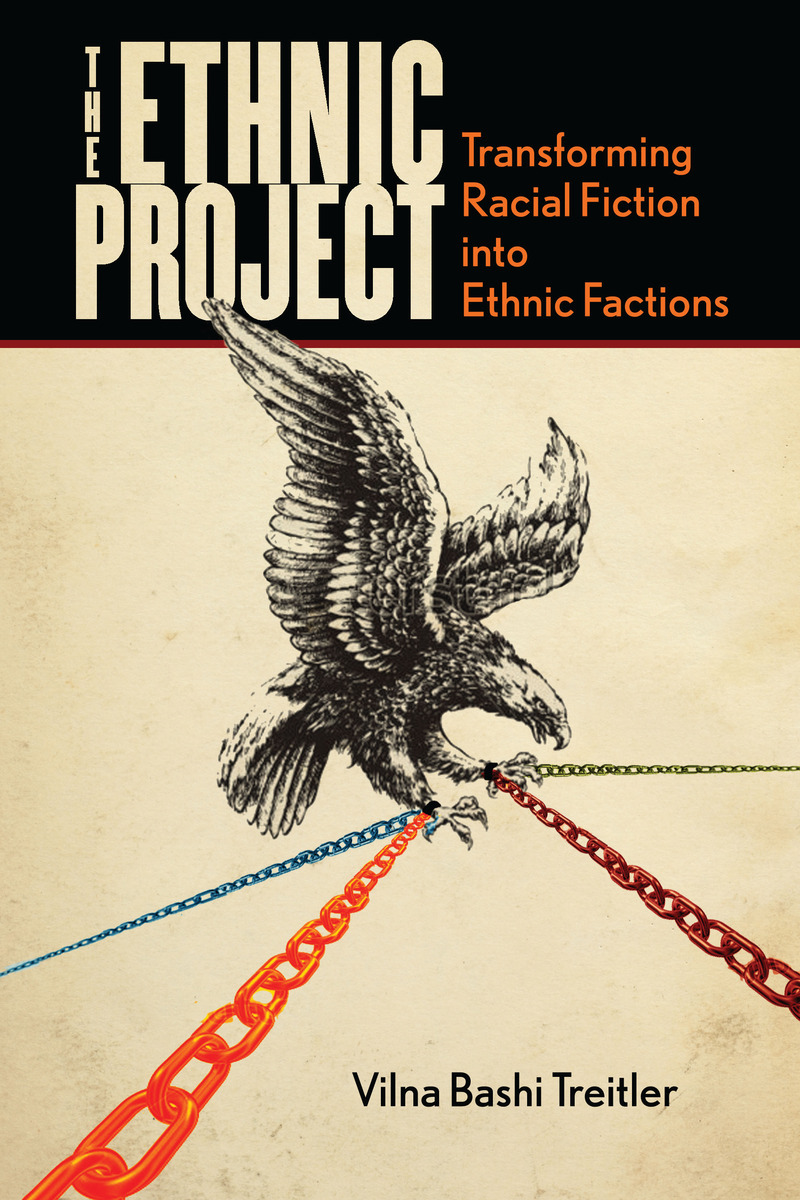
The Ethnic Project: Transforming Racial Fiction into Ethnic Factions

Posted in Anthropology, Books, History, Media Archive, Monographs, Social Science, United States on 2013-09-07 17:14Z by Steven

The Ethnic Project: Transforming Racial Fiction into Ethnic Factions

Stanford University Press
2013
240 pages
7 illustrations
Cloth ISBN: 9780804757713
Paper ISBN: 9780804757720
E-bok ISBN: 9780804787284

Vilna Bashi Treitler, Professor of Sociology and Black and Hispanic Studies
Baruch College, City University of New York

Race is a known fiction—there is no genetic marker that indicates someone’s race—yet the social stigma of race endures. In the United States, ethnicity is often positioned as a counterweight to race, and we celebrate our various hyphenated-American identities. But Vilna Bashi Treitler argues that we do so at a high cost: ethnic thinking simply perpetuates an underlying racism.

In The Ethnic Project, Bashi Treitler considers the ethnic history of the United States from the arrival of the English in North America through to the present day. Tracing the histories of immigrant and indigenous groups—Irish, Chinese, Italians, Jews, Native Americans, Mexicans, Afro-Caribbeans, and African Americans—she shows how each negotiates America’s racial hierarchy, aiming to distance themselves from the bottom and align with the groups already at the top. But in pursuing these “ethnic projects” these groups implicitly accept and perpetuate a racial hierarchy, shoring up rather than dismantling race and racism. Ultimately, The Ethnic Project shows how dangerous ethnic thinking can be in a society that has not let go of racial thinking.

Contents

  • Acknowledgments
  • 1. Racism and Ethnic Myths
  • 2. How Ethnic and Racial Structures Operate
  • 3. Ethnic Winners and Losers
  • 4. The Irish, Chinese, Italians, and Jews: Successful Ethnic Projects
  • 5. The Native Americans, Mexicans, and Afro-Caribbeans: Struggling Ethnic Projects
  • 6. African Americans and the Failed Ethnic Project
  • 7. The Future of U.S. Ethnoracism
  • Notes
  • Index
Tags: , , ,

Quadroons for Beginners: Discussing the Suppressed and Sexualized History of Free Women of Color with Author Emily Clark

Posted in Articles, History, Interviews, Louisiana, Media Archive, United States, Women on 2013-09-07 16:42Z by Steven

Quadroons for Beginners: Discussing the Suppressed and Sexualized History of Free Women of Color with Author Emily Clark

The Huffington Post
2013-09-04

Stacy Parker Le Melle

“As a historian, I knew that mixed race women and interracial families were everywhere in America from its earliest days. And I knew that most of the free women of color in antebellum New Orleans bore no resemblance to the quadroons of myth.” —Dr. Emily Clark

As an American, I follow my roots like trails across the globe. My mother is from Kansas and is of German descent, and my deceased father was black with roots in North Carolina, and before then, Africa. Arguably you can trace all of us back to Africa. But my parents’ union created me: a black American woman, a woman of color, a mixed kid, a mulatta, maybe an Oreo, definitely a myriad of identities and categories to embrace or resist.

Living in Harlem, I see so many mixed marriages, mixed kids everyday all the time. Traveling the South, I see so many kids with the telltale curly locks. Growing up in Metro Detroit in the 80s, I knew there were other black & white mixes like me. I just didn’t know them. Only at college in Washington, DC, did I meet mixed girls and have them as friends. And not until my English, women’s studies, and African-American history courses did I learn any American history about women like me.

Before college, maybe I’d encounter a definition of “miscegenation” – that very special crime of racemixing in segregated America. And maybe an explanation of the “one drop rule” that went on to create the classifications of “mulatto” and “quadroon” and “octaroon“—your label dependent upon which fraction of African was in your genealogy. But that was it. In my high school American History texts, I don’t remember any acknowledgement of centuries of rape and consensual relationships between whites and blacks. None of my suburban history teachers lingered on the taboo. Maybe I didn’t either. When I think of the mania around racemixing, and of the cultural trope of the “tragic mulatta“—the woman doomed because she is too white for the blacks, too black for the whites—it was easy to assume that the history of mixed-race women in America was simple in its sadness and injustice.

Yet there is nothing simple about the American Quadroon. Once she was the picture of irresistible beauty, the symbol of a city thought of as irredeemably “other”, an earthbound goddess who conjured so much desire that white men made her concubines, and slavetraders scoured the states for enslaved girls that fit her description to fulfill buyer demand. That was the myth, the dominant story. But as Tulane historian Emily Clark writes in her richly-researched and compelling The Strange History of the American Quadroon: Free Women of Color in the Revolutionary Atlantic World (UNC Press), she was also a family-woman, marrying men of color, living the propriety dream in her New Orleans society. If her myth was simple in its power, her reality was rich and complicated—by no means a single story…

How do you define an “American Quadroon”?

Dr. Clark: There are really two versions. One is the virtually unknown historical reality, the married free women of color of New Orleans who were paragons of piety and respectability. The other is the more familiar mythic figure who took shape in the antebellum American imagination. If you asked a white nineteenth-century American what a quadroon was, they would answer that she was a light-skinned free woman of color who preferred being the mistress of a white man to marriage with a man who shared her racial ancestry. In order to ensnare white lovers who would provide for them, quadroons were supposedly schooled from girlhood by their mothers to be virtuosos in the erotic arts. When they came of age, their mothers put them on display at quadroon balls and negotiated a contract with a white lover to set the young woman up in a house and provide enough money to support her and any children born of the liaison. The arrangement usually ended in heartbreak for the quadroon when the lover left her to marry a white woman. If this sounds like a white male rape fantasy, that is exactly what it was. There is one other key characteristic of the mythic American Quadroon: she was to be found only in New Orleans…

Read the entire interview here.

Tags: , , , , , ,

N.Y. mayor’s race front-runner cast as a ‘socialist redistributionist’

Posted in Articles, Media Archive, Politics/Public Policy, United States on 2013-09-06 04:00Z by Steven

N.Y. mayor’s race front-runner cast as a ‘socialist redistributionist’

The Christian Science Monitor
2013-09-04

Harry Bruinius, Staff writer

Democrat Bill de Blasio, the most liberal major candidate in the New York City mayor’s race, is leading polls ahead of the Sept. 10 primary. Republicans sense an opportunity.

The surprising ascendancy of New York City Public Advocate Bill de Blasio may have energized the liberal wing of city Democrats, but the commanding mayoral front-runner has some Republicans cheering as well.

Despite the fact that the Republican line has won the mayor’s office five consecutive times in New York, conventional wisdom has long had the Democratic nominee easily winning the Nov. 5 general election this year.

It is still a city in which registered Democrats outnumber Republicans 6 to 1, after all, and which gave Obama 81 percent of its votes in 2012. Even the Democrat-turned-Republican-turned-Independent Mayor Michael Bloomberg, who won three terms on the Republican line, has deftly played down standard partisan divisions during his 12-year tenure.

But Mr. de Blasio has stunned the more moderate Democratic candidates the past few weeks with his relentless critique of the Bloomberg administration, as well as his dogged liberal message of income inequality in the shadow of Wall Street wealth. He also was very effective showcasing his interracial family – including his teenage son, Dante, whose Afro-style hair and descriptions of his father in campaign commercials have become some of the most memorable of the race…

…But even de Blasio’s multicultural and nontraditional family could cause some problems in the general election – even in a city like New York. His wife, Chirlane McCray, was a high-profile lesbian activist who wrote a groundbreaking article for Essence magazine in 1979, describing her coming out as a gay black woman.

According to GOP consultant Johnson, who says he is familiar with some of the internal polling of the Lhota campaign, there are a number of groups, including many Jewish voters, who remain uncomfortable with de Blasio.

“Despite all the popularity, despite everything we’ve heard about his son stealing the show, they’re also seeing, too, that there is still some backlash about the mixed marriage,” he says…

Read the entire article here.

Tags: , , , ,