‘It’s not written on their skin like it is ours’: Greek letter organizations in the age of the multicultural imperative

Posted in Articles, Campus Life, Media Archive, Social Science, United States on 2013-09-19 22:05Z by Steven

‘It’s not written on their skin like it is ours’: Greek letter organizations in the age of the multicultural imperative

Ethnicities
Volume 13, Number 5 (October 2013)
pages 519-543
DOI: 10.1177/1468796812471127

Joanna S. Hunter, Assistant Professor of Sociology
Radford University, Radford, Virginia

Matthew W. Hughey, Associate Professor of Sociology
University of Connecticut

Today’s students wrestle with the continued salience of racial identity on campuses that encourage the celebration of ‘diversity’ while at once digesting messages that the USA is now largely ‘post-racial’. Based on data collected through fieldwork observation, focus groups and in-depth interviews with a local Multicultural Greek Council for fraternities and sororities, we argue that ‘multicultural’ student organizations engage in a variety of racial identity tactics that simultaneously constrain and enable the perception of their racial identities. By relying on the two cultural narratives of multiculturalism—abstract and organizational—members of Greek organizations that do not conform to the White/Black binary can construct identities and a movement understood as rational, progressive and generally innocuous. Yet, in practice, the dominant expectations to perform ‘multiculturalism’ were manifest in narrow, essentialist and singular expressions of ethnic pride as an oppositional identity to Anglo-conformity and color-blindness, rather than an embrace of pluralism and multiculturalism per se. By highlighting how members of multicultural student organizations navigate this troubling paradox, our study raises important questions about the concept of multiculturalism, especially as it is constructed and enacted by the millennial generation.

Read or purchase the article here.
Tags: , , , ,

The Two or More Races Population: 2010

Posted in Census/Demographics, Media Archive, Reports, United States on 2013-09-19 21:34Z by Steven

The Two or More Races Population: 2010

United States Census Bureau
2010 Census Briefs (C2010BR-13)
September 2012
24 pages

Nicholas A. Jones, Chief, Racial Statistics Branch
Population Division
United States Census Bureau

Jungmiwha J. Bullock
United States Census Bureau

INTRODUCTION

Data from the 2010 Census and Census 2000 present information on the population reporting more than one race and enable comparisons of this population from two major data points for the first time in U.S. decennial census history. Overall, the population reporting more than one race grew from about 6.8 million people to 9.0 million people. One of the most effective ways to compare the 2000 and 2010 data is to examine changes in specific race combination groups, such as people who reported White as well as Black or African American—a population that grew by over one million people, increasing by 134 percent—and people who reported White as well as Asian—a population that grew by about three-quarters of a million people, increasing by 87 percent. These two groups exhibited significant growth in size and proportion since 2000, and they exemplify the important changes that have occurred among people who reported more than one race over the last decade.

This report looks at our nation’s changing racial and ethnic diversity. It is part of a series that analyzes population and housing data collected from the 2010 Census and provides a snapshot of the population reporting multiple races in the United States. Racial and ethnic population group distributions and growth at the national level and at lower levels of geography are presented.

This report also provides an overview of race and ethnicity concepts and definitions used in the 2010 Census. The data for this report are based on the 2010 Census Redistricting Data (Public Law 94-171) Summary File, which was the first 2010 Census data product released with data on race and Hispanic origin and was provided to each state for use in drawing boundaries for legislative districts.

Read the entire report here.

Tags: , , , ,

Mixed Race Show ‘n’ Tell

Posted in Campus Life, Live Events, Media Archive, United States on 2013-09-19 17:27Z by Steven

Mixed Race Show ‘n’ Tell

Columbia College
618 Building, Multipurpose Studio
618 S. Michigan, Chicago, IL, Chicago
Tuesday, 2013-10-01, 12:00-14:00 (Local Time)

Are you multiracial? Mixed race? Biracial? Adopted across cultures? Dating someone of another culture? Ever been asked “What are you?”

Bring a special object to the Mixed Race Show N Tell, sponsored by The What Are You Project. Be prepared to share, and discuss what you’d like to do to foster mixed race community on campus.

For more information, click here.

Tags:

Colour Coded Health Care: The Impact of Race and Racism on Canadians’ Health

Posted in Canada, Health/Medicine/Genetics, Media Archive, Politics/Public Policy, Reports, Social Science, Social Work on 2013-09-19 00:03Z by Steven

Colour Coded Health Care: The Impact of Race and Racism on Canadians’ Health

Wellesly Institute: advancing urban health
Toronto, Ontario, Canada
January 2012
30 pages

Sheryl Nestel, Ph.D.

Scope and Purpose of the Review

Canada is home to a much-admired system of universal health care, understood as a central pillar of this nation’s overall commitment to principles of social equity and social justice. Such an understanding makes it difficult to raise the issue of racial inequities within the context of the Canadian health-care system. Indeed, as a number of Canadian health scholars have argued, with the exception of the substantial data on First Nations health, very little research has been conducted in Canada on racial inequality in health and health care (Health Canada, 2001; Johnson, Bottorff, Hilton, & Grewell, 2002; O’Neill & O’Neill, 2007; Rodney & Copeland, 2009). This literature review attempts to bring together data published between 1990 and 2011 on racial inequities in the health of non-Aboriginal racialized people in Canada. The decision not to include data on Aboriginal people in this review is by no means intended to obscure or minimize the appalling health conditions among Aboriginal people and the central role of colonialism and racism in their creation and perpetuation. It is clear, as Kelm (2005) has argued, that “social and economic deprivation, physical, sexual, cultural and spiritual abuse” (p. 397) underlie inexcusable inequities in Aboriginal health. Aboriginal health inequities were not included in this review because we chose not to subsume under an umbrella of racial inequities in health the unique history and continuing injustice of Aboriginal health conditions.

We begin our review with a discussion of the concept of race and its relationship to health outcomes and then move to a discussion of the significance of racial inequities in health and the relationship of these inequities to other forms of social inequality. We also examine mortality and morbidity data for various racialized groups in Canada and explore evidence of the role of bias, discrimination, and stereotyping in health-care delivery. Unequal access to medical screening, lack of adequate resources such as translation services, and new and important research on the physiological impact of a racist environment are also explored. This review concludes with a discussion of the limitations of available data on racial inequities in health and health care in Canada. It also surveys the challenges faced by other jurisdictions, such as the United States and Great Britain, in collecting racial data to monitor the extent of such inequities, understand their causes, and address the consequences of unequal access to health care. Finally, it offers recommendations related to the collection of racial data…

Read the entire report here.

Tags: , ,

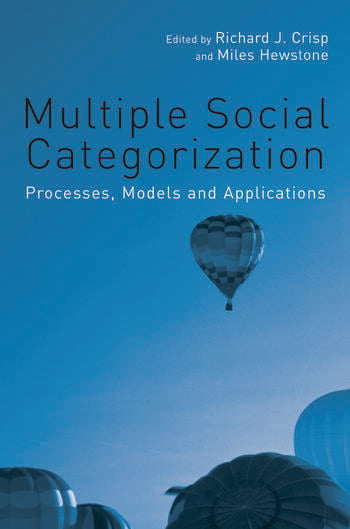
Multiple Social Categorization: Processes, Models and Applications

Posted in Anthologies, Books, Identity Development/Psychology, Media Archive, Social Science on 2013-09-18 01:38Z by Steven

Multiple Social Categorization: Processes, Models and Applications

Psychology Press (an imprint of Taylor & Francis Group)
2006-10-12
344 pages
Hardback ISBN: 978-1-84169-502-0
Paperback ISBN: 978-0-415-65567-5

Edited by

Richard J. Crisp, Professor of Psychology
University of Kent

Miles Hewstone, Professor of Social Psychology and Fellow
New College, Oxford

‘Ethnic cleansing’, ‘institutional racism’, and ‘social exclusion’ are just some of the terms used to describe one of the most pressing social issues facing today’s societies: prejudice and intergroup discrimination. Invariably, these pervasive social problems can be traced back to differences in religion, ethnicity, or countless other bases of group membership: the social categories to which people belong.

Social categorization, how we classify ourselves and others, exerts a profound influence on our thoughts, beliefs, feelings, and behaviors. In this volume, Richard Crisp and Miles Hewstone bring together a selection of leading figures in the social sciences to focus on a rapidly emerging, but critically important, new question: how, when, and why do people classify others along multiple dimensions of social categorization? The volume also explores what this means for social behavior, and what implications multiple and complex perceptions of category membership might have for reducing prejudice, discrimination, and social exclusion.

Topics covered include:

  • the cognitive, motivational, and affective implications of multiple categorization
  • the crossed categorization and common ingroup methods of reducing prejudice and intergroup discrimination
  • the nature of social categorization among multicultural, multiethnic, and multilingual individuals.

Multiple Social Categorization: Process, Models and Applications addresses issues that are central to social psychology and will be of particular interest to those studying or researching in the fields of Group Processes and Intergroup Relations.

Contents

  • Part 1. Introduction
    • R.J. Crisp, M. Hewstone, Multiple social categorization: Context, process, and social consequences
  • Part 2. Multiple Category Representation
    • C. McGarthy, Hierarchies and minority groups: The roles of salience, overlap and background knowledge in selecting meaningful social categorizations from multiple alternatives
    • E.R. Smith, Multiply categorizable social objects: representational models and some potential determinants of category use
  • Part 3. Multiple Categorization and Social Judgement
    • J.F. Dovidio, S.L. Gaertner, G. Hodson, B.M. Riek, K.M. Johnson, M. Houlette, Recategorization and crossed categorization: The implications of group salience and representations for reducing bias
    • R.J. Crisp, Commitment and categorization in common ingroup contexts
    • M.A. Hogg, M.J. Hornsey, Self-concept threat and multiple categorization within groups
  • Part 4. Cross-Cutting Categorization and Evaluation
    • N. Miller, J. Kenworthy, C.J. Canales, D.M. Stenstrom, Explaining the effects of crossed categorization on ethnocentric bias
    • T.K. Vescio, C.M. Judd, P. Chua, The crossed categorization hypothesis: cognitive mechanisms and patterns of intergroup bias
    • R. Singh, Gender among multiple social categories: Social attraction in women but interpersonal attraction in men
  • Part 5. Broader Perspectives
    • J. Phinney, L.L. Alipuria, Social categorization among multicultural, multiethnic, and multiracial individuals: Processes and implications
    • N.A. Carter, Political institutions and multiple social identities
  • Part 6. Conclusion
    • M. Hewstone, R. Turner, J. Kenworthy, R.J. Crisp, Multiple social categorization: Future directions
Tags: , , , , , , , , , , , , , , , , , , , , , , , , , ,

One Drop of Love: A Multimedia Solo Performance on Racial Identity by Fanshen Cox DiGiovanni at James R. Fitzgerald Theater

Posted in Arts, Census/Demographics, History, Identity Development/Psychology, Live Events, Media Archive, Social Science, United States on 2013-09-17 19:20Z by Steven

One Drop of Love: A Multimedia Solo Performance on Racial Identity by Fanshen Cox DiGiovanni at James R. Fitzgerald Theater

James R. Fitzgerald Theater
Cambridge Rindge & Latin School
459 Broadway
Cambridge, Massachusetts 02138
Friday, 2013-08-30, 19:30 EDT (Local Time)

Fanshen Cox DiGiovanni, Playwright, Producer, Actress, Educator

Jillian Pagan, Director

Produced by: Ben Affleck, Matt Damon and Chay Carter

How does our belief in ‘race’ affect our most intimate relationships?

One Drop of Love: A Daughter’s Search for her Father’s Racial Approval is a multimedia solo show that journeys from the U.S. to East & West Africa and from 1790 to the present as a culturally Mixed woman explores the influence of the “one -drop rule” on her family and society.

For more information, click here.

Tags: , , , ,

Esther J. Cepeda: Debate grows over Hispanics and the 2020 Census

Posted in Articles, Census/Demographics, Latino Studies, Media Archive, Social Science, United States on 2013-09-17 02:07Z by Steven

Esther J. Cepeda: Debate grows over Hispanics and the 2020 Census

San Jose Mercury News
San Jose, California
2013-09-07

Esther J. Cepeda, Columnist
The Washington Post

CHICAGO—A debate is raging about whether the U.S. Census Bureau should offer Hispanics the option of identifying themselves as a separate race in the 2020 count. But let’s instead ponder how accurately they’ll be defined.

According to a new study by Duke University professor Jen’nan Ghazal Read, policymakers should be working hard to ensure that demographic subgroups are portrayed as accurately as the data allow.

“While it’s great that people are concerned about how they want to self-identify, what I’m concerned about is the information we overlook,” Read told me as she described research she conducted on Public Use Microdata Samples, or PUMS, from the 2000 census.

In her study published in the journal Population Research and Policy Review, Read used two distinct subgroups, Mexicans and Arabs, to tease out very different stories about the nature of their circumstances compared to how the census usually describes them.

She found that if the census broadened its standard definition to include people who don’t identify themselves as Hispanic or Latino—but who were nonetheless born in Mexico or report Mexican ancestry—in the “Mexican” Hispanic origin question, the number of Mexican-Americans known to be legally in the U.S. would increase nearly 10 percent…

Read the entire opinion piece here.

Tags: , , , , ,

Vietnam Legacy: Finding G.I. Fathers, and Children Left Behind

Posted in Articles, Asian Diaspora, Family/Parenting, Media Archive, Politics/Public Policy, United States on 2013-09-16 20:57Z by Steven

Vietnam Legacy: Finding G.I. Fathers, and Children Left Behind

The New York Times
2013-09-16

James Dao, Military and Veterans Affairs Reporter

SALTILLO, Miss. — Soon after he departed Vietnam in 1970, Specialist James Copeland received a letter from his Vietnamese girlfriend. She was pregnant, she wrote, and he was the father.

He re-enlisted, hoping to be sent back. But the Army was drawing down and kept him stateside. By the time Saigon fell to the North Vietnamese in 1975, he had lost touch with the woman. He got a job at a plastics factory in northern Mississippi and raised a family. But a hard question lingered: did she really have his child?

“A lot of things we did in Vietnam I could put out of my mind,” said Mr. Copeland, 67. “But I couldn’t put that out.”

In 2011, Mr. Copeland decided to find the answer, acknowledging what many other veterans have denied, kept secret or tried to forget: that they left children behind in Vietnam…

Read the entire article here.

Tags: , , , , ,

Mixed emotions: Reflections on researching racial mixing and mixedness

Posted in Articles, Media Archive, Social Science on 2013-09-16 20:47Z by Steven

Mixed emotions: Reflections on researching racial mixing and mixedness

Emotion, Space and Society
Volume 11, May 2014
pages 79–88
DOI: 10.1016/j.emospa.2013.07.002

Chamion Cabellero, Senior Research Fellow
Social Capital Research Group
London South Bank University

Researching racial and ethnic issues can involve entering a highly emotive terrain and the subject of ‘mixed race’ is no exception. The growing collection of both historical and contemporary accounts of those who are perceived to be mixing or of mixed race highlight the often intense emotions involved in crossing perceived boundaries of colour and culture. Yet, whilst discussions of the sensitivities and politics facing those mixing or of mixed race form the backbone of much research into the subject, much less is said about these issues in relation to the research process. Such reflections, however, are important not only for making sense of the frequent intensity of emotion that emerges from such research but also as regards constructing, conducting and disseminating it. Drawing in particular on a number of research projects conducted by the author and colleagues, this paper will discuss some of the emotive issues involved in researching the notion of ‘mixedness’ and their methodological implications for researchers as well as the research field itself.

Read or purchase the article here.

Tags: ,

“It’s Only Other People Who Make Me Feel Black”: Acculturation, Identity, and Agency in a Multicultural Community

Posted in Articles, Identity Development/Psychology, Media Archive, United Kingdom on 2013-09-16 20:36Z by Steven

“It’s Only Other People Who Make Me Feel Black”: Acculturation, Identity, and Agency in a Multicultural Community

Political Psychology
Published online: 2013-02-18
DOI: 10.1111/pops.12020

Caroline Howarth, Senior Lecturer in Social Psychology
London School of Economics, United Kingdom

Wolfgang Wagner, Professor of Psychology
Johannes Kepler University, Linz, Austria
University of the Basque Country, San Sebastián, Spain

Nicola Magnusson
The Open University, United Kingdom

Gordon Sammut, Lecturer in Psychology
University of Malta

This article explores identity work and acculturation work in the lives of British mixed-heritage children and adults. Children, teenagers, and parents with mixed heritage participated in a community arts project that invited them to deliberate, construct, and reconstruct their cultural identities and cultural relations. We found that acculturation, cultural and raced identities, are constructed through a series of oppositional themes: cultural maintenance versus cultural contact; identity as inclusion versus identity as exclusion; institutionalized ideologies versus agency. The findings point towards an understanding of acculturation as a dynamic, situated, and multifaceted process: acculturation in movement. To investigate this, we argue that acculturation research needs to develop a more dynamic and situated approach to the study of identity, representation, and culture. The article concludes with a discussion on the need for political psychologists to develop methods attuned to the tensions and politics of acculturation that are capable of highlighting the possibilities for resistance and social change.

Read or purchase the article here.

Tags: , , , ,