A Lot Like You

Posted in Autobiography, Identity Development/Psychology, Live Events, Media Archive, United States, Videos on 2013-10-04 02:53Z by Steven

A Lot Like You

DePaul University
Center for Intercultural Programs
LPC-Cortelyou Commons
2324 N Fremont St.
2013-10-15, 18:00-19:00 CDT (Local Time)

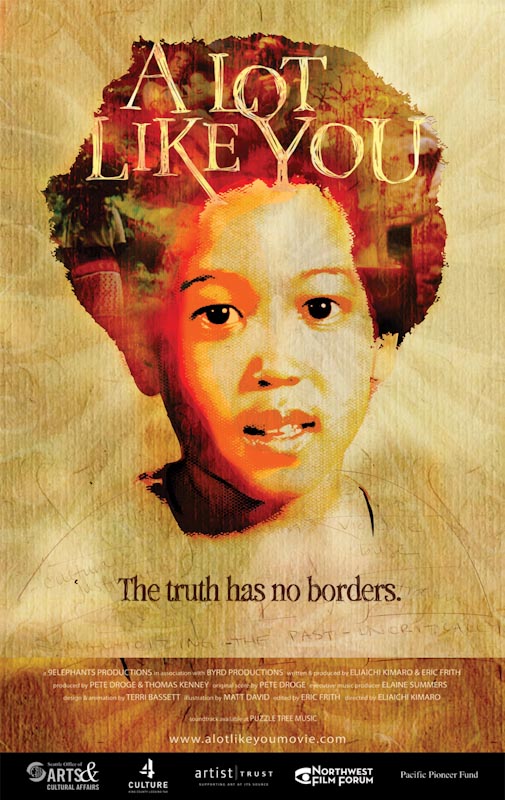
Join documentary filmmaker Eliaichi Kimaro for a screening and discussion of scenes from A Lot Like Me, her own original autobiographical journey of self-discovery. Her film follows her experience as a mixed-race, first-generation American reconciling the culture she’s inherited with how she defines herself today.

For more information, click here.

Tags: , ,

The Drock Story (Second Edition)

Posted in History, Media Archive, Papers/Presentations, Slavery, United States on 2013-10-04 02:40Z by Steven

The Drock Story (Second Edition)

Our Family Tree – Ancestors of Donald W.L. Roddy and Related Family Lines
August 2005
29 pages

Donald W. L. Roddy (From Research by: Daryl Y. [Hooper] Holmes and Donald W. L. Roddy)

1730 – Norwich, Connecticut:

My great-great-great-great-great grandfather, Guy Drock, was probably born sometime between 1726 and 1742, most likely around 1730, give or take a few years. He may have been born in Norwich, or born elsewhere and brought to Norwich as a child. Guy officially became a Christian on 31 July, 1742, when he was baptized in the First Congregational Church in Norwich, New London County, in the Colony of Connecticut in New England. Nothing is said about his age in the baptismal Record, other than that he was a boy, so we don’t know if his was an infant baptism or a voluntary baptism sometime in his later childhood.

As a boy, and young man, Guy worked for Captain Benajah Bushnell, who was a wealthy, influential land speculator, and one of the original settlers of what became Norwich in New London County in the Colony of Connecticut in New England. He got the title “Captain”, not from any association with seafaring, but because of his involvement with the local militia which conducted drills at least once a year, whether they needed it or not. Sometime around 1755, Sarah Powers, a young woman from Newport, on the Colony of Rhode Island, also started working for Benajah Bushnell. We do not know whether Sarah Powers was a voluntary employee of Bushnell or an indentured servant legally obligated to work for him for a specified period of time. In fact, we know very little about Sarah …. we do not even know for sure that she was born in Rhode Island, only that she had lived there prior to appearing in Norwich.

While working for Bushnell, Sarah apparently fell in love with Guy, and probably married him sometime around 1757 or before. It is likely that she also had a child by Guy between 1757 and 1759, perhaps Simon. In June, 1759, Guy and Sarah probably stopped working for Benajah Bushnell, and set about trying to make a new life for themselves. The so called French and Indian War was raging at the time. Guy opened a small blacksmith shop in downtown Norwich. He may have learned his blacksmith’s skills while working for Bushnell, or perhaps he became self taught after he left Bushnell’s service. During the war, inflation ran rampant. After the war, of course, came an economic depression. Guy and Sarah must have been hard pressed indeed to keep body and soul together. Then, to make matters worse, the British parliament started passing the series of acts that eventually led to the Revolutionary War.

Read the entire paper here.

Tags: , , , , , ,

The Counterfeit Family Tree of Vee Crawford-Wong

Posted in Asian Diaspora, Books, Media Archive, Novels, United States on 2013-10-03 23:47Z by Steven

The Counterfeit Family Tree of Vee Crawford-Wong

Simon & Schuster Books for Young Readers
July 2013
368 pages
Hardcover ISBN: 9781442412644
eBook ISBN: 9781442412668

L. Tam Holland

A hysterically funny debut novel about discovering where you come from—even if you have to lie to get there.

When Vee Crawford-Wong’s history teacher assigns an essay on his family history, Vee knows he’s in trouble. His parents—Chinese-born dad and Texas-bred Mom—are mysteriously and stubbornly close-lipped about his ancestors. So, he makes it all up and turns in the assignment. And then everything falls apart.

After a fistfight, getting cut from the basketball team, offending his best friend, and watching his grades plummet, one thing becomes abundantly clear to Vee: No one understands him! If only he knew where he came from… So Vee does what anyone in his situation would do: He forges a letter from his grandparents in China, asking his father to bring their grandson to visit. Astonishingly, Vee’s father agrees. But in the land of his ancestors, Vee learns that the answers he seeks are closer to home then he could have ever imagined.

Tags: , , ,

New mixed-race student group holds first meeting

Posted in Arts, Campus Life, Media Archive, United States on 2013-10-03 19:42Z by Steven

New mixed-race student group holds first meeting

North by Northwestern
2013-10-01

Julia Clark-Riddell

North by Northwestern is Northwestern University’s leading independent online publication, updated around the clock with stories about campus and culture.

Wildcat Connection lists exactly 100 student groups in the “cultural” category, from the African Students Association to the Women in Leadership program, but, before this year, none had addressed the mixed-race community specifically.

MIXED, formally known as the Mixed Race Student Coalition, held its first official meeting Tuesday night, beginning what co-presidents and founders Tori Marquez and Kalina Silverman hope will be a student group that can provide a safe space for mixed-race students on campus, as well as students interested in mixed-race culture.

More than 40 students attended Tuesday’s meeting, where the seven executives of the group led introductions, icebreakers and small group discussions in a tucked away classroom of Seabury…

…Medill professor Loren Ghiglione is writing a book about a cross-country trip he took with a couple of Medill students interviewing people about issues of race, sexual orientation and immigration. He was looking for signs of progress on these issues to add to his epilogue when he was saw that an organization like MIXED could be a good example…

Read the entire article here.

Tags: , , , , ,

Descendants of Norwich slave, owner meet

Posted in Articles, History, Media Archive, Slavery, United States on 2013-10-03 05:00Z by Steven

Descendants of Norwich slave, owner meet

Norwich Bulletin
Norwich, Connecticut
2012-03-29

Adam Benson

Norwich, Conn.—When descendants of Norwich slave Guy Drock and the man who owned him met  for the first time Thursday, they weren’t sure what would happen.

Grant Hayter-Menzies’ fifth-generation great-grandfather, Capt. Benejah Bushnell, owned Drock for a decade in the mid-1700s in Norwich.

Hayter-Menzies, of British Columbia; Daryl D’Angelo, of Amherst, N.H.; and her cousin, Donald Roddy, of Spokane, Wash. — all of them white — came to Karen Cook’s U.S. history class at Norwich Free Academy with a story they said had to be told.

“I don’t have any of the cultural and social legacies of someone who grew up identified as an African-American, and I still had a moment of, ‘What does this guy want from me,’” D’Angelo said of meeting Hayter-Menzies.

Hayter-Menzies was apprehensive, too…

… Roddy, a retired airline pilot, said he stumbled across his Drock lineage several years ago, while doing genealogical research on his family.

“I had no idea I had African ancestors until a few years ago,” Roddy said. “No one in my living family had a clue about that.”

Hayter-Menzies said he’s forged a unique bond with D’Angelo and Roddy, and quickly felt a kinship with them once they finally met.

“My first reaction was to reach out and hug you,” Hayter-Menzies told D’Angelo. “We feel like friends already.”…

Read the entire article here.
Tags: , , , , , ,

“Slavery, Freedom and Reunion in a Colonial Connecticut Town” with Grant Hayter-Menzies, Daryl D’Angelo and Donald Roddy

Posted in Audio, History, Live Events, Media Archive, Slavery, United States on 2013-10-03 03:25Z by Steven

“Slavery, Freedom and Reunion in a Colonial Connecticut Town” with Grant Hayter-Menzies, Daryl D’Angelo and Donald Roddy

Research at the National Archives and Beyond
BlogTalk Radio
Thursday, 2013-10-03, 21:00 EDT, (Friday, 2013-10-04, 01:00Z)

Bernice Bennett, Host

In June 1759, Norwich, Connecticut businessman Benajah Bushnell sold Guy Drock, a slave of African ancestry, to Sarah Powers, the Caucasian woman Drock had possibly married. Ironically, this deed freed Drock from Bushnell’s control but not from slavery. In March 2012, descendants of Guy and Sarah Drock and of Benajah Bushnell came together in Norwich for the first time in over two centuries. Drock descendants Daryl D’Angelo and Donald Roddy—who when they began their research years earlier did not know they had African ancestry, and Bushnell descendant Grant Hayter-Menzies—who thought only his Southern ancestors were slave owners—met to try to understand a legacy they did not know they shared. In the town where their past began, they sought to explore the personal impact of their ancestors’ intertwined histories, how the past has shaped them, their research and their interactions with one another today, and the relatively unknown institution of slavery in early New England.

  • Grant Hayter-Menzies is an internationally published biographer and journalist .
  • Daryl D’Angelo is a wife and mother, photographer and writer, and lives in a small town [Amherst] in southern New Hampshire.
  • Donald Roddy is a 78 year old retired Airline Pilot.

For more information, click here.

Tags: , , , , , ,

Owning white privilege and then what?

Posted in Articles, Media Archive on 2013-10-03 01:00Z by Steven

Owning white privilege and then what?

Transracial Parenting: A Race Together
2013-04-09

Rachel Dangermond

My own brand of narrow vision at work here: I’m not a big coffee shop person; I go rarely and usually when I have a deadline that I have put off until I can’t bear it anymore and I need a change of venue to focus. I’ve always thought this pastime was a European and Middle Eastern activity. So the other day when I was in CC’s on Esplanade working through a deadline, I was surprised I was the only white person in the whole place. Who knew?

I sat down at a window table and a woman I know came in, but I couldn’t recall her name, so I just smiled in greeting. She sat behind me and soon two older gentlemen joined her and they began talking about their organization that is helping to economically empower black owned businesses. I know this because I am a consummate eavesdropper. I actually was going to approach the woman and ask what they are doing to see if it in any way aligned with my efforts, but I never found my in and my friend had come to meet me.

It’s an odd phenomenon that once you become aware of something, you start seeing the signposts of that awareness everywhere and certainly that is the hope of anyone who is working in this country to end racism…

…But this morning, I had a truly wonderful Skype session with a similarly like-minded woman, Jennifer Chandler. She is a PhD candidate at Cardinal Stritch University in Milwauke and her thesis is to study white mothers of biracial daughters or sons and cull descriptions of their interactions with the teachers and principals at the children’s school. She is pursuing her Doctorate degree in Leadership for the Advancement of Learning and Service…

Read the entire article here.

Tags: , , , , ,

Film Review: Multiracial Identity

Posted in Articles, Book/Video Reviews, Census/Demographics, Media Archive, Social Science, United States on 2013-10-02 01:36Z by Steven

Film Review: Multiracial Identity

Teaching Sociology
Volume 41, Number 4 (October 2013)
pages 397-399
DOI: 10.1177/0092055X13496205

Sara McDonough
Department of Sociology
Virginia Polytechnic Institute and State University

David L. Brunsma, Professor of Sociology
Virginia Polytechnic Institute and State University

Multiracial Identity. 77 minutes. 2010. Brian Chinhema , director. Bullfrog Films. PO Box 149, Oley, PA 19547. 610.779.8226. http://www.bullfrogfilms.com/.

Released in 2011, Multiracial Identity is a timely, well-crafted film written and directed by Brian Chinhema that presents many of the key concepts, debates, and questions surrounding mixed-race identity and multiraciality in American society. Narrated by Dieter Weber, the film integrates both scholarly and nonscholarly voices to present a number of key discussions and tensions about the place and recognition of multiracial people in U.S. society while also providing space for multiracial individuals or the parents of mixed-race children to talk about their experiences and insights on the meanings of multiraciality in the United States. Featuring prominent scholars in the field of multiracial identity, such as Rainier Spencer and Naomi Zack, as well as Aaron Gullickson and Aliya Saperstein, the film provides some basic historical background to contextualize contemporary discussions about multiraciality. While the numbers show an increase of 33 percent in the multiracial population between 2000 and 2010, the existence of multiracial people is not a new phenomenon. The film sets the historical and conceptual stage early, so students might ask, “What has changed in terms of (multi)race and (multi)racial identity in the United States?”

Viewers are provided with an introductory overview of the existence, status, and sociocultural dilemmas that have faced multiracial populations historically. The film does a good job showing the changing meaning of multiraciality across time and space (e.g., regional differences and across racial/ethnic combinations). Though the historically central organizing principle of the black/white binary is discussed, the film raises the question of the utility of this paradigm for understanding multiraciality as it gives attention to the experience of other multiracial individuals (e.g., Hapa-Haoles/Asian-white). Interfacing with the changing demographics associated with the repeal of certain anti-immigration laws in the 1960s, and the increase in Asian and Hispanic/Latino migration in particular, the film more than adequately …

Read or purchase the review here.

Tags: , , , , , , , , , ,

“I’ve Never Heard of the Métis People”: The Politics of Naming, Racialization, and the Disregard for Aboriginal Canadians

Posted in Articles, Canada, Media Archive, Native Americans/First Nation on 2013-10-01 01:38Z by Steven

“I’ve Never Heard of the Métis People”: The Politics of Naming, Racialization, and the Disregard for Aboriginal Canadians

ActiveHistory.ca
2012-10-18

Crystal Fraser
University of Alberta

Mike Commito
McMaster University

The controversial selection of a hamburger name by a Toronto restaurant had customers and critics raising their eyebrows this past August. Holy Chuck Burgers, located on Yonge Street, specializes in gourmet hamburgers, some of which sport clever titles like “Go Chuck Yourself” and “You Fat Pig.” Recently, the restaurant has come under criticism, not for its indulgent offerings, but because of the names of two of its items: “The Half Breed” and “The Dirty Drunken Half Breed.” It was not long before Twitterverse exploded, slamming Holy Chuck Burgers for its use of racially-charged, insensitive discourse that has had a longstanding history against Canada’s Indigenous peoples. While the criticism was well deserved, the apparent disconnect to Aboriginal issues is unfortunately part of a much larger and longer colonial mentality of indifference.

Like many racial designations in Canada, the term ‘half-breed’ is both complex and problematic. Historically, the designation was used to describe people of ‘mixed’ descent whose lineage originated from intimate relationships between non-Aboriginal newcomers and Aboriginal people. The racial designation of ‘half-breed’ was applied not only to Métis people, but also to other Aboriginals as a way to essentialize and deauthenticate all forms of indigenity. Today, by way of colonial discourse, the Métis are sometimes linked to the historic understanding of ‘half-breed.’ This was demonstrated when Holy Chuck Burgers’ racist food names were viewed as a direct attack on Métis people. But the equation of ‘half breed’ to Métis is intrinsically problematic, since many Indigenous peoples are of ‘mixed’ ancestry but not labelled as such. Nevertheless, Holy Chuck Burgers’ owner explained that the poor selection in burger names originated from the fact that the burger patties consist of a mixture of ground pork and beef. In “The Dirty Drunken Half Breed,” “dirty” refers to the chili that was poured all over the burger and “drunken” denotes the wine that was used in the cooking preparation. When considering Holy Chuck Burgers’ choice of language, it is difficult not to think about racial stereotypes about Aboriginal people that have been historically imposed and, to some extent, continue to be used…

Read the entire article here.

Tags: , ,

Complicating Constructions: Race, Ethnicity, Hybridity in American Texts

Posted in Anthologies, Books, Literary/Artistic Criticism, Media Archive, United States on 2013-10-01 01:18Z by Steven

Complicating Constructions: Race, Ethnicity, Hybridity in American Texts

University of Washington Press
2007-06-15
352 pages
notes, bibliog., index
6 x 9 in.
Paperback ISBN: 9780295988351
Hardcover ISBN-10: 0295986816; ISBN-13: 978-0295986814
eBook ISBN: 9780295800745

Edited by

David S. Goldstein, Senior Lecturer, School of Interdisciplinary Arts and Sciences
University of Washington, Bothell

Audrey B. Thacker, Lecturer in English
California State University, Northridge

This volume of collected essays offers truly multiethnic, historically comparative, and meta-theoretical readings of the literature and culture of the United States. Covering works by a diverse set of American authors—from Toni Morrison to Bret Harte—these essays provide a vital supplement to the critical literary canon, mapping a newly variegated terrain that refuses the distinction between “ethnic” and “nonethnic” literatures.

Other contributors include Jesse Alemán, Ariel Balter, Olivia Castellano, AnnaMarie Christiansen, Georgina Dodge, Tracy Floreani, Joe Lockard, Edwin J. McAllister, Sheree Meyer, William Over, Jeffrey F. L. Partridge, Chauncey Ridley, Derek Parker Royal, Alexander W. Schultheis, Andrea Tinnenmeyer, and Jose L. Torres-Padilla.

Contents

  • Contents
  • Acknowledgments
  • Introduction
  • I. Re-Constructing Race and Ethnicity: Identity Imposed or Adopted
    • 1. Citizenship Rights and Colonial Whites: The Cultural Work of Maria Amparo Ruiz de Burton’s Novels
    • 2. Testifying Bodies: Citizenship Debates in Bret Harte’s Gabriel Conroy
    • 3. The Color of Money in The Autobiography of an Ex-Colored Man
    • 4. Passing as the “Tragic” Mulatto: Constructions of Hybridity in Toni Morrison’s Novels
    • 5. Re-Viewing the Literary Chinatown: Multicultural Hybridity in Gish Jen’s Mona in the Promised Land
    • 6. Reading The Turner Diaries: Jewish Blackness, Judaized Blacks, and Head-Body Race Paradigms
  • II. Re-Contextualizing Race and Ethnicity: Texts in Historical and Political Perspective
    • 7. Smallpox, Opium, and Invasion: Chines Invasion, White Guilt, and Native American Displacement in Late Nineteenth- and Early Twentieth-Century American Fiction
    • 8. Visualizing Race in American Immigrant Autobiography
    • 9. Maud Martha vs. I Love Lucy: Taking on the Postwar Consumer Fantasy
  • III. Re-Considering Race and Ethnicity: Meta-Issues in Theory and Criticism
    • 10. Some Do, Some Don’t: Whiteness Theory and the Treatment of Race in African American Drama
    • 11. Traumatic Legacy in Darryl Pinckney’s High Cotton
    • 12. Portnoy’s Neglected Siblings: A Case for Postmodern Jewish American Literary Studies
    • 13. Tension, Conversation, and Collectivity: Examining the Space of Double-Consciousness in the Search for Shared Knowledge
    • 14. When Hybridity Doesn’t Resist: Giannina Braschi’s Yo-Yo Boing!
  • Contributors
  • Index
Tags: , , , , , , , , , , , , , , , , , , , ,