“Hiding in Plain Sight: Mixed Blood Families and Race in the 19th-Century United States West”

Posted in Audio, History, Interviews, Media Archive, Native Americans/First Nation, United States on 2014-04-01 02:23Z by Steven

“Hiding in Plain Sight: Mixed Blood Families and Race in the 19th-Century United States West”

Public Radio Tulsa
Studio Tulsa
Tulsa, Oklahoma
2014-03-25

Rich Fisher, General Manager & Host

Our guest on ST is Anne Hyde, the William R. Hochman Professor of History at Colorado College. She’ll be giving the 2014 H.G. Barnard Distinguished Lecture, which is presented annually by the TU Department of History, tonight (Tuesday the 25th) at the Gilcrease Museum Auditorium here in Tulsa. The lecture begins at the 7pm and is free to the public. Prof. Hyde, who mainly teaches courses on the history of Native America as well as that of North America, received her A.B. degree in American Studies from Mount Holyoke College and her M.A. and Ph.D. in History from the University of California at Berkeley. She has published widely on the history of the American West, has served on editorial boards for the Pacific Historical Review and the Western Historical Quarterly, and has been elected to the Councils of the Western Historical Association and the American Historical Association. Her address at Gilcrease tonight is entitled “Hiding in Plain Sight: Mixed Blood Families and Race in the 19th-Century United States West” — and it’s derived from her book, “Empires, Nations, and Families: A New History of the North American West, 1800-1860.” A reviewer for the Western Quarterly Review has called this text: “Ingenious. A magnificent scholarly achievement. A sweeping new narrative account of [western] history. A book to ponder and plunder.”

Listen to or download the interview (00:28:58) here.
Tags: , , , , ,

Where Did “Hispanics” Come From?

Posted in Articles, Census/Demographics, Latino Studies, Media Archive, Social Science, United States on 2014-04-01 01:58Z by Steven

Where Did “Hispanics” Come From?

Sociological Images: Inspiring Sociological Imaginations Everywhere
2014-03-29

Claude S. Fischer, Professor of Sociology
University of California, Berkeley

One may well wonder where the term “Hispanic,” and for that matter, “Latino,” came from. The press and pundits are all abuzz about the Hispanic vote, Hispanic organizations, and Hispanic cultural influences. Back in the mid-twentieth century, however, they wrote about Mexicans or Puerto Ricans or Guatemalans, not about Hispanics. Of course, people of Latin American origin have become far more numerous in the United States since then and the immigration itself brings more attention. Nonetheless, the labels have changed. Starting in the 1970s, the media rapidly adopted the “pan-ethnic” term Hispanic, and to a lesser degree, Latino, and slowed down their use of specific national labels.* So did, organizations, agencies, businesses, and “Hispanics” themselves.

As recounted in her important new book, Making Hispanics, sociologist (and my colleague) G. Cristina Mora tells the story of how people as diverse as Cuban-born businessmen in Miami, undocumented Mexican farm workers in California, and third-generation part-Puerto Ricans in New York who do not even understand Spanish were brought together into one social category: Hispanic-Americans…

Read the entire article here.

Tags: , , , ,

Making Hispanics: How Activists, Bureaucrats, and Media Constructed a New American

Posted in Books, Census/Demographics, History, Latino Studies, Media Archive, Monographs, Social Science, United States on 2014-04-01 01:55Z by Steven

Making Hispanics: How Activists, Bureaucrats, and Media Constructed a New American

University of Chicago Press
March 2014
256 pages
1 halftone, 5 line drawings, 3 tables
6 x 9
Cloth ISBN: 9780226033662
Paper ISBN: 9780226033839
E-book ISBN: 9780226033976

G. Cristina Mora, Assistant Professor of Sociology
University of California, Berkeley

How did Puerto Ricans, Mexicans, and Cubans become known as “Hispanics” and “Latinos” in the United States? How did several distinct cultures and nationalities become portrayed as one? Cristina Mora answers both these questions and details the scope of this phenomenon in Making Hispanics. She uses an organizational lens and traces how activists, bureaucrats, and media executives in the 1970s and ’80s created a new identity category—and by doing so, permanently changed the racial and political landscape of the nation.

Some argue that these cultures are fundamentally similar and that the Spanish language is a natural basis for a unified Hispanic identity. But Mora shows very clearly that the idea of ethnic grouping was historically constructed and institutionalized in the United States. During the 1960 census, reports classified Latin American immigrants as “white,” grouping them with European Americans. Not only was this decision controversial, but also Latino activists claimed that this classification hindered their ability to portray their constituents as underrepresented minorities. Therefore, they called for a separate classification: Hispanic. Once these populations could be quantified, businesses saw opportunities and the media responded. Spanish-language television began to expand its reach to serve the now large, and newly unified, Hispanic community with news and entertainment programming. Through archival research, oral histories, and interviews, Mora reveals the broad, national-level process that led to the emergence of Hispanicity in America.

Contents

  • List of Illustrations
  • Preface
  • Acknowledgments
  • List of Organizations
  • Introduction: Making Hispanics: Classification and the Politics of Ambiguity
  • One: Civil Rights, Brown Power, and the “Spanish-Speaking” Vote: The Development of the Cabinet Committee on Opportunities for Spanish Speaking People
  • Two: The Rise of a Hispanic Lobby: The National Council of La Raza
  • Three: “The Toughest Question”: The US Census Bureau and the Making of Hispanic Data
  • Four: Broadcasting Panethnicity: Univision and the Rise of Hispanic Television
  • Conclusion: The Hispanic Category and the Development of a New Identity Politics in America
  • Notes
  • Index
Tags: ,

Empire, Race, and the Debate over the Indian Marriage Market in Elizabeth Hamilton’s Memoirs of Modern Philosophers (1800)

Posted in Articles, Literary/Artistic Criticism, Media Archive, United Kingdom on 2014-03-31 17:49Z by Steven

Empire, Race, and the Debate over the Indian Marriage Market in Elizabeth Hamilton’s Memoirs of Modern Philosophers (1800)

Eighteenth-Century Fiction
Volume 26, Number 3, Spring 2014
pages 427-454
DOI: 10.1353/ecf.2014.0004

John C. Leffel, Assistant Professor of English
State University of New York, Cortland

In the late eighteenth century, East India Company stations were characterized as marriage “bazaars” in which Englishwomen were traded like any other merchandise. Women at the centre of such trafficking were depicted as complicit in their own commodification. In the face of such pervasive negative stereotyping, women returning to Britain after time spent on the subcontinent often found themselves ridiculed and shunned. In this article, I explore how author Elizabeth Hamilton (1758–1816) responded to this potent imperial stigma. She absorbed and perpetuated popular negative stereotypes regarding these matrimonial “speculators” in her own writing, but in her second novel, Memoirs of Modern Philosophers (1800), she subtly recalibrated her stance, in ways that illuminate the changing tenor of Anglo-Indian social, political, and sexual relations. By the turn of the nineteenth century, burgeoning discourses of racial difference and the perceived threat of sexual “miscegenation” in the empire became thoroughly entwined with debates regarding the “Indian marriage market” and female emigration.

Tags: , , , ,

Race Reporting Among Hispanics: 2010

Posted in Census/Demographics, Latino Studies, Media Archive, Papers/Presentations, United States on 2014-03-31 13:08Z by Steven

Race Reporting Among Hispanics: 2010

United States Census Bureau
Population Division
Washington, D.C. 20233
Working Paper No.102
March 2014

Merarys Ríos

Fabián Romero

Roberto Ramírez

Since the release of the 2010 Census Race and Hispanic Origin Alternative Questionnaire Experiment (AQE) report in August 2012, much has been written about the AQE results (Compton et al., 2012; Hill and Bentley, 2013; Stokes et al., 2012). Several recommendations were made based on the AQE findings; one of which was to further test a combined race and Hispanic origin question. Recently, numerous articles and blogs supporting or arguing against the use of combined or separate race and ethnicity questions have made national headlines (El Nasser, 2013); particularly, about the Census Bureau’s recommendation to continue testing a combined question during the 2020 Census testing cycle (Compton et al., 2012). One concern, largely stemming from the Latino community, is the potential negative impact on race reporting among the Hispanic or Latino population (e.g., the undercounting of ‘Afro-Latinos’) if a new combined question is approved for the 2020 Census. In response to these concerns, the Census Bureau developed supplemental analysis from the AQE, specifically examining differences in race distributions by Hispanic origin when alternative questions were tested (Hill and Bentley, 2013). The results from this study are discussed later in this paper.

The Census Bureau is committed to improving the validity and reliability of census data, and over the last few decades, many census studies have examined race reporting among Hispanics (Stokes et al., 2012; Ennis et al., 2011; Martin, 2002; U.S. Census Bureau, 1996 and 1997). However, none examined race reporting among self-reported Hispanics in the decennial census. In this analysis, self-reported Hispanics are defined as those whose origin was not imputed.

Read the entire paper here.

Tags: , , , , ,

Mixed Race Related Sessions at ACPA 2014

Posted in Campus Life, Live Events, Media Archive, United States on 2014-03-31 12:44Z by Steven

Mixed Race Related Sessions at ACPA 2014

American College Personnel Association
2014 Annual Convenetion
Indianapolis, Indiana
2014-03-30 through 2014-04-02

574: Coloring Outside the Lines: How to Advocate for Multiracial Students on the College Campus
Equity, Diversity, and Inclusion (EDI)
Tuesday, 2014-04-01, 10:30-11:30 CDT (Local Time)
Location: Indiana Convention Center, 141

Program Presenter:

Jessica Harris
Indiana University

Additional Presenter

Jordan West
The Pennsylvania State University

Utilizing Milem, Chang, and Antonio’s (2005) campus climate framework and existing literature, this session explores the racialized experiences of multiracial students on the college campus. Systemic factors that create challenges for the growing population of multiracial students in higher education are explored. Additionally, to create praxis, we offer suggestions on how participants can support and advocate for multiracial students within the campus climate.

Research Paper Session #11
723 Race in the College Experience
Indianapolis Marriott Downtown – Indiana D
Tuesday, 2014-04-01, 15:00-16:15 CDT (Local Time)

Discussant:

Nick Bowman
Bowling Green State University (Ohio)

Chair: Claire Gonyo

Mixed Messages: The Role of Multiraciality in Students’ Racial Claims

Marc P. Johnston
The Ohio State University

Prema Chaudhari
University of Pittsburgh (Pennsylvania)

Race in College Students’ Leadership Development: A Longitudinal Assessment

Cassie L Barnhardt
University of Iowa

Jiajun Liu
University of Iowa

Wei Lin Chen
University of Iowa

Importance of American Indian/Alaskan Native Cultural/Resource Centers

Bianica Yellowhair
Michigan State University

759: Where Do I Fit?: Serving and Supporting Multiracial College Students
Equity, Diversity, and Inclusion (EDI); Student Learning and Development
Location: Indianapolis Marriott
Downtown, Indiana F
Tuesday, 2014-04-01, 16:30-17:45 CDT (Local Time)

Program Presenter:

Jennifer B. Chapman
CSU Channel Islands

Additional Presenter:

Janson Chapman
CSU Channel Islands

For more information, click here.

Tags: , , , , , ,

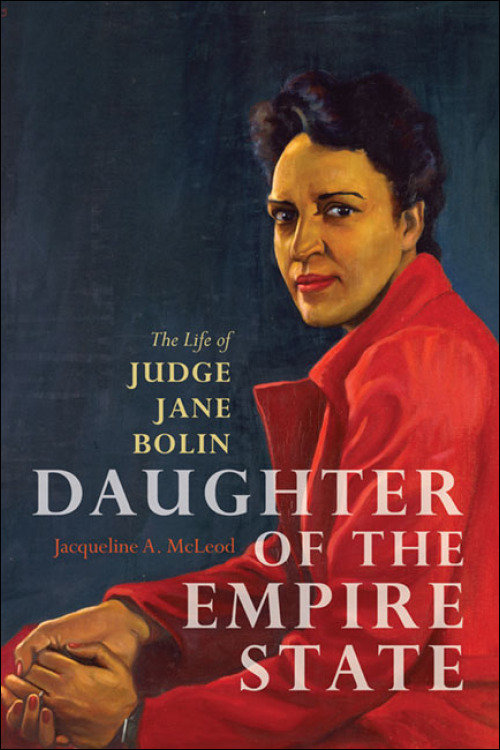
Daughter of the Empire State: The Life of Judge Jane Bolin

Posted in Biography, Books, Law, Media Archive, Monographs, United States, Women on 2014-03-30 14:58Z by Steven

Daughter of the Empire State: The Life of Judge Jane Bolin

University of Illinois Press
December 2011
168 pages
6 x 9 in.
4 black & white photographs
Cloth ISBN: 978-0-252-03657-6
Ebook ISBN: 978-0-252-09361-6

Jacqueline A. McLeod, Associate Professor of History and African & African American Studies
Metropolitan State College of Denver

The trailblazing work of the first African American woman judge

This long overdue biography of the nation’s first African American woman judge elevates Jane Matilda Bolin to her rightful place in American history as an activist, integrationist, jurist, and outspoken public figure in the political and professional milieu of New York City before the onset of the modern Civil Rights movement.

Bolin was appointed to New York City’s domestic relations court in 1939 for the first of four ten-year terms. When she retired in 1978, her career had extended well beyond the courtroom. Drawing on archival materials as well as a meeting with Bolin in 2002, historian Jacqueline A. McLeod reveals how Bolin parlayed her judicial position to impact significant reforms of the legal and social service system in New York.

Beginning with Bolin’s childhood and educational experiences at Wellesley and Yale, Daughter of the Empire State chronicles Bolin’s relatively quick rise through the ranks of a profession that routinely excluded both women and African Americans. Deftly situating Bolin’s experiences within the history of black women lawyers and the historical context of high-achieving black New Englanders, McLeod offers a multi-layered analysis of black women’s professionalization in a segregated America.

Linking Bolin’s activist leanings and integrationist zeal to her involvement in the NAACP, McLeod analyzes Bolin’s involvement at the local level as well as her tenure on the organization’s national board of directors. An outspoken critic of the discriminatory practices of New York City’s probation department and juvenile placement facilities, Bolin also co-founded, with Eleanor Roosevelt, the Wiltwyck School for boys in upstate New York and campaigned to transform the Domestic Relations Court with her judicial colleagues. McLeod’s careful and highly readable account of these accomplishments inscribes Bolin onto the roster of important social reformers and early civil rights trailblazers.

Table of Contents

  • Preface
  • Acknowledgments
  • 1. Her Standing in Poughkeepsie: Family Lineage and Legacy
  • 2. On Her Own: The Years at Wellesley and Yale
  • 3. Politics of Preparation: The Making of the Nation’s First African American Woman Judge
  • 4. Politics of Practice: An African American Woman Judge on the Domestic Relations Court
  • 5. Speaking Truth to Power: A View from the Benchof Judge Jane Bolin
  • 6. Persona Non Grata: Jane Bolin and the NAACP, 1931–50
  • Epilogue
  • Notes
  • Index
Tags: , , , , ,

When it Comes to Diversity, Who Counts?

Posted in Articles, Campus Life, Census/Demographics, Media Archive, United States on 2014-03-27 15:19Z by Steven

When it Comes to Diversity, Who Counts?

The Huffington Post
The Blog
2014-03-26

Martha S. Jones, Arthur F Thurnau Professor, Associate Professor of History and Afroamerican and African Studies
University of Michigan

When talking diversity at colleges and universities, the numbers count. Still, when it comes to mixed-race students, too often they do not count at all. This is a missed opportunity. University leaders rely upon statistics for a measure of where students of color stand on campus. Data on those who self-identify as Black, Latino and Native American are said to reflect how well diversity goals are being met. What about those who check more than one box? Their numbers and their contributions to campus diversity are largely overlooked.

On my campus, the University of Michigan, numbers matter. This past fall, student activists set off a debate. Their movement began with a Twitter speak-out known by its hashtag #BBUM, Being Black at the University of Michigan. The declining number of Black students has been much discussed, and with good reason. Black students were 7.8 percent of the student body in 2004. Ten years later, their number has dropped to 4.8 percent. As we respond to this challenge, administrators, faculty, staff and students all recognize that the numbers reflect a diminishment in campus diversity. And as student testimony makes plain, there is a correlation between dropping enrollments and the increasing marginalization of Black students.

At Michigan, we also count mixed-race students. Since 2010, students have had the opportunity to check more than one box when reporting their race. The numbers have remained steady. 3.3 percent of the university’s 37,000 students report that they are mixed-race. This new demographic parallels what we know from the United States census. There, in the year 2000, respondents were given the option of checking more than one box for the first time. By 2010, over 9 million people self-identified as more than one race, nearly three percent of the population. By these numbers mixed-race people have become visible…

Read the entire article here.

Tags: , ,

Jean Toomer and Cultural Pluralism

Posted in Articles, Literary/Artistic Criticism, Media Archive, United States on 2014-03-27 01:52Z by Steven

Jean Toomer and Cultural Pluralism

Gino Michael Pellegrini: Education, Race, Multiraciality, Class & Solidarity
2014-03-21

Gino Michael Pellegrini, Adjunct Assistant Professor of English
Pierce College, Woodland Hills, California

[This short paper was originally written for “Jean Toomer and Politics,” a Special Session Roundtable at the 2012 MLA Conference in Seattle. I have made a few edits.]

In disagreeing with Rudolph Byrd and Henry Louis Gates Jr., I will not directly critique their support and rhetorical strategies. Instead, I will put forth my own interpretation of Toomer’s political vision. Toomer saw literature as his means to address socioeconomic inequalities, transform himself, and influence people in a manner that would advance the promise of democracy in America. We should ask then, not whether he identified as black or white, but what his political vision is, what it is not, and what it entails. Specifically, I argue that his political vision conflicts with the cultural pluralisms of his mentors, Alain Locke and Waldo Frank, and anticipates some postethnic, cosmopolitan, and multiracial perspectives that have emerged in recent history in strong opposition to the limitations and problems of multiculturalism…

Read the entire paper here.

Tags: , , ,

Jane Bolin, the Country’s First Black Woman to Become a Judge, Is Dead at 98

Posted in Articles, Biography, Law, Media Archive, United States, Women on 2014-03-26 20:10Z by Steven

Jane Bolin, the Country’s First Black Woman to Become a Judge, Is Dead at 98

The New York Times
2007-01-10

Douglas Martin

Jane Bolin, whose appointment as a family court judge by Mayor Fiorello H. La Guardia in 1939 made her the first black woman in the United States to become a judge, died on Monday in Queens. She was 98 and lived in Long Island City, Queens.

Her death was announced by her son, Yorke B. Mizelle.

Judge Bolin was the first black woman to graduate from Yale Law School, the first to join the New York City Bar Association, and the first to work in the office of the New York City corporation counsel, the city’s legal department.

In January 1979, when Judge Bolin had reluctantly retired after 40 years as a judge, Constance Baker Motley, a black woman and a federal judge, called her a role model.

In her speech, Judge Motley said, “When I thereafter met you, I then knew how a lady judge should comport herself.”.

The “lady judge” was frequently in the news at the time of her appointment with accounts of her regal bearing, fashionable hats and pearls. But her achievements transcended being a shining example. As a family court judge, she ended the assignment of probation officers on the basis of race and the placement of children in child-care agencies on the basis of ethnic background.

Jane Matilda Bolin was born on April 11, 1908, in Poughkeepsie, N.Y. Her father, Gaius C. Bolin, was the son of an American Indian woman and an African-American man. Her mother, the former Matilda Emery, was a white Englishwoman…

Read the entire obituary here.

Tags: , , , , ,